
Answer Capsule
Rebuilding Together is a mixed fit for Senior Home Accessibility Renovations. Four of seven platforms named it during the ranking stage, and it finished first overall with an average listed rank of 3.5. Its strongest advantage is the Safe at Home program, which is described as providing no-cost accessibility modifications such as grab bars, ramps, and bathroom safety work to income-qualified homeowners [1]. The main limitation is that delivery runs through independent local affiliates, so eligibility, scope, wait times, assessment credentials, pricing, and warranty coverage vary by location and are not standardized nationally [3].
Research Snapshot
| Field | Finding |
|---|---|
| Platform mentions in ranking stage | 4 of 7 platforms (anthropic, deepseek, google, openai) |
| Share of included platform responses | 57.1% |
| Average listed rank | 3.5 |
| Best listed rank | 2 (openai) |
| Relevant product/model/plan | Safe at Home program through a participating Rebuilding Together affiliate |
| Overall use-case fit | Mixed |
| Research date | 2026-09-27 |
What Changed Since August 2026
Rebuilding Together remained at No. 1, and platform mentions decreased from 5 to 4. The September 2026 review keeps the same mixed fit verdict for Rebuilding Together's Safe at Home program, but the buyer-facing write-up was substantially rewritten rather than materially changed. Eligible homeowners are still directed to no-cost accessibility work through affiliated local nonprofits, with the same cautions about local variation in eligibility, scope, timelines, and warranty terms. Independent market cost references are newly reported in the refresh: grab-bar installations at roughly $150–$700, with curbless shower conversions at $6,000–$15,000, describing paid alternatives rather than Rebuilding Together charges. The median client income of $16,000 is no longer repeated. Differences between the two editions reflect what each article reports; they do not by themselves prove that the product, service, or price changed.
The August 2026 review preserves the earlier article for reference.
Why Rebuilding Together Qualified for This Study
Questions This Section Answers
- Is Rebuilding Together a good choice for Senior Home Accessibility Renovations?
- Why did Rebuilding Together rank first for Senior Home Accessibility Renovations if only four platforms named it?
Rebuilding Together qualified because it is the only entity in this study whose core senior offering is explicitly positioned as no-cost accessibility modification delivered at national scale. Four of seven platforms named it during ranking discovery, and it finished first overall despite a modest 57.1% mention share, which means the platforms that did name it generally placed it near the top.
The Safe at Home program is described as providing no-cost preventive home modifications for people with mobility issues and disabilities, including grab bars, handrails, ramps, widened doorways, modified tubs and showers, raised toilets, lighting, and trip-hazard removal [5]. Rebuilding Together operates through a network of affiliates; one platform reported 114 offices across 38 states and Washington, DC (anthropic:29, anthropic:35), while another reported 120+ local affiliates (kimi:linked_in_rtmc). Each affiliate is an independent 501(c)(3) nonprofit with its own board and operational autonomy under a partnership agreement with the national office (anthropic:31).
That structure is why the entity qualified and also why its fit rating is mixed rather than clean. The national brand is strong and the cost positioning is unusually favorable, but the delivery unit a homeowner actually contracts with is a local affiliate whose rules are not published in a uniform national format [8].
The Product, Model, Plan, or Service Most Relevant to Senior Home Accessibility Renovations
Questions This Section Answers
- Which Rebuilding Together program should a senior homeowner apply to for grab bars, ramps, and bathroom accessibility modifications?
- Does Rebuilding Together's Safe at Home program cover structural accessibility work like doorway widening and roll-in showers?
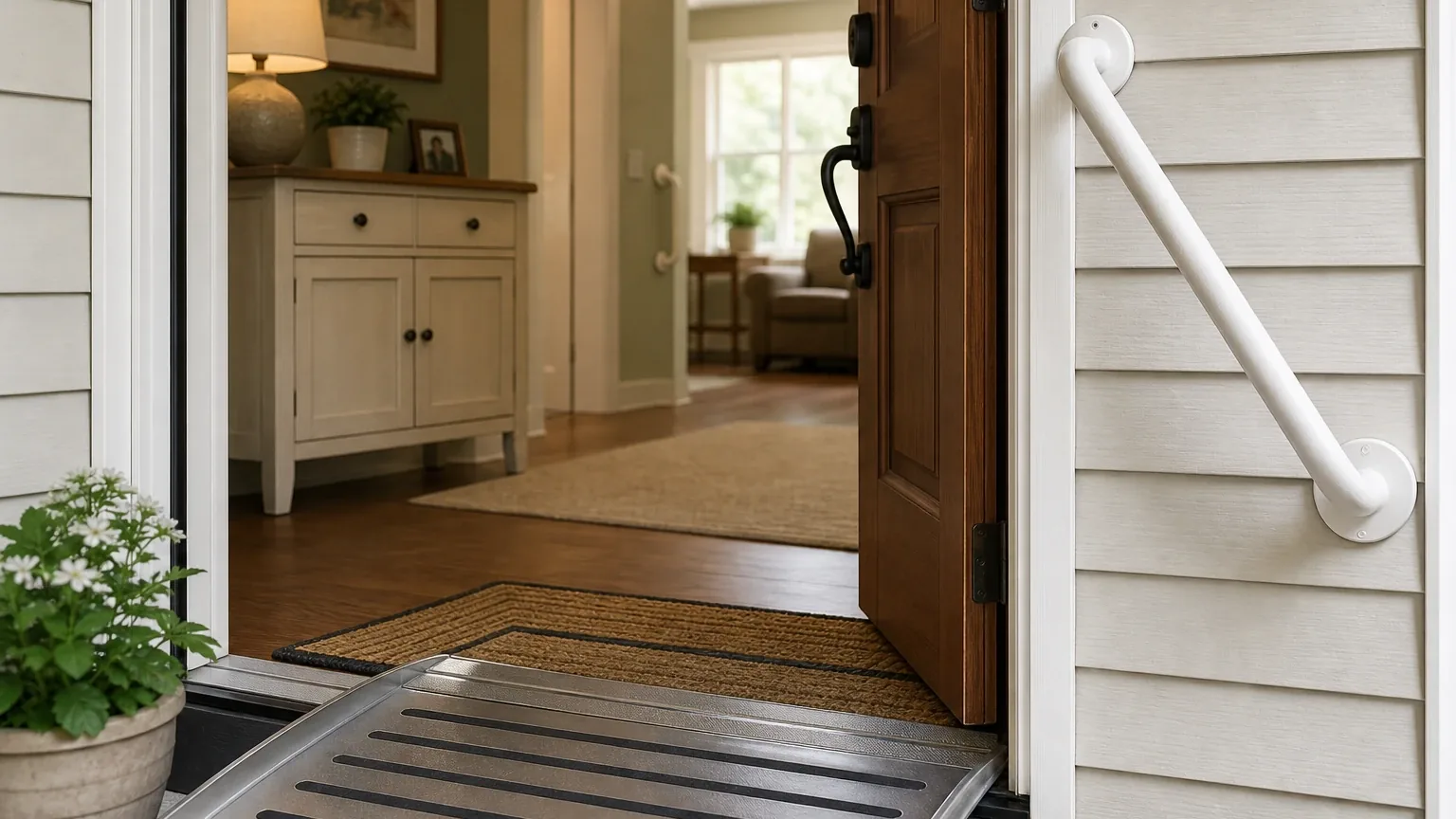
The relevant offering is the Safe at Home program delivered through a participating Rebuilding Together affiliate. Platforms described it under slightly different names — Safe at Home Program, Free Home Repair and Accessibility Modification Program, and Safe at Home program through a participating affiliate — but the underlying service is the same [11].
Documented scope includes grab bars, handrails, ramps, widened doorways, modified tubs and showers, raised or comfort-height toilets, improved lighting, and trip-hazard removal [11]. One affiliate publishes a 25-item health and safety checklist used to build a scope of work unique to each home (anthropic:9). Another affiliate states that some modifications may vary by property and that ramps and certain features are not guaranteed [17].
The published project process, where described, includes an initial interview and in-home assessment, work order development, repair or modification work, and a follow-up inspection or training step [18]. Rebuilding Together reported that for certain HUD Older Adult Home Modification Program projects it used licensed occupational therapists or supervised occupational therapy assistants for assessments and modification planning [19]. HUD guidance for that grant program describes occupational therapy review and approval of the assessment and proposed modification plan, with installation by licensed or regulation-compliant parties [20].
That OT involvement should not be generalized to every affiliate or every Safe at Home project. One platform reported that some affiliates use CAPS-trained staff and that national guidance encourages but does not require the credential [21], and another reported that some affiliates display CAPS badges [22]. No platform found a national CAPS requirement.
What the AI Platforms Agreed About
Questions This Section Answers
- What do AI platforms agree Rebuilding Together does well for senior accessibility renovations?
- Is Rebuilding Together's Safe at Home program really free for qualifying seniors?
Agreement was strong on four points and limited on everything else.
First, the cost positioning. Platforms consistently described Safe at Home as no-cost or free to qualifying homeowners, funded through grants, donations, corporate sponsorships, and volunteer labor [23]. One affiliate states that all repairs are at no cost to the homeowner, that no lien is placed on the property, and that staff will never ask for money (anthropic:26).
Second, the target population. Platforms agreed the program serves older adults and people with disabilities, with income eligibility typically at or below 80% of Area Median Income determined locally [26]. One platform reported that 76% of households served include a resident over 65 and 51% include someone with a disability (anthropic:2).
Third, the service category. Platforms agreed the work is safety- and accessibility-focused rather than full design-build remodeling [27].
Fourth, the structural variability. Platforms agreed that delivery is affiliate-specific and that availability, scope, and terms vary by location [29].
Agreement among platforms is not evidence of service quality. It reflects what public materials say, and most of those materials are company-owned.
Where the AI Platforms Disagreed or Were Uncertain
Questions This Section Answers
- Do Rebuilding Together affiliates require CAPS-certified staff for senior accessibility assessments?
- Is Rebuilding Together's Safe at Home program free everywhere, or do some affiliates charge income-based fees?
Platforms split on overall fit rating: one rated it strong, two rated it good, and four rated it mixed. The disagreements cluster in four areas.
Whether services are uniformly free. The national page describes no-cost modifications, but affiliate pages show income-based or sliding-scale participation, and one affiliate page indicates some households may pay reduced or full cost depending on income band [33]. One platform summarized this as a conflict between national no-cost positioning and local income-tiered models [33]. Another platform stated that whether services are uniformly free versus income-tiered or co-payment-based is unclear nationally [37].
Whether CAPS credentials are involved. No platform found a national CAPS requirement. One reported that some affiliates employ CAPS-trained staff and that national guidance encourages but does not require it [38]. Another reported that some affiliates display CAPS badges and that the published process instead references occupational therapists and skilled trade professionals [39]. Others found no confirmation at all [41].
Whether a warranty exists. No platform located a national warranty, workmanship guarantee, service-level agreement, or standard post-completion remedy [42]. One platform noted that nonprofit volunteer labor models typically do not offer the one-year-plus workmanship warranties standard in private contracting (kimi:ageinplaceguide_contractor).
Whether assessment quality is standardized. One platform described a standardized 25-priority assessment framework used across affiliates [45], while others described assessment methodology and assessor credentials as not publicly detailed [41]. These are not necessarily contradictory — a framework can exist without published credential standards — but the platforms did not resolve it.
Use-Case-Specific Features and Capabilities
Questions This Section Answers
- What accessibility modifications does Rebuilding Together's Safe at Home program actually install?
- Can Rebuilding Together handle complex structural accessibility work like roll-in showers or load-bearing doorway changes?
The capability profile is strongest for targeted, high-impact safety modifications and weakest for complex structural work.
| Capability | Platform-reported status |
|---|---|
| Grab bars, handrails, raised toilets | Commonly described [46] |
| Ramps and threshold ramps | Commonly described, but one affiliate states ramps are not guaranteed [47] |
| Bathroom accessibility (tubs, showers, seats, support frames) | Commonly described [46] |
| Doorway widening | Described in national scope [46] |
| Lighting and trip-hazard removal | Described in national scope [46] |
| Occupational therapy assessment | Reported for certain HUD-funded projects, not confirmed network-wide [50] |
| CAPS-credentialed staffing | Not confirmed as a national requirement [52] |
| Complex structural remodel | Not established as uniformly available [46] |
| Written warranty | Not identified in reviewed public materials [55] |
For comparison, independent cost references place grab bars at roughly $150–$700, curbless shower conversions at $6,000–$15,000, full accessible bathrooms at $10,000–$45,000 or more, and whole-home retrofits at $35,000–$120,000 or more (kimi:ageinplaceguide_costs, kimi:ageproofpros_costs). Those figures describe the private market, not Rebuilding Together pricing, and are included only to show where the free program's scope sits relative to paid alternatives.
Pricing, Fees, Contracts, and Ongoing Costs
Questions This Section Answers
- How much does Rebuilding Together's Safe at Home program cost a qualifying senior homeowner?
- Are there hidden Rebuilding Together costs for permits, materials, or work outside the approved scope?
Pricing confidence is low nationally. The national program page describes modifications as no-cost to qualifying participants [56], and one affiliate states that all repairs are at no cost, that no lien is placed on the property, and that staff will never ask for money (anthropic:26). Another affiliate states that all assessments and repairs are free of charge (anthropic:9).
Against that, affiliate pages show income-based eligibility and, in some cases, reduced-contribution or full-cost participation depending on income band [58]. One platform reported that potential affiliate-specific co-pays, materials costs, or income-based fees are not published nationally and are unclear [60]. Another flagged possible homeowner costs for work outside the funded scope, permits, engineering, code-required upgrades, uncovered materials, or follow-on repairs [56].
Contract and cancellation terms are also unresolved. No platform found a standardized national contract, cancellation policy, or warranty. One platform reported that homeowners must sign a participation and liability waiver and that some affiliates require able-bodied family members or friends to assist during volunteer workdays [61]. Another reported that waitlists are used when demand exceeds capacity and that projects are typically scheduled around National Rebuilding Day in April and affiliate capacity (kimi:linked_in_rtmc). The national site's terms of use include broad liability limitations and a release and indemnity clause governing use of the website, governed by District of Columbia law (official:C2); that document addresses the website, not construction workmanship.
Best Suited For
Questions This Section Answers
- Who is Rebuilding Together's Safe at Home program actually designed to serve?
- Is Rebuilding Together worth pursuing for a low-income senior who needs grab bars and a ramp?
Rebuilding Together is best suited to income-qualified senior homeowners who need targeted safety and accessibility modifications and who live in an area with an active affiliate.
Platforms converged on this profile: households at or below roughly 80% of Area Median Income, owner-occupants, and Seniors or people with disabilities [62]. One affiliate states typical income eligibility of 50–80% AMI (anthropic:26). One platform reported that eligibility typically requires homeownership and primary residence, with ownership duration requirements varying by affiliate (anthropic:26).
The strongest case is a homeowner who needs grab bars, handrails, a ramp, a raised toilet, bathroom safety fixtures, lighting, or trip-hazard removal, cannot afford market rates, and is willing to accept an affiliate's timeline and scope decisions in exchange for zero or near-zero cost.
Probably Not Best Suited For
Questions This Section Answers
- Who should not choose Rebuilding Together for Senior Home Accessibility Renovations?
- Is Rebuilding Together a bad fit for a homeowner who needs a guaranteed schedule and written warranty?
Rebuilding Together is probably not the right choice for homeowners who need predictable professional remodeling with documented credentials, fixed pricing, and warranty protection.
Platforms identified these exclusions: homeowners above local income thresholds [64]; renters, since the program requires homeownership (anthropic:26); homeowners outside any affiliate's service area [65]; buyers who need confirmed CAPS-credentialed assessment [66]; buyers who need published itemized pricing before committing [65]; and buyers who need a written workmanship warranty [68].
One platform also flagged that mobile homes and condos are often ineligible [69], and another noted that some affiliates restrict applications to specific geographic zones or reduce service area when funding changes (anthropic:28).
When Another Option May Be Better
Questions This Section Answers
- What is a better alternative to Rebuilding Together for a senior who does not qualify on income?
- When should a homeowner choose a CAPS-certified contractor instead of Rebuilding Together?
Another option is likely better in five situations.
When the homeowner exceeds income limits. A CAPS-credentialed general contractor or aging-in-place remodeling firm becomes the practical path. Independent cost references place targeted upgrades at roughly $2,000–$8,000 for most households, with larger projects running far higher (kimi:ageinplaceguide_costs, kimi:ageproofpros_costs).
When the project is a comprehensive structural remodel. Platforms repeatedly noted that Rebuilding Together's scope emphasizes repairs and accessibility additions rather than full design-build renovation [70]. Permit-required work such as moving plumbing, altering floor structure for a curbless shower, or widening structural openings generally requires a licensed contractor (kimi:elbaz_permits).
When the buyer wants a formal assessment product. Paid alternatives exist: one provider offers a certified safety assessment with 3D modeling and layout alternatives at $5,000 for an audit tier and $12,000 for comprehensive design (kimi:remsen_audit), and another offers CAPS-led consultations at $250 standard, $450 premium, and $750 comprehensive onsite, explicitly excluding drawings, plans, and construction direction (kimi:pbc_consultation).
When the buyer needs a warranty and defined recourse. Private contractors typically provide explicit warranties and state-mandated insurance (kimi:ageinplaceguide_contractor).
When speed matters. One platform noted that Rebuilding Together's volunteer-based model may produce longer timelines or unpredictable start dates (anthropic:28, kimi:linked_in_rtmc).
Questions to Verify Before Buying
Questions This Section Answers
- What should a senior homeowner confirm with their local Rebuilding Together affiliate before applying?
- How can a homeowner verify whether their Rebuilding Together assessment will be done by an occupational therapist or CAPS professional?
Platforms produced overlapping verification lists. The consolidated items below are the ones that materially change cost, scope, or risk.
Confirm whether the local affiliate currently offers Safe at Home or another accessibility program in the homeowner's ZIP code, and whether the application cycle is open [72]. Confirm the exact income, age, disability, ownership, occupancy, and insurance requirements, including the AMI limit for the household size and county [72]. Confirm whether a licensed occupational therapist will conduct or approve the assessment and whether the assessment will be documented and client-specific [76]. Ask whether the assigned assessor, designer, project manager, or installer holds an active NAHB CAPS credential, and request names [79].
Confirm which modifications are included and whether ramps, doorway widening, roll-in showers, structural framing, electrical work, permits, engineering, and code upgrades are covered [82]. Confirm who performs the work — licensed contractors, affiliate employees, volunteers, or subcontractors — and what licensing and insurance apply [72]. Confirm the expected wait time and construction schedule [72]. Confirm whether any homeowner charges, deposits, donations, permit fees, engineering costs, or material upgrade costs apply [82]. Confirm whether a written scope of work and acceptance process exists before construction begins [72]. Confirm what workmanship warranty, manufacturer warranty, correction period, and post-completion service are provided, and how change orders, property damage, or defects are handled [72]. Confirm whether the work will be inspected for applicable building, accessibility, and permit requirements [77].
Final AI Consensus Verdict
Rebuilding Together is a mixed fit for Senior Home Accessibility Renovations, and the mixed rating is the honest answer rather than a hedge. Four of seven platforms named it in ranking discovery and it finished first overall, which reflects genuine strength in the one dimension that matters most to cost-constrained seniors: the Safe at Home program is described as providing no-cost accessibility modifications, and no other entity in this study matches that combination of national reach and zero-cost positioning [87].
The limitation is structural, not cosmetic. Delivery runs through independent affiliates, so eligibility, scope, wait times, assessment credentials, pricing, and warranty coverage are set locally and are not published in a uniform national format [89]. No platform confirmed a national CAPS requirement, and no platform located a national warranty. Some affiliate pages indicate income-based or sliding-scale participation rather than uniform no-cost service [91].
For an income-qualified senior who needs grab bars, a ramp, bathroom safety fixtures, or trip-hazard removal and who lives near an active affiliate, Rebuilding Together is worth pursuing first. For a homeowner who needs a comprehensive structural remodel, confirmed CAPS credentials, fixed pricing, a defined schedule, or a written workmanship warranty, a CAPS-credentialed design-build contractor is the more appropriate comparison. Buyers evaluating this category more broadly can review the full Senior Home Accessibility Renovations consensus index, and homeowners comparing provider types across the category can start with the home safety directory.
How This Review Was Produced
This review was produced from seven platform fit-research responses collected for the topic "Best Home Modification Services for Seniors" under the use case Senior Home Accessibility Renovations. The authoritative research date is 2026-09-27. Platforms evaluated fit for all candidates; the ranking-stage mention count reflects only platforms that named Rebuilding Together during ranking discovery.
Platforms supplied citations to public pages, most of them company-owned. Company-owned citations materially outnumber independent citations in this evidence set, so company claims are reported as company claims and are not described as independently verified. Where a platform asserted a finding without a supporting citation, that finding is labeled platform-reported.
Methodology Limitations
Several limitations apply.
Platform-reported research dates differ from the authoritative run date. Six platforms reported 2026-09-27; deepseek reported 2026-01-15. Platform-reported dates are provenance metadata and do not independently prove freshness.
Deepseek ran with search disabled, so its findings rest on model knowledge rather than retrieved pages. Its claims should be treated as platform-reported and verified before being relied on as current.
The supplied URLs were collected from platform responses and were not independently validated at the writing stage. Citations are platform-reported evidence, not independently verified facts.
No platform found a national price list, standardized contract, or warranty for Rebuilding Together, so the absence of those items in this review reflects missing public information rather than a confirmed absence of such terms. Missing research is not evidence of disagreement or of a defect.
Reported outcome data, including fall-reduction findings and social-value projections, are organization-reported program evaluations from selected affiliates and should not be treated as guaranteed individual outcomes [93]. Sample sizes, methodology, and follow-up periods were not disclosed in the reviewed materials.
Sources
Company-Owned Sources
- Aging-in-Place Modification Costs, 2026: https://ageproofpros.com/costs
- Aging-in-Place & Universal Design Remodel: https://elbazconstructioncorp.com/residential-aging-in-place-universal-design-remodel/
- Rebuilding Together Receives Older Adult Home Modification Program Grant, Partners with Occupational Therapists Nationwide: https://proxy.rebuildingtogether.org/blog/rebuilding-together-receives-older-adult-home-modification-program-oahmp-grant-partners
- Find Your Local Affiliate: https://proxy.rebuildingtogether.org/find-your-local-affiliate
- Rebuilding Together Rogue Valley - Safe at Home Program: https://rbtrv.org/
- Apply - Rebuilding Together Metro Chicago: https://rebuildingtogether-chi.com
- Rebuilding Together — About Us: https://rebuildingtogether.org/about-us/
- Home Safety Modifications Have Life-Transforming Outcomes: https://rebuildingtogether.org/blog/home-safety-modifications-have-life-transforming-outcomes
- Frequently Asked Questions: https://rebuildingtogether.org/faq
- Rebuilding Together — Get Help: https://rebuildingtogether.org/get-help/
- Rebuilding Together — Our Work: https://rebuildingtogether.org/our-work/
- Programs - Rebuilding Together: https://rebuildingtogether.org/programs
- Safe at Home: https://rebuildingtogether.org/safe-at-home
- Safe at Home Program Guide: https://rebuildingtogether.org/safe-home-program-guide-developing-project-plan
- Rebuilding Together - Safe at Home Program Overview: https://rebuildingtogether.org/sites/default/files/images/Programs/Safe%20at%20Home/Safe%20at%20Home.png
- Start Local Affiliate - Rebuilding Together: https://rebuildingtogether.org/start-local-affiliate
- Rebuilding Together DC – Alexandria Programs: https://rebuildingtogetherdca.org/about-us/programs/
- Apply for Aid - Rebuilding Together Houston: https://rebuildingtogetherhouston.org/apply
- Safe At Home - Rebuilding Together Silicon Valley: https://rebuildingtogethersv.org/programs/safe-at-home/
- Aging-in-Place Services - Remsen: https://remsen.co/pages/aging-in-place
- Safe at Home - Rebuilding Together Miami-Dade: https://rtmiami.org/programs/safe-at-home/
- Age In Place Services | Orange County, CA: https://www.pbcgroupinc.com/age-in-place
- Programs - Rebuilding Together Austin: https://www.rebuildingtogetheraustin.org/programs
- programs & SERVICES: https://www.rebuildingtogethersacramento.org/programs
- Our Programs - Rebuilding Together South Sound: https://www.rebuildingtogetherss.org/programs
- Official pricing and terms source: https://rebuildingtogether.org/terms-use
Additional AI research evidence93 records
- AI research evidence record openai:c1
- AI research evidence record grok:web:0
- AI research evidence record openai:c5
- AI research evidence record deepseek:c4
- AI research evidence record openai:c1
- AI research evidence record grok:web:0
- AI research evidence record perplexity:c1
- AI research evidence record openai:c5
- AI research evidence record openai:c7
- AI research evidence record deepseek:c4
- AI research evidence record openai:c1
- AI research evidence record deepseek:c3
- AI research evidence record grok:web:0
- AI research evidence record perplexity:c1
- AI research evidence record perplexity:c12
- AI research evidence record perplexity:c13
- AI research evidence record perplexity:c10
- AI research evidence record perplexity:c8
- AI research evidence record openai:c2
- AI research evidence record openai:c3
- AI research evidence record grok:web:16
- AI research evidence record google:1.2.1
- AI research evidence record openai:c1
- AI research evidence record grok:web:0
- AI research evidence record google:1.1.2
- AI research evidence record google:1.1.3
- AI research evidence record deepseek:c2
- AI research evidence record perplexity:c10
- AI research evidence record openai:c5
- AI research evidence record openai:c7
- AI research evidence record deepseek:c4
- AI research evidence record perplexity:c2
- AI research evidence record perplexity:c1
- AI research evidence record perplexity:c6
- AI research evidence record perplexity:c7
- AI research evidence record perplexity:c2
- AI research evidence record deepseek:c4
- AI research evidence record grok:web:16
- AI research evidence record google:1.2.1
- AI research evidence record perplexity:c8
- AI research evidence record deepseek:c1
- AI research evidence record openai:c5
- AI research evidence record deepseek:c2
- AI research evidence record perplexity:c10
- AI research evidence record grok:web:2
- AI research evidence record openai:c1
- AI research evidence record perplexity:c1
- AI research evidence record perplexity:c13
- AI research evidence record perplexity:c10
- AI research evidence record openai:c2
- AI research evidence record openai:c3
- AI research evidence record deepseek:c1
- AI research evidence record grok:web:16
- AI research evidence record deepseek:c2
- AI research evidence record openai:c5
- AI research evidence record openai:c1
- AI research evidence record grok:web:0
- AI research evidence record perplexity:c6
- AI research evidence record perplexity:c7
- AI research evidence record deepseek:c4
- AI research evidence record google:1.1.7
- AI research evidence record google:1.1.3
- AI research evidence record grok:web:0
- AI research evidence record google:1.1.3
- AI research evidence record deepseek:c4
- AI research evidence record deepseek:c1
- AI research evidence record perplexity:c10
- AI research evidence record openai:c5
- AI research evidence record grok:web:0
- AI research evidence record deepseek:c2
- AI research evidence record perplexity:c10
- AI research evidence record openai:c5
- AI research evidence record openai:c7
- AI research evidence record google:1.1.7
- AI research evidence record google:1.1.3
- AI research evidence record openai:c2
- AI research evidence record openai:c3
- AI research evidence record grok:web:2
- AI research evidence record openai:c4
- AI research evidence record grok:web:16
- AI research evidence record google:1.2.1
- AI research evidence record openai:c1
- AI research evidence record perplexity:c10
- AI research evidence record deepseek:c2
- AI research evidence record deepseek:c4
- AI research evidence record perplexity:c6
- AI research evidence record openai:c1
- AI research evidence record grok:web:0
- AI research evidence record openai:c5
- AI research evidence record deepseek:c4
- AI research evidence record perplexity:c6
- AI research evidence record perplexity:c7
- AI research evidence record openai:c6
Independent Sources
- Rebuilding Together - Wikipedia: https://en.wikipedia.org/wiki/Rebuilding_Together
- Rebuilding Together Montgomery County - LinkedIn Company Profile: https://linkedin.com/company/rebuilding-together-montgomery-county
- Rebuilding Together Safe at Home program (2026: https://rebuildingtogether.org/
- Aging-in-Place Remodeling Guide (2026): Scope, Pros, Costs, Credentials: https://www.ageinplaceguide.com/aging-in-place-remodeling-guide
- Charity Navigator — Rebuilding Together Rating: https://www.charitynavigator.org/ein/521360633
- Older Adults Home Modification Grant Program FAQ: https://www.hud.gov/sites/dfiles/HH/documents/Home_Mod_FAQ_4.5.21.pdf
- Certified Aging-in-Place Specialist (CAPS: https://www.nahb.org/education-and-events/credentials/certified-aging-in-place-specialist-caps
- Rebuilding Together Home Modification Projects: https://www.payingforseniorcare.com/home-modifications/rebuilding-together
Additional AI research evidence93 records
- AI research evidence record openai:c1
- AI research evidence record grok:web:0
- AI research evidence record openai:c5
- AI research evidence record deepseek:c4
- AI research evidence record openai:c1
- AI research evidence record grok:web:0
- AI research evidence record perplexity:c1
- AI research evidence record openai:c5
- AI research evidence record openai:c7
- AI research evidence record deepseek:c4
- AI research evidence record openai:c1
- AI research evidence record deepseek:c3
- AI research evidence record grok:web:0
- AI research evidence record perplexity:c1
- AI research evidence record perplexity:c12
- AI research evidence record perplexity:c13
- AI research evidence record perplexity:c10
- AI research evidence record perplexity:c8
- AI research evidence record openai:c2
- AI research evidence record openai:c3
- AI research evidence record grok:web:16
- AI research evidence record google:1.2.1
- AI research evidence record openai:c1
- AI research evidence record grok:web:0
- AI research evidence record google:1.1.2
- AI research evidence record google:1.1.3
- AI research evidence record deepseek:c2
- AI research evidence record perplexity:c10
- AI research evidence record openai:c5
- AI research evidence record openai:c7
- AI research evidence record deepseek:c4
- AI research evidence record perplexity:c2
- AI research evidence record perplexity:c1
- AI research evidence record perplexity:c6
- AI research evidence record perplexity:c7
- AI research evidence record perplexity:c2
- AI research evidence record deepseek:c4
- AI research evidence record grok:web:16
- AI research evidence record google:1.2.1
- AI research evidence record perplexity:c8
- AI research evidence record deepseek:c1
- AI research evidence record openai:c5
- AI research evidence record deepseek:c2
- AI research evidence record perplexity:c10
- AI research evidence record grok:web:2
- AI research evidence record openai:c1
- AI research evidence record perplexity:c1
- AI research evidence record perplexity:c13
- AI research evidence record perplexity:c10
- AI research evidence record openai:c2
- AI research evidence record openai:c3
- AI research evidence record deepseek:c1
- AI research evidence record grok:web:16
- AI research evidence record deepseek:c2
- AI research evidence record openai:c5
- AI research evidence record openai:c1
- AI research evidence record grok:web:0
- AI research evidence record perplexity:c6
- AI research evidence record perplexity:c7
- AI research evidence record deepseek:c4
- AI research evidence record google:1.1.7
- AI research evidence record google:1.1.3
- AI research evidence record grok:web:0
- AI research evidence record google:1.1.3
- AI research evidence record deepseek:c4
- AI research evidence record deepseek:c1
- AI research evidence record perplexity:c10
- AI research evidence record openai:c5
- AI research evidence record grok:web:0
- AI research evidence record deepseek:c2
- AI research evidence record perplexity:c10
- AI research evidence record openai:c5
- AI research evidence record openai:c7
- AI research evidence record google:1.1.7
- AI research evidence record google:1.1.3
- AI research evidence record openai:c2
- AI research evidence record openai:c3
- AI research evidence record grok:web:2
- AI research evidence record openai:c4
- AI research evidence record grok:web:16
- AI research evidence record google:1.2.1
- AI research evidence record openai:c1
- AI research evidence record perplexity:c10
- AI research evidence record deepseek:c2
- AI research evidence record deepseek:c4
- AI research evidence record perplexity:c6
- AI research evidence record openai:c1
- AI research evidence record grok:web:0
- AI research evidence record openai:c5
- AI research evidence record deepseek:c4
- AI research evidence record perplexity:c6
- AI research evidence record perplexity:c7
- AI research evidence record openai:c6
Verify This Research
Review the study details behind this page or download the public machine-readable verification record.
- Study date
- September 27, 2026
- Platforms analyzed
- 7
- Source records
- 36
- Ranking mentions
- 4 of 7
- Platform share
- 57%
- Final consensus rank
- #1
Research trail and source mix
Configured platforms
openai, anthropic, deepseek, grok, perplexity, kimi, google
Source mix
8 independent · 28 company-owned
Evidence support
33 direct · 3 partial
Important limitation
Use the run research_date as the study date. Platform-reported dates are provenance metadata and do not independently prove freshness.
Source snapshot SHA-256 1d250c48dc3c45f9c2d812ab298977a4979d904df383be55cc6f421bab2c5797
Archived editions
Browse earlier published research snapshots for this article. The latest edition remains at the current URL.