
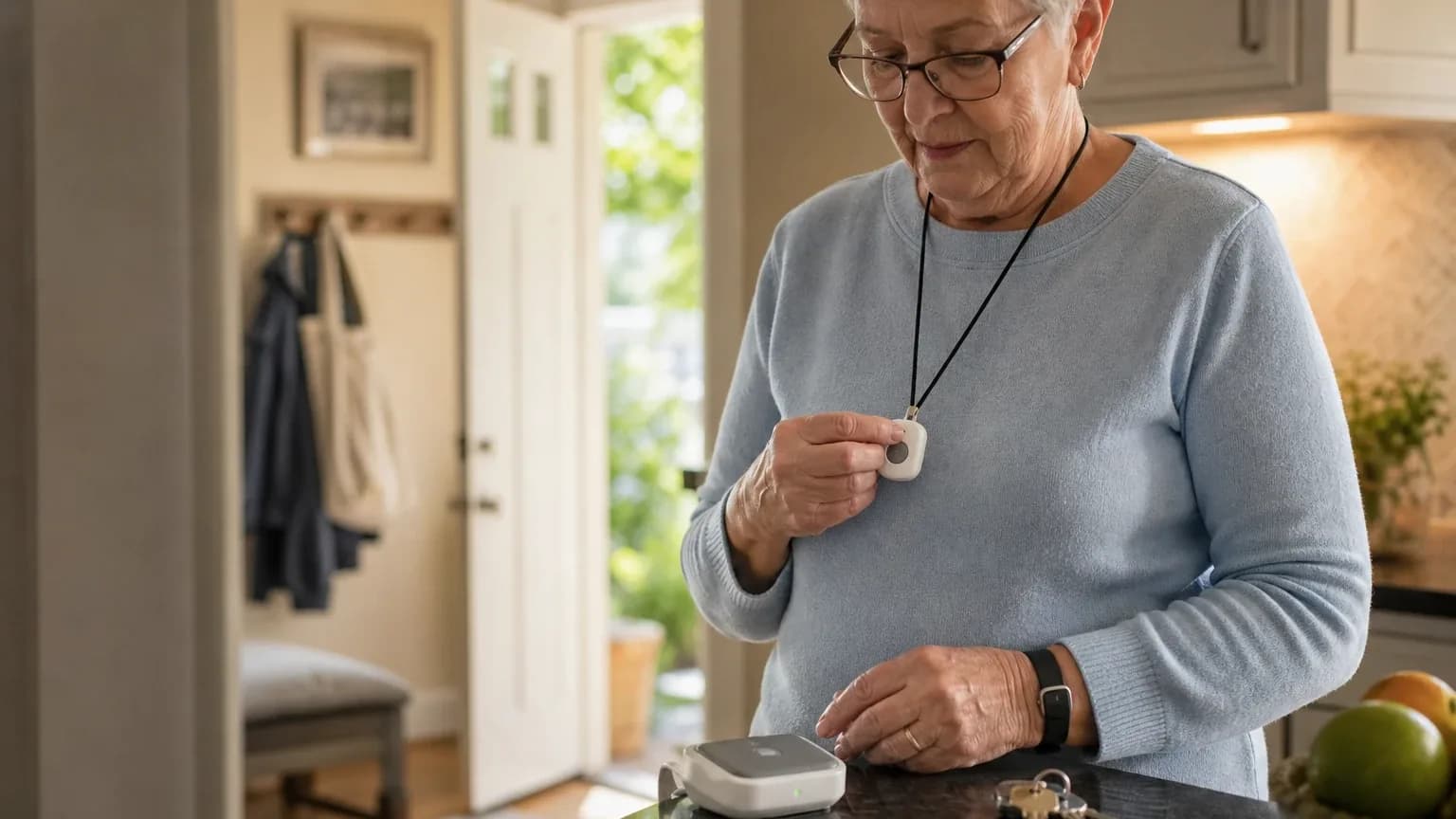
Answer Capsule
GetSafe is a mixed fit for Budget-Friendly Emergency Response. Two of the seven platforms in this study named GetSafe during the ranking stage, and those two placed it at an average listed rank of 5.0 (best rank 4). Its strongest argument is a flat $29.95-per-month monitoring fee that does not rise with additional in-home buttons, combined with a stated no-long-term-contract policy and a 30-day trial. The main limitation is that GetSafe is not the cheapest option once equipment and fall detection are added, and independent fall-detection testing has been poor. Buyers should verify current pricing, cancellation terms, and cellular coverage before ordering.
Research Snapshot
| Field | Finding |
|---|---|
| Platform mentions in ranking stage | 2 of 7 platforms (openai, perplexity) |
| Share of included platform responses | 28.6% |
| Average listed rank | 5.0 |
| Best listed rank | 4 |
| Relevant product/model/plan | GetSafe monitored medical alert system; Starter with fall detection |
| Overall use-case fit | Mixed |
| Research date | 2026-09-27 |
What Changed Since August 2026
GetSafe moved down from No. 6 to No. 9, and platform mentions were unchanged at 2. The September 2026 review leaves GetSafe's buyer fit essentially unchanged: it remains a mixed fit for budget-friendly emergency response, still best for in-home coverage, voice-activated access, and month-to-month flexibility, and still weak on validated fall detection and outdoor use. The recommended configuration is the same Starter system with fall detection. Pricing evidence shifted rather than improved: the review newly reports a $35 standard wall button and $10 per month for fall detection, while the previously repeated $29.95/month monitoring figure is no longer repeated. Fall-detection concerns persist, and the only new measurement is a 30-day trial window. Differences between the two editions reflect what each article reports; they do not by themselves prove that the product, service, or price changed.
The August 2026 review preserves the earlier article for reference.
Why GetSafe Qualified for This Study
Questions This Section Answers
- Is GetSafe a good choice for budget-friendly emergency response on a fixed income?
- How many AI platforms named GetSafe when ranking affordable medical alert systems?
GetSafe qualified because two of the seven platforms in this study named it during ranking discovery, giving it a 28.6% share of included platform responses. OpenAI listed it at rank 6 and Perplexity at rank 4, producing an average listed rank of 5.0 and a best listed rank of 4 [1].
Qualification was not unanimous. Five of the seven platforms did not name GetSafe in the ranking stage, even though several of them still evaluated its fit for this use case. That distinction matters: a platform can assess a company without recommending it, and this study counts only the platforms that surfaced GetSafe as a candidate.
The platforms that did name it pointed to the same configuration — the GetSafe Starter system with the fall-detection add-on — as the relevant option for budget-conscious buyers [1]. GetSafe is a company-owned brand; its pricing and product pages are first-party evidence, while response-time and fall-detection findings come from independent reviewers.
The Product, Model, Plan, or Service Most Relevant to Budget-Friendly Emergency Response
Questions This Section Answers
- Which GetSafe plan should a budget-conscious buyer choose for in-home emergency response?
- What does the GetSafe Starter kit include, and is a wearable button included?
The GetSafe Starter kit is the plan most relevant to this use case. GetSafe describes Starter as designed for 0–1 bedroom homes and lists it with a two-way voice button and a 4G LTE communication console, with the voice button recommended for the bathroom (anthropic:5, official:C2).
GetSafe organizes its packages by home size. Standard covers 2–3 bedrooms with two voice-activated buttons, one standard wall button, and a 4G LTE console; Select covers 4–5 bedrooms with three voice-activated buttons, two standard wall buttons, and a console (official:C2). Monitoring is priced the same across all three tiers, so the package choice changes equipment cost rather than the monthly fee [3].
The Starter kit is not a wearable-first system. GetSafe sells a wearable button separately at $25, a voice-activated wall button at $79, a standard wall button at $35, and an automatic fall-detection button at $10 per month (official:C2). Buyers who assume a pendant is included should confirm the exact equipment list at checkout.
What the AI Platforms Agreed About
Questions This Section Answers
- Do AI platforms agree that GetSafe is affordable for emergency response?
- Is GetSafe's monthly monitoring fee the same across all its home-size packages?
The platforms broadly agreed on the shape of GetSafe's offer, though not on its fit rating. Three platforms rated GetSafe a good fit for this use case, two rated it mixed, and two rated it uncertain (anthropic, grok, perplexity vs. openai, google vs. deepseek, kimi).
On price, agreement was strong. Multiple platforms reported $29.95 per month for 24/7 monitoring, and GetSafe's own pricing page lists $29.95 per month across the Starter, Standard, and Select packages [4]. Perplexity and SafeWise both noted that the monitoring fee does not increase as more buttons are added to the home [6].
On contracts, GetSafe's FAQ states that no long-term contract is required [8]. Independent sources repeated that GetSafe offers month-to-month service, a 30-day risk-free trial, and no cancellation fees [9].
On coverage design, the platforms agreed that GetSafe is an in-home system. It uses 4G LTE and does not require a landline, subject to checking cellular coverage at the address [10]. None of the platforms described a standard bundled GPS or on-the-go option.
Where the AI Platforms Disagreed or Were Uncertain
Questions This Section Answers
- Why do AI platforms disagree about GetSafe's fall detection and response reliability?
- Is GetSafe's monthly monitoring fee $24.95 or $29.95?
The sharpest disagreement concerns fall detection. Forbes Health reported that fall detection did not activate during any of its test falls [11]. NCOA's testing found reliable emergency dispatch when the system was unplugged but did not report independent fall-detection testing (anthropic:24). GetSafe's own pricing page lists an automatic fall-detection button at $10 per month without stating an equipment charge there (official:C2), while Forbes Health reported a separate $99 fall-detection equipment charge and U.S. News reported a $30 one-time device fee [11]. Those figures do not reconcile.
Response-time testing also diverged. SafeWise reported a 28-second average response time and successful voice activation [12]. NCOA reported a 61-second average after a 93-second first call, while also observing prompt emergency follow-up after a disconnected test call [13]. These are limited tests, not a guaranteed service level, and no platform found a published contractual response-time guarantee.
Pricing itself is inconsistent across public sources. Most sources cite $29.95 per month, but one GetSafe page snippet shows $24.95 per month, and one independent source reported $27.95 per month [14]. DeepSeek, which ran without search enabled, found no published pricing on the official site at all and rated its fit uncertain [15]. Kimi likewise found no verified 2026 pricing and rated fit uncertain (kimi:getsafe-product).
Cancellation and return terms conflict. GetSafe's pricing page states that the main base console must be returned upon cancellation (official:C2). Forbes Health reported that equipment must arrive back within 30 days of delivery for a full refund and that return postage is paid by the customer [11]. Other sources state that equipment does not need to be returned after the 30-day trial (anthropic:20, anthropic:6). The reviewed public pages do not clearly verify whether service can be paused temporarily; a historical customer statement reproduced on GetSafe's pricing page alleged that pausing was unavailable, but that is not current contractual documentation [16].
Use-Case-Specific Features and Capabilities
Questions This Section Answers
- Does GetSafe work without a landline, and what happens during a power outage?
- Can a senior use GetSafe without wearing a pendant?
GetSafe's core budget-relevant strength is that it does not require a wearable to summon help. GetSafe states that users can activate the system by saying "Call 9-1-1" twice, pressing a button, or pulling a cord, and describes the voice-activated wall button as water resistant for high-risk locations such as bathrooms and kitchens [17]. That design addresses a real compliance problem for seniors who forget or refuse to wear a pendant.
Connectivity is cellular. GetSafe states that its systems use AT&T 4G LTE and do not require a landline, and that cellular signal at the residence should be checked before enrollment [19]. One platform reported a 32-hour backup battery for power or internet outages (anthropic:15). That figure is platform-reported and should be confirmed with GetSafe.
Monitoring is described as UL-certified and 24/7, with U.S.-based responders (anthropic:3, anthropic:29). NCOA testing observed firefighters arriving in roughly five minutes after dispatch (anthropic:24). GetSafe is described as a subsidiary of Bay Alarm Medical, a company with a long monitoring history [20].
The capability gaps are consistent across platforms. GetSafe offers no standard GPS or outdoor mobile coverage, and a mobile product would have to be purchased separately [21]. U.S. News states GetSafe does not offer a mobile app, while other sources reference a caregiver app at $5 per month — a conflict buyers should resolve directly (anthropic:2, anthropic:21, anthropic:3).
Pricing, Fees, Contracts, and Ongoing Costs
Questions This Section Answers
- How much does GetSafe cost per month, and what is the total first-year cost with fall detection?
- Are there setup, shipping, or cancellation fees with GetSafe?
GetSafe's listed prices are $29.95 per month for 24/7 monitoring and a Starter equipment charge of $39.50 promotional or $79 regular, with Standard at $96.50 promotional or $193 regular and Select at $153.50 promotional or $307 regular (official:C2). The promotion is described as 50% off with free shipping, and promotional availability can change [22].
Adding automatic fall detection at the listed $10 per month produces a recurring minimum of $39.95 per month before any separate fall-detection hardware charge [22]. At those listed prices, the first-year total is at least $519.40 with the promotional equipment price or $558.90 at regular equipment pricing, before taxes, shipping, or additional devices [22]. Independent sources put the annual figure in a similar range of roughly $440 to $520 (anthropic:1, anthropic:30).
Other costs reported by platforms include a $25 wearable button, $79 voice-activated wall buttons, $35 standard wall buttons, an optional hardware protection plan around $5 per month, and shipping that is regularly around $12 though sometimes discounted [23]. Forbes Health reported that return postage is paid by the customer [24].
On contracts, GetSafe's FAQ states no long-term contract is required, and independent sources describe month-to-month service, a 30-day money-back guarantee, and no cancellation fees [25]. One source states there are no prorated refunds after the 30-day period (anthropic:20). GetSafe's terms of use reserve the right to cancel orders containing pricing errors and state that promotional codes may expire or change without notice (official:C3).
Best Suited For
Questions This Section Answers
- Who gets the most value from GetSafe for budget-friendly emergency response?
- Is GetSafe a good fit for a senior who will not wear a pendant?
GetSafe fits budget-conscious buyers who primarily need in-home coverage and want predictable monthly pricing. The flat $29.95 monitoring fee across all home sizes means a household adding multiple buttons does not pay more per month, which favors small homes and apartments where wall coverage is practical [27].
It also fits seniors who will not reliably wear a pendant. Voice activation and wall-mounted buttons reduce dependence on remembering a wearable, and the Starter kit places a two-way voice button in the bathroom by design [29].
Buyers who value exit flexibility are a third fit. The stated no-long-term-contract policy, 30-day trial, and no cancellation fees align with the criteria this study used to evaluate budget-friendly emergency response [31].
Probably Not Best Suited For
Questions This Section Answers
- Who should not choose GetSafe for budget-friendly emergency response?
- Is GetSafe suitable for a senior who leaves the house regularly?
Buyers seeking the absolute lowest ongoing cost should look elsewhere. GetSafe's $29.95 monthly fee is competitive but not the lowest advertised in the market, and adding fall detection pushes the recurring cost to $39.95 per month [32].
Buyers who need protection outside the home are a poor fit. GetSafe's coverage is in-home only, with no standard GPS or mobile option bundled, so an active senior who shops, drives, or walks regularly would need a separate mobile product or a different provider [34].
Buyers who require validated automatic fall detection should be cautious. Forbes Health reported that fall detection did not activate during any of its test falls, and the fall-detection equipment charge is unresolved across sources [35].
Buyers unwilling to manage equipment returns or pay return shipping should also weigh the decision carefully, since the base console must be returned upon cancellation and return postage may fall to the customer [35].
When Another Option May Be Better
Questions This Section Answers
- What is a better alternative to GetSafe if the buyer needs outdoor or GPS coverage?
- Which competitor is better than GetSafe if the buyer wants zero upfront equipment cost?
Another option may be better in four specific situations. When the senior needs outdoor or mobile protection, platforms pointed to Medical Guardian, MobileHelp, and Lively Mobile, or to Bay Alarm Medical's SOS All-In-One and Lifeline's On the Go mobile plans (anthropic, kimi:bayalarm-review, kimi:lifeline-ongo).
When the buyer cannot afford upfront equipment and prioritizes a $0-down arrangement, platforms named MobileHelp Classic and LifeFone, and noted that Bay Alarm Medical offers leasing options (anthropic, kimi:mobilehelp-review, kimi:bayalarm-review). One platform cited MobileHelp at $25 per month with fewer features as the lower-cost monthly alternative (anthropic).
When verified response reliability is the deciding factor, one platform pointed to Bay Alarm Medical at $27.95 per month with independent Editors' Choice testing (kimi:bayalarm-review). When no monthly fee is acceptable at all, one platform cited LogicMark at $299 one-time with a monitoring-center caveat (kimi:logicmark-review).
These alternatives are platform-reported recommendations, not independently tested comparisons by this study.
Questions to Verify Before Buying
Questions This Section Answers
- What should a buyer confirm with GetSafe before signing up for the Starter plan?
- How can a buyer verify GetSafe's fall-detection cost and cancellation terms before paying?
Confirm the exact total for Starter with automatic fall detection, including any fall-detection hardware charge, taxes, shipping, and activation fees, because the official page lists $10 per month while Forbes Health reported a $99 equipment charge and U.S. News reported a $30 device fee [36].
Confirm whether the $29.95 monitoring rate survives the promotional period and whether billing is month-to-month, since one GetSafe page snippet shows $24.95 and one independent source reported $27.95 [37].
Confirm the minimum term, early-termination fee, annual prepayment requirement, and any service-restoration fee, because the reviewed public pages do not clearly verify a no-long-term-contract commitment beyond the FAQ statement [38].
Confirm whether monitoring can be paused during travel, hospitalization, or seasonal absence, since current pause terms are unclear and a historical customer statement alleged pausing was unavailable [39].
Confirm the exact cancellation procedure, refund deadline, and who pays return shipping, because sources conflict on whether equipment must be returned and whether postage is the customer's responsibility [36].
Confirm the full Starter equipment list, including whether any wearable button is included or must be purchased separately at $25 (official:C2).
Confirm the AT&T LTE signal level required at the residence and whether GetSafe can test the exact address before payment [40].
Confirm how GetSafe responds if the user cannot hear or speak with the monitoring operator, what the documented fall-detection limitations are, and whether any published response-time statistics, service-level commitments, or outage procedures exist [39].
Final AI Consensus Verdict
GetSafe is a mixed fit for budget-friendly emergency response, and the platforms did not converge on a single rating. Three platforms rated it good, two rated it mixed, and two rated it uncertain. Two of seven platforms named it during ranking discovery, at an average listed rank of 5.0.
The case for GetSafe rests on a flat $29.95 monthly monitoring fee that does not rise with additional in-home buttons, a stated no-long-term-contract policy, a 30-day trial, and voice-activated wall access that removes dependence on a wearable. The case against rests on equipment costs that are higher than competitors offering $0-down leasing, a fall-detection add-on that raises the recurring cost to $39.95 per month with an unresolved hardware charge, independent fall-detection testing that failed to trigger, and materially different response-time results across testers.
For the narrowly defined budget-friendly emergency response use case, GetSafe is a reasonable choice for a senior who stays home, will not wear a pendant, and wants month-to-month flexibility. It is a weak choice for an active senior, a buyer needing the lowest possible monthly cost, or anyone who requires validated automatic fall detection. Verify the fall-detection hardware price, cancellation and return terms, and cellular coverage at the address before ordering.
How This Review Was Produced
This review evaluates GetSafe only for the Budget-Friendly Emergency Response use case within the broader medical alert systems category. It is not a general company review.
The study used seven AI platforms: OpenAI, Anthropic, Google, Grok, Perplexity, DeepSeek, and Kimi. Each platform was asked to research and assess GetSafe against the same use-case criteria: monthly monitoring fee, upfront equipment cost, lack of long-term contracts, fall-detection add-on fee, cancellation flexibility, and response reliability. All seven platforms evaluated fit, but only two named GetSafe during ranking discovery, and platform mentions in the Research Snapshot count only those two.
The research date for this study is 2026-09-27. Platform-reported research dates are provenance metadata and do not independently prove freshness. DeepSeek's platform-reported research date was 2026-01-19, and DeepSeek ran without search enabled.
Citations in this article are platform-reported evidence, not independently verified facts. Company-owned pages are first-party evidence. Independent reviews are third-party evidence. Where a platform supplied no citation for a factual claim, the claim is labeled platform-reported or unverified.
Methodology Limitations
Several limitations apply. The supplied URLs were collected from platform responses and were not independently validated by the writer stage. Platform-reported research dates differ from the authoritative run date, and DeepSeek's responses were generated without search enabled, which limits its pricing findings.
Public pricing for GetSafe is inconsistent across sources, including a $24.95, $27.95, and $29.95 monthly figure, and the fall-detection equipment charge is unresolved between $0, $30, and $99 depending on the source. These conflicts were not resolved by guessing.
Independent response-time testing varies substantially, from a 28-second SafeWise average to a 61-second NCOA average with a 93-second first call. Fall-detection performance rests on a single independent test that reported no activations. No platform found a published contractual response-time guarantee.
Agreement among AI platforms does not prove product quality. Platform fit ratings reflect each platform's own assessment against the stated criteria and should be treated as reported opinions, not verified performance.
Sources
Company-Owned Sources
- Pricing - Try It, Stay Connected, Protect Me & Protect Me On The Move Plans: https://imalive.co/pricing
- SOS & Emergency Escalation — How I'm Alive Responds: https://imalive.co/sos
- My Free Ambulance | Piscataway | ResponseNow Medical Alert: https://responsenow.com/my-free-ambulance-piscataway/
- GetSafe Standard Checkout Page: https://shop.getsafe.com/
- GetSafe Medical Alert Systems: https://www.getsafe.com/
- GetSafe FAQ: https://www.getsafe.com/faq/
- How to Choose a Medical Alert System - GetSafe: https://www.getsafe.com/how-to-choose-a-medical-alert-system/
- How GetSafe Medical Alert Systems Work: https://www.getsafe.com/medical-alert-systems/
- Medical Alert Plans and Pricing: https://www.getsafe.com/medical-alert-systems/pricing/
- Voice-Activated Wall Button: https://www.getsafe.com/medical-alert-systems/voice-activated-mini-console/
- On the Go | Mobile Medical Alert for Seniors: https://www.lifeline.com/product/on-the-go/
- Official pricing and terms source: https://www.getsafe.com/terms-of-use/
Additional AI research evidence41 records
- AI research evidence record openai:c1
- AI research evidence record perplexity:c1
- AI research evidence record perplexity:c4
- AI research evidence record openai:c1
- AI research evidence record perplexity:c1
- AI research evidence record perplexity:c4
- AI research evidence record perplexity:c8
- AI research evidence record deepseek:c2
- AI research evidence record google:3.1.1
- AI research evidence record openai:c6
- AI research evidence record openai:c4
- AI research evidence record openai:c3
- AI research evidence record openai:c7
- AI research evidence record perplexity:c7
- AI research evidence record deepseek:c1
- AI research evidence record openai:c1
- AI research evidence record openai:c2
- AI research evidence record openai:c5
- AI research evidence record openai:c6
- AI research evidence record google:1.1.3
- AI research evidence record google:3.1.2
- AI research evidence record openai:c1
- AI research evidence record google:1.1.2
- AI research evidence record openai:c4
- AI research evidence record deepseek:c2
- AI research evidence record google:3.1.1
- AI research evidence record perplexity:c4
- AI research evidence record perplexity:c8
- AI research evidence record openai:c2
- AI research evidence record openai:c5
- AI research evidence record deepseek:c2
- AI research evidence record openai:c1
- AI research evidence record perplexity:c1
- AI research evidence record google:3.1.2
- AI research evidence record openai:c4
- AI research evidence record openai:c4
- AI research evidence record perplexity:c7
- AI research evidence record deepseek:c2
- AI research evidence record openai:c1
- AI research evidence record openai:c6
- AI research evidence record openai:c7
Independent Sources
- GetSafe Reviews | BestCompany.com: https://bestcompany.com/medical-alert-systems/getsafe
- GetSafe Reviews, Consumer Reviews 2026 - Best Reviews: https://bestreviews.net/getsafe-reviews/
- Medical Alert vs GetSafe - Elder Guide: https://elderguide.com/medical-alert-systems/medical-alert-vs-getsafe/
- No-Contract Medical Alert Prices 2026: $25.95+ | I'm Alive: https://imalive.co/data/medical-alert-no-contract-2026
- LogicMark Review 2026: The $299 No-Monthly-Fee Medical Alert: https://medicalalertreview.com/logicmark-review
- MobileHelp Review 2026: Cost, Plans & Verdict: https://medicalalertreview.com/mobilehelp-review
- GetSafe Medical Alert System Review 2026 | U.S. News: https://realestate.usnews.com/home-services/medical-alert-system/getsafe
- How Much Do Medical Alert Systems Cost?: https://www.aginginplace.org/how-much-do-medical-alert-systems-cost/
- Award-Winning Medical Alert Systems for Seniors: https://www.bayalarmmedical.com/medical-alert-system/
- GetSafe Medical Alert System Review 2026 - Caring.com: https://www.caring.com/senior-products/best-medical-alert-systems/getsafe
- GetSafe Medical Alert Reviews: Written By Customers: https://www.consumeraffairs.com/medical-alert-systems/getsafe-medical-alert.html
- GetSafe Medical Alert - Consumer Affairs: https://www.consumeraffairs.com/medical-alert-systems/getsafe.html
- GetSafe Medical Alert Review | Rating & Price: https://www.consumersadvocate.org/medical-alerts/c/getsafe-medical-alert-review
- 8 Best Medical Alert Systems Of 2026: Tested & Reviewed: https://www.forbes.com/health/medical-alert-systems/best-medical-alert-systems/
- GetSafe Medical Alert Starter Review: https://www.forbes.com/health/medical-alert-systems/getsafe-medical-alert-starter-review/
- GetSafe Medical Alert Starter Review – Forbes Health: https://www.forbes.com/health/medical-alerts/getsafe-starter-review/
- GetSafe Reviews | Complaints, Cost & Pricing Info: https://www.medicalalertadvice.com/reviews/getsafe/
- The Best Medical Alert Systems in 2026: https://www.ncoa.org/product-resources/medical-alert-systems/best-medical-alert-systems/
- GetSafe Medical Alert Review 2026: Tested by Experts: https://www.ncoa.org/product-resources/medical-alert-systems/getsafe-review/
- GetSafe Medical Alert Starter Review - PCMag: https://www.pcmag.com/reviews/getsafe-medical-alert-starter
- GetSafe Medical Alert Reviews With Costs | Retirement Living: https://www.retirementliving.com/reviews/getsafe-medical-alert
- 7 Best Medical Alert Systems of 2026: https://www.safewise.com/senior-safety/medical-alerts/
- Most Affordable Medical Alert Systems | SafeWise: https://www.safewise.com/senior-safety/medical-alerts/affordable/
- GetSafe Medical Alert Review: https://www.safewise.com/senior-safety/medical-alerts/getsafe/
- GetSafe Review (2026) - Everything You Need to Know: https://www.top10.com/medical-alerts/reviews/getsafe
- GetSafe Medical Alert System Review 2026 | U.S. News: https://www.usnews.com/360-reviews/services/medical-alert-system/getsafe
- The Best Medical Alert Systems: We Put Them to The Test: https://www.usnews.com/360-reviews/services/medical-alert-systems
Additional AI research evidence41 records
- AI research evidence record openai:c1
- AI research evidence record perplexity:c1
- AI research evidence record perplexity:c4
- AI research evidence record openai:c1
- AI research evidence record perplexity:c1
- AI research evidence record perplexity:c4
- AI research evidence record perplexity:c8
- AI research evidence record deepseek:c2
- AI research evidence record google:3.1.1
- AI research evidence record openai:c6
- AI research evidence record openai:c4
- AI research evidence record openai:c3
- AI research evidence record openai:c7
- AI research evidence record perplexity:c7
- AI research evidence record deepseek:c1
- AI research evidence record openai:c1
- AI research evidence record openai:c2
- AI research evidence record openai:c5
- AI research evidence record openai:c6
- AI research evidence record google:1.1.3
- AI research evidence record google:3.1.2
- AI research evidence record openai:c1
- AI research evidence record google:1.1.2
- AI research evidence record openai:c4
- AI research evidence record deepseek:c2
- AI research evidence record google:3.1.1
- AI research evidence record perplexity:c4
- AI research evidence record perplexity:c8
- AI research evidence record openai:c2
- AI research evidence record openai:c5
- AI research evidence record deepseek:c2
- AI research evidence record openai:c1
- AI research evidence record perplexity:c1
- AI research evidence record google:3.1.2
- AI research evidence record openai:c4
- AI research evidence record openai:c4
- AI research evidence record perplexity:c7
- AI research evidence record deepseek:c2
- AI research evidence record openai:c1
- AI research evidence record openai:c6
- AI research evidence record openai:c7
Verify This Research
Review the study details behind this page or download the public machine-readable verification record.
- Study date
- September 27, 2026
- Platforms analyzed
- 7
- Source records
- 39
- Ranking mentions
- 2 of 7
- Platform share
- 29%
- Final consensus rank
- #9
Research trail and source mix
Configured platforms
openai, anthropic, deepseek, grok, perplexity, kimi, google
Source mix
27 independent · 12 company-owned
Evidence support
33 direct · 6 partial
Important limitation
Use the run research_date as the study date. Platform-reported dates are provenance metadata and do not independently prove freshness.
Source snapshot SHA-256 d446d480692366f5886129cf8b1847921aa4587920bbb362db5d6e0021b23583
Archived editions
Browse earlier published research snapshots for this article. The latest edition remains at the current URL.