
Answer Capsule
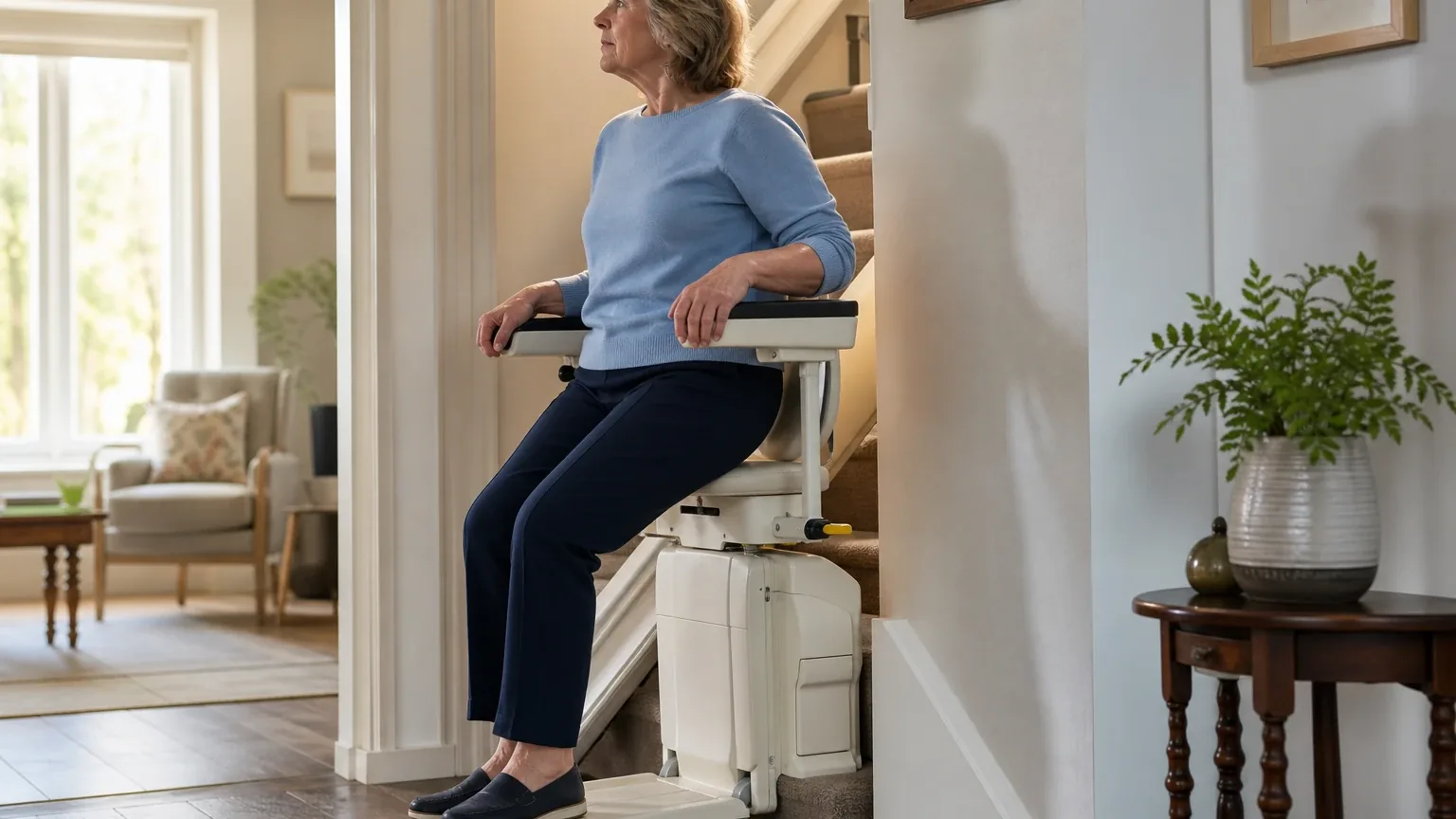
The Stannah Sadler is a good fit for buyers who struggle to bend their knees or sit fully but can safely ride in a supported, near-standing perch position. All seven platforms that named it in the ranking stage placed it in their standing stairlift results, with an average listed rank of 1.14 and a best rank of 1. Its strongest advantage is a purpose-built saddle-style perch seat with adjustable height, a non-slip surface, and a seat-belt interlock. The main limitation is that the Sadler is not a true stand-on lift: Stannah's own manual states it is not designed to be used as a stand-on product, and buyers must be able to transfer onto and balance on the perch seat.
Research Snapshot
| Field | Finding |
|---|---|
| Platform mentions in ranking stage | 7 of 7 included platforms |
| Share of included platform responses | 100% |
| Average listed rank | 1.14 |
| Best listed rank | 1 |
| Relevant product/model/plan | Stannah Sadler standing/perch stairlift (US configuration; Model 260 Sadler) |
| Overall use-case fit | Good, with a key qualification: supported perch travel, not true stand-on travel |
| Research date | 2026-09-27 |
What Changed Since August 2026
Stannah Sadler remained at No. 1, and platform mentions were unchanged at 7. The September 2026 review of the Stannah Sadler shifts the product framing from a general Stannah perch stairlift to the Model 260 Sadler specifically, with the perch-versus-stand-on distinction stated more plainly. Buyer fit is now described as good with a qualification rather than good-to-strong, and buyers are asked to confirm they can balance on the seat for roughly 30 to 60 seconds. Pricing evidence is less specific: a range of $4,700 to $8,500 for straight installations is newly reported, while the previously repeated $4,700 to $14,500 range is no longer repeated. Warranty and service-life details were reworked. Recommended configuration is unchanged, and the core buyer-facing substance is largely unchanged. Differences between the two editions reflect what each article reports; they do not by themselves prove that the product, service, or price changed.
The August 2026 review preserves the earlier article for reference.
Why Stannah Sadler Qualified for This Study
Questions This Section Answers
- Is Stannah Sadler a good choice for Standing & Semi-Standing Stair Travel?
- How many AI platforms named Stannah Sadler in their standing stairlift rankings?
The Stannah Sadler qualified because it was the only entity named by every platform in the ranking stage. All seven included platforms — Anthropic, DeepSeek, Google, Grok, Kimi, OpenAI, and Perplexity — listed it, giving it a 100% platform share, an average listed rank of 1.14, and a best rank of 1 [1]. Six of the seven placed it first; DeepSeek listed it second (deepseek:S1).
The platforms converged on the same reason: the Sadler is purpose-built for the stated use case rather than adapted from a conventional seated chair. Stannah describes it as a perch-style, near-standing stairlift intended for users with limited hip, knee, or back flexibility [1]. That positioning matches the target buyer directly.
Qualification was not unanimous on fit strength. Google and Grok rated it a strong fit; OpenAI, Anthropic, Kimi, and Perplexity rated it good; DeepSeek rated it mixed, citing thin public US-market specification and availability documentation (deepseek:S1). The ranking-stage consensus is therefore stronger than the fit-rating consensus.
The Product, Model, Plan, or Service Most Relevant to Standing & Semi-Standing Stair Travel
Questions This Section Answers
- Which Stannah Sadler model or configuration is relevant for a buyer who needs supported semi-standing stair travel?
- Is the Stannah Sadler a true stand-on stairlift or a perch seat?
The relevant product is the Stannah Sadler standing/perch stairlift, identified in US materials as the Model 260 Sadler [6]. It is a saddle-style perch seat, not a stand-on platform.
Stannah's US product page describes a sprung, non-slip seat with adjustable seat height, an immobilizer seat belt, and a compact profile positioned for narrow stairs [8]. The seat is described as tilting to assist entry and exit, with an arm-to-footrest linkage that folds the footrest automatically [9].
The critical qualifier appears in Stannah's own manual: "The Sadler is not designed to be used as a stand-on product" [7]. Buyers seeking a lift they stand on without seat contact should not treat the Sadler as that product. The platforms that rated it highly did so on the understanding that it is a supported perch design.
What the AI Platforms Agreed About
Questions This Section Answers
- What do AI platforms agree the Stannah Sadler does well for semi-standing stair travel?
- Does the Stannah Sadler have a seat belt interlock and obstruction sensors?
Agreement was strong on design intent and safety interlocks, and unanimous on the perch-seat concept.
Every platform that discussed the seat described a saddle or perch design that supports an upright posture while carrying part of the user's weight through the seat rather than the legs [11]. Multiple platforms noted the seat is adjustable in height at installation [11].
Platforms also agreed on the seat-belt interlock. Stannah materials state the lift will not operate until the belt is fastened, and the belt is described as operable with one hand [17]. Pressure-sensitive safety edges on the carriage and footrest were reported by several platforms [16].
Narrow-stair positioning drew broad agreement. Stannah repeatedly markets the Sadler as suitable where a traditional seated stairlift may be too wide [22].
Weight capacity was reported consistently in US materials at 300 pounds [24], though one platform noted a 298-pound figure in a safety database [20].
Where the AI Platforms Disagreed or Were Uncertain
Questions This Section Answers
- What is the exact minimum stair width required for a Stannah Sadler installation?
- Is Stannah Sadler currently available and sold in the United States?
The platforms disagreed on minimum stair width, US availability confidence, and ride-quality evidence.
Minimum width figures ranged across sources. Stannah's US Sadler page lists approximately 26 to 28 inches depending on configuration [27]. One US distributor document states approximately 29 inches to accommodate the user's knees [29]. Another US page gives 25.6 inches for curved stairs with a shorter footrest option [30]. Google cited 26.5 inches [31]. These are not reconcilable from public materials; the platforms treat width as configuration- and user-dependent and requiring an in-home survey.
US availability confidence varied. Perplexity found US Sadler pages and a US location page indicating the product is marketed in the United States [32]. DeepSeek rated fit mixed and stated that current US availability of the Sadler specifically is not clearly documented, noting ACORN stairlifts as a US-market standing alternative (deepseek:S1, deepseek:S2).
Ride smoothness evidence is thin. Stannah states its stairlifts operate at approximately 18 feet per minute [33]. No platform found independent Sadler-specific smoothness testing. One independent review describes the model as a niche product with limited independent review volume [34]. Anthropic noted user testing conducted by the RCA Helen Hamlyn Research Centre in 2011, with results not publicly available [35].
Weight capacity showed a minor discrepancy: 300 pounds in US materials versus 135 kg (about 297 pounds) in UK metric specifications [36].
Use-Case-Specific Features and Capabilities
Questions This Section Answers
- Does the Stannah Sadler include a full-body harness or dedicated grab bar for semi-standing travel?
- How does the Stannah Sadler handle narrow staircases and curved stair configurations?
Standing support design is the Sadler's core advantage. Stannah describes a perch-style, near-standing stairlift that supports a more upright posture while transferring part of the user's weight through the seat, intended for users with limited hip, knee, or back flexibility [38]. Kimi described the saddle seat as distributing weight more evenly than flat perch alternatives (kimi:stannah-sadler-product).
Perch seat stability rests on a sprung, non-slip seat with soft ridges and adjustable seat height [38]. Public materials do not establish suitability for users with poor balance or an inability to maintain a supported perch posture.
Harness and grab-bar support is a limitation, not a strength. The Sadler has an immobilizer seat belt that prevents operation unless fastened [42]. Public US materials reviewed do not clearly specify a full-body harness or a dedicated grab bar. Armrests are described as serving as grab points with automatic linkage to the footrest [40]. Buyers should not assume a harness is included.
Minimum stair width is configuration-dependent. Stannah lists approximately 26 to 28 inches on the US product page [38]. A separate Stannah dimensions resource states width depends on obstructions and configuration, so an in-home survey is required [44].
Obstruction sensors are listed but not specified in detail. Stannah lists integrated safety sensors for the Sadler [42], and platforms reported pressure-sensitive safety edges on the footrest and carriage sides that stop the lift on contact [40]. Public materials do not provide sensor-zone specifications or independent testing results.
Ride smoothness is neutral in the evidence. Stannah states approximately 18 feet per minute and describes controlled travel [44]. Independent Sadler-specific smoothness data was not found by any platform.
Weight capacity is stated at 300 pounds in US materials [39]. Anthropic noted capacity drops to 120 kg (about 19 stone) if a hinged rail is used [43]. Buyers should confirm the quoted configuration retains the stated capacity.
Curved-stair compatibility is available. The Sadler is offered for curved stairs, requiring roughly 400 mm (about 16 inches) of overrun at the top of the stairs [40]. Google reported compatibility with both straight and custom curved rail tracks in the US [50].
Pricing, Fees, Contracts, and Ongoing Costs
Questions This Section Answers
- How much does a Stannah Sadler cost, and is a Sadler-specific US price published?
- What cancellation and warranty terms apply to a Stannah Sadler purchase in the United States?
Stannah does not publish a Sadler-specific US price. Pricing is quote-based after an in-home assessment [51].
The only published Stannah figure is a general starting price of $4,700 for Stannah stairlifts, which is not confirmed as the Sadler price [51]. Independent estimates place straight Stannah installations at roughly $4,700 to $8,500 and curved installations at $8,500 to $14,500 or more [53]. Grok cited straight examples around $5,700 and curved examples around $10,800 [54]. Kimi reported standing stairlifts generally at $2,000 to $5,000 for straight stairs, with Stannah positioned at the premium end (kimi:modernize-standing-2026).
Installation is described as included in the quoted package according to Stannah's pricing materials [51]. Google reported that Stannah quotes are all-inclusive of the home visit, custom fabrication, and installation [55].
Cancellation terms carry real cost. US terms provide a limited cancellation or return window; for curved models, Stannah may retain 25% of the purchase price if cancellation occurs within the stated post-transaction and post-installation period [56]. After eight or more days following installation, the US terms state Stannah may remove the lift without charge while retaining payments made [56]. Google reported a 7-day money-back guarantee for direct purchases [55].
Warranty coverage differs by purchase channel. New US Stannah units purchased directly carry a lifetime carriage motor gearbox warranty and a one-year parts and labor warranty, subject to exclusions; coverage may differ when purchased through a distributor [57].
Ongoing costs are not fully published. Electricity use and eventual battery replacement are ownership considerations, but Sadler-specific amounts were not publicly verified [51]. Anthropic noted annual service is recommended, with battery life typically 3 to 5 years and remote batteries 1 to 2 years, but no published service price [59]. Kimi cited UK annual maintenance contracts typically at £100 to £250 per year, which does not map directly to US pricing (kimi:uk-stairlift-cost-2026).
Best Suited For
Questions This Section Answers
- Who is the Stannah Sadler best suited for in a semi-standing stair travel use case?
- Is the Stannah Sadler a good fit for a narrow indoor staircase?
The Sadler is best suited to users who struggle with knee, hip, or back flexion and can safely maintain a supported near-standing posture [60]. It fits buyers who prefer a semi-seated perch over a conventional stairlift chair.
It also suits narrow indoor staircases where a compact perch design is useful [63]. Buyers seeking direct manufacturer installation, a personalized survey, and US warranty support are a further match [64].
Kimi added that users should be able to stand with support for roughly 30 to 60 seconds and maintain adequate balance, citing installer refusal criteria for standing lifts (kimi:all-american-standing-2026).
Probably Not Best Suited For
Questions This Section Answers
- Who should not choose the Stannah Sadler for Standing & Semi-Standing Stair Travel?
- Can a buyer over 300 pounds use the Stannah Sadler?
Buyers who cannot safely stand or perch, control their trunk, or hold a stable posture during travel should not choose the Sadler [66]. Users who require a fully seated, heavily supported chair position are also a poor match [66].
Users above the stated 300-pound Sadler capacity are excluded [68]. Buyers needing a published fixed price or independently verified large-scale customer outcome data will not find either in public Sadler materials [71].
Users unable to operate a seat belt independently and without caregiver assistance are also a poor fit, since the lift will not run until the belt is fastened [72].
When Another Option May Be Better
Questions This Section Answers
- What is a better alternative to the Stannah Sadler for a buyer who needs a true stand-on lift or higher weight capacity?
- When is a conventional seated stairlift a better choice than the Stannah Sadler?
A conventional seated stairlift is better when the user cannot safely maintain a perched or near-standing position [74]. A platform lift or vertical platform lift is better when the buyer truly needs to remain standing or travel with a wheelchair [74].
Another manufacturer is better when the buyer requires substantially higher weight capacity, a fully enclosed restraint system, or independently documented ride and safety testing [74]. Stannah's own Starla and Siena models support up to 25 stone (about 158 kg), above the Sadler's stated capacity [76]. ACORN Stairlifts markets a standing/perch stairlift in the US with a published standing model, providing a US-documented alternative (deepseek:S2). Google noted competitor sit/stand units rated to 350 pounds [77].
A rental or refurbished option may be better for short-term use or uncertain duration, subject to Sadler availability and contract terms [74]. Buyers prioritizing transparent published pricing and terms may prefer a competitor that publishes them [75].
Questions to Verify Before Buying
- Can the user safely transfer onto the perch seat, fasten the belt, maintain trunk and leg stability, and exit at the top and bottom? [78]
- Is the quoted unit the current US Sadler configuration, and is the 300-pound capacity valid for the exact staircase and rail configuration? [79]
- What exact stair width is required after measuring handrails, moldings, walls, turns, and top-of-stairs clearance? [81]
- Does the quoted package include a powered swivel, manual swivel, footrest configuration, and any grab handle or additional support requested by the buyer? [78]
- Are the safety sensors located under the footrest, along the carriage, or elsewhere, and what obstructions do they detect? [83]
- What is the written total price including installation, taxes, permits if any, delivery, removal, and optional features? [85]
- What are the rental minimum term, monthly charge, installation and removal charges, purchase-option terms, and cancellation charges? [85]
- Which repairs, labor, batteries, rollers, and wear items are excluded from the warranty? [87]
- Will service be provided directly by Stannah or by a distributor, and what are the expected response times in the buyer's ZIP code? [87]
- Can the buyer test the Sadler on a comparable staircase before committing? [78]
Final AI Consensus Verdict
The consensus verdict is a good fit with a key qualification. The Stannah Sadler is well matched to supported near-standing stair travel for users who can balance and perch safely, but it is not a true stand-on lift [88].
Its design, seat-height adjustment, non-slip seat, belt interlock, narrow-stair positioning, and 300-pound capacity align with the stated use case [90]. The buyer should obtain an in-home assessment and written confirmation of posture support, width, capacity, restraint features, total price, and local after-sales coverage [93].
Platform agreement on ranking does not prove product quality. It reflects that seven platforms independently identified the same model as the leading answer for this use case, which is a signal of positioning clarity rather than verified performance.
How This Review Was Produced
This review was produced from platform fit-research responses collected for the Standing & Semi-Standing Stair Travel use case, with a research date of 2026-09-27. Seven platforms supplied fit assessments: Anthropic, DeepSeek, Google, Grok, Kimi, OpenAI, and Perplexity. Each platform's ranking-stage mentions, fit rating, use-case findings, pricing notes, and verification questions were compiled and compared.
Ranking statistics reflect only platforms that named the entity during ranking discovery. All included platforms evaluated fit, but platform mentions count only those that named Stannah Sadler in their standing stairlift results.
Methodology Limitations
Platform-reported research dates differ from the authoritative run date. Anthropic reported 2025-01-15 and DeepSeek reported 2026-01-15, while the remaining platforms reported 2026-09-27. These dates are provenance metadata and do not independently prove freshness.
Company-owned citations materially outnumber independent citations in the supplied evidence. Company claims in this review should not be read as independently verified.
The supplied URLs were collected from platform responses and were not independently validated by the writer stage. Citations are platform-reported evidence, not independently verified facts.
DeepSeek's response was produced with search disabled, so its claims about US availability and specification gaps are platform-reported and require verification before being treated as current facts.
Conflicting product names, pricing, and capabilities were not resolved by guessing. Where sources conflicted — minimum stair width, weight capacity rounding, and US availability confidence — the conflict is described and buyers are directed to verify.
No personal testing, customer experience, medical benefit, or guaranteed performance is claimed in this review.
Sources
Company-Owned Sources
- Standing Stairlifts: Perch Models for Knee Limitations (2026: https://allamericanstairlifts.com/stairlifts/standing/
- Standing Stair Lifts: What's Safe vs. What You See Online: https://arrowlift.com/blog/truth-about-standing-stair-lifts/
- Model 260 Sadler User Manual: https://resources.stannah.com/hubfs/UK%20Consumer/Stairlift/260%20Sadler.pdf
- What Is a Standing Stairlift? | Stairlift Guru®: https://stairliftguru.co.uk/standing-stairlifts/what-is-a-standing-stairlift/
- Sadler Stairlift For Curved Stairs - Stannah In The Mountain West: https://stannahinthemountainwest.com/sadler/sadler-stairlift
- Standing Stairlift Cost 2026 | UK Stairlift: https://uk-stairlift.co.uk/standing-stairlift-cost/
- ACORN Stairlifts Standing Stairlift: https://www.acornstairlifts.com/stairlifts/standing-stairlift/
- Stannah Sadler Product Page: https://www.stannah.com
- Arm-To-Footrest Link: https://www.stannah.com.au/resources/perching-stairlift-sadler/
- Standing Stair Lift for Compact and Narrow Stairs | The Sadler: https://www.stannah.com/en-ca/stairlifts/sadler-chair
- General Terms and Conditions of Sale: https://www.stannah.com/en-us/general-terms-and-conditions-of-sale
- Stairlifts & Chair Lifts | Nashville, TN - Stannah: https://www.stannah.com/en-us/locations/tennessee/nashvillle
- Warranty: Register Your Stairlift for Full Coverage: https://www.stannah.com/en-us/register
- Your Guide to Choosing a Comfortable and Safe Stairlift: https://www.stannah.com/en-us/resources/guide-to-choosing-a-comfortable-and-safe-stairlift
- Stairlift Dimensions: Perfect Fit Guide for Your Home: https://www.stannah.com/en-us/resources/stairlift-dimensions
- Handicap Chair Lifts - Stair lifts for Disabled Individuals - Stannah: https://www.stannah.com/en-us/resources/stairlift-for-disabled
- Stairlift Weight Limits: Capacity, Safety, and Heavy-Duty Options Explained: https://www.stannah.com/en-us/resources/stairlift-weight-limits
- Stairlift Solutions for Home Accessibility and Comfort - Stannah: https://www.stannah.com/en-us/stairlifts
- Curved Stairlift Solutions: Navigate Your Home Easily: https://www.stannah.com/en-us/stairlifts/curved-stairlifts
- The Sadler: Standing Stair Lift With Secure and Stable Support: https://www.stannah.com/en-us/stairlifts/sadler-chair
- How Much Does a Stair Lift Cost? Find Your Perfect Fit: https://www.stannah.com/en-us/stairlifts/stairlift-prices-and-cost
- Stairlifts For Straight & Curved Staircases: https://www.stannah.com/our-stairlifts
- Stairlifts For Narrow Stairs: https://www.stannah.com/our-stairlifts/narrow-stairs
- Perch stairlifts - Stannah: https://www.stannah.com/our-stairlifts/perch-stairlifts
- Sadler Stairlift | Limited Flexibility Solution: https://www.stannah.com/our-stairlifts/sadler
- Stannah video library: https://www.stannah.com/resources/video-library
- Stannah Sadler Stairlift: https://www.stannah.com/stairlifts/sadler
- The Sadler Stairlift Standing stairlift with a perch seat: https://www.stannah.gg/stairlifts/sadler-chair/
- Installing a stairlift requires no building work: https://www.stannah.je/no-building-work/
Additional AI research evidence95 records
- AI research evidence record openai:c1
- AI research evidence record anthropic:c1
- AI research evidence record grok:web:0
- AI research evidence record perplexity:c1
- AI research evidence record openai:c2
- AI research evidence record anthropic:c3
- AI research evidence record openai:c6
- AI research evidence record openai:c1
- AI research evidence record anthropic:c6
- AI research evidence record google:1.2.4
- AI research evidence record openai:c1
- AI research evidence record anthropic:c2
- AI research evidence record grok:web:0
- AI research evidence record perplexity:c1
- AI research evidence record google:1.2.1
- AI research evidence record anthropic:c1
- AI research evidence record openai:c3
- AI research evidence record anthropic:c5
- AI research evidence record perplexity:c8
- AI research evidence record google:1.2.2
- AI research evidence record google:1.2.4
- AI research evidence record perplexity:c9
- AI research evidence record perplexity:c14
- AI research evidence record openai:c2
- AI research evidence record anthropic:c3
- AI research evidence record grok:web:3
- AI research evidence record openai:c1
- AI research evidence record perplexity:c1
- AI research evidence record anthropic:c4
- AI research evidence record perplexity:c6
- AI research evidence record google:1.3.1
- AI research evidence record perplexity:c13
- AI research evidence record openai:c4
- AI research evidence record openai:c5
- AI research evidence record anthropic:c7
- AI research evidence record openai:c2
- AI research evidence record anthropic:c2
- AI research evidence record openai:c1
- AI research evidence record openai:c2
- AI research evidence record anthropic:c1
- AI research evidence record google:1.2.1
- AI research evidence record openai:c3
- AI research evidence record anthropic:c5
- AI research evidence record openai:c4
- AI research evidence record google:1.2.4
- AI research evidence record grok:web:0
- AI research evidence record anthropic:c4
- AI research evidence record anthropic:c3
- AI research evidence record grok:web:3
- AI research evidence record google:1.3.1
- AI research evidence record openai:c8
- AI research evidence record perplexity:c1
- AI research evidence record google:1.1.2
- AI research evidence record grok:web:5
- AI research evidence record google:1.1.1
- AI research evidence record openai:c7
- AI research evidence record openai:c9
- AI research evidence record google:1.1.3
- AI research evidence record anthropic:c4
- AI research evidence record openai:c1
- AI research evidence record anthropic:c2
- AI research evidence record perplexity:c8
- AI research evidence record perplexity:c9
- AI research evidence record openai:c7
- AI research evidence record openai:c9
- AI research evidence record openai:c1
- AI research evidence record perplexity:c1
- AI research evidence record openai:c2
- AI research evidence record anthropic:c3
- AI research evidence record grok:web:3
- AI research evidence record openai:c5
- AI research evidence record anthropic:c5
- AI research evidence record openai:c3
- AI research evidence record openai:c1
- AI research evidence record perplexity:c1
- AI research evidence record anthropic:c2
- AI research evidence record google:1.2.2
- AI research evidence record openai:c1
- AI research evidence record openai:c2
- AI research evidence record anthropic:c3
- AI research evidence record openai:c4
- AI research evidence record perplexity:c1
- AI research evidence record openai:c3
- AI research evidence record anthropic:c1
- AI research evidence record openai:c7
- AI research evidence record openai:c8
- AI research evidence record openai:c9
- AI research evidence record openai:c6
- AI research evidence record anthropic:c3
- AI research evidence record openai:c1
- AI research evidence record openai:c2
- AI research evidence record anthropic:c1
- AI research evidence record openai:c4
- AI research evidence record openai:c7
- AI research evidence record perplexity:c1
Independent Sources
- Sadler Stairlift Overview: https://caringvillage.com
- Modernize Stairlift Guide: https://modernize.com
- Standing Stairlifts: Your 2026 Guide to Costs, Installation & Features: https://modernize.com/stair-lifts/types/standing-stairlifts
- Stannah Sadler Review: https://stairlift.expert/reviews/stannah-sadler/
- Caring.com Stairlift Reviews: https://www.caring.com
- Stannah Stairlift Review - Caring.com: https://www.caring.com/senior-products/best-stairlifts/stannah
- ConsumerAffairs Stannah Review: https://www.consumeraffairs.com
- Best Standing Stair Lifts for Seniors (2026: https://www.consumeraffairs.com/homeowners/standing-stair-lifts-for-seniors.html
- Stannah Stair Lifts Review 2026: Tested: https://www.ncoa.org/product-resources/mobility/stannah-stair-lift-review/
- Stairlift Guru Width Guide: https://www.stairliftguru.co.uk
Additional AI research evidence95 records
- AI research evidence record openai:c1
- AI research evidence record anthropic:c1
- AI research evidence record grok:web:0
- AI research evidence record perplexity:c1
- AI research evidence record openai:c2
- AI research evidence record anthropic:c3
- AI research evidence record openai:c6
- AI research evidence record openai:c1
- AI research evidence record anthropic:c6
- AI research evidence record google:1.2.4
- AI research evidence record openai:c1
- AI research evidence record anthropic:c2
- AI research evidence record grok:web:0
- AI research evidence record perplexity:c1
- AI research evidence record google:1.2.1
- AI research evidence record anthropic:c1
- AI research evidence record openai:c3
- AI research evidence record anthropic:c5
- AI research evidence record perplexity:c8
- AI research evidence record google:1.2.2
- AI research evidence record google:1.2.4
- AI research evidence record perplexity:c9
- AI research evidence record perplexity:c14
- AI research evidence record openai:c2
- AI research evidence record anthropic:c3
- AI research evidence record grok:web:3
- AI research evidence record openai:c1
- AI research evidence record perplexity:c1
- AI research evidence record anthropic:c4
- AI research evidence record perplexity:c6
- AI research evidence record google:1.3.1
- AI research evidence record perplexity:c13
- AI research evidence record openai:c4
- AI research evidence record openai:c5
- AI research evidence record anthropic:c7
- AI research evidence record openai:c2
- AI research evidence record anthropic:c2
- AI research evidence record openai:c1
- AI research evidence record openai:c2
- AI research evidence record anthropic:c1
- AI research evidence record google:1.2.1
- AI research evidence record openai:c3
- AI research evidence record anthropic:c5
- AI research evidence record openai:c4
- AI research evidence record google:1.2.4
- AI research evidence record grok:web:0
- AI research evidence record anthropic:c4
- AI research evidence record anthropic:c3
- AI research evidence record grok:web:3
- AI research evidence record google:1.3.1
- AI research evidence record openai:c8
- AI research evidence record perplexity:c1
- AI research evidence record google:1.1.2
- AI research evidence record grok:web:5
- AI research evidence record google:1.1.1
- AI research evidence record openai:c7
- AI research evidence record openai:c9
- AI research evidence record google:1.1.3
- AI research evidence record anthropic:c4
- AI research evidence record openai:c1
- AI research evidence record anthropic:c2
- AI research evidence record perplexity:c8
- AI research evidence record perplexity:c9
- AI research evidence record openai:c7
- AI research evidence record openai:c9
- AI research evidence record openai:c1
- AI research evidence record perplexity:c1
- AI research evidence record openai:c2
- AI research evidence record anthropic:c3
- AI research evidence record grok:web:3
- AI research evidence record openai:c5
- AI research evidence record anthropic:c5
- AI research evidence record openai:c3
- AI research evidence record openai:c1
- AI research evidence record perplexity:c1
- AI research evidence record anthropic:c2
- AI research evidence record google:1.2.2
- AI research evidence record openai:c1
- AI research evidence record openai:c2
- AI research evidence record anthropic:c3
- AI research evidence record openai:c4
- AI research evidence record perplexity:c1
- AI research evidence record openai:c3
- AI research evidence record anthropic:c1
- AI research evidence record openai:c7
- AI research evidence record openai:c8
- AI research evidence record openai:c9
- AI research evidence record openai:c6
- AI research evidence record anthropic:c3
- AI research evidence record openai:c1
- AI research evidence record openai:c2
- AI research evidence record anthropic:c1
- AI research evidence record openai:c4
- AI research evidence record openai:c7
- AI research evidence record perplexity:c1
Other Sources
- Stand-up Stair Lifts for Seniors: Features and Evaluation: https://www.reference.com/business-finance/stand-stair-lifts-seniors-features-evaluation
Additional AI research evidence95 records
- AI research evidence record openai:c1
- AI research evidence record anthropic:c1
- AI research evidence record grok:web:0
- AI research evidence record perplexity:c1
- AI research evidence record openai:c2
- AI research evidence record anthropic:c3
- AI research evidence record openai:c6
- AI research evidence record openai:c1
- AI research evidence record anthropic:c6
- AI research evidence record google:1.2.4
- AI research evidence record openai:c1
- AI research evidence record anthropic:c2
- AI research evidence record grok:web:0
- AI research evidence record perplexity:c1
- AI research evidence record google:1.2.1
- AI research evidence record anthropic:c1
- AI research evidence record openai:c3
- AI research evidence record anthropic:c5
- AI research evidence record perplexity:c8
- AI research evidence record google:1.2.2
- AI research evidence record google:1.2.4
- AI research evidence record perplexity:c9
- AI research evidence record perplexity:c14
- AI research evidence record openai:c2
- AI research evidence record anthropic:c3
- AI research evidence record grok:web:3
- AI research evidence record openai:c1
- AI research evidence record perplexity:c1
- AI research evidence record anthropic:c4
- AI research evidence record perplexity:c6
- AI research evidence record google:1.3.1
- AI research evidence record perplexity:c13
- AI research evidence record openai:c4
- AI research evidence record openai:c5
- AI research evidence record anthropic:c7
- AI research evidence record openai:c2
- AI research evidence record anthropic:c2
- AI research evidence record openai:c1
- AI research evidence record openai:c2
- AI research evidence record anthropic:c1
- AI research evidence record google:1.2.1
- AI research evidence record openai:c3
- AI research evidence record anthropic:c5
- AI research evidence record openai:c4
- AI research evidence record google:1.2.4
- AI research evidence record grok:web:0
- AI research evidence record anthropic:c4
- AI research evidence record anthropic:c3
- AI research evidence record grok:web:3
- AI research evidence record google:1.3.1
- AI research evidence record openai:c8
- AI research evidence record perplexity:c1
- AI research evidence record google:1.1.2
- AI research evidence record grok:web:5
- AI research evidence record google:1.1.1
- AI research evidence record openai:c7
- AI research evidence record openai:c9
- AI research evidence record google:1.1.3
- AI research evidence record anthropic:c4
- AI research evidence record openai:c1
- AI research evidence record anthropic:c2
- AI research evidence record perplexity:c8
- AI research evidence record perplexity:c9
- AI research evidence record openai:c7
- AI research evidence record openai:c9
- AI research evidence record openai:c1
- AI research evidence record perplexity:c1
- AI research evidence record openai:c2
- AI research evidence record anthropic:c3
- AI research evidence record grok:web:3
- AI research evidence record openai:c5
- AI research evidence record anthropic:c5
- AI research evidence record openai:c3
- AI research evidence record openai:c1
- AI research evidence record perplexity:c1
- AI research evidence record anthropic:c2
- AI research evidence record google:1.2.2
- AI research evidence record openai:c1
- AI research evidence record openai:c2
- AI research evidence record anthropic:c3
- AI research evidence record openai:c4
- AI research evidence record perplexity:c1
- AI research evidence record openai:c3
- AI research evidence record anthropic:c1
- AI research evidence record openai:c7
- AI research evidence record openai:c8
- AI research evidence record openai:c9
- AI research evidence record openai:c6
- AI research evidence record anthropic:c3
- AI research evidence record openai:c1
- AI research evidence record openai:c2
- AI research evidence record anthropic:c1
- AI research evidence record openai:c4
- AI research evidence record openai:c7
- AI research evidence record perplexity:c1
Verify This Research
Review the study details behind this page or download the public machine-readable verification record.
- Study date
- September 27, 2026
- Platforms analyzed
- 7
- Source records
- 43
- Ranking mentions
- 7 of 7
- Platform share
- 100%
- Final consensus rank
- #1
Research trail and source mix
Configured platforms
openai, anthropic, deepseek, grok, perplexity, kimi, google
Source mix
11 independent · 31 company-owned · 1 unclear
Evidence support
32 direct · 11 partial
Important limitation
Use the run research_date as the study date. Platform-reported dates are provenance metadata and do not independently prove freshness.
Source snapshot SHA-256 ee2fe010365dbba49d04a2c7c04982c345d6478a53f8d352f8a88b0210628c91
Archived editions
Browse earlier published research snapshots for this article. The latest edition remains at the current URL.