
Answer Capsule
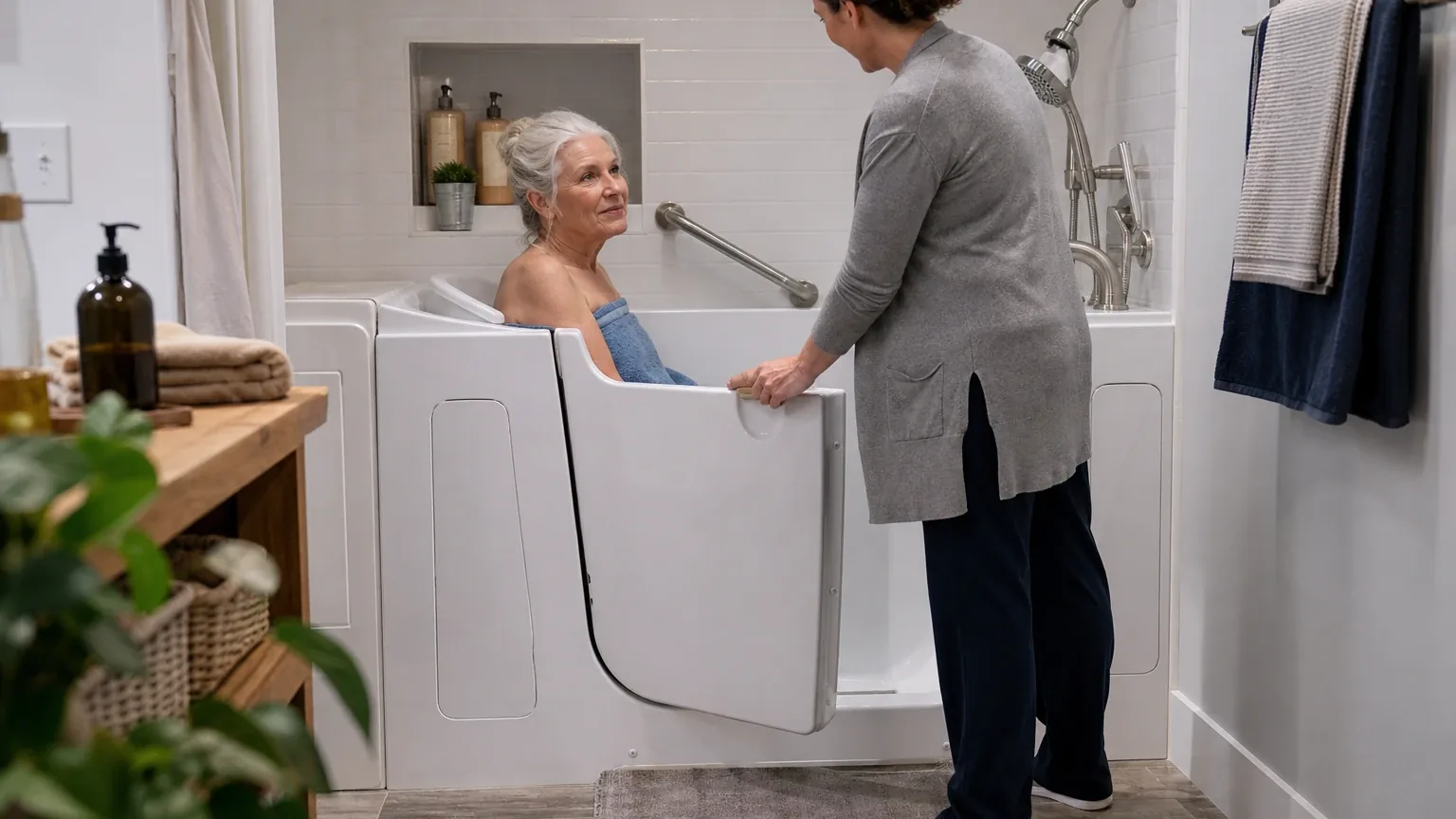
Safe Step Walk-In Tub is a mixed fit for Caregiver-Assisted Bathing. Four of the seven platforms named it during the ranking stage (57% of included platform responses), at an average listed rank of 3.5 and a best rank of 2. Its strongest case is a well-equipped seated-bathing package: low threshold, built-in seat, grab bars, anti-scald control, handheld shower wand, caregiver-operable controls, and installation-inclusive lifetime warranty claims. The main limitation is the inward-swinging door on standard models, combined with unpublished caregiver clearance, door width, and seat geometry. Platform fit ratings split four "good" to three "mixed." Buyers should treat hands-on suitability as installation-specific and require a written quote plus a live transfer demonstration.
Research Snapshot
| Field | Detail |
|---|---|
| Platform mentions in ranking stage | 4 of 7 included platforms (anthropic, deepseek, kimi, perplexity) |
| Share of included platform responses | 57% (0.57) |
| Average listed rank | 3.5 |
| Best listed rank | 2 (anthropic) |
| Relevant product/model/plan | Safe Step Walk-In Tub line, especially the Hybrid Walk-In Tub or a standard tub with optional shower package, built-in seating, handheld shower, grab bars, low threshold, and professional installation |
| Overall use-case fit | Good (4 platforms); Mixed (3 platforms) — 7 platforms analyzed |
| Research date | 2026-11-10 |
Why Safe Step Walk-In Tub Qualified for This Study
Questions This Section Answers
- Why did Safe Step Walk-In Tub make the shortlist for caregiver-assisted bathing when only four of seven platforms named it?
- Does Safe Step Walk-In Tub qualify for a caregiver-assisted bathing comparison on safety features alone?
Safe Step qualified because four of the seven included platforms named it during ranking discovery, clearing the study's two-mention threshold, and because its published feature set maps directly onto the category criteria: access for an assisting person, door clearance, seating, control placement, and safety features [24]. It ranked as high as second on one platform and no lower than fifth, giving it an average listed rank of 3.5.
Qualification is not endorsement. The platforms that named it disagreed on fit: anthropic, google, kimi, and perplexity rated it "good," while openai, deepseek, and grok rated it "mixed." Safety features alone did not carry the qualification; the deciding factor was that Safe Step publishes caregiver-facing material and a hybrid tub-shower configuration that other brands in this comparison do not emphasize as heavily [29].
The Product, Model, Plan, or Service Most Relevant to Caregiver-Assisted Bathing
Questions This Section Answers
- Which Safe Step Walk-In Tub configuration should a family choose for caregiver-assisted bathing?
- Is the Safe Step Hybrid Walk-In Tub or a standard tub with a handheld shower better for an aide assisting a seated bather?
The most relevant configuration is the Safe Step Hybrid Walk-In Tub, or a standard Safe Step tub fitted with the optional stand-up shower package and handheld shower wand. The Hybrid combines a soaking tub with a rainfall showerhead and handheld wand, letting a caregiver switch between seated soaking and shower rinsing without waiting for a full drain cycle [14]. Safe Step also markets a separate wheelchair-accessible line with a reported 0.75-inch threshold and wider doors, but independent sources describe standard models as not wheelchair accessible [1].
For most caregiver households, the practical choice is the Hybrid or a standard tub with handheld shower, because the caregiver assists from outside the tub rather than entering it. Buyers who need lateral wheelchair transfer should treat the wheelchair-accessible line as a distinct product requiring separate verification, not an upgrade to the standard tub.
What the AI Platforms Agreed About
Questions This Section Answers
- What do AI platforms agree the Safe Step Walk-In Tub does well for caregiver-assisted bathing?
- Do AI platforms agree that Safe Step Walk-In Tub is safe for hands-on caregiver bathing?
The platforms agreed, near-unanimously, on the feature inventory. Every platform that named Safe Step described a low step-in threshold, built-in seating, grab bars, slip-resistant surfaces, anti-scald technology, and a handheld shower option [24]. All seven also agreed that pricing is quote-based and requires an in-home consultation, with no published fixed price [24].
They also agreed that the standard tub is designed around a single seated bather, not two people inside the enclosure. No platform claimed the standard model is optimized for a caregiver working inside the tub space [16]. Agreement on features does not establish that hands-on bathing is safe for every mobility level; no platform supplied independent clinical or accessibility-body testing.
Where the AI Platforms Disagreed or Were Uncertain
Questions This Section Answers
- Why do AI platforms disagree about whether Safe Step Walk-In Tub is a good fit for caregiver-assisted bathing?
- Is the Safe Step Walk-In Tub wheelchair accessible for a caregiver-assisted transfer?
The clearest disagreement is the overall fit rating: four platforms called it "good" and three called it "mixed." The split tracks how much weight each platform placed on the inward-swinging door. Anthropic and kimi flagged the inward door as a limitation but still rated the tub good for light assistance [15]. OpenAI and deepseek treated the inward door plus undocumented caregiver clearance as disqualifying for intensive hands-on bathing [24].
Wheelchair accessibility is a direct conflict. Safe Step's own limited-mobility page describes wheelchair and walker accommodation [31], while an independent review states standard models are not wheelchair accessible except the Safe Step Walk-In Shower [1]. Safe Step's own comparison guide also says walk-in showers are the most wheelchair-friendly design [26]. Threshold measurements conflict too: the owner's manual lists a 3.875-inch uninstalled step-in height [3], while marketing and other sources cite 2 to 4 inches [13]. Door width is reported as 15.75 to 20.5 inches depending on model [15]. None of these conflicts can be resolved without a written, model-specific specification.
Use-Case-Specific Features and Capabilities
Questions This Section Answers
- Which Safe Step Walk-In Tub features actually help a caregiver assisting a seated bather?
- How does the Safe Step Walk-In Tub's inward-swinging door affect a caregiver's ability to assist?
The features that genuinely help a caregiver are the handheld shower wand, caregiver-operable controls, anti-scald protection, grab bars, and the built-in seat. Safe Step publishes an LED keypad, a floating waterproof remote, and a no-strength locking handle that let a caregiver manage water, jets, and drain without the bather's hand strength [20]. The handheld wand lets an aide rinse a seated bather from outside the tub [29]. The built-in seat, described as ADA-compliant and heated on some models, reduces transfer strain [34].
The inward-swinging door is the central constraint. It is self-sealing under water pressure, which is good for leak prevention but means the door cannot be opened from outside while the tub is filled, limiting emergency access [6]. It also narrows the working space a caregiver has during entry and transfer [34]. Safe Step advertises rapid fill and a quick-release drain that empties the tub faster than earlier models, typically in 5 to 15 minutes, which shortens the window a bather must wait inside the sealed tub [17]. Actual fill and drain times for a specific installation were not verified.
Pricing, Fees, Contracts, and Ongoing Costs
Questions This Section Answers
- How much does a Safe Step Walk-In Tub cost installed for a caregiver-assisted bathing setup?
- What should a buyer confirm about Safe Step Walk-In Tub financing and warranty terms before signing?
Pricing is quote-based and internally inconsistent. Safe Step's official pricing page states fully installed tubs range from $10,000 to $26,000, with basic accessibility tubs starting around $3,000, premium hydrotherapy models typically $8,000 to $12,000, and tub-shower combinations $10,000 to $15,000 [21]. The same site elsewhere describes $5,000 to $15,000 and $8,000 to $12,000 as typical [24]. Independent sources report installed ranges from roughly $8,000 to $27,000 [35]. The applicable 2026 price cannot be determined without a written, itemized quote.
Additional costs can include electrical work, plumbing changes, flooring or tile, old-tub removal, and water-heater upgrades [35]. Safe Step advertises a lifetime warranty covering the tub and installation, a Lowest Price Guarantee, third-party financing subject to credit approval, and a limited-time $2,000-off plus free toilet promotion that expires 12/31/2026 and is available in select markets only [25]. Warranty exclusions, cancellation terms, transferability, and financing APR were not verified from the reviewed materials [24].
Best Suited For
Questions This Section Answers
- Is Safe Step Walk-In Tub a good choice for an older adult who needs light caregiver supervision during bathing?
- Which caregiver-assisted bathing households get the most value from a Safe Step Walk-In Tub?
Safe Step is best suited to households where the older adult can enter through a low threshold and transfer onto the built-in seat with limited physical lifting, and the caregiver assists from outside or from the accessible side of the tub [24]. It fits families who want a combined tub-shower option for both seated soaking and shower rinsing [14], and buyers who value bundled professional installation and a reported lifetime warranty on tub and installation [35]. It also suits bathrooms with limited floor space where an inward-opening door is an advantage rather than an obstacle [34].
Probably Not Best Suited For
Questions This Section Answers
- When is Safe Step Walk-In Tub a poor choice for hands-on caregiver bathing?
- Is Safe Step Walk-In Tub unsuitable for a wheelchair-dependent bather?
Safe Step is probably not best suited to users who need frequent two-person lifting, extensive in-tub repositioning, or caregiver access from multiple sides [24]. It is a poor fit for wheelchair-dependent bathers unless Safe Step confirms a specific wheelchair-accessible configuration with documented transfer geometry [1]. It is also weak where the inward door would obstruct transfers or leave insufficient caregiver space, and for buyers who need transparent, comparable pricing before an in-home sales visit [24].
When Another Option May Be Better
Questions This Section Answers
- When is a roll-in shower a better choice than a Safe Step Walk-In Tub for caregiver-assisted bathing?
- When should a family choose a transfer-focused tub instead of a Safe Step Walk-In Tub?
A roll-in shower or barrier-free walk-in shower may be better when the primary need is wheelchair access, barrier-free entry, or more room for a caregiver to assist from outside the enclosure [26]. A transfer-focused tub with an outward-opening or U-shaped door and a level transfer deck may be better when the bather needs lateral wheelchair transfer or a mechanical lift [5]. A sliding transfer system with tilt may be better for complete dependence [7]. A published-price supplier or local contractor may be better when transparent pricing and independent installation comparisons matter more than a bundled sales process [24].
Questions to Verify Before Buying
Questions This Section Answers
- What should a caregiver confirm about Safe Step Walk-In Tub door width and seat dimensions before signing a contract?
- What should a buyer ask Safe Step about caregiver clearance and transfer geometry during the in-home consultation?
Confirm the exact model and configuration, including door opening width, seat height and width, interior width, and total exterior dimensions [24]. Ask how much clear floor and side access the caregiver will have during entry, washing, repositioning, and exit, and whether the door swings inward in the quoted configuration [24]. Confirm whether the tub is compatible with a wheelchair, transfer board, lift, or transfer bench and what the documented approach dimensions are [24]. Ask where the shower controls, handheld shower, drain controls, grab bars, and emergency-access features are located, and request tested fill and drain times for the exact plumbing setup [24]. Finally, request an itemized installed quote, the written warranty with exclusions, financing APR and total repayment, and cancellation terms [24].
Final AI Consensus Verdict
The consensus is a qualified mixed fit. Safe Step Walk-In Tub is a reasonable choice for caregiver-assisted bathing when the older adult retains some transfer ability and the caregiver assists from outside the tub, backed by a strong seated-bathing feature set and installation-inclusive warranty claims. It is not a clearly strong choice for intensive hands-on bathing, because the inward-swinging door and unpublished caregiver clearance, door width, and seat geometry create material uncertainty, and because platform fit ratings split four "good" to three "mixed." Buyers should require an in-home measurement, a live transfer demonstration with the actual caregiver, and an itemized written quote before purchase.
How This Review Was Produced
This review used the supplied platform fit-research responses from seven AI platforms (openai, anthropic, google, grok, perplexity, kimi, deepseek) collected for the Caregiver-Assisted Bathing use case on the 2026-11-10 research date. Ranking statistics reflect how many platforms named Safe Step during ranking discovery and where it placed. Fit ratings and feature findings are platform-reported and were not independently verified by the writer. Company-owned citations materially outnumber independent citations, so company claims are described as company claims. This review is part of the broader Caregiver-Assisted Bathing comparison and sits within the walk in tubs category.
Methodology Limitations
Platform-reported research dates differ from the authoritative run date: deepseek reported 2026-06-15 while the other six platforms reported 2026-11-10, so deepseek findings may be less current. Deepseek ran without search enabled, so its claims are model-reported rather than retrieved. The supplied URLs were collected from platform responses and were not independently validated. Company-owned sources outnumber independent sources, and no independent clinical or accessibility-body testing of caregiver-assisted bathing suitability was located. Pricing, door width, threshold height, and wheelchair-accessibility claims conflict across sources and were not resolved. Platform agreement on features does not prove product quality or safety.
Sources
Company-Owned Sources
- Safe Step Walk-In Tub Owner's Manual: https://customers.safesteptub.com/wp-content/uploads/2025/02/SS_TUB_OwnersManual.pdf
- HoistAssist and CareGiver Assisted-Bathing Systems: https://ellasbubbles.com/support/article/hoistassist-and-caregiver-assisted-line/
- Ella HomeCare Wheelchair Transfer Tub 32x60 | Ella's Bubbles: https://ellasbubbles.com/walk-in-tubs/assisted-bathtubs-and-equipment/home-care-wheelchair-transfer-tub/
- Safe Step Walk-In Tubs official website: https://www.safesteptub.com/
- How Do Walk-In Tubs Work?: https://www.safesteptub.com/blog/how-do-walk-in-tubs-work/
- Is a Walk-In Tub Worth the Investment? - Safe Step Tub: https://www.safesteptub.com/blog/is-a-walk-in-tub-worth-the-investment/
- Safe Bathing Solutions for Caregivers - Safe Step Tub: https://www.safesteptub.com/caregivers/
- Walk-In Tub Convenience Features: https://www.safesteptub.com/features/walk-in-tub/convenience/
- How Much Does a Walk-In Tub Cost in 2026?: https://www.safesteptub.com/pricing/
- The Hybrid Walk-In Tub With Shower - Safe Step Tub: https://www.safesteptub.com/products/hybrid-walk-in-tub/
- Walk-In Bath Tub Shower Combo - Best Prices & Designs: https://www.safesteptub.com/products/the-hybrid-walk-in-tub-bathtub-features/
- Walk-In Tubs for Seniors | Sit-In Bathtubs | Safe Step: https://www.safesteptub.com/products/walk-in-tub/
- Frequently Asked Questions - Safe Step: https://www.safesteptub.com/resources/faq/
- Compare Safe Step Products | Walk-In Tub vs. Shower: https://www.safesteptub.com/resources/product-comparison-guide/
- Explore Different Types of Walk-In Tubs | Safe Step: https://www.safesteptub.com/resources/types-of-walk-in-tub/
- Walk-In Tub Design Resource Guide: https://www.safesteptub.com/resources/walk-in-tub-design-guide/
- Safe Bathing Solutions for Caregivers: https://www.safesteptub.com/solutions/caregivers/
- Safe Bathing Solutions for Your Loved Ones | Safe Step: https://www.safesteptub.com/solutions/family-members/
- Safe Bathing Solutions for People with Limited Mobility: https://www.safesteptub.com/solutions/limited-mobility/
- How Much Does a Walk-In Tub Cost in 2026? - Safe Step Tub: https://www.safesteptub.com/walk-in-tub-cost/
- Walk-In Tub Dimensions, Sizing & Specifications | Safe Step: https://www.safesteptub.com/walk-in-tub-dimensions/
- Official pricing and terms source: https://www.safesteptub.com/pricing/stairlift-pricing/
Independent Sources
- Is the Safe Step Walk-In Tub Right for You? - AgingInPlace.org: https://aginginplace.org/walk-in-tubs/safe-step-review/
- Accessible bathtub: https://en.wikipedia.org/wiki/Accessible_bathtub
- ShowerBuddy SB2T TubBuddy with Tilt: https://familycaredme.com/products/showerbuddy-sb2t-tubbuddy-with-tilt
- Safe Step Walk-in Tubs Review: https://www.caring.com/senior-products/best-walk-in-tubs/safe-step
- Safe Step Walk-In Tubs Reviews: https://www.consumeraffairs.com/homeowners/safe-step-walk-in-tubs.html
- The Best Walk-In Bathtubs (2026 Guide: https://www.consumeraffairs.com/homeowners/walk-in-bathtubs/
- Walk-in tub overview (National Council on Aging: https://www.ncoa.org/article/walk-in-tubs-for-seniors
- The Best Walk-In Tub Shower Combinations of 2026: https://www.ncoa.org/product-resources/mobility/best-walk-in-tub-shower-combinations/
- Compare the Best Walk-In Tubs 2026: https://www.ncoa.org/product-resources/mobility/best-walk-in-tubs/
- Best Walk-In Tubs (with Reviews & Costs: https://www.retirementliving.com/best-walk-in-tubs
- 3 Best Walk-In Tubs for People With Disabilities in 2026: https://www.retirementliving.com/best-walk-in-tubs/walk-in-tubs-for-disabled
- Comparing Safe Step and American Standard Walk-in Tubs: https://www.seniorliving.org/walk-in-tubs/safe-step-vs-american-standard/
- Safe Step Walk-In Tubs Review (2026): With Costs: https://www.seniorliving.org/walk-in-tubs/safe-step/
- How Much Does A Safe Step Walk-In Tub Cost?: https://www.thepricer.org/safe-step-tub-cost/
- Safe Step Walk-In Tub Reviews (2026: https://www.theseniorlist.com/walk-in-bathtubs/safe-step/
Verify This Research
Review the study details behind this page or download the public machine-readable verification record.
- Study date
- November 10, 2026
- Platforms analyzed
- 7
- Source records
- 38
- Ranking mentions
- 4 of 7
- Platform share
- 57%
- Final consensus rank
- #3
Research trail and source mix
Configured platforms
openai, anthropic, deepseek, grok, perplexity, kimi, google
Source mix
16 independent · 22 company-owned
Evidence support
26 direct · 9 partial
Important limitation
Use the run research_date as the study date. Platform-reported dates are provenance metadata and do not independently prove freshness.
Source snapshot SHA-256 c31cac6b8209c05eece8afccd2c1b320c1203357b8cc718bae1d4ee3ee4d3112