
Answer Capsule
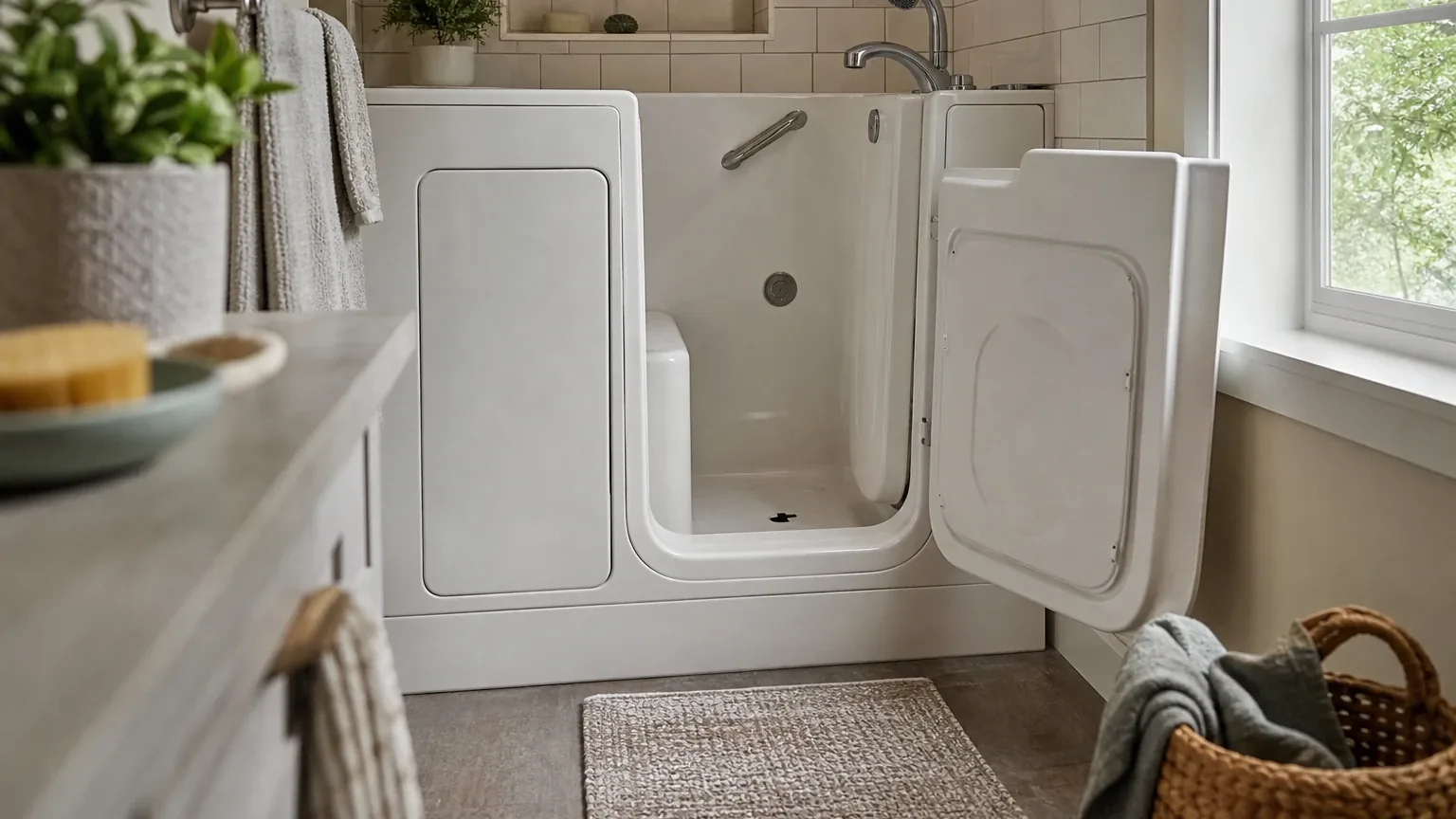
For most buyers choosing a walk-in tub door for a specific bathroom, the outward-opening door is the better default. All seven AI platforms studied named it, and six of the seven ranked it first, because it keeps the bathing well clear during entry, supports wheelchair and lateral transfers, and lets a caregiver reach a collapsed bather from outside without draining the tub. The buyer who should choose the other approach instead is the one whose bathroom cannot give up floor space in front of the tub — where an outward swing would strike a toilet, vanity, wall, or the bathroom door. The decision turns on measured exterior clearance versus the need for assisted bathing and emergency access. Seven platforms were studied. The principal limitation: this guide reports what AI platforms stated, not what was installed, tested, or measured, and no platform supplied a verifiable all-in installed price difference.
Research Snapshot
- Topic: Inward- versus outward-swing walk-in tub doors, United States, 2026.
- Target buyer: Buyers and caregivers choosing a walk-in tub door style for a specific bathroom.
- Approaches compared: Outward-opening door (rank 1) and inward-opening door (rank 2).
- Platforms included (7): openai, anthropic, deepseek, grok, perplexity, kimi, google.
- Research date: 2026-11-10.
- What the platforms were asked to decide: Which door configuration a buyer should choose for a specific bathroom, weighed against safety, accessibility, bathroom clearance, assisted bathing, and emergency access.
Both approaches were named by all seven platforms (100% platform share each). The ranking separates them on average rank: 1.29 for the outward-opening door against 1.71 for the inward-opening door. Both recorded a best rank of 1, meaning at least one platform placed each first.
The Two Options Compared
Questions This Section Answers
- Should a buyer install an outward-opening or an inward-opening walk-in tub door when emergency access matters most?
- Is an inward-opening or an outward-opening door better for a small bathroom where a toilet sits beside the tub?
- Which walk-in tub door style is easier for a caregiver to operate during assisted bathing?
The single most decision-relevant difference is what happens when a bather is against the door. Six platforms (openai, anthropic, deepseek, perplexity, kimi, google) stated that an outward door can be opened from outside in an emergency, while an inward door is pushed shut by water pressure and by a body leaning against it. Grok was the outlier, ranking the inward door first on clearance grounds.
| Decision dimension | Outward-opening door | Inward-opening door | Which the supplied evidence favours |
|---|---|---|---|
| Emergency access | Opens toward the room; can be opened from outside without draining (openai, anthropic, deepseek, perplexity, kimi, google) | Cannot be opened until the tub drains; water pressure holds it closed (openai, anthropic, perplexity, google) | Outward — six platforms against grok's silence on this point |
| Assisted bathing and caregiver reach | Caregiver stands at an unobstructed opening (deepseek, kimi, google) | Door panel blocks the near side during entry (deepseek, kimi) | Outward |
| Wheelchair and lateral transfer | Supports direct lateral transfer, including L-shape transfer variants (anthropic, perplexity, kimi, google) | Not suitable for direct lateral transfers (anthropic, google) | Outward |
| Bathroom clearance outside the tub | Needs clear floor space for the swing arc; figures range from 21 in to 60 in depending on platform and door style | Little or no exterior clearance; swing stays over the tub footprint | Inward — this is the dimension that decides the purchase for tight rooms |
| Interior bathing-well space | Footwell stays clear during entry and closing (kimi, google) | Door consumes interior space; bather must clear it with knees (openai, anthropic, kimi, google) | Outward |
| Seal mechanism | Relies on mechanical latch and gasket; water pressure does not assist (anthropic, grok, kimi, google) | Water pressure assists a self-tightening seal (anthropic, grok, kimi, google) | Inward |
| Tub-only purchase price | Reported premium over inward, ranging from about $350 to $2,000+ depending on platform | Reported as the lower-cost baseline | Inward on purchase price; the all-in difference is not settled |
| Product availability | Widely available; standard for bariatric and disability-accessible models (anthropic, deepseek) | Widest availability per some platforms (anthropic, perplexity); fewer models per deepseek | Does not separate them — platforms conflict |
| Flooding risk if opened early | Risk of room flooding if unlatched before draining (google) | Not raised as a risk by any platform | Inward, on google's single statement only |
Which Buyer Should Choose Each Option
Questions This Section Answers
- Should a wheelchair user choose an outward-opening walk-in tub door over an inward-opening one?
- Is an inward-opening door the right choice for a bathroom too narrow for an outward door swing?
- Which door style suits a bather who bathes independently with no caregiver present?
The buyer situation, not the door style in the abstract, settles this. A household with a caregiver or a wheelchair user should start from the outward door and check clearance second; a household in a five-foot alcove hemmed in by fixtures should start from the inward door and accept the emergency-access trade-off.
| Buyer situation | Better fit | Why, from the supplied evidence |
|---|---|---|
| Caregiver assists with bathing | Outward | Caregiver reaches the bather without a panel in the way (deepseek, kimi); door opens from outside in an emergency (openai, anthropic) |
| Wheelchair or walker user transferring laterally | Outward | Direct lateral transfer supported, including L-shape transfer doors (anthropic, perplexity, kimi, google) |
| Bather with severe leg-extension or foot-repositioning limits | Outward | Footwell stays clear; user can sit first and swing legs in (anthropic, kimi) |
| Bathroom where an outward swing would hit a toilet, vanity, wall, or the room door | Inward | Swing stays over the tub footprint; zero exterior clearance needed (openai, anthropic, deepseek, kimi, google) |
| Standard or small bathroom with typical mobility needs and no caregiver | Inward | Grok ranked it first for exactly this buyer; google cites the typical five-foot alcove |
| Bather who bathes independently and can self-evacuate | Inward | Anthropic names this buyer explicitly; lower purchase cost and self-sealing |
| Buyer who values a self-tightening seal over emergency speed | Inward | Water pressure assists the seal (anthropic, grok, kimi, google) |
| Bariatric or disability-accessible configuration needed | Outward | Described as the standard configuration for these models (anthropic) |
| Household where the bather may collapse against the door | Outward | An inward door is pushed shut by a body against it (deepseek, openai) |
1. Outward-opening door
Questions This Section Answers
- Should a buyer choose an outward-opening walk-in tub door for assisted bathing?
- How much clear floor space does an outward-opening walk-in tub door need in front of the tub?
- Why does an outward-opening door cost more than an inward-opening door for a walk-in tub?
Verdict: The Outward-opening door is the stronger default for most buyers because it is the only one of the two that six platforms say can be opened from outside during an emergency, and the only one they associate with wheelchair transfers and unobstructed caregiver access. Its cost is paid in floor space, not primarily in money.
The full Outward-opening door fit review sets out the platform-by-platform reasoning behind this ranking.
Who should choose it. Buyers in households where a caregiver provides assistance, where a wheelchair or walker is used, or where the buyer is actively worried about a medical emergency in the tub. OpenAI frames it as best for "most buyers who prioritize caregiver assistance, wheelchair or lateral transfers, and the ability to reach the bather quickly." Anthropic adds buyers in tight bathrooms who can confirm 36–60 inches of exterior clearance, arguing the safety benefits often outweigh the space trade-off. Deepseek calls it the better default for most U.S. buyers. Grok and google both place it second but recommend it specifically for wheelchair accessibility, larger users, and maximum interior maneuvering room.
What it does well for this use case.
- Emergency access without draining the tub, because water pressure does not press the door shut against an occupant (openai, anthropic, deepseek).
- Lateral transfer from a wheelchair or walker, including L-shape transfer door variants (anthropic, perplexity, kimi, google).
- An unobstructed footwell during entry and door closing, so the bather does not have to reposition feet around a panel (kimi, google).
- A seat-first entry pattern on models where the door extends over the seat: sit, then swing legs in (anthropic).
- Availability as the standard configuration for bariatric and disability-accessible models (anthropic), and from multiple U.S. manufacturers and installers (openai).
What it costs the buyer.
- Space: clear floor area outside the tub for the door arc and caregiver movement. Platform figures vary widely — grok says 21 inches or more; google says 21 to 30 inches; anthropic says 36 to 60 inches; kimi says 21 to 36.5 inches depending on door shape. The spread itself is a warning to measure against the specific model's specification, not a generic number.
- Layout conflict: the swing can strike a toilet, vanity, bathroom door, or narrow walkway unless the model's clearance is verified (openai, deepseek, grok, kimi).
- Trip hazard: the swing arc can obstruct a walker or wheelchair in the room (deepseek).
- Hardware dependence: the door relies on a mechanical latch and heavy-duty gasket rather than water pressure, which google says increases potential leak points over time and creates a flooding risk if the door is opened before the tub drains.
- Handle operation: the handle can be difficult for users with limited hand strength or dexterity (anthropic).
- Money: a reported tub-only premium over inward doors, with no verifiable all-in figure (see the cost section below).
- Upkeep: the door, seals, and surrounding floor may need more frequent cleaning and inspection because the door opens into the room (openai).
Where platforms disagreed about it. Grok and google ranked it second rather than first, while openai, anthropic, deepseek, perplexity, and kimi ranked it first. The clearance figure is the sharpest disagreement: 21 inches (grok), 21–30 inches (google), 21–36.5 inches (kimi), and 36–60 inches (anthropic) cannot all describe the same door. Deepseek was the only platform to label its own confidence moderate on clearance grounds, and kimi likewise rated confidence moderate. No platform claimed the outward door removes the need for a low threshold or reduced-height seat; deepseek explicitly said those are separate features.
2. Inward-opening door
Questions This Section Answers
- Should a buyer choose an inward-opening walk-in tub door when the bathroom has no floor space in front of the tub?
- Is an inward-opening door safer than an outward-opening door for a bather who bathes alone?
- What are the drawbacks of an inward-opening walk-in tub door for wheelchair users?
Verdict: The Inward-opening door is the correct choice when the room, not the bather, makes the decision. It needs little or no floor space outside the tub and its seal is helped by water pressure, but it cannot be opened until the tub drains and it does not support lateral transfers — a trade-off five platforms describe and one (grok) ranks first anyway.
The Inward-opening door fit review carries the detailed platform reasoning.
Who should choose it. Buyers whose tub sits close to a toilet, vanity, wall, or the bathroom entry door, so that an outward swing would collide. OpenAI, anthropic, deepseek, kimi, and google all name this buyer. Anthropic adds three further cases: buyers whose primary goal is fall prevention rather than wheelchair access, users who can self-evacuate with no caregiver involved, and households that value the self-sealing property and lower cost over emergency-access speed. Grok goes further and recommends it for most U.S. buyers in standard or smaller bathrooms with typical mobility needs — the single strongest statement in favour of the inward door across the seven platforms.
What it does well for this use case.
- Preserves open bathroom floor space because the door swings into the tub (openai, deepseek, kimi).
- Fits compact bathrooms and layouts with obstructions immediately outside the tub (openai, anthropic, perplexity).
- Water pressure assists a self-tightening, leak-resistant seal when the tub is full (anthropic, grok, kimi, google).
- Easier to close from inside the tub, because the door closes away from the user (anthropic, grok).
- Reported as the lower purchase cost option and the most common configuration (anthropic, perplexity, google).
- Keeps the path around the toilet, vanity, and doorway clear for mobility devices in the room (deepseek).
What it costs the buyer.
- Emergency access: the door cannot be opened until the tub drains, and water pressure holds it closed (openai, anthropic, perplexity, google). Deepseek adds that a bather leaning or falling against the door can push it shut.
- Interior space: the door consumes bathing-well space and the bather must clear it with their knees while standing inside (openai, anthropic, kimi, google).
- Transfer limits: not suitable for direct lateral transfers from a wheelchair (anthropic, google); narrower effective entry (anthropic).
- Caregiver access: the door panel blocks the near side of the tub during assisted entry (deepseek, kimi).
- Physical demand: the user must be able to stand, maneuver, and close the door past their knees from inside the tub (kimi, google).
- Choice: deepseek states fewer models and configurations are offered by U.S. manufacturers, narrowing size and feature choice — a claim anthropic and perplexity contradict.
- Money: a lower reported tub-only price, but openai warns a lower purchase price does not guarantee a lower installed cost.
Where platforms disagreed about it. Grok and google ranked it first; openai, anthropic, deepseek, perplexity, and kimi ranked it second. Deepseek rated its own confidence low. The availability claim is directly contested: deepseek says fewer models are offered, while anthropic calls it the most common configuration with the widest product availability and perplexity calls it the most common and typically most affordable. Kimi notes that KOHLER Belay and Safe Step inward-opening models do not publish door-specific pricing, and that American Standard positions both door types without transparent price differentiation — so the "cheaper" label rests on reported, not published, comparisons.
What the Cost Difference Looks Like
Questions This Section Answers
- How much more does an outward-opening walk-in tub door cost than an inward-opening one?
- Why is there no published all-in price difference between inward- and outward-swing walk-in tub doors?
No platform supplied a verifiable all-in installed price difference between the two door styles. Every all-in figure in the supplied evidence is quote-only, and the platforms say so themselves.
| Figure | Amount | Status | Source platform |
|---|---|---|---|
| Tub-only comparison, outward vs. inward | ~$5,720 vs. ~$4,840 (≈$880 difference) | Reported — a comparison the platform cites, pre-installation | openai |
| Outward premium over inward | $350–$2,000 | Reported — manufacturer and retailer pricing | anthropic, perplexity |
| Outward premium, narrower estimate | ~$500–$2,000 | Reported — published U.S. market coverage | perplexity |
| Representative model pair | Ella's Bubbles inward at $4,002 vs. outward at $4,357 ($355 difference) | Reported by manufacturer | anthropic |
| Wider wheelchair-accessible outward doors | Add $1,000–$3,000 | Reported | anthropic |
| Outward/transfer tub unit alone | $4,000–$10,000+ | Reported | |
| Outward turnkey installed | $8,000–$15,000 | Reported | |
| Inward tub unit alone | $2,500–$7,000 | Reported | |
| Inward total installed | $5,000–$10,000 | Reported | |
| Basic inward soaking tubs | $2,500–$5,000 before installation | Reported | anthropic |
| General U.S. walk-in-tub installation | ~$4,000–$15,000+ | Reported | openai |
| All-in door-style differential | No figure | Quote-only — stated by openai, deepseek, grok, kimi | four platforms |
Three platforms — deepseek, grok, and kimi — state flatly that no reliable published all-in price difference exists and that pricing is quote-only. Kimi adds that American Standard and other brands position both door types across their catalogs without transparent price differentiation. Deepseek goes further than any other platform, saying the outward approach usually costs about the same as inward within the same model line — a direct contradiction of the $350–$2,000 premium reported by anthropic and perplexity. That contradiction is not resolved by the supplied evidence.
The practical reading: expect a reported tub-only premium for the outward door somewhere between a few hundred and a couple of thousand dollars, treat the $880 sample as one data point rather than a rule, and get a written all-in quote for the specific model in the specific bathroom before comparing.
Where the AI Platforms Agreed
Six points drew broad agreement across the seven platforms.
- The outward door is the emergency-access option. OpenAI, anthropic, deepseek, perplexity, kimi, and google all state that an outward door can be opened from outside without draining the tub, and that an inward door cannot. Grok did not contest the mechanism; it simply weighted clearance more heavily.
- The outward door suits wheelchair and lateral transfers. Anthropic, perplexity, kimi, and google say so directly; openai and deepseek say it supports assisted bathing and side assistance. No platform claimed the inward door supports lateral transfer.
- The inward door needs little or no exterior clearance. OpenAI, anthropic, deepseek, kimi, and google all agree, and grok ranks it first on that basis.
- The inward door's seal is helped by water pressure. Anthropic, grok, kimi, and google all describe a self-sealing or self-tightening mechanism.
- The outward door depends on mechanical latching. Anthropic, grok, kimi, and google all note the latch or gasket must resist water pressure actively.
- The all-in price is quote-only. OpenAI, deepseek, grok, and kimi state that no reliable published all-in differential exists.
Where the AI Platforms Disagreed
Questions This Section Answers
- Why do AI platforms disagree about whether an inward-opening or outward-opening walk-in tub door is the better default?
- How much clearance do AI platforms say an outward-opening walk-in tub door needs?
Three disagreements matter to a buyer, and none is settled by the supplied evidence.
Which door is the default. Five platforms (openai, anthropic, deepseek, perplexity, kimi) ranked the outward door first. Two (grok, google) ranked the inward door first. Grok's reasoning is that most U.S. buyers in standard or smaller bathrooms with typical mobility needs get no benefit from exterior clearance they do not have. Google's is that the typical five-foot alcove cannot accommodate an outward swing. The majority view is outward, but the minority view describes a very common American bathroom.
How much clearance an outward door needs. The figures do not reconcile: 21 inches or more (grok), 21–30 inches (google), 21–36.5 inches depending on door shape (kimi), and 36–60 inches (anthropic). OpenAI adds that some U.S. models are designed to swing over a nearby toilet, but that this must be verified for the selected model. A buyer should treat every one of these numbers as a prompt to check the model specification, not as a planning figure.
Whether the outward door costs more. Anthropic and perplexity report a $350–$2,000 premium; deepseek says the two usually cost about the same within a model line; kimi says there is no consistent published premium. OpenAI's $880 sample sits inside the anthropic range but is explicitly pre-installation.
A fourth, smaller disagreement concerns availability: deepseek says inward models are fewer, while anthropic and perplexity call the inward door the most common configuration.
How to Decide
Questions This Section Answers
- What should a buyer measure in their bathroom before choosing an outward-opening walk-in tub door?
- Should a caregiver choose an outward-opening door even if the bathroom is tight?
- Which walk-in tub door style fits a five-foot alcove bathroom?
Answer these in order; the first two usually settle it.
- Measure the clear floor in front of the tub. From the tub rim to the nearest obstruction — toilet, vanity, wall, or the bathroom door — in the direction the door would swing. Compare that measurement to the specific model's published swing clearance, not to a generic range. If the space is short, the inward door is the only one that physically fits, and the decision ends there.
- Ask who bathes whom. If a caregiver is routinely involved, or a wheelchair or walker is in the room, the outward door's advantages in assisted bathing and emergency access are the ones five platforms describe. If the bather bathes independently and can self-evacuate, the inward door's lower cost and self-sealing become reasonable.
- Ask what happens if the bather collapses against the door. If the answer needs to be "the caregiver opens it from outside," the outward door is the only one of the two that six platforms say allows it.
- Check whether the bather can stand and close a door past their knees from inside the tub. If not, the inward door is a poor fit regardless of room size (kimi, google).
- Confirm the model, not the category. Ask the dealer for the specific model's swing clearance, latch type, and whether the door is designed to swing over a nearby fixture. OpenAI notes that swing-over-toilet capability exists on some U.S. models but must be verified for the selected one.
- Get an all-in written quote for both configurations in your bathroom. Because the all-in difference is quote-only, the only comparable number is the one a dealer puts in writing for your installation, including demolition, plumbing, and electrical work.
For the wider product category, the walk in tubs directory covers models and manufacturers beyond this door-style decision.
Methodology
This guide reports what seven AI platforms stated when asked which walk-in tub door configuration a buyer should choose for a specific bathroom, weighed against safety, accessibility, bathroom clearance, assisted bathing, and emergency access. The platforms were openai, anthropic, deepseek, grok, perplexity, kimi, and google. Research date was 2026-11-10, geography the United States.
Each platform's answer was captured as a ranked position with a stated confidence level and a who-should-choose-it, what-it-does-well, what-it-costs, and cost breakdown. The two approaches were ranked by average rank across the seven platforms: outward-opening door at 1.29 (rank 1) and inward-opening door at 1.71 (rank 2). Both were named by all seven platforms. The final ranking table is the sole authority for rank, platform mentions, platform share, and average rank; platform mentions count ranking-discovery mentions only.
No product was installed, tested, measured, or inspected for this guide. Prices are reproduced as the platforms reported them and are labelled reported or quote-only throughout. Brand names appear only where a platform supplied a specification or price for that brand, and their appearance is not a recommendation of that company.
Methodology Limitations
- No primary testing. The study reports platform statements, not installation outcomes, measured clearances, or leak testing.
- No verifiable all-in price. No platform supplied a published all-in installed differential; four platforms explicitly called it quote-only.
- Clearance figures conflict. The supplied ranges (21 in to 60 in) cannot all describe the same door, and none was independently validated.
- Source URLs were not validated. The URLs in the consolidated sources were collected from platform responses and were not independently validated by either writer stage.
- Fit-review status. Both fit reviews were recorded as pending rather than completed at the time of the audit, and neither carried a Sources section in the source article; the citations below are consolidated from the supplied source catalog.
- No company-owned evidence for either approach. Neither approach is a company, and the source catalog contains no verified official domain for either; company sources listed below are manufacturer or retailer pages cited by the platforms, not endorsements.
- Confidence varies. Deepseek rated its inward-door answer low confidence and its outward-door answer moderate; kimi rated both moderate. The remaining platforms rated high.
- U.S. scope only. Nothing here addresses code requirements, permits, or non-U.S. markets, because the supplied evidence does not.
Final Verdict
Choose the outward-opening door if a caregiver assists, a wheelchair or walker is in the room, or the household needs the ability to reach a bather from outside without draining the tub. That is the majority position across the seven platforms and the reason it ranks first.
Choose the inward-opening door if the bathroom cannot spare the floor in front of the tub, the bather bathes independently, and the household values the water-assisted seal and lower reported purchase price over emergency-access speed. Grok and google rank it first for exactly this buyer, and it is not a compromise so much as a different set of priorities.
The decision turns on two measurements and one question: the clear floor in front of the tub, the bather's ability to close a door past their knees from inside, and who — if anyone — would need to reach them in an emergency.
Frequently Asked Questions
Can an inward-opening walk-in tub door be opened in an emergency?
Not until the tub drains, according to openai, anthropic, perplexity, and google. Water pressure holds it closed, and deepseek adds that a bather leaning against it can push it shut.
How much floor space does an outward-opening door need?
Platform figures range from 21 inches (grok) to 36–60 inches (anthropic), with google at 21–30 inches and kimi at 21–36.5 inches. Check the specific model's specification.
Is an outward-opening door more expensive?
Reported tub-only premiums run from about $350 to $2,000 (anthropic, perplexity), with an $880 sample comparison cited by openai. Deepseek says the two usually cost about the same within a model line. No verifiable all-in figure exists.
Which door is better for a wheelchair user?
The outward-opening door. Anthropic, perplexity, kimi, and google all describe it as supporting lateral transfer, including L-shape transfer variants; anthropic and google say the inward door is not suitable for direct lateral transfers.
Which door suits a small bathroom?
The inward-opening door, because its swing stays over the tub footprint. OpenAI, anthropic, deepseek, kimi, and google all name tight layouts as its case.
Do both door types need the bather to stay in the tub while it fills and drains?
OpenAI states the user must generally remain inside while the tub fills and drains, as with other walk-in tubs. The supplied evidence does not separate the two door styles on this point.
Consolidated Sources
Company-owned sources
- Inswing Walk-in Tub Vs. Outswing Walk-in Tub — Bathtubs Plus: https://bathtubsplus.com/blogs/bathtubsplus-blog/inswing-vs-outswing-walk-in-tub
- Do walk-in tub doors swing in or out, and which leaks less? — Ella's Bubbles: https://ellasbubbles.com/support/article/door-swing-inward-or-outward-which-leaks-less/
- Inward or Outward Swing Door: Which Should You Choose? — Ella's Bubbles: https://ellasbubbles.com/support/article/inward-vs-outward-swing-door-choice/
- Do Walk-In Tub Doors Swing In or Out, and Is Outswing a Different Model? — Ella's Bubbles: https://ellasbubbles.com/support/article/inward-vs-outward-swing-door-different-model/
- Ella's Bubbles walk-in tub product information: https://www.ellasbubbles.com/
- Walk-in Tubs Elegance and Safety — Kohler RX: https://kohllsrx.com/walk-in-tubs-elegance-and-safety/
- Extra-Wide Walk-In Tub Door — Kohler: https://reveal.kohler.com/en/walk-in-bath/features/safety/wide-door
- Kohler walk-in bath: https://www.kohler.com/
- Walk-In Tub Features: Extra-Wide Door — Kohler Walk-In Bath: https://www.kohlerwalkinbath.com/features/safety/extra-wide-door/
- Why Walk-In Tubs Are the Safest Bathing Solution for Seniors — Royal Bath Place: https://royalbathplace.com/blog/walk-in-tubs-safe-bathing-for-seniors/
- A Guide to Walk-in Tub Doors — Safety Bath: https://safetybathtubs.com/blogs/guide-to-walk-in-tub-doors/
- Outswing vs Inswing Walk-In Tub Doors: What to Know — SecureBaths: https://securebaths.com/outswing-vs-inswing-doors
- Liberation Walk-In Tubs — American Standard: https://walkintubs.americanstandard-us.com/products/
- Model SSOD5230 Specification Sheet — American Standard: https://walkintubs.americanstandard-us.com/wp-content/uploads/2016/04/Safetytubs_SSOD5230.pdf
- Gelcoat Premium Series 32 in. x 52 in. Outward Opening Door Walk-In Bathtub — American Standard: https://www.americanstandard-us.com/products/gelcoat-premium-series-32-in-x-52-in-outward-opening-door-walk-in-bathtub
- Standard Walk-In Tub — Walk-In Tubs of America: https://walkintubsofamerica.com/product/standard/
- Walk-In Tubs Installed — Lifeway Mobility: https://www.lifewaymobility.com/showers-bath/walk-in-tubs-1/walk-in-tubs/
- A Comprehensive Guide to Walk-In Bathtubs — Safe Step Tub: https://www.safesteptub.com/blog/a-comprehensive-guide-to-walk-in-bathtubs/
- Built-In Door — Safe Step Tub: https://www.safesteptub.com/features/walk-in-tub/safety/built-in-door/
- Walk-In Tub Installation Cost Guide — Home Depot: https://www.homedepot.com/services/c/cost-walk-in-tub-installation/67a61682f
Independent sources
- Walk-In Tub Door Types: Inward vs Outward vs Transfer Door — Accessible Bath Advisor: https://accessiblebathadvisor.com/walk-in-tub-door-types-inward-vs-outward-vs-transfer-door/
- Walk-In Tub Door Types: Inward vs Outward vs Transfer Door — Accessible Bath Advisor: https://accessiblebathadvisor.com/walk-in-tub-door-types/
- Accessible Bathtub — Wikipedia: https://en.wikipedia.org/wiki/Accessible_bathtub
- Walk In Bathtub & Walk-in Shower Guide — Horowe: https://horowe.com/blogs/news/walk-in-bathtub-walk-in-shower-guide
- Inward-Opening vs. Outward-Opening Doors: Pros and Cons of Walk-In Bathtubs — Livinator: https://livinator.com/inward-vs-outward-opening-doors-on-walk-in-bathtubs/
- Walk-In Tub Dimensions and Size Guide — MyHomePros: https://myhomepros.com/walk-in-tubs/walk-in-tub-dimensions-and-size-guide/
- Walk-In Tubs for Seniors: Benefits, Safety & Features — Renuity Home: https://renuityhome.com/blog/walk-in-tubs-for-seniors/
- Walk-In Tub Cost: 2026 Pricing Guide — The Everything Depot: https://theeverythingdepot.com/walk-in-tub-cost/
- Outward Swing Walk-In Tubs: Clearance & Models — WalkInTubUSA: https://walkintubusa.com/outward-swing-door-walk-in-tubs/
- Why You Need an Outward Opening Door on Your Walk-In Tub — Aging In Place: https://www.aginginplace.org/why-you-need-an-outward-opening-door-on-your-walk-in-tub/
- How Much Does It Cost to Install a Walk-In Bathtub? 2026 Data — Angi: https://www.angi.com/articles/walk-in-bathtub-cost.htm
- Accessibility Professionals Freedom Bathtubs Review — Caring.com: https://www.caring.com/senior-products/best-walk-in-tubs/freedom-bathtubs
- Walk-In Tub Installation Guide (2026) — ConsumerAffairs: https://www.consumeraffairs.com/homeowners/walk-in-tub-installation-guide.html
- Walk-in tub buying guide — Consumer Reports: https://www.consumerreports.org/
- Buying Advice: How to Choose the Best Walk-In Tub — ElderLife Financial: https://www.elderlifefinancial.com/best-walk-in-tubs-of-2026/
- 6 Walk-In Tub Features for Seniors With Low Mobility — ElderLife Financial: https://www.elderlifefinancial.com/blog/6-walk-in-tub-features-for-seniors-with-low-mobility/
- Ella's Bubbles Walk-in Tubs Review 2026 — National Council on Aging: https://www.ncoa.org/product-resources/mobility/ellas-bubbles-walk-in-tub-review/
- Walk-in tubs: what to know — National Institute on Aging: https://www.nia.nih.gov/health/falls-and-falls-prevention
- Best Walk-In Tubs (with Reviews & Costs) — Retirement Living: https://www.retirementliving.com/best-walk-in-tubs
- Walk-In Tub Dimensions: A Sizing Guide — Retirement Living: https://www.retirementliving.com/best-walk-in-tubs/walk-in-tub-dimensions
- Best Walk-In Tubs for People With Disabilities in 2026 — Retirement Living: https://www.retirementliving.com/best-walk-in-tubs/walk-in-tubs-for-disabled
- What to Consider When Choosing a Walk-in Tub — Retirement Living: https://www.retirementliving.com/what-to-consider-when-choosing-a-walk-in-tub
- How Much Does a Walk-In Tub Cost in 2026? — This Old House: https://www.thisoldhouse.com/bathrooms/walk-in-tub-cost
- Health and Welfare Alert: Drowning Prevention — Tuscarawas County Board of Developmental Disabilities: https://www.tuscbdd.org/cmsb/uploads/health-and-welfare-alert-drowning-prevention-06-2021-%281%29.pdf
- The 8 Best Walk-In Tubs of 2022 — Verywell Health: https://www.verywellhealth.com/best-walk-in-tubs-5205282
Verify This Research
Review the study details behind this page or download the public machine-readable verification record.
- Study date
- November 10, 2026
- Platforms analyzed
- 7
- Source records
- 45
- Candidates reviewed
- 2
- Qualified finalists
- 2
Research trail and source mix
Configured platforms
openai, anthropic, deepseek, grok, perplexity, kimi, google
Source mix
0 independent · 0 company-owned · 45 unclear
Evidence support
0 direct · 0 partial
Important limitation
Exactly 7 platforms were included in this run: openai, anthropic, deepseek, grok, perplexity, kimi, google. The configured source value 7 is provenance only and must never be described as the number of platforms studied.
Source snapshot SHA-256 b62f15f5f22f22e750a8bb8edfad1d5cef3a4a6f6be309029a18dae8e379e49a