
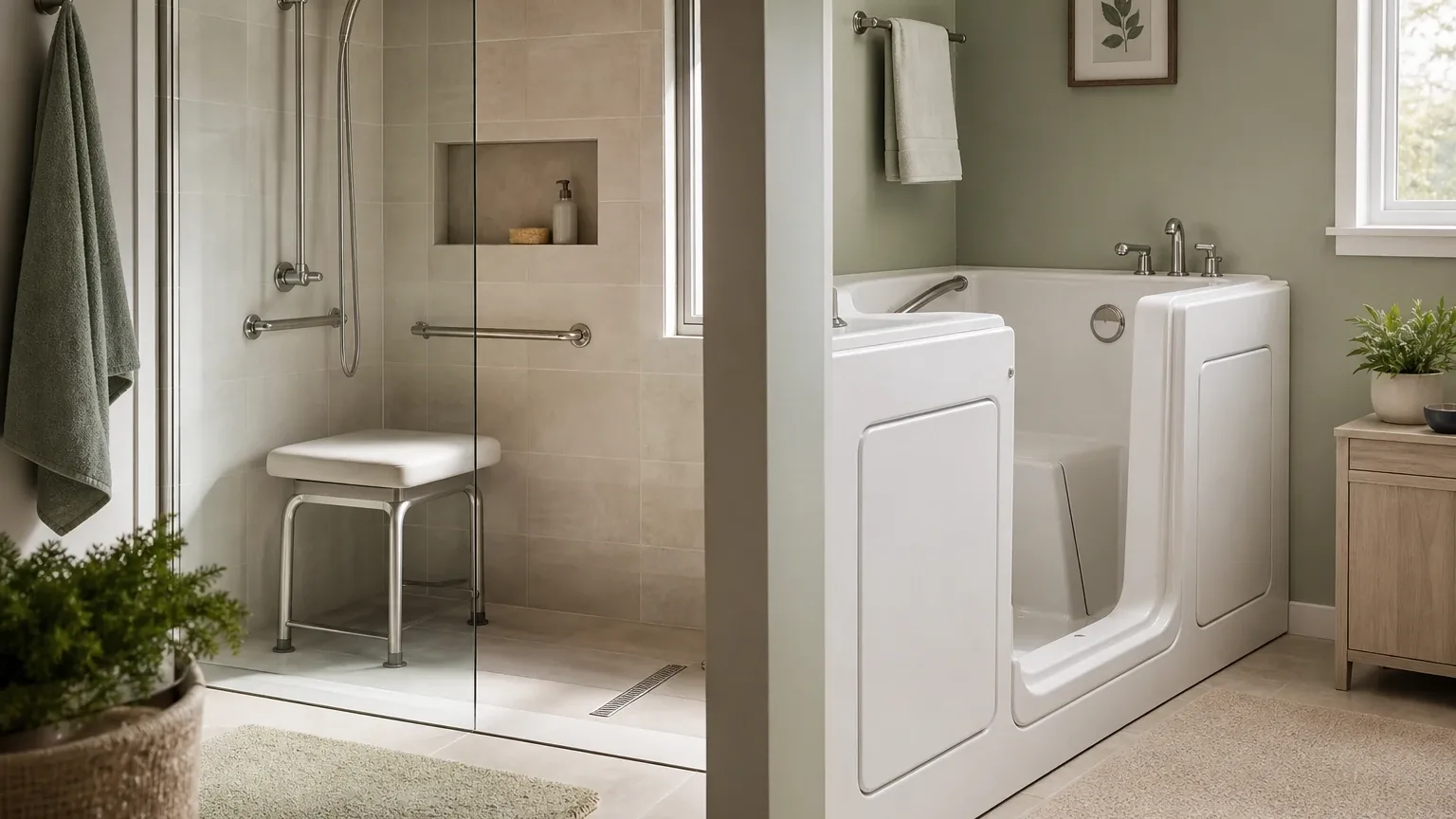
Answer Capsule
For most adults buying a safer bathing option for themselves or an older adult at home, a walk-in shower is the better default. All seven AI platforms studied ranked the walk-in shower first and the walk-in bathtub second, and the strongest shared reasons were step-free or low-threshold entry, room for a shower chair, bench, walker or wheelchair, faster daily use, and broader resale appeal. The walk-in bathtub keeps a real buyer: someone who strongly prefers soaking, wants seated hydrotherapy for joint pain, can still step over a low sill and transfer to a built-in seat, and does not need a mobility aid inside the fixture. The decision turns on bathing preference, transfer ability, assistance needs, bathroom space and resale. Seven platforms were studied. The principal limitation is that this guide reports what those platforms stated; it did not install, test or measure any fixture, and the cost figures are reported or published estimates, not verified quotes.
Research Snapshot
- Topic: Walk-In Tub vs. Walk-In Shower for Seniors (2026), a safer bathing retrofit.
- Target buyer: Adults buying a safer bathing option for themselves or an older adult at home, in the United States.
- The two approaches compared: Walk-in shower (rank 1) and walk-in bathtub (rank 2).
- Platforms included: openai, anthropic, deepseek, grok, perplexity, kimi and google — seven platforms in this run.
- Research date: 2026-11-09.
- What the platforms were asked to decide: which of the two approaches better serves a safer bathing retrofit for an older adult, weighing installed cost, ease of entry, assistance needs, bathing preference, bathroom space and resale impact.
- Ranking authority: the final ranking table. Both approaches were named by all seven platforms (100% platform share); the walk-in shower holds an average rank of 1.0 and the walk-in bathtub an average rank of 2.0.
The Two Options Compared
Questions This Section Answers
- Should a buyer install a walk-in shower or a walk-in bathtub for a senior who may need a walker later?
- Is a walk-in bathtub or a walk-in shower better for a senior who wants hydrotherapy for arthritis pain?
- What should a buyer check about their bathroom before choosing a walk-in shower for a safer bathing retrofit?
The walk-in shower wins on entry, assistance and adaptability; the walk-in bathtub wins on soaking and, in some bathrooms, on fitting an existing tub alcove. The table below records where the supplied evidence separates them and where it does not.
| Decision dimension | Walk-in shower | Walk-in bathtub | Which the supplied evidence favours |
|---|---|---|---|
| Installed cost | Published ranges cluster roughly $3,000–$15,000+, with prefabricated conversions lower and custom curbless work higher | Published ranges cluster roughly $4,000–$20,000+, with hydrotherapy models above $20,000 | Walk-in shower, on most published ranges — but the ranges overlap and several platforms call the difference quote-only |
| Ease of entry | Zero or low threshold; roll-in possible in a curbless design | Low door sill, typically described as 3–7 inches, plus a built-in seat to transfer onto | Walk-in shower |
| Assistance needs | Open floor space for a caregiver, bench or shower chair; walkers and wheelchairs can enter a curbless design | Caregiver access is restricted by the tub walls; mobility aids stay outside the fixture | Walk-in shower |
| Bathing preference | Standing or seated showering; no soaking | Seated soaking, with optional jets, air massage and heated seating | Walk-in bathtub |
| Bathroom space | Generally fits standard footprints; a curbless build may need more floor area and floor re-grading | Can often replace a standard tub in the same alcove; still occupies substantial floor area | Does not separate them — it depends on the individual bathroom |
| Resale impact | Neutral to positive, especially when at least one tub remains in the home | Niche appeal; may reduce appeal, particularly in a single-bathroom home | Walk-in shower |
| Daily routine time | Immediate use, no fill or drain wait | User waits inside during a fill cycle and a drain cycle | Walk-in shower |
| Upkeep | Tile, grout and glass need regular cleaning | Door seals, jets, pumps and heaters add maintenance and repair complexity | Walk-in shower |
| Future flexibility as mobility declines | Adapts to seated, assisted and roll-in use without replacement | Limited once a walker or wheelchair is needed inside the fixture | Walk-in shower |
Which Buyer Should Choose Each Option
Questions This Section Answers
- Who should choose a walk-in shower rather than a walk-in bathtub for an older adult who uses a walker?
- Who is a walk-in bathtub actually the better choice for in a safer bathing retrofit?
- Does the choice between a walk-in tub and a walk-in shower change if the home has only one bathroom?
The buyer's own bathroom, mobility and bathing habit decide this more than either approach being superior. Each row below names a situation and the approach the supplied evidence supports for it.
| Buyer situation | Better fit | Why, from the supplied evidence |
|---|---|---|
| Senior uses, or is likely to use, a walker, rollator or wheelchair | Walk-in shower | A curbless shower lets mobility aids enter with the bather; a tub requires leaving the aid outside and transferring |
| Senior needs a caregiver in the bathing space | Walk-in shower | Open floor space supports assistance; tub walls restrict caregiver access |
| Senior strongly prefers soaking and finds it therapeutic | Walk-in bathtub | Only the tub provides seated immersion, with optional hydrotherapy jets |
| Senior has stable mobility, can step over a 3–7 inch sill and transfer to a seat unaided | Walk-in bathtub | The tub's low door and built-in seat suit a bather with adequate transfer ability |
| Home has only one bathroom and the buyer is thinking about resale | Walk-in shower | Removing the only tub may concern some buyers, but a well-designed accessible shower is described as attractive to aging-in-place buyers; a tub's niche look is the bigger resale risk |
| Home has multiple bathrooms, so resale impact is minimal | Either — walk-in bathtub becomes viable | With a tub retained elsewhere, the resale objection to a specialized tub largely falls away |
| Bathroom is a standard tub alcove and the buyer wants minimal layout change | Walk-in bathtub | The tub can often replace a standard tub in the same footprint |
| Buyer wants the fixture to keep working as mobility declines | Walk-in shower | It adapts to seated, assisted and roll-in use without replacement |
| Buyer wants the lowest published installed range | Walk-in shower | Most published shower ranges start lower than tub ranges, though the ranges overlap |
1. Walk-in shower
Questions This Section Answers
- Should a buyer install a walk-in shower rather than a walk-in bathtub for a senior who wants the safest everyday entry?
- Is a walk-in shower or a walk-in bathtub better for a safer bathing retrofit when resale value matters most?
- Why does a curbless walk-in shower cost more to install than a prefabricated shower conversion?
Verdict: The Walk-in shower is the approach all seven platforms ranked first, and the one they describe as the safer default for a household that values step-free entry, room for assistance and a fixture that keeps working as mobility changes. It gives up soaking, and a true curbless build can cost as much as a tub.
The Walk-in shower fit review carries the full platform-by-platform assessment behind this section.
Who should choose it. The platforms converge on a similar buyer. OpenAI recommends it for buyers who prioritize the easiest entry, reduced fall risk, use with a shower seat or caregiver assistance, and flexibility as mobility declines — particularly someone who prefers showering, uses a walker or wheelchair, needs help bathing, or wants a retrofit that serves multiple users. Anthropic frames the choice as turning primarily on mobility and resale impact, and advises choosing the shower unless the buyer has specific therapeutic needs and can safely transfer into a tub. DeepSeek calls it the better default because it stays useful as mobility declines and keeps the bathroom usable by other family members and future owners. Grok points to quick daily routines, ease of entry with mobility aids, lower installed cost and long-term accessibility. Perplexity emphasizes step-free access, lower assistance needs and broader market appeal over deep soaking. Kimi says it fits the broader set of aging-in-place scenarios because the level-entry design accommodates more progression paths of mobility decline without replacement. Google recommends it for most buyers seeking a safer bathing retrofit because of broad accessibility, resale value, standard footprint fit and quick entry and exit.
What it does well for this use case.
- Entry: a no-step or low-threshold entry removes the need to lift a leg over a tub wall; curbless designs allow roll-in access.
- Assistance: it can be configured with a seat, handheld shower, grab bars and clear space for a caregiver. AARP, as cited by OpenAI, identifies doorless roll-in showers, flat thresholds, hand showers, seats and grab bars as useful aging-in-place features.
- Speed: bathing is faster because the user does not wait for an enclosure to fill or drain.
- Adaptability: it works for seated and standing bathers, so it adapts as mobility changes, and it generally preserves more usable floor space than a walk-in tub.
- Resale: described as neutral to positive, especially when at least one tub remains elsewhere in the home.
What it costs the buyer.
- Money: a properly accessible installation may require substantial waterproofing, drainage work, wall reinforcement, demolition and finish work. Anthropic puts curbless floor re-grading and complex drainage at an extra $1,500–$3,000 in labor.
- Space and disruption: a curbless or larger shower may need more floor area than a simple tub replacement. Anthropic describes 3–5 days of disruption for curbless designs versus 1–2 days for prefabricated kits; Grok describes 1–4 weeks as typical.
- Loss of soaking: it does not provide a seated soaking bath, so it is a poor fit for someone who strongly prefers bathing or seeks hydrotherapy.
- Design dependence: a poorly placed threshold, slippery surface, absent seat or inadequate grab-bar reinforcement can undermine safety. Slip risk on wet floors remains if the base is not textured and grab bars are not installed.
- Resale caveat: removing the home's only bathtub may reduce appeal to some future buyers, including families with young children.
Where platforms disagreed about it. The platforms disagreed on cost. Anthropic states showers are lower by $3,000–$8,000 on average and gives $3,000–$12,000 installed versus $5,000–$20,000 for tubs. Grok and Perplexity describe showers as several thousand dollars lower. Google gives $4,000–$15,000+ installed. Kimi and DeepSeek break ranks on the certainty of any saving: Kimi says the ranges overlap substantially and neither is consistently cheaper, and DeepSeek calls the installed comparison quote-only because published national averages are not reliably available. OpenAI goes further and notes that HomeBuddy's 2026 reported median of about $15,900 for walk-in shower projects sits above HomeAdvisor's reported $13,100 average for walk-in tubs — meaning the published averages can point the other way. The platforms also differed on disruption time, from 1–2 days for a prefab kit to 1–4 weeks.
2. Walk-in bathtub
Questions This Section Answers
- Should a buyer install a walk-in bathtub instead of a walk-in shower for a senior with arthritis who wants seated soaking?
- Is a walk-in bathtub or a walk-in shower better for a safer bathing retrofit when the bather cannot stand for long?
- What does a walk-in bathtub cost the buyer in fill-and-drain time and daily upkeep compared with a walk-in shower?
Verdict: The Walk-in bathtub is the right answer for a narrower buyer: someone who genuinely prefers soaking, wants seated hydrotherapy, can still manage a low sill and a seat transfer, and does not need a mobility aid inside the fixture. It is the only one of the two that delivers immersion, and it can often drop into an existing tub alcove.
The Walk-in bathtub fit review carries the full platform-by-platform assessment behind this section.
Who should choose it. OpenAI recommends it for a buyer who strongly prefers soaking, can transfer onto the tub seat with limited assistance, and expects to stay in the home long enough to benefit — and notes it can be the better choice when the bathroom already has a standard tub alcove. Anthropic sets out the conditions plainly: the buyer values deep soaking for arthritis or joint pain, can safely step over a 3–7 inch threshold and transfer to a built-in seat, has multiple bathrooms so resale impact is minimal, and can fund the higher cost — and must not need a walker or wheelchair inside the fixture. DeepSeek frames it as the right choice for someone who strongly prefers soaking, has or will have help getting in and out and filling and draining, and whose bathroom cannot accommodate a curbless conversion. Grok points to chronic arthritis, muscle pain or doctor-recommended hydrotherapy combined with a safe small-step threshold and a preference for seated soaking. Perplexity emphasizes a seated, enclosed bath used frequently. Kimi specifies stable mobility unlikely to progress to walker or wheelchair dependence. Google ties it to severe chronic joint pain, arthritis or circulatory issues requiring deep-soak hydrotherapy, with the mobility to step over a low threshold and sit unassisted.
What it does well for this use case.
- Therapy: optional jets, air massage and heated seating for pain relief, which a shower cannot replicate.
- Seated bathing: a built-in seat and low door sill let the bather sit rather than climb over a conventional tub wall, providing stability during fill and drain.
- Footprint: it can often replace a standard tub in the same alcove without reconfiguring the room.
- Warmth: the enclosed water retains warmth around the body.
- Durability: Anthropic describes acrylic construction as lasting 15–30 years with proper maintenance.
What it costs the buyer.
- Money: Anthropic gives $5,000–$20,000 installed on average, with luxury models above $20,000, and equipment at $2,000–$15,000 plus $2,500–$8,000 in labor. Google gives $3,000 for basic acrylic units up to $20,000+ for hydrotherapy models requiring electrical and water-heater upgrades.
- Time inside the fixture: the bather must enter and close the watertight door before filling, then wait for the water to drain before opening it. Anthropic describes a 6–15 minute fill and a 2–3 minute drain; Grok describes 10–15 minutes of use time from fill and drain. This creates cold, waiting-related and supervision concerns.
- Transfer demand: the sill and seat transfer may still require strength, balance or caregiver assistance, and the tub is not wheelchair-accessible.
- Household systems: Anthropic notes a larger water heater may be needed (40–80 gallons versus 25–45 for a standard tub); Google notes high-capacity water heaters, dedicated electrical circuits and heavy-duty plumbing.
- Upkeep: jets, pumps, heaters, door seals and specialized hardware increase purchase price, upkeep and repair complexity, with potential for leaks if seals fail.
- Resale and flexibility: the specialized form may offer less flexibility for future buyers, and it does not serve standing shower users.
Where platforms disagreed about it. The platforms disagreed on how much the tub costs relative to a shower. Anthropic states the tub runs $3,000–$8,000 higher than a shower. Grok and Perplexity say several thousand dollars more. Google and Kimi present overlapping ranges and stop short of a consistent premium — Kimi says neither category guarantees savings. DeepSeek calls the difference quote-only. OpenAI inverts the comparison against one published benchmark: HomeAdvisor's reported $13,100 average for walk-in tubs is about $2,800 below HomeBuddy's reported $15,900 median for walk-in shower projects, while stressing that this is not a like-for-like premium. The platforms also differed on threshold height, described variously as 3–7 inches (Anthropic, Grok) and 3–6 inches (Google).
What the Cost Difference Looks Like
Questions This Section Answers
- Is a walk-in shower or a walk-in bathtub cheaper all-in for a safer bathing retrofit?
- Why can a custom curbless walk-in shower cost as much as a walk-in bathtub?
- What walk-in tub and walk-in shower cost figures are published rather than quote-only?
No single all-in difference is verifiable from the supplied evidence. The published ranges overlap, and the platforms split on whether a dependable gap exists at all. Every figure below is marked by how the platforms presented it.
| Figure | Approach | Amount | Status |
|---|---|---|---|
| HomeAdvisor walk-in tub installed cost, as cited by OpenAI | Walk-in bathtub | About $4,000–$22,100, averaging $13,100 | Published |
| HomeBuddy 2026 walk-in shower project median, as cited by OpenAI | Walk-in shower | About $15,900, most between $13,500 and $18,800 | Reported |
| Installed range | Walk-in shower | $3,000–$12,000 | Reported (Anthropic) |
| Installed range | Walk-in bathtub | $5,000–$20,000, luxury above $20,000 | Reported (Anthropic) |
| Stated gap | Walk-in shower vs. tub | $3,000–$8,000 lower for showers | Reported (Anthropic) |
| Installed range | Walk-in shower | $3,000–$15,000+ | Published (Grok, Perplexity) |
| Installed range | Walk-in bathtub | $5,000–$20,000+ | Published (Grok, Perplexity) |
| Installed range | Walk-in shower | $4,000–$15,000+ | Reported (Google) |
| Installed range | Walk-in bathtub | $5,000–$20,000+ | Reported (Google) |
| Installed range | Walk-in shower | $6,000–$12,000 | Published (Kimi) |
| Installed range | Walk-in bathtub | $4,000–$15,000, with NCOA citing $3,000–$17,000+ | Published (Kimi) |
| Prefabricated tub-to-shower conversion kit | Walk-in shower | $2,000–$5,000 installed | Reported (Anthropic) |
| Custom tiled or curbless shower | Walk-in shower | $6,000–$12,000 to $8,000–$17,000 | Reported (Anthropic) |
| Curbless floor re-grading and drainage adder | Walk-in shower | $1,500–$3,000 in labor | Reported (Anthropic) |
| Tub equipment and labor split | Walk-in bathtub | $2,000–$15,000 equipment; $2,500–$8,000 labor | Reported (Anthropic) |
| All-in installed comparison | Both | Quote-only; no reliable national averages | Quote-only (DeepSeek) |
Where no figure is verifiable: DeepSeek states plainly that published national averages are not reliably available for the installed comparison and that the difference should be treated as quote-only. OpenAI warns that the published averages are not a fixed or like-for-like premium, because a basic shower can be cheaper and a custom accessible shower can be more expensive. Kimi notes the ranges overlap substantially and that cost depends more on specific features and structural requirements than on category. No platform supplied a verified, like-for-like quote for the same bathroom under both approaches.
Where the AI Platforms Agreed
All seven platforms ranked the walk-in shower first and the walk-in bathtub second, and they agreed on several substantive points.
- Entry safety favours the shower. Every platform described the shower's low or zero threshold as easier to negotiate than a tub wall or door sill, and several noted that a curbless design permits roll-in access.
- Mobility aids favour the shower. OpenAI, Anthropic, DeepSeek, Grok, Perplexity, Kimi and Google all noted that walkers and wheelchairs can accompany the bather into a curbless shower, while a tub requires the aid to stay outside.
- Caregiver assistance favours the shower. Multiple platforms cited open floor space and bench placement as supporting assistance; the tub's walls were described as restricting it.
- Soaking favours the tub. Every platform credited the walk-in bathtub with seated soaking and, where equipped, hydrotherapy that a shower cannot provide.
- The tub imposes a fill-and-drain wait. OpenAI, Anthropic, DeepSeek, Grok, Perplexity, Kimi and Google all raised the wait inside the tub during fill and drain, and several raised chilling.
- The tub carries more upkeep. Door seals, jets, pumps and heaters were repeatedly named as maintenance and repair liabilities.
- Resale generally favours the shower. The shower was described as neutral to positive; the tub was described as niche, with the single-bathroom case called out as the main risk for both.
- The decision turns on the bather, not the category. Every platform framed the choice around bathing preference, transfer ability and assistance needs rather than declaring one approach universally correct.
Where the AI Platforms Disagreed
The disagreements are narrower than the agreements but matter for budgeting and for buyers near the mobility margin.
- Whether showers are reliably cheaper. Anthropic, Grok and Perplexity state a shower saving of roughly $3,000–$8,000. Kimi says neither category is consistently cheaper. DeepSeek calls the comparison quote-only. OpenAI notes that HomeBuddy's reported shower median exceeds HomeAdvisor's reported tub average, so the published averages can favour the tub.
- How long installation takes. Anthropic describes 3–5 days for curbless and 1–2 days for prefabricated kits; Grok describes 1–4 weeks as typical. The supplied evidence does not settle this.
- How high the tub sill is. Anthropic and Grok describe a 3–7 inch threshold; Google describes 3–6 inches. The supplied evidence does not settle a single figure.
- How much bathroom space each needs. Perplexity says the tub usually uses more space and can be a poor fit for small bathrooms; OpenAI says the tub can occupy substantial floor area even in a standard alcove; DeepSeek and Google say the shower generally fits standard footprints more easily. Kimi and Perplexity both note a curbless shower may need more floor area than a simple tub replacement. The evidence does not separate them cleanly on space.
- How strong the resale penalty is. Most platforms treat the shower as neutral to positive and the tub as niche. Anthropic and Kimi qualify the shower's advantage: removing the only tub can concern buyers with young children, and the shower's benefit is strongest when another tub remains.
- Whether hydrotherapy is a medical need or a preference. Google and Grok frame deep soaking around chronic pain and doctor-recommended hydrotherapy; Perplexity and DeepSeek frame it as a preference that must be genuine to justify the tub.
How to Decide
Questions This Section Answers
- What should a buyer check about their own mobility before choosing a walk-in shower or a walk-in bathtub?
- Does a walk-in tub or a walk-in shower make more sense if the home has only one bathroom?
- How should a buyer weigh bathing preference against future mobility decline when choosing between a walk-in tub and a walk-in shower?
Answer these in order; the first two usually settle it.
- Will a mobility aid need to go into the bathing space — now or later? If a walker, rollator or wheelchair is in use or likely, the shower is the fit. A tub requires the aid to stay outside and the bather to transfer.
- Is soaking a genuine preference or a therapeutic need? If the bather strongly prefers baths or has a clinician-linked hydrotherapy need and can transfer safely, the tub earns its place. If showering is the habit, the tub's advantages do not apply.
- Can the bather step over a low sill and transfer to a seat unaided or with minor help? The tub's sill is described as roughly 3–7 inches. If that transfer is doubtful, the shower is safer.
- Will a caregiver need to be in the space? If so, the shower's open floor supports it; the tub's walls restrict it.
- How many bathrooms does the home have? With a tub retained elsewhere, the tub's resale objection largely disappears. In a single-bathroom home, removing the only tub is the risk to weigh.
- What does the bathroom physically allow? A standard tub alcove suits a tub replacement. A curbless shower may need floor re-grading, drainage work and more floor area — and that work drives cost and disruption.
- What is the budget, and is it quote-based? Treat every figure in this guide as an estimate. Get an on-site quote for the specific bathroom under each approach before committing.
- How long will the buyer stay in the home? OpenAI ties the tub's value to staying long enough to benefit from the specialized setup; a shorter horizon favours the more broadly appealing shower.
Methodology
This guide reports what seven AI platforms — openai, anthropic, deepseek, grok, perplexity, kimi and google — stated when asked to compare a walk-in shower and a walk-in bathtub for a safer bathing retrofit for an older adult in the United States. The research date is 2026-11-09. The two approaches were fixed in advance as the decision options; the platforms were asked which better serves the target buyer across installed cost, ease of entry, assistance needs, bathing preference, bathroom space and resale impact.
The ranking order is taken from the final ranking table, which is the sole authority for rank, platform mentions, platform share, average rank and best rank. Both approaches were named by all seven platforms. The walk-in shower holds rank 1 with an average rank of 1.0; the walk-in bathtub holds rank 2 with an average rank of 2.0. Platform mentions count ranking-discovery mentions only and are not a count of platforms that later completed a fit assessment.
Each approach's section consolidates the platform answers supplied for it. Where a platform cited a third-party source — HomeAdvisor, HomeBuddy, AARP, NCOA or manufacturer guidance — that source is named in the text and listed in Consolidated Sources. Cost figures are labelled published, reported or quote-only according to how the platforms presented them. No figure was independently verified, and no bathroom was inspected, measured or quoted for this guide.
Methodology Limitations
- No testing or measurement. This guide reports platform statements. No fixture was installed, tested, measured or inspected, and no site visit was made.
- No verified quotes. Every cost figure is a published or reported estimate or a quote-only statement. No like-for-like quote for the same bathroom under both approaches was obtained.
- Overlapping and conflicting ranges. The published ranges overlap substantially, and the platforms disagree on whether a dependable cost gap exists. The cost section records the conflict rather than resolving it.
- Unsettled dimensions. Installation duration, tub sill height and space requirements are not settled by the supplied evidence.
- Source validation. The source URLs were collected from platform responses and were not independently validated by the writer. Some are company-owned, some independent; ownership is grouped in Consolidated Sources where the catalog identifies it.
- No company recommendation. This guide compares two approaches, not companies. No brand is recommended. Brands appear only where the supplied evidence carries their specifications or guidance.
- Geography and date. Findings are scoped to the United States and to the 2026 research date; prices and guidance may change.
Final Verdict
The walk-in shower is the better default for most buyers making a safer bathing retrofit, and all seven platforms ranked it first. It wins on entry, assistance, adaptability, daily speed, upkeep and resale, and it keeps working as mobility declines. The walk-in bathtub is not the wrong choice — it is the right choice for a specific buyer who strongly prefers soaking or needs seated hydrotherapy, can still manage a low sill and a seat transfer, does not need a mobility aid inside the fixture, and can absorb the higher published cost and the fill-and-drain wait. The decision turns on the bather's transfer ability, assistance needs, bathing preference, bathroom layout and resale horizon. Because the cost evidence conflicts and no figure is verified, the final step for either approach is an on-site quote for the actual bathroom.
Frequently Asked Questions
Is a walk-in shower or a walk-in bathtub better for seniors?
For most buyers, the walk-in shower. All seven platforms ranked it first, citing step-free entry, room for a shower chair or caregiver, adaptability as mobility declines and broader resale appeal. The walk-in bathtub is better for a bather who strongly prefers soaking or needs seated hydrotherapy and can transfer safely.
Is a walk-in shower cheaper than a walk-in bathtub?
Usually, on most published ranges, but not reliably. Anthropic, Grok and Perplexity state a shower saving of roughly $3,000–$8,000. Kimi says neither is consistently cheaper, DeepSeek calls the comparison quote-only, and OpenAI notes that one reported shower median ($15,900) exceeds one reported tub average ($13,100).
Can a wheelchair user use a walk-in bathtub?
Not by entering with the chair. The platforms describe the tub as requiring a transfer over a low sill onto a built-in seat, with the wheelchair staying outside. A curbless walk-in shower permits roll-in access.
How long does a walk-in bathtub take to fill and drain?
Anthropic describes a 6–15 minute fill and a 2–3 minute drain, during which the bather waits inside. Grok describes 10–15 minutes of use time from fill and drain. Kimi warns that fill time depends on the home's water pressure and heater capacity.
Does replacing a tub with a walk-in shower hurt resale value?
Generally the platforms describe the shower as neutral to positive, especially when at least one tub remains in the home. Removing the only tub may concern some buyers, including families with young children.
Do I need a bigger water heater for a walk-in bathtub?
Anthropic notes a larger water heater may be needed — 40–80 gallons versus 25–45 for a standard tub — and Google notes high-capacity water heaters, dedicated electrical circuits and heavy-duty plumbing for hydrotherapy models.
How long does installation take?
The evidence does not settle this. Anthropic describes 3–5 days for curbless showers and 1–2 days for prefabricated kits; Grok describes 1–4 weeks as typical.
Consolidated Sources
Sources are grouped by ownership where the supplied catalog identifies it. URLs are reproduced verbatim. Where ownership is not identified in the catalog, the source is listed under Independent and third-party.
Company-owned sources
- Walk-In Tub Owner's Manual — https://walkintubusa.com/pdf/products/TubToday_standard_manual.pdf
- Walk-In Tub Safety Instructions — https://www.americanbathgroup.com/wp-content/uploads/2020/08/16.pdf
- Choosing Between a Walk-In Shower or Walk-In Tub for Your Upstate New York Bath Remodel — https://www.comfortshowersandbaths.com/blog/p.261015000/choosing-between-a-walk-in-shower-or-walk-in-tub-for-your-upstate-new-york-bath/
- Walk-In Shower vs. Bathtub: Which Is Right for Your Fairfax County Bathroom? — https://www.kdcfairfax.com/blog/walk-in-shower-vs-bathtub
- Walk-In Baths vs. Walk-In Showers for Aging in Place — https://www.kohlerwalkintub.com/blog/walk-in-bath-vs-walk-in-shower/
- 2026 Industry Pricing: Walk-In Tub Cost - Reveal by KOHLER — https://www.kohlerwalkintub.com/blog/walk-in-tub-cost/
Independent and third-party sources
- Walk-In Tub vs Walk-In Shower: Which Is Better? — https://accessiblebathadvisor.com/walk-in-tub-vs-walk-in-shower/
- Walk-In Shower vs Walk-In Tub: Which Is Better for Seniors? — https://agingathomeliving.com/bathroom-safety/walk-in-shower-vs-walk-in-tub/
- Best Walk-In Showers for Seniors in 2026 — https://homesimprover.com/bathroom-safety/best-walk-in-showers-seniors/
- Best Walk-In Showers for Seniors: Modern, Safe Solutions — https://horow.com/blogs/guide/best-walk-in-showers-for-seniors-modern-safe-solutions-to-age-in-place
- Walk-In Tub vs. Walk-In Shower: Which Is Better for Seniors? — https://seniorgearhub.com/walk-in-tub-vs-walk-in-shower-seniors/
- Are Walk-In Tubs Worth It? Pros, Cons & Who Should Buy — https://unitedrenewals.com/advice/are-walk-in-tubs-worth-it/
- Does a Walk-In Tub Increase Home Value? (The Honest Answer) — https://unitedrenewals.com/advice/does-a-walk-in-tub-increase-home-value/
- Senior Bathroom Renovation Cost Guide - 101 Mobility — https://www.101mobility.com/blog/senior-bathroom-renovation-cost/
- 14 Bathroom Updates to Make As You Age in Place — https://www.aarp.org/home-living/bathroom-upgrades-as-you-age.html
- Smart Guide to Aging in Place — https://www.aarp.org/home-living/smart-guide-aging-in-place/
- Walk-In Tubs vs. Walk-In Showers: Which Is Better? — https://www.aginginplace.org/walk-in-tubs-vs-walk-in-showers/
- Accessible Bathtubs for Seniors: 5 Options From $40 to $20,000 (2026) — https://www.agingsafelybaths.com/accessible-bathtubs-for-seniors/
- Walk-In Tub vs. Walk-In Shower for Seniors: How to Choose — https://www.blockrenovation.com/guides/walk-in-tub-vs.-walk-in-shower-for-seniors
- Walk-In Showers vs. Walk-In Tubs (2026) - Consumer Affairs — https://www.consumeraffairs.com/homeowners/walk-in-shower-vs-walk-in-tub.html
- Aging-in-Place Renovation Costs in 2026 — https://www.costtorenovate.com/blog/aging-in-place-renovation-cost-2026/
- Walk-In Tub vs. Walk-In Shower for Seniors - ElderLife Financial — https://www.elderlifefinancial.com/walk-in-tub-vs-walk-in-shower/
- Walk-In Tub Costs and Installation — https://www.homeadvisor.com/cost/plumbing/install-a-walk-in-tub/
- How Much Does It Cost to Install a Walk-In Bathtub? [2025 Data] — https://www.homeadvisor.com/cost/plumbing/walk-in-tubs
- Walk-In Shower Cost Index 2026 — https://www.homebuddy.com/costs/research/walk-in-shower-cost-index
- Will Removing My Tub Affect Resale Value? — https://www.improveitusa.com/blog/will-removing-my-tub-affect-resale-value/
- Understanding the Cost of Walk In Tubs — https://www.ncoa.org/article/how-much-do-walk-in-tubs-cost/
- The Best Walk-In Tub Shower Combinations of 2026 — https://www.ncoa.org/product-resources/mobility/best-walk-in-tub-shower-combinations/
- Bathroom Safety for Older Adults (aging in place guidance) — https://www.nia.nih.gov/health/safety
- Cost of a Walk-In Shower Installation (2026) — https://www.retirementliving.com/best-walk-in-showers/cost-of-walk-in-shower-installation
- How Much Does a Walk-In Shower Cost? (2026) — https://www.retirementliving.com/best-walk-in-showers/walk-in-shower-cost
- Does a Walk-In Tub Add Value to Your Home? (2026) — https://www.retirementliving.com/best-walk-in-tubs/does-a-walk-in-tub-add-value-to-your-home
- How Much Does A Walk-In Tub Cost? (2026) — https://www.retirementliving.com/best-walk-in-tubs/how-much-does-a-walk-in-tub-cost
- The Complete 2026 Guide to Walk in Bathtubs for Seniors — https://www.seniorliving.org/walk-in-tubs/
- Best Walk In Tubs for Seniors (October 2026) — https://www.thisoldhouse.com/bathrooms/walk-in-tubs-for-seniors
For the full set of walk-in bathing options beyond these two approaches, see the walk in tubs category directory.
Verify This Research
Review the study details behind this page or download the public machine-readable verification record.
- Study date
- November 9, 2026
- Platforms analyzed
- 7
- Source records
- 35
- Candidates reviewed
- 2
- Qualified finalists
- 2
Research trail and source mix
Configured platforms
openai, anthropic, deepseek, grok, perplexity, kimi, google
Source mix
0 independent · 0 company-owned · 35 unclear
Evidence support
0 direct · 0 partial
Important limitation
Exactly 7 platforms were included in this run: openai, anthropic, deepseek, grok, perplexity, kimi, google. The configured source value 7 is provenance only and must never be described as the number of platforms studied.
Source snapshot SHA-256 85126d06fe5fb9a4290175cdd8275e014f22144ea7c8ab11c6f2d2925bb9ba32