
Answer Capsule
Medical Care Alert is a good but not clearly strongest fit for Budget-Friendly Emergency Response. Two of seven AI platforms named it during the ranking stage (29% platform share), with an average listed rank of 8.0 and a best rank of 7. The strongest reason to consider it is the combination of no long-term contract, no upfront equipment purchase for the HOME system, and optional AutoFALL fall detection at a $10/month add-on. The main limitation is pricing uncertainty: the current official homepage lists the base in-home system at $29.95/month, not the $19.95/month figure cited in ranking-stage materials, and HOME with AutoFALL runs $39.95/month. Independent verification of response times and fall-detection accuracy is limited, and the system is designed primarily for in-home use.
Research Snapshot
| Metric | Value |
|---|---|
| Platform mentions in ranking stage | 2 of 7 platforms (anthropic, deepseek) |
| Share of included platform responses | 29% |
| Average listed rank | 8.0 |
| Best listed rank | 7 |
| Relevant product/model/plan | Medical Care Alert HOME System (In-Home Basic) with optional AutoFALL |
| Overall use-case fit | Good (2 platforms), Strong (2), Mixed (2), Uncertain (1) |
| Research date | 2026-08-06 |
Why Medical Care Alert Qualified for This Study
Medical Care Alert qualified for this Budget-Friendly Emergency Response evaluation because it met the category criteria of low monthly monitoring fees, no long-term contracts, optional fall detection, and cancellation flexibility. Two of seven AI platforms (anthropic and deepseek) named the company during the ranking stage, giving it a 29% platform share. The company's In-Home Basic plan and HOME System with AutoFALL were the products most frequently cited as relevant to the use case.
The platform fit ratings were split: anthropic rated it "good," deepseek "strong," google "strong," grok "mixed," kimi "mixed," openai "good," and perplexity "uncertain." No platform rated it as a poor fit, but none rated it as the clear best option for this use case.
The Product, Model, Plan, or Service Most Relevant to Budget-Friendly Emergency Response
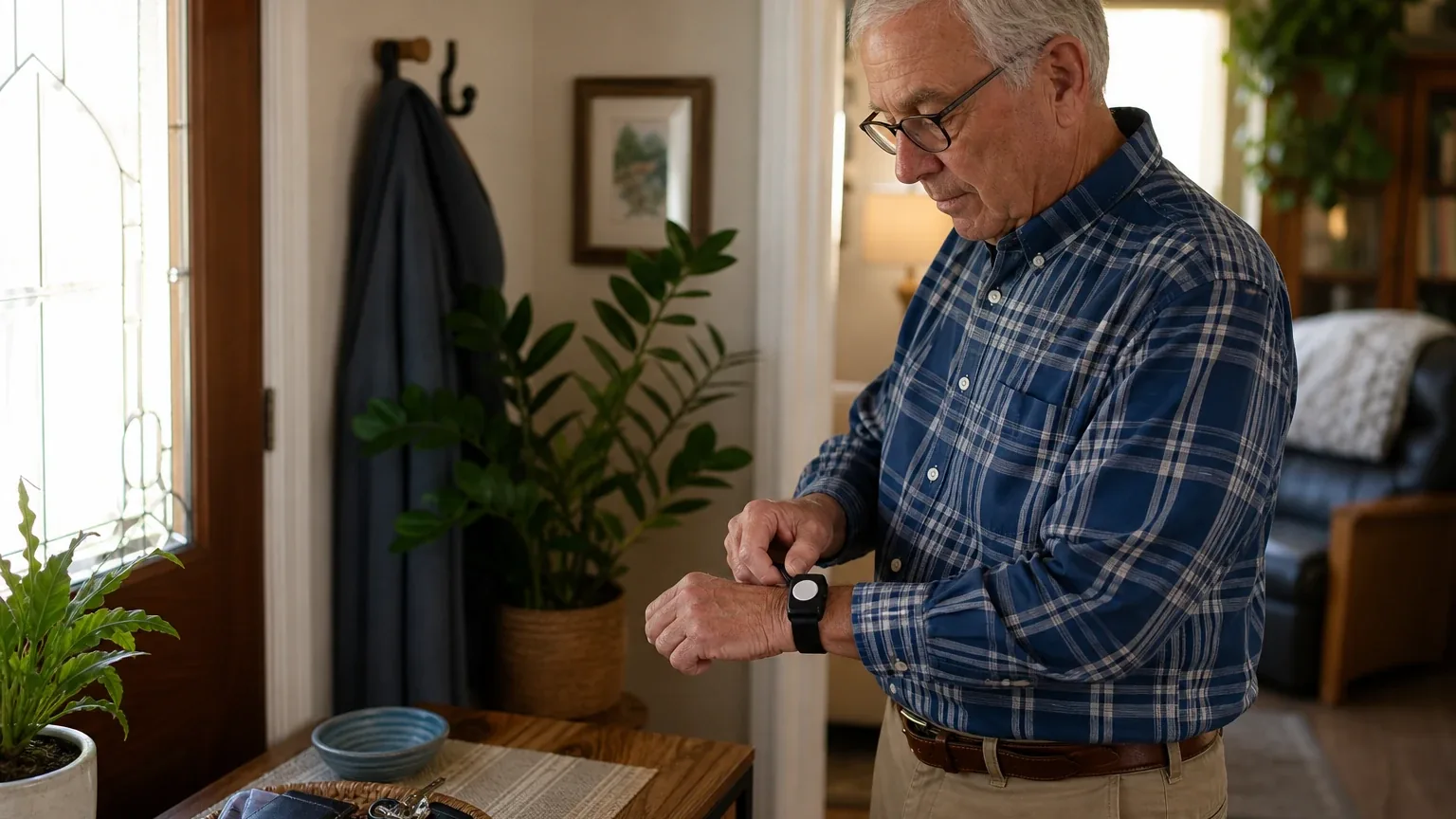
The most relevant product is the Medical Care Alert HOME System (also called In-Home Basic), a landline or cellular in-home medical alert system with a wearable pendant. The optional AutoFALL pendant adds automatic fall detection for $10/month. Current official pages list the base in-home system at $29.95/month and HOME with AutoFALL at $39.95/month [1].
The HOME system includes a base station and waterproof pendant that never requires charging [10]. The pendant has a stated range of approximately 400 feet from the base station on one company page [4] and up to 600 feet on another [7]; an independent review cites up to 1,000 feet [10]. Monitoring is provided 24/7 through American Response Technologies with two redundant call centers in New York and California [14].
What the AI Platforms Agreed About
No long-term contract and cancellation flexibility (unanimous among platforms that provided pricing data). All platforms that supplied pricing information confirmed Medical Care Alert offers no long-term contracts, month-to-month billing, and cancellation at any time without early termination fees [2]. The company states there are no setup, activation, deposit, or cancellation fees, and prepaid unused service is prorated after equipment return [2].
No upfront equipment purchase for the HOME system (strong agreement). The company states equipment is included with the subscription rather than purchased separately [2]. Independent reviews from Forbes and NCOA confirm no upfront device purchase is required for the HOME system [9]. Equipment must be returned upon cancellation [9].
AutoFALL costs $10/month (strong agreement). Multiple platforms confirmed the fall-detection add-on costs $10/month [4]. This falls within the industry standard range of $5–$12/month [11].
Professional 24/7 monitoring with EMT/EMD-certified operators (strong agreement). The company employs EMT/EMD-certified operators at US-based monitoring centers [10]. Forbes testing confirmed the response team was "attentive and responsive" [9]. NCOA reports an average response time of 17 seconds [10].
14-day trial period (strong agreement). Medical Care Alert offers a 14-day risk-free trial with full refunds for undamaged products returned within that window [9]. Deepseek reported a 30-day money-back guarantee, creating a factual conflict [18].
Waterproof pendant (agreement). The buttons are waterproof and safe for shower use, confirmed by Forbes testing [10].
Where the AI Platforms Disagreed or Were Uncertain
Base monthly price: $19.95 vs. $29.95. This is the most significant conflict. The ranking-stage description and several platforms (deepseek, kimi, google) reported In-Home Basic at approximately $19.95/month [17]. However, the current official homepage lists the in-home system at $29.95/month [1], and independent reviews from NCOA and Forbes confirm $29.95/month [10]. The openai platform explicitly noted the $19.95 figure was not confirmed on current official pages reviewed.
Equipment fee: included vs. ~$99.95 one-time. Most platforms reported no equipment purchase required for the HOME system [2]. Deepseek, however, reported a one-time equipment fee of approximately $99.95 [17]. The company's official FAQ states "nothing to buy" and that the button cost is included [2].
Fall-detection accuracy. Forbes testing found the fall-detection pendant detected falls on the back but missed side falls [9]. The company acknowledges no system detects 100% of falls [4]. This limitation was noted by anthropic and openai but not emphasized by other platforms.
In-home range: 400, 600, or 1,000 feet. Company pages list 400 feet [4] and 600 feet [7] for the AutoFALL pendant; NCOA reports up to 1,000 feet from the base station [10]. Forbes noted the range is limited for large homes [9].
Trial period: 14 days vs. 30 days. Most platforms reported a 14-day trial [9]. Deepseek reported a 30-day money-back guarantee [18].
Response-time verification. NCOA reports a 17-second average response time [10], but openai noted no independently audited response-time statistics were located [8]. Deepseek described the "under 20 seconds" claim as company-reported without independent verification [15].
Use-Case-Specific Features and Capabilities
Monthly monitoring fee. The base in-home system is $29.95/month on the current official homepage [1], with one month free on annual billing. This positions Medical Care Alert at the mid-range of budget options; the industry range is $25–$60/month [13]. Some landline-only competitors start around $20/month [10].
Upfront equipment cost. No equipment purchase is required for the HOME system; equipment is leased and must be returned upon cancellation [2]. An older 2023 company form listed optional installation at $29.95, with self-installation free [3].
Fall-detection add-on. AutoFALL adds $10/month, bringing the total to $39.95/month for HOME with AutoFALL [4]. This is within the industry standard of $5–$12/month [11]. The company expressly states no system detects 100% of falls [4].
Cancellation flexibility. No long-term contracts, no cancellation fees, cancellation at any time, and prorated refunds for prepaid unused service after equipment return [2]. This is a strong advantage for seniors whose living arrangements may change.
Response reliability. Monitoring is provided through American Response Technologies with two fully redundant 24/7 call centers in New York and California [14]. NCOA reports a 17-second average response time [10]. Forbes testing confirmed attentive and responsive operators [9]. However, independently audited response-time data was not located [8].
In-home coverage. The HOME system is designed for use in and around the home. The AutoFALL pendant range is stated as approximately 400 feet [4] or up to 600 feet [7] on company pages; NCOA reports up to 1,000 feet [10]. Forbes noted this is insufficient for large homes or outdoor protection [9].
Device durability. Buttons are waterproof and safe for shower use, and never require charging [10].
Pricing, Fees, Contracts, and Ongoing Costs
| Cost Item | Amount | Source |
|---|---|---|
| Base in-home monitoring (current official) | $29.95/month | [1] |
| In-Home Basic (ranking-stage claim) | ~$19.95/month | [17] |
| HOME with AutoFALL | $39.95/month | [4] |
| AutoFALL add-on | $10/month | [4] |
| HOME Cellular (older 2023 form) | $34.95/month | [3] |
| HOME landline (older 2023 form) | $29.95/month | [3] |
| Optional installation (older 2023 form) | $29.95 | [3] |
| Equipment fee (disputed) | $0 or ~$99.95 | openai:C2 vs. deepseek:C1 |
| Smartwatch equipment fee | $149.99 one-time | [10] |
| Shipping | $11.95 (waived on annual/semi-annual plans per some reviews) | [1] |
| Annual billing | One month free | [1] |
Contract terms. No long-term commitment; month-to-month billing available; cancel anytime without early termination fees [2]. Prepaid unused service is prorated after equipment return [6]. Equipment must be returned upon cancellation [9].
Trial period. 14-day risk-free trial with full refund for undamaged returns [9]. Return shipping cost may be deducted from refund if a label is requested [9]. Deepseek reported 30 days, which conflicts with the 14-day figure [18].
Pricing confidence. Moderate to high across platforms, but the $19.95 vs. $29.95 conflict and the disputed equipment fee reduce overall confidence. The openai platform rated pricing confidence as "moderate" and noted the ranking-stage $19.95 figure was not verified on current official pages.
Best Suited For
Medical Care Alert is best suited for:
- Budget-conscious seniors who primarily stay at home and need reliable in-home emergency response without premium monthly costs (anthropic, openai, deepseek)
- Buyers who prioritize no long-term contract and the ability to cancel with a prorated refund after equipment return [2]
- Families seeking simple, button-based activation over complex technology (anthropic)
- Users who want optional automatic fall detection without purchasing equipment separately (openai)
- Seniors with reliable landline or cellular coverage (anthropic)
- Buyers who want professional 24/7 monitoring rather than a phone-only caregiver app (openai)
Probably Not Best Suited For
Medical Care Alert is probably not best suited for:
- Buyers whose strict budget is below approximately $30/month before fall detection (openai)
- Active seniors who need protection outside the home or nationwide GPS tracking (anthropic, openai, deepseek, kimi)
- Users with high fall risk who require highly accurate automatic fall detection — Forbes testing found side falls were missed [9]
- Buyers living in large homes where the 400–1,000 foot range is insufficient [9]
- Users whose home has poor AT&T/cellular or landline connectivity (anthropic, openai)
- Buyers seeking independently verified response-time data or independently tested fall-detection accuracy (openai, perplexity)
- Those needing advanced health tracking, medication reminders, or smart-home integrations (deepseek, google)
When Another Option May Be Better
Consider another provider when:
- The buyer needs the lowest verified monthly price with fall detection included. Some competitors bundle fall detection in the base price rather than charging a $10/month add-on (anthropic, kimi).
- Mobile or GPS protection is required. Medical Care Alert's mobile options (HOME & AWAY) cost more, and competitors like Medical Guardian or MobileHelp may offer better budget mobile plans (anthropic, deepseek, kimi).
- Independently published response-time or device-testing data is more important than price. The public materials reviewed do not provide independently audited response-time statistics [8].
- The buyer lives in a very large home or multi-story property. Systems with longer range (1,400+ feet) from competitors like Medical Guardian may be better (anthropic).
- Caregiver-focused technology platforms with app-based monitoring are preferred over a traditional professional monitoring center (openai).
- Price certainty is important. Given the unverified $19.95 vs. $29.95 pricing conflict, buyers who need confirmed pricing before purchase should verify directly or consider competitors with clearer published rates (perplexity, kimi).
Questions to Verify Before Buying
-
What is the exact monthly price for your address, connectivity type, and billing frequency? The current official homepage lists $29.95/month, but ranking-stage materials cite $19.95/month [1].
-
Is there an equipment fee? Most sources say no, but deepseek reported approximately $99.95 [17].
-
Does the $39.95/month HOME with AutoFALL price include all required equipment, cellular connectivity, shipping, and taxes? (openai)
-
Is installation free if self-installed, and is the $29.95 installation charge still applicable? An older 2023 form listed this fee [3].
-
What is the exact AutoFALL pendant range from the base station? Company pages list 400 feet and 600 feet; NCOA reports 1,000 feet [7].
-
What is the trial period — 14 days or 30 days? Most sources say 14 days; deepseek reported 30 days [9].
-
What happens if the pendant battery is depleted, the base station loses power, or cellular service is unavailable? (openai)
-
What is the required equipment-return process and deadline after cancellation? Are there restocking, replacement, shipping, or unreturned-equipment charges? (openai, anthropic)
-
What are the measured average and worst-case monitoring response times? NCOA reports 17 seconds, but this is not independently audited [10].
-
Which cellular network is used at your address, and can coverage be tested before purchase? The cellular option reportedly uses AT&T (anthropic).
-
Can you designate caregivers first and emergency services second, and are caregiver contacts included without an extra fee? (openai)
-
Does your state Medicaid program or Area Agency on Aging offer this system at a subsidized rate? (anthropic)
Final AI Consensus Verdict
Medical Care Alert is a good, but not clearly strongest, fit for Budget-Friendly Emergency Response. The AI platforms reached a mixed-to-positive consensus: two rated it "strong," two "good," two "mixed," and one "uncertain." No platform rated it as a poor fit.
The strongest case for Medical Care Alert is its combination of no long-term contract, no upfront equipment purchase for the HOME system, professional 24/7 monitoring with EMT/EMD-certified operators, and optional AutoFALL at a $10/month add-on. The 14-day trial and month-to-month cancellation flexibility reduce financial risk for budget-conscious seniors.
The main limitations are pricing uncertainty and verification gaps. The current official homepage lists the base system at $29.95/month, not the $19.95/month figure cited in ranking-stage materials. HOME with AutoFALL runs $39.95/month, which is no longer clearly "budget" when fall detection is included. Independent evidence for response reliability and fall-detection accuracy is limited, and Forbes testing found the fall-detection pendant missed side falls.
Buyers should verify current pricing, equipment fees, range, trial period, and response-time data directly with the company before purchasing. For seniors who primarily stay home, want no-contract flexibility, and can afford roughly $30–$40/month, Medical Care Alert is a reasonable choice. For those needing mobile protection, the lowest possible price, or independently verified reliability data, other providers may be better.
How This Review Was Produced
This review was produced by aggregating fit-research responses from seven AI platforms (anthropic, deepseek, google, grok, kimi, openai, perplexity) that evaluated Medical Care Alert against the Budget-Friendly Emergency Response use case. The research date is 2026-08-06. Platform responses included company-owned citations (10 of 19 total) and independent citations (9 of 19 total), drawn from sources including medicalcarealert.com, Forbes, NCOA, AssistedLiving.org, Trustpilot, and the Better Business Bureau.
The entity ranking statistics show Medical Care Alert was named by 2 of 7 platforms during the ranking stage, with an average listed rank of 8.0 and a best rank of 7. The fit ratings were aggregated from platform responses without modification.
Methodology Limitations
- Company-owned citations materially outnumber independent citations (10 owned vs. 9 independent). Company claims about pricing, cancellation terms, and monitoring capabilities should not be treated as independently verified.
- The supplied URLs were collected from platform responses and were not independently validated by the writer stage.
- Platform-reported research dates differ from the authoritative run date. Deepseek's research date is 2026-04-15, while the authoritative run date is 2026-08-06. This means deepseek's pricing and terms may be stale.
- Official-site retrieval failed for one or more mentions; no failed fetch was used as a verified domain key.
- The $19.95/month pricing figure is unverified on current official pages and conflicts with the $29.95/month figure on the current homepage.
- The disputed equipment fee (~$99.95) could not be resolved from the supplied evidence.
- No platform independently tested response times or fall-detection accuracy beyond Forbes' controlled simulation, which found side falls were missed.
- Trustpilot ratings are based on a small sample (17 reviews), limiting statistical confidence [9].
- AI-platform agreement does not prove product quality; it reflects the platforms' assessment of available evidence.
Explore more medical alert systems guidance in the category directory.
Sources
- Medical Care Alert official homepage — https://www.medicalcarealert.com/ (openai:C1, google:1.1.1, grok:C1, kimi:C1)
- Medical Care Alert FAQ — https://www.medicalcarealert.com/faq-general-questions/ (openai:C2)
- Medical Care Alert New Subscriber Intake & Payment Form 2023 — https://www.medicalcarealert.com/content/v/vspfiles/pdf/Medical%20Care%20Alert%20New%20Subscriber%20Intake%20%26%20Payment%20Form%202023.pdf (openai:C3)
- Medical Care Alert Automatic Fall Detection page — https://www.medicalcarealert.com/fall-detection-systems/ (openai:C4, openai:C9, google:1.2.1)
- Medical Care Alert Fall Detection FAQ — https://www.medicalcarealert.com/faq-fall-detection-medical-alert-systems/ (openai:C5)
- Medical Care Alert HOME & AWAY FLEX GPS page — https://www.medicalcarealert.com/home-away-flex-gps-medical-alert-system/ (openai:C6)
- Medical Care Alert HOME System page — https://www.medicalcarealert.com/home-medical-alert-system-2/ (openai:C8)
- Forbes Medical Care Alert Review — https://www.forbes.com/health/medical-alert-systems/medical-care-alert-review/ (openai:C7)
- Forbes Medical Care Alert HOME System Review — https://www.forbes.com/health/medical-alert-systems/medical-care-alert-home-system-review/ (anthropic:C3, anthropic:C5, anthropic:C8, anthropic:C11, anthropic:C14, anthropic:C16, anthropic:C17)
- NCOA Medical Care Alert Review 2026 — https://www.ncoa.org/product-resources/medical-alert-systems/medical-care-alert-review/ (anthropic:C1, anthropic:C4, anthropic:C6, anthropic:C10, anthropic:C13, anthropic:C15)
- NCOA Best Medical Alert Systems with Fall Detection 2026 — https://www.ncoa.org/product-resources/medical-alert-systems/best-medical-alert-systems-with-fall-detection/ (anthropic:C7, anthropic:C9)
- NCOA Best Medical Alert Systems 2026 — https://www.ncoa.org/product-resources/medical-alert-systems/best-medical-alert-systems/ (grok:C2)
- SeniorLiving.org Average Medical Alert System Costs — https://www.seniorliving.org/medical-alert-systems/cost/ (anthropic:C2)
- AssistedLiving.org Medical Care Alert Review — https://www.assistedliving.org/best-medical-alert-systems/medical-care-alert/ (anthropic:C12)
- Trustpilot Medical Care Alert reviews — https://www.trustpilot.com/review/medicalcarealert.com (deepseek:C3)
- Better Business Bureau Medical Care Alert profile — https://www.bbb.org/us/nj/.../medical-care-alert-... (deepseek:C4)
- Medical Care Alert pricing and plans — https://www.medicalcarealert.com/packages-pricing (deepseek:C1)
- Medical Care Alert FAQ — https://www.medicalcarealert.com/faq (deepseek:C2)
- Salesforce product-market fit article — https://www.salesforce.com/blog/sales/product-market-fit/ (perplexity:C1)
For a broader comparison of budget-friendly options, see the Budget-Friendly Emergency Response consensus index. For all evaluated providers in this category, visit the medical alert systems directory.
Verify this research
Review the study details behind this page or download the public machine-readable verification record.
- Study date
- Aug 6, 2026
- Platforms analyzed
- 7
- Source records
- 19
- Ranking mentions
- 2 of 7
- Platform share
- 29%
- Final consensus rank
- #8
Research trail and source mix
Platforms
openai, anthropic, deepseek, grok, perplexity, kimi, google
Source mix
9 independent · 10 company-owned
Evidence support
15 direct · 4 partial
Important limitation
Use the run research_date as the study date. Platform-reported dates are provenance metadata and do not independently prove freshness.
Source snapshot SHA-256 f7dcdc2be01bfdcc21623165d31d376b0fed3f53f7774e703d36e20904364653