
Answer Capsule
MobileHelp Classic is a good fit for In-Home Base Station Coverage, not an outstanding one. All seven platforms that evaluated this use case named MobileHelp Classic during the ranking stage — a 100% mention rate — and it finished with an average listed rank of 4.0 and a best rank of 1. The strongest reason to consider it is the advertised 1,400-foot wearable range on the Classic Cellular variant, which is unusually broad for an in-home system and can cover a house, driveway, or yard when AT&T signal is dependable. The main limitation is that real-world range, speaker audibility, and backup-battery runtime are environment-dependent or unverified, and MobileHelp's public contract terms conflict with its homepage claims.
Research Snapshot
| Field | Finding |
|---|---|
| Platform mentions in ranking stage | 7 of 7 included platforms (anthropic, deepseek, google, grok, kimi, openai, perplexity) |
| Share of included platform responses | 100% |
| Average listed rank | 4.0 |
| Best listed rank | 1 (grok) |
| Relevant product/model/plan | MobileHelp Classic Cellular in-home system; Classic Landline is the alternative where cellular coverage is unsuitable |
| Overall use-case fit | Good (five platforms rated "good"; google, grok, and kimi rated "strong") |
| Research date | 2026-09-27 |
What Changed Since August 2026
MobileHelp Classic moved down from No. 1 to No. 4, and platform mentions increased from 4 to 7. The September 2026 review reframes the item from "MobileHelp" to MobileHelp Classic, and the buyer-facing picture is now more cautious: range and backup-battery claims that once looked settled are presented as property-specific or unverified, with a cited test reaching only 500 feet and a roughly 28-hour battery result against a 30-hour claim. Contract terms are now flagged as a direct conflict between month-to-month marketing and a three-month minimum with restocking and non-return charges. Pricing has shifted upward: $29.95/month is newly reported for the Classic plan, while $25.95 is no longer repeated. Fit guidance otherwise points to the same buyer profile. Differences between the two editions reflect what each article reports; they do not by themselves prove that the product, service, or price changed.
The August 2026 review preserves the earlier article for reference.
Why MobileHelp Classic Qualified for This Study
Questions This Section Answers
- Why did MobileHelp Classic qualify for an in-home base station coverage review?
- How many AI platforms named MobileHelp Classic for in-home base station coverage?
MobileHelp Classic qualified because every platform in this study named it during ranking discovery, and each one evaluated it specifically as an in-home base station system rather than as a mobile or on-the-go device. The entity cleared the study's two-mention minimum with a perfect 7-of-7 mention rate, an average listed rank of 4.0, and a best rank of 1 from grok.
The platforms converged on the same product: the Classic Cellular in-home system, a plug-in base station paired with a wearable help button. Openai described it as the "Classic Cellular in-home system," with Classic Landline as the alternative where cellular coverage is unsuitable. Anthropic named the "MobileHelp Classic Cellular In-Home System ($29.95/month)," and grok, kimi, and perplexity used equivalent names. Google was the only platform that framed the entity as covering both the Cellular and Landline variants.
Qualification was not unanimous on fit strength. Google, grok, and kimi rated the fit "strong," while anthropic, deepseek, openai, and perplexity rated it "good." That split is the central tension in this review: the hardware concept fits the use case well, but verification gaps around range, battery, and contract terms keep the consensus below top-tier confidence.
The Product, Model, Plan, or Service Most Relevant to In-Home Base Station Coverage
Questions This Section Answers
- Which MobileHelp Classic model is best for in-home base station coverage?
- Is MobileHelp Classic Cellular or Classic Landline better for a senior who stays home?
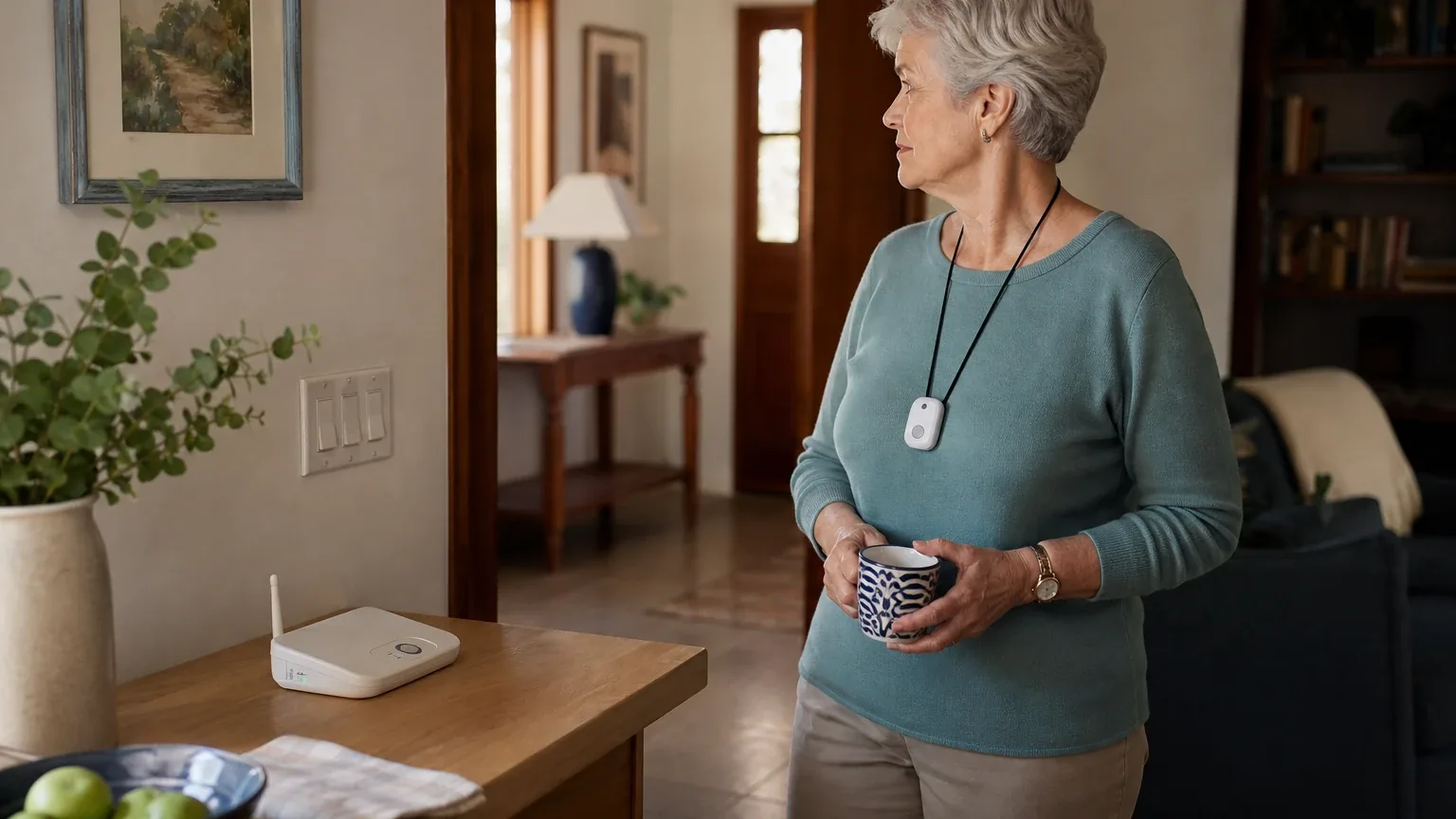
The Classic Cellular in-home system is the variant that matters for this use case. It pairs a plug-in base station with a wearable help button and uses AT&T cellular service included in the monitoring subscription, so no household landline is required [1]. MobileHelp states the base station provides two-way communication and that the help buttons themselves do not contain speakers [1].
The Classic Landline variant is materially different. MobileHelp lists it as a landline system with up to 600 feet of coverage [2], and independent review describes it as requiring a phone jack with fewer accessory options [3]. Google reported that fall detection is not supported on the Classic Landline system at all [4]. Buyers who want the 1,400-foot figure and the fall-detection add-on should confirm they are ordering the Cellular model.
MobileHelp's own FAQ states that the Classic Cellular and Classic Landline home systems provide in-home coverage up to 1,400 feet "depending on device" [5]. That single passage is the source of a documented conflict: the product listing and independent sources identify Classic Landline as up to 600 feet, not 1,400 [2]. Buyers should treat the variant name on the order confirmation as the controlling fact.
What the AI Platforms Agreed About
Questions This Section Answers
- What do AI platforms agree on about MobileHelp Classic for in-home coverage?
- Is the 1,400-foot range on MobileHelp Classic Cellular confirmed across sources?
The platforms agreed on four points: the Classic Cellular variant advertises up to 1,400 feet of in-home range, it does not require a landline, the base station carries two-way voice rather than the pendant, and fall detection is an optional add-on rather than a standard feature.
On range, the agreement was broad. MobileHelp states up to 1,400 feet for Classic Cellular [8], and independent reviews at Forbes, SafeWise, SeniorLiving, and SafeHome repeat the same figure [9]. Google called the 1,400-foot range "industry-leading" for the cellular variant [14].
On setup, the platforms agreed that the cellular model avoids landline dependency and includes AT&T service in the monitoring plan [16]. On two-way voice, openai and anthropic both noted that the base station holds the speaker and microphone, not the wearable button [16]. On fall detection, MobileHelp lists the Fall Button at $11 per month and states compatibility with Classic while warning it does not detect 100% of falls [20].
Agreement across platforms does not establish product quality. It establishes that the same public claims circulated widely enough to be repeated.
Where the AI Platforms Disagreed or Were Uncertain
Questions This Section Answers
- What is unverified or disputed about MobileHelp Classic for in-home base station coverage?
- Does MobileHelp Classic have a contract or is it month-to-month?
Five material conflicts or gaps surfaced, and none of them were resolved by the platforms.
Range in practice. Grok reported that one independent test reached only 500 feet maximum against the 1,400-foot advertised figure [21]. Openai's cited testing found successful use in a 1,300-square-foot home with reduced audibility behind a closed door and a running fan [22]. SafeWise noted that walls and obstacles reduce practical coverage [23]. The advertised number is a ceiling, not a guaranteed radius.
Backup battery. Anthropic reported a 30-hour base station backup battery [24], and grok and perplexity repeated roughly 30 hours [25]. Google cited test results of about 28 hours out of 30 claimed [27]. But openai stated that the reviewed current official materials did not clearly establish a runtime for the current Classic Cellular hardware [28], and kimi found no explicit Classic base station duration at all (kimi:mobilehelp-review-2026). Treat runtime as unconfirmed for the exact model.
Contract terms. MobileHelp's homepage states that no contract is required and service is month-to-month and cancellable at any time [29]. MobileHelp's terms state a three-month minimum commitment and a $50 restocking fee for returned equipment [30]. Both statements come from company-owned pages. This conflict must be resolved before purchase.
Pricing. Public figures range from $24.95 to $29.95 per month depending on source and variant [31]. Fall detection appears as both $10 and $11 per month [34].
Monitoring center. MobileHelp identifies Affiliated Monitoring with geographically diverse centers [37], while grok reported partner Rapid Response [25]. Openai also flagged that monitoring-center branding and contact numbers appear inconsistent across MobileHelp pages. No platform supplied independent service-uptime or response-time verification specific to Classic.
Use-Case-Specific Features and Capabilities
Questions This Section Answers
- Does MobileHelp Classic Cellular cover a yard or driveway for a senior who stays home?
- Can a senior hear the MobileHelp Classic base station from another room?
Range is the headline capability and the weakest verified one. MobileHelp advertises up to 1,400 feet for Classic Cellular [38], and independent testing found the range generous in a roughly 1,300-square-foot home with doors open [39]. The same testing found messages difficult to hear through a closed door with a fan running [39], and grok's cited test topped out at 500 feet [40]. Yard coverage is plausible but not guaranteed; walls, terrain, metal, and landscaping all reduce it [41].
Two-way voice runs through the base station, not the wearable. MobileHelp states that help buttons do not contain speakers [42], and manual instructions emphasize not blocking the microphone [43]. MobileHelp also states that if the operator cannot hear the member, emergency response may be contacted based on the situation [42].
Fall detection is an add-on. MobileHelp lists the Fall Button at $11 per month, states compatibility with Classic, and warns it does not detect 100% of falls [44]. Google reported it is unavailable on the Classic Landline variant [45].
Setup is plug-and-play: connect power, establish the cellular connection, and test the buttons [42]. MobileHelp recommends regular testing, and buyers should test every room and required yard location after installation [39].
Pricing, Fees, Contracts, and Ongoing Costs
Questions This Section Answers
- How much does MobileHelp Classic Cellular cost per month, and what does fall detection add?
- Are there setup, restocking, or cancellation fees with MobileHelp Classic?
MobileHelp's current product listing shows Classic Home/Cellular starting at $29.95 per month [47]. That figure is not stable across sources. Forbes reported a $24.95 monthly option with quarterly and annual alternatives [50], and a MobileHelp promotional page showed $24.95 per month [52]. Grok reported $29.95 monthly, $89.85 quarterly, and $329.45 annually [53]. Checkout pricing should control.
Fall detection adds $10 to $11 per month depending on source [54]. Google also listed optional Protection Plan at $6.99 per month and OnGuard Text Alerts at $2.99 per month [55].
Contract terms are the sharpest conflict in the file. MobileHelp's homepage says month-to-month with no contract and cancellation at any time [56]. MobileHelp's terms state a three-month minimum commitment, a $50 restocking fee on returns, a full refund only if equipment is returned within 15 calendar days of delivery, and a $350 equipment charge if the system is not returned within 30 days of termination [57]. Kimi reported no cancellation fee and a 30-day money-back guarantee (kimi:mobilehelp-review-2026), which does not match the terms document. Buyers should get the applicable terms in writing for their specific order.
Best Suited For
Questions This Section Answers
- Who is MobileHelp Classic Cellular best suited for in an in-home coverage scenario?
- Is MobileHelp Classic a good choice for a senior in a large house with a yard?
MobileHelp Classic Cellular suits seniors who spend most of their time at home, live where AT&T signal is dependable, and want coverage that reaches beyond a single room. Openai's fit assessment named homes with dependable AT&T coverage, seniors needing coverage across a relatively large house, driveway, or yard, buyers wanting a simple plug-in system with two-way communication through the base station, and buyers who want optional fall detection without a long-term contract [58].
Anthropic added seniors who frequently shower and need a waterproof button, and budget-conscious buyers seeking an affordable in-home-only system [60]. Kimi emphasized larger properties where extended range matters and buyers who want to avoid equipment and activation fees (kimi:mobilehelp-review-2026). Google highlighted budget-conscious buyers avoiding upfront equipment and activation fees [62].
The common thread across platforms is a homebound buyer with a large coverage footprint and reliable AT&T service at the address.
Probably Not Best Suited For
Questions This Section Answers
- Who should not choose MobileHelp Classic for in-home base station coverage?
- Is MobileHelp Classic a poor fit for a senior who leaves the house regularly?
MobileHelp Classic is a poor fit for buyers who need coverage away from home. Every platform flagged this. Openai, anthropic, deepseek, kimi, and google all directed on-the-go buyers toward the MobileHelp Elite or another mobile GPS system instead [63].
It is also a weak fit for properties with unreliable AT&T service. Openai, anthropic, deepseek, and grok all named weak or inconsistent AT&T coverage as a disqualifier [63]. Deepseek noted that in-home reliability is contingent on carrier coverage at the base-station address [68].
Other exclusions: buyers who need the wearable pendant itself to provide two-way voice [63]; buyers who need fall detection included at no extra cost [65]; buyers who require confirmed battery-runtime specifications or a company-owned monitoring center [70]; and buyers who require firm, publicly documented contract terms before purchase [65].
When Another Option May Be Better
Questions This Section Answers
- What is a better alternative to MobileHelp Classic for a senior who needs coverage outside the home?
- When should a buyer choose a landline system instead of MobileHelp Classic Cellular?
A mobile GPS system is the better choice when the senior regularly leaves the property. Openai, anthropic, deepseek, and kimi all pointed to the MobileHelp Elite or an equivalent mobile-capable system for confirmed coverage beyond the base station [72].
A landline system is the better choice only in a narrow case: when AT&T coverage is unreliable and a compatible, stable landline is available. Openai cautioned that buyers choosing this route should verify the shorter range first, since Classic Landline is advertised at up to 600 feet with fewer accessory options [75]. Google noted fall detection is not supported on that variant [77].
Kimi named specific competitors for specific gaps: Bay Alarm Medical for a slightly lower starting price with free second-user coverage, competitors that bundle fall detection at no add-on cost, Medical Guardian for more GPS form factors, and LifeStation Sidekick Home for faster published response times (kimi:mobilehelp-review-2026, kimi:pcmag-lifestation-2026). Those comparisons are platform-reported and were not independently verified in this study.
Questions to Verify Before Buying
Questions This Section Answers
- What should a buyer confirm with MobileHelp before signing up for Classic Cellular?
Confirm the exact variant and range for the order being placed, since the Cellular and Landline models carry different advertised coverage [78]. Confirm that AT&T provides reliable indoor and outdoor service at the specific residence, including the farthest yard or driveway location [80].
Ask MobileHelp to document the backup-battery runtime for the exact current base station during a power outage [82]. Resolve whether the order carries a three-month minimum commitment or true month-to-month cancellation, and whether the $50 restocking fee applies [83].
Confirm the current Fall Button price and whether it is $10 or $11 per month [85]. Ask which monitoring company and contact number will serve the account [87]. Test the base station's audibility from bedrooms, bathrooms, upstairs rooms, and outdoor locations before relying on it [89].
Final AI Consensus Verdict
MobileHelp Classic is a good fit for in-home base station coverage for seniors who stay mostly at home, provided AT&T cellular service is reliable at the property and the base station is centrally positioned. All seven platforms named it, its average listed rank was 4.0, and its best rank was 1. Five platforms rated the fit "good" and three rated it "strong."
The strongest case for it is range: the advertised 1,400-foot wearable range on Classic Cellular is unusually broad for an in-home system and can plausibly cover a house, driveway, or yard. The case against top-tier confidence rests on verification gaps rather than on any platform calling the product unsuitable. Real-world range is property-specific and one cited test reached only 500 feet. Speaker audibility degrades behind closed doors and background noise. Backup-battery runtime for the current hardware is not clearly established in official materials. Public contract terms conflict with the homepage's month-to-month claim. Fall detection costs extra and is imperfect by the company's own disclosure.
Buyers who validate AT&T coverage, test the range on site, and get the applicable contract terms in writing are working with a system that fits the use case. Buyers who need guaranteed outdoor coverage, included fall detection, or fully transparent published terms should compare alternatives first.
How This Review Was Produced
This review evaluates MobileHelp Classic only for the In-Home Base Station Coverage use case. It is not a broad company review. Seven AI platforms — anthropic, deepseek, google, grok, kimi, openai, and perplexity — were asked to assess fit for this use case, and all seven named MobileHelp Classic during ranking discovery. Their responses, cited sources, and stated uncertainties form the evidence base.
Platform fit ratings were: anthropic good, deepseek good, google strong, grok strong, kimi strong, openai good, perplexity good. Ranking statistics were calculated from the platforms that named the entity during the ranking stage. This review sits within a broader In-Home Base Station Coverage comparison, and the wider medical alert systems category directory covers adjacent use cases.
Methodology Limitations
Platform-reported research dates differ from the authoritative run date of 2026-09-27. Anthropic's response is dated 2025-01-15 and deepseek's is dated 2026-01-15; the remaining five platforms are dated 2026-09-27. Those dates are provenance metadata and do not independently prove freshness.
Deepseek ran with search disabled, so its findings are model-reported rather than retrieved. All citations are platform-reported evidence, not independently verified facts. The supplied URLs were collected from platform responses and were not independently validated by the writer stage. No platform supplied independent service-uptime or response-time verification specific to MobileHelp Classic.
Where sources conflicted on pricing, range, fall-detection cost, or contract terms, this review describes the conflict rather than resolving it. Missing research was not treated as disagreement. No personal testing, customer experience, medical benefit, or guaranteed performance is claimed anywhere in this review.
Sources
Company-Owned Sources
- Medical alert devices by MobileHelp® - 2 Free Months. No: https://offers.mobilehelp.com/medical-alert-devices/
- In-Home vs. Mobile Medical Alert Systems: How Do You Choose the Right One?: https://www.lifestation.com/in-home-or-mobile-medical-alert/
- MobileHelp Homepage: https://www.mobilehelp.com/
- All Products: https://www.mobilehelp.com/collections/all-products
- MobileHelp Coverage and Setup Information: https://www.mobilehelp.com/coverage/
- MobileHelp Medical Alert Systems: https://www.mobilehelp.com/medical-alert-systems/
- About MobileHelp: https://www.mobilehelp.com/pages/about
- User Guides and Forms: https://www.mobilehelp.com/pages/download-user-guides-and-forms
- Fall Button: https://www.mobilehelp.com/pages/fall-button
- Medical Alert Systems from MobileHelp® - As Low as $0.90/Day: https://www.mobilehelp.com/pages/medical-alert-systems
- Terms and Conditions: https://www.mobilehelp.com/pages/terms-and-conditions
- Classic Cellular Medical Alert System | No Landline - MobileHelp: https://www.mobilehelp.com/products/classic-cellular
- Classic Cellular Medical Alert System | No Landline: https://www.mobilehelp.com/products/in-home-medical-alert-system
- Classic Cellular: https://www.mobilehelp.com/products/mobilehelp-classic
- Official pricing and terms source: https://www.mobilehelp.com/pages/terms-of-use
Additional AI research evidence89 records
- AI research evidence record openai:c4
- AI research evidence record openai:c5
- AI research evidence record openai:c6
- AI research evidence record google:1.2.4
- AI research evidence record openai:c1
- AI research evidence record anthropic:c3
- AI research evidence record perplexity:c7
- AI research evidence record openai:c1
- AI research evidence record openai:c2
- AI research evidence record openai:c3
- AI research evidence record grok:web:0
- AI research evidence record perplexity:c11
- AI research evidence record perplexity:c7
- AI research evidence record google:1.1.2
- AI research evidence record google:1.1.3
- AI research evidence record openai:c4
- AI research evidence record anthropic:c2
- AI research evidence record grok:web:10
- AI research evidence record anthropic:c7
- AI research evidence record openai:c8
- AI research evidence record grok:web:2
- AI research evidence record openai:c2
- AI research evidence record openai:c3
- AI research evidence record anthropic:c3
- AI research evidence record grok:web:3
- AI research evidence record perplexity:c5
- AI research evidence record google:1.2.8
- AI research evidence record openai:c7
- AI research evidence record openai:c12
- AI research evidence record openai:c11
- AI research evidence record perplexity:c3
- AI research evidence record perplexity:c6
- AI research evidence record openai:c5
- AI research evidence record openai:c8
- AI research evidence record anthropic:c8
- AI research evidence record google:1.1.5
- AI research evidence record openai:c9
- AI research evidence record openai:c1
- AI research evidence record openai:c2
- AI research evidence record grok:web:2
- AI research evidence record openai:c3
- AI research evidence record openai:c4
- AI research evidence record anthropic:c7
- AI research evidence record openai:c8
- AI research evidence record google:1.2.4
- AI research evidence record anthropic:c6
- AI research evidence record openai:c5
- AI research evidence record anthropic:c1
- AI research evidence record perplexity:c4
- AI research evidence record anthropic:c8
- AI research evidence record perplexity:c6
- AI research evidence record perplexity:c3
- AI research evidence record grok:web:3
- AI research evidence record openai:c8
- AI research evidence record google:1.1.5
- AI research evidence record openai:c12
- AI research evidence record openai:c11
- AI research evidence record openai:c4
- AI research evidence record openai:c5
- AI research evidence record anthropic:c1
- AI research evidence record anthropic:c5
- AI research evidence record google:1.1.2
- AI research evidence record openai:c4
- AI research evidence record anthropic:c2
- AI research evidence record deepseek:c1
- AI research evidence record google:1.1.2
- AI research evidence record anthropic:c1
- AI research evidence record deepseek:c3
- AI research evidence record grok:web:0
- AI research evidence record openai:c9
- AI research evidence record perplexity:c4
- AI research evidence record openai:c4
- AI research evidence record anthropic:c2
- AI research evidence record deepseek:c1
- AI research evidence record openai:c5
- AI research evidence record openai:c6
- AI research evidence record google:1.2.4
- AI research evidence record openai:c1
- AI research evidence record openai:c5
- AI research evidence record openai:c4
- AI research evidence record anthropic:c1
- AI research evidence record openai:c7
- AI research evidence record openai:c11
- AI research evidence record openai:c12
- AI research evidence record openai:c8
- AI research evidence record anthropic:c8
- AI research evidence record openai:c9
- AI research evidence record grok:web:3
- AI research evidence record openai:c2
Independent Sources
- MobileHelp Review 2026: Cost, Plans & Verdict: https://medicalalertreview.com/mobilehelp-review
- MobileHelp Medical Alert System Review 2026: https://realestate.usnews.com/home-services/medical-alert-system/mobilehelp
- LifeStation Sidekick Home - Review 2026 - PCMag UK: https://uk.pcmag.com/medical-alert-systems/134796/lifestation-in-home-no-landline-medical-alert-system
- MobileHelp Medical Alert System Review 2025 - AgingInPlace.org: https://www.aginginplace.org/mobilehelp-review/
- MobileHelp Classic Cellular Medical Alert System Review - Caring.com: https://www.caring.com/caregivers/medical-alert-systems/mobilehelp-classic-cellular-review/
- Best Medical Alert Systems with Fall Detection: https://www.caring.com/senior-products/best-medical-alert-systems/best-medical-alert-systems-with-fall-detection
- MobileHelp Reviews (From First-hand Experiences: https://www.consumeraffairs.com/medical-alert-systems/mobilehelp.html
- MobileHelp Classic Review: Tried And Tested: https://www.forbes.com/health/medical-alert-systems/mobile-help-classic-review/
- MobileHelp Classic Review: Tried and Tested - Forbes: https://www.forbes.com/health/medical-alerts/mobilehelp-classic-review/
- MobileHelp Review in 2026: Is It a Good Value? - The National Council on Aging (NCOA: https://www.ncoa.org/adviser/medical-alert-systems/mobilehelp-review/
- Your 2026 MobileHelp Review: https://www.ncoa.org/product-resources/medical-alert-systems/mobilehelp-review/
- MobileHelp Medical Alert System Pricing and Full Review – 2026 Recommendations: https://www.safehome.org/medical-alert-systems/mobilehelp/
- Mobilehelp Vs. Medical: https://www.safehome.org/senior-safety/medical-alerts/mobile-help/
- LifeStation Review│ Hands-On Test Results: https://www.safewise.com/senior-safety/medical-alerts/life-station/
- MobileHelp Medical Alert System Review: https://www.safewise.com/senior-safety/medical-alerts/mobile-help/
- MobileHelp Medical Alert System Cost & Pricing in 2026: https://www.seniorliving.org/medical-alert-systems/mobilehelp/
- MobileHelp Medical Alert System Review 2026: https://www.seniorliving.org/medical-alert-systems/mobilehelp/reviews/
- MobileHelp Medical Alert: Costs, Systems, and Plans: https://www.theseniorlist.com/medical-alert-systems/mobilehelp/
- MobileHelp Medical Alert: Costs, Systems, and Plans - The Senior List: https://www.theseniorlist.com/medical-alert-systems/mobilehelp/costs/
Additional AI research evidence89 records
- AI research evidence record openai:c4
- AI research evidence record openai:c5
- AI research evidence record openai:c6
- AI research evidence record google:1.2.4
- AI research evidence record openai:c1
- AI research evidence record anthropic:c3
- AI research evidence record perplexity:c7
- AI research evidence record openai:c1
- AI research evidence record openai:c2
- AI research evidence record openai:c3
- AI research evidence record grok:web:0
- AI research evidence record perplexity:c11
- AI research evidence record perplexity:c7
- AI research evidence record google:1.1.2
- AI research evidence record google:1.1.3
- AI research evidence record openai:c4
- AI research evidence record anthropic:c2
- AI research evidence record grok:web:10
- AI research evidence record anthropic:c7
- AI research evidence record openai:c8
- AI research evidence record grok:web:2
- AI research evidence record openai:c2
- AI research evidence record openai:c3
- AI research evidence record anthropic:c3
- AI research evidence record grok:web:3
- AI research evidence record perplexity:c5
- AI research evidence record google:1.2.8
- AI research evidence record openai:c7
- AI research evidence record openai:c12
- AI research evidence record openai:c11
- AI research evidence record perplexity:c3
- AI research evidence record perplexity:c6
- AI research evidence record openai:c5
- AI research evidence record openai:c8
- AI research evidence record anthropic:c8
- AI research evidence record google:1.1.5
- AI research evidence record openai:c9
- AI research evidence record openai:c1
- AI research evidence record openai:c2
- AI research evidence record grok:web:2
- AI research evidence record openai:c3
- AI research evidence record openai:c4
- AI research evidence record anthropic:c7
- AI research evidence record openai:c8
- AI research evidence record google:1.2.4
- AI research evidence record anthropic:c6
- AI research evidence record openai:c5
- AI research evidence record anthropic:c1
- AI research evidence record perplexity:c4
- AI research evidence record anthropic:c8
- AI research evidence record perplexity:c6
- AI research evidence record perplexity:c3
- AI research evidence record grok:web:3
- AI research evidence record openai:c8
- AI research evidence record google:1.1.5
- AI research evidence record openai:c12
- AI research evidence record openai:c11
- AI research evidence record openai:c4
- AI research evidence record openai:c5
- AI research evidence record anthropic:c1
- AI research evidence record anthropic:c5
- AI research evidence record google:1.1.2
- AI research evidence record openai:c4
- AI research evidence record anthropic:c2
- AI research evidence record deepseek:c1
- AI research evidence record google:1.1.2
- AI research evidence record anthropic:c1
- AI research evidence record deepseek:c3
- AI research evidence record grok:web:0
- AI research evidence record openai:c9
- AI research evidence record perplexity:c4
- AI research evidence record openai:c4
- AI research evidence record anthropic:c2
- AI research evidence record deepseek:c1
- AI research evidence record openai:c5
- AI research evidence record openai:c6
- AI research evidence record google:1.2.4
- AI research evidence record openai:c1
- AI research evidence record openai:c5
- AI research evidence record openai:c4
- AI research evidence record anthropic:c1
- AI research evidence record openai:c7
- AI research evidence record openai:c11
- AI research evidence record openai:c12
- AI research evidence record openai:c8
- AI research evidence record anthropic:c8
- AI research evidence record openai:c9
- AI research evidence record grok:web:3
- AI research evidence record openai:c2
Other Sources
- MobileHelp Classic In-Home Wireless System User Guide: https://manualspro.net/176009-mobilehelp-classic-in-home-wireless-system-user-guide
- MobileHelp Classic CBS 5 In-Home Wireless System User Guide: https://manualspro.net/176821-mobilehelp-classic-cbs-5-in-home-wireless-system-user-guide
- MobileHelp 20205EG91NA Mobile Medical Alert Systems User Guide: https://manualspro.net/463813-mobilehelp-20205eg91na-mobile-medical-alert-systems-user-guide
- MobileHelp Classic Cellular – MedGrade: https://medgrade.org/devices/mobilehelp-classic-cellular/
Additional AI research evidence89 records
- AI research evidence record openai:c4
- AI research evidence record openai:c5
- AI research evidence record openai:c6
- AI research evidence record google:1.2.4
- AI research evidence record openai:c1
- AI research evidence record anthropic:c3
- AI research evidence record perplexity:c7
- AI research evidence record openai:c1
- AI research evidence record openai:c2
- AI research evidence record openai:c3
- AI research evidence record grok:web:0
- AI research evidence record perplexity:c11
- AI research evidence record perplexity:c7
- AI research evidence record google:1.1.2
- AI research evidence record google:1.1.3
- AI research evidence record openai:c4
- AI research evidence record anthropic:c2
- AI research evidence record grok:web:10
- AI research evidence record anthropic:c7
- AI research evidence record openai:c8
- AI research evidence record grok:web:2
- AI research evidence record openai:c2
- AI research evidence record openai:c3
- AI research evidence record anthropic:c3
- AI research evidence record grok:web:3
- AI research evidence record perplexity:c5
- AI research evidence record google:1.2.8
- AI research evidence record openai:c7
- AI research evidence record openai:c12
- AI research evidence record openai:c11
- AI research evidence record perplexity:c3
- AI research evidence record perplexity:c6
- AI research evidence record openai:c5
- AI research evidence record openai:c8
- AI research evidence record anthropic:c8
- AI research evidence record google:1.1.5
- AI research evidence record openai:c9
- AI research evidence record openai:c1
- AI research evidence record openai:c2
- AI research evidence record grok:web:2
- AI research evidence record openai:c3
- AI research evidence record openai:c4
- AI research evidence record anthropic:c7
- AI research evidence record openai:c8
- AI research evidence record google:1.2.4
- AI research evidence record anthropic:c6
- AI research evidence record openai:c5
- AI research evidence record anthropic:c1
- AI research evidence record perplexity:c4
- AI research evidence record anthropic:c8
- AI research evidence record perplexity:c6
- AI research evidence record perplexity:c3
- AI research evidence record grok:web:3
- AI research evidence record openai:c8
- AI research evidence record google:1.1.5
- AI research evidence record openai:c12
- AI research evidence record openai:c11
- AI research evidence record openai:c4
- AI research evidence record openai:c5
- AI research evidence record anthropic:c1
- AI research evidence record anthropic:c5
- AI research evidence record google:1.1.2
- AI research evidence record openai:c4
- AI research evidence record anthropic:c2
- AI research evidence record deepseek:c1
- AI research evidence record google:1.1.2
- AI research evidence record anthropic:c1
- AI research evidence record deepseek:c3
- AI research evidence record grok:web:0
- AI research evidence record openai:c9
- AI research evidence record perplexity:c4
- AI research evidence record openai:c4
- AI research evidence record anthropic:c2
- AI research evidence record deepseek:c1
- AI research evidence record openai:c5
- AI research evidence record openai:c6
- AI research evidence record google:1.2.4
- AI research evidence record openai:c1
- AI research evidence record openai:c5
- AI research evidence record openai:c4
- AI research evidence record anthropic:c1
- AI research evidence record openai:c7
- AI research evidence record openai:c11
- AI research evidence record openai:c12
- AI research evidence record openai:c8
- AI research evidence record anthropic:c8
- AI research evidence record openai:c9
- AI research evidence record grok:web:3
- AI research evidence record openai:c2
Verify This Research
Review the study details behind this page or download the public machine-readable verification record.
- Study date
- September 27, 2026
- Platforms analyzed
- 7
- Source records
- 39
- Ranking mentions
- 7 of 7
- Platform share
- 100%
- Final consensus rank
- #4
Research trail and source mix
Configured platforms
openai, anthropic, deepseek, grok, perplexity, kimi, google
Source mix
19 independent · 16 company-owned · 4 unclear
Evidence support
28 direct · 10 partial
Important limitation
Use the run research_date as the study date. Platform-reported dates are provenance metadata and do not independently prove freshness.
Source snapshot SHA-256 6a73b30d1ce237664904732841516d09db06795e9a0527f04685fbd47fc8bded