
Answer Capsule
LifeFone At-Home Landline is a good fit for seniors with confirmed, compatible landline service who want a traditional in-home pendant system at a relatively low recurring cost. All 7 platforms that named the entity in the ranking stage included it, and it finished second overall with an average listed rank of 2.71. The strongest reason to consider it is the combination of a low advertised monitoring price, no stated equipment or activation fee, month-to-month terms, and a 32-hour base-station backup battery. The main limitation is a material gap between the advertised 1,300-foot range and independent hands-on testing, plus unverified landline-provider compatibility.
Research Snapshot
| Field | Finding |
|---|---|
| Platform mentions in ranking stage | 7 of 7 platforms (anthropic, deepseek, google, grok, kimi, openai, perplexity) |
| Share of included platform responses | 100% |
| Average listed rank | 2.71 |
| Best listed rank | 1 (kimi, openai) |
| Relevant product/model/plan | LifeFone At-Home Landline medical alert system with standard wearable pendant and monthly monitoring |
| Overall use-case fit | Good — strong on cost, terms, and battery backup; limited by landline dependency and a range discrepancy |
| Research date | 2026-09-27 |
Why LifeFone At-Home Landline Qualified for This Study
Questions This Section Answers
- Why did LifeFone At-Home Landline qualify for a landline-based emergency monitoring study?
- How many AI platforms named LifeFone At-Home Landline during the ranking stage?
LifeFone At-Home Landline qualified because it is a purpose-built landline product, not a cellular system adapted to the category. It connects to a home telephone jack and is marketed explicitly as a landline medical alert system [1]. All 7 platforms that named the entity in the ranking stage included it, giving it a 100% share of included platform responses and an average listed rank of 2.71. It earned first-place listings from kimi and openai and was placed sixth by perplexity.
The system also matched the study's configured criteria directly: landline compatibility, base station range, pendant durability, response center speed, backup battery life, monthly monitoring fee, equipment cost, and contract terms. LifeFone publishes positions on all eight, though with varying levels of specificity [4].
One qualification caveat applies. The available source evidence flagged unresolved official-domain identity issues and used an unverified reported-domain evidence, retaining the reported domain for downstream research while marking it unverified. The cited pages are hosted on lifefone.com, but buyers should treat the official domain as a detail to confirm rather than an established fact.
The Product, Model, Plan, or Service Most Relevant to Landline-Based Emergency Monitoring
Questions This Section Answers
- Which LifeFone At-Home Landline plan is most relevant for a senior who wants traditional in-home landline monitoring?
- Does LifeFone At-Home Landline include a wearable pendant and base station for landline emergency monitoring?
The relevant configuration is the LifeFone At-Home Landline medical alert system with a standard wearable pendant and monthly monitoring. Every platform converged on this same product, though naming varied slightly: "At-Home Landline," "At-Home Landline Plan," "At-Home Landline with Basic Service," and "At-Home Landline with standard pendant, monthly monitoring" all appear in the platform responses.
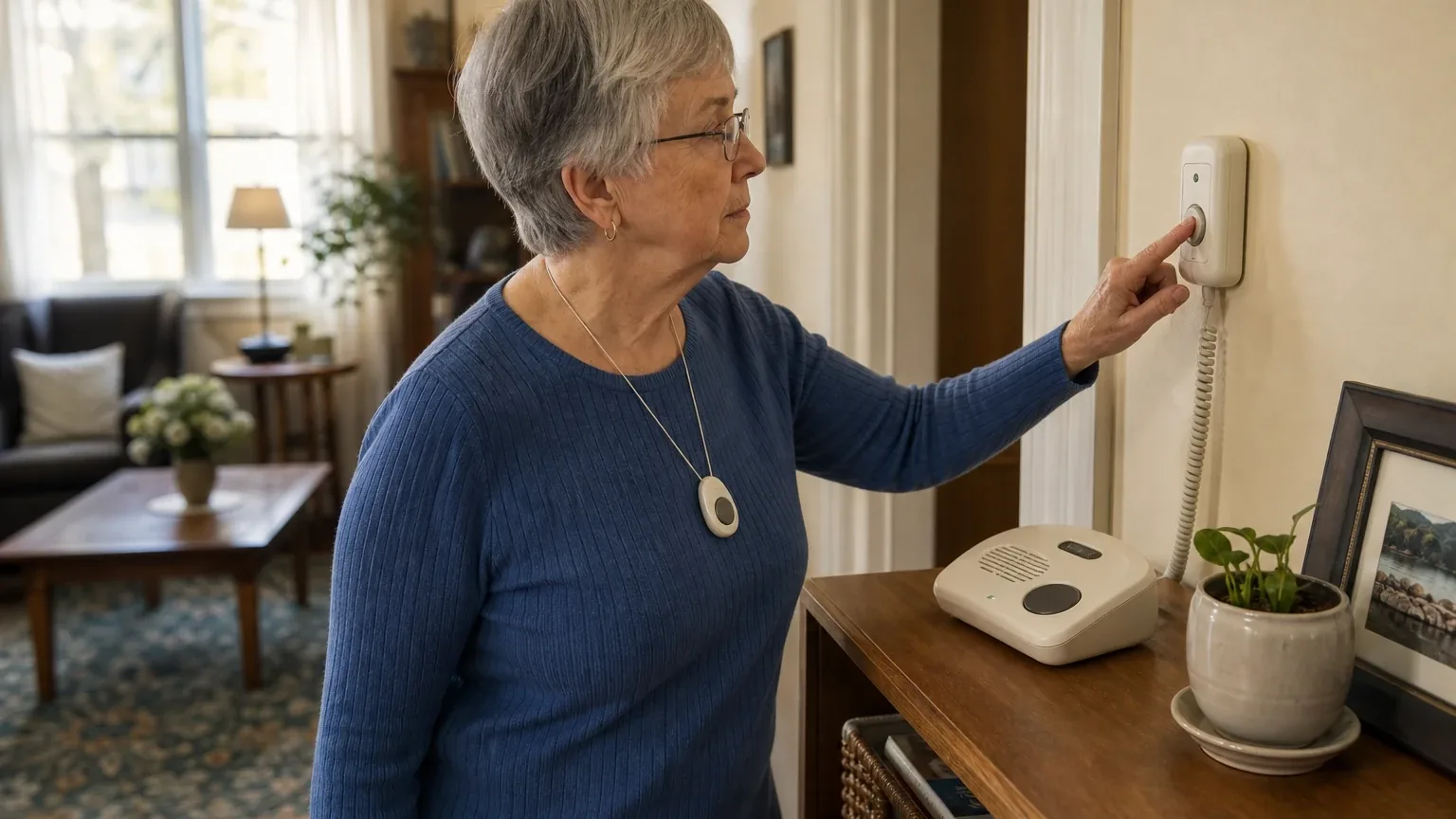
The hardware is a wired base station connected to the primary phone line plus a wearable help button that can be worn as a pendant or wristband [8]. LifeFone lists the standard pendant as water resistant, and one platform response describes the standard help button as 100% water and dust resistant [9]. The official user guide documents communication, battery, trouble, and help-button status indicators on the base unit [12].
Optional fall detection is available on the same product line for an added monthly fee [13]. The fall-detection pendant carries a shorter stated range than the standard pendant — up to 600 feet versus up to 1,300 feet [11].
What the AI Platforms Agreed About
Questions This Section Answers
- What do AI platforms agree on about LifeFone At-Home Landline for landline-based emergency monitoring?
- Is LifeFone At-Home Landline considered a low-cost option for landline medical alert monitoring?
Agreement was strong on cost structure, contract flexibility, and battery backup. Six of seven platforms described the system as a low-cost or among-the-lowest-cost landline option, and the fit ratings clustered at the positive end: google, grok, and kimi rated it a strong fit; openai, anthropic, and perplexity rated it a good fit; deepseek alone rated it mixed.
Points of strong or unanimous agreement:
- No equipment or activation fee. LifeFone states it charges neither, and independent reviewers repeat the claim [17].
- Month-to-month terms with no minimum commitment. LifeFone describes cancel-anytime service, and reviewers corroborate no long-term contract [17].
- 32-hour base-station backup battery. Multiple platforms and the order page report this figure [26].
- Advertised 1,300-foot range for the standard pendant. Reported across official and independent sources [26].
- 24/7 U.S.-based monitoring. LifeFone states its monitoring centers operate 24/7, 365 days a year [25].
- Optional fall detection at $5 per month. Reported consistently across platforms [30].
- Free second pendant for a spouse on basic at-home service. Reported by multiple platforms [30].
Agreement on these points does not establish product quality. It establishes that the platforms read the same published claims.
Where the AI Platforms Disagreed or Were Uncertain
Questions This Section Answers
- Why do AI platforms disagree about the advertised range of LifeFone At-Home Landline?
- Is the monthly price of LifeFone At-Home Landline unclear across billing plans?
Disagreement and uncertainty concentrated in four areas.
Range. LifeFone advertises up to 1,300 feet between base station and pendant [33]. An independent SafeWise hands-on test reported connection only up to 65 feet for a tested LifeFone at-home system [36]. Kimi's independent source found range "much shorter than advertised" without stating a tested distance (kimi:R1). Google's source noted real-world outdoor range was significantly limited versus specifications [37]. The tested configuration may not have been the same landline model, and test conditions may differ, but the gap is material and unresolved.
Price. The official order page displays $24.95 per month and states that price is based on annual billing [33]. Independent sources report a month-to-month rate of $29.95, a quarterly equivalent of $27.95, and annual equivalents ranging from $22.87 to $24.95 [38]. NCOA reports monthly plans running roughly $30 to $48 depending on device [42]. Current monthly and quarterly prices were not established from the reviewed official page.
Spouse monitoring. LifeFone marketing states spouses are protected free with basic service, and multiple platforms repeat a free second pendant [43]. One independent source lists a spouse monitoring fee of $39.95 [45]. This conflict is unresolved.
Response time. TechRadar reported average answer times of approximately 45 seconds and later 37 seconds [46]. SafeWise reported calls answered within 60 seconds on average [36]. One source cites a 15-second response time [45]. These figures are for LifeFone overall or unspecified at-home configurations, not clearly isolated to the exact At-Home Landline model, and none is a guaranteed response time.
Deepseek's assessment diverged most sharply. Because its research ran without search enabled, it could not confirm pricing, contract terms, range, or battery specifications and rated the fit mixed [48]. That outcome reflects a research-capability limitation rather than a documented product defect, and it should not be read as evidence that the specifications are absent.
Use-Case-Specific Features and Capabilities
Questions This Section Answers
- Does LifeFone At-Home Landline work with VoIP or only a traditional copper landline?
- What happens to the phone line during a LifeFone At-Home Landline emergency alert?
Landline compatibility is the gating requirement. The system uses a wired base station connected to the primary phone line, and LifeFone states that some landline providers may be incompatible, recommending its cellular system in that situation [50]. One platform response states the system does not work with VoIP services or cellular-only households [52]. The reviewed official materials do not specify which landline technologies or providers are supported.
A documented call-path limitation applies. LifeFone's terms state that when the wired base station uses the primary phone line to contact the response center, the household cannot use that telephone line for other calls, including 911 calls, during the connection [51].
| Capability | Reported detail | Evidence quality |
|---|---|---|
| Landline compatibility | Wired base station on primary phone line; "most, but not all" providers supported | Company-stated; provider list not published [51] |
| Base station range | Up to 1,300 ft advertised; 65 ft observed in one independent test | Material conflict [54] |
| Fall-detection pendant range | Up to 600 ft | Company manual and independent review [56] |
| Pendant durability | Water resistant; one source says 100% water and dust resistant | No published drop or IP rating [54] |
| Pendant battery life | Up to 3 years standard; about 1 year with fall detection | Company-stated; one source says 1–5 years [53] |
| Base backup battery | 32 hours | Company-stated; independent test of another at-home configuration reported under 24 hours [54] |
| Automatic battery replacement | Help-button battery replaced at no cost below 20% | Company-stated; logistics unspecified [50] |
| Response center | U.S.-based, 24/7; reported answer times of 15–60 seconds | Mixed independent results, not model-specific [55] |
| Fall detection | Optional, $5/month; does not detect every fall | Company-stated plus independent false-alarm findings [61] |
| Room temperature monitoring | Included on base At-Home Landline service | Platform-reported [52] |
| Remote phone answering | Answer incoming landline calls via help button | Platform-reported (kimi:F1) |
| Caregiver app | Not available on At-Home Landline | Independent review (kimi:R1) |
Independent testing also reported mixed audio quality during LifeFone testing [55]. No reviewed material establishes a specific pendant durability rating, ingress-protection rating, or guaranteed response-time standard.
Pricing, Fees, Contracts, and Ongoing Costs
Questions This Section Answers
- How much does LifeFone At-Home Landline cost per month, and are there setup or cancellation fees?
- What charges apply if LifeFone At-Home Landline equipment is lost, damaged, or returned late?
The advertised entry price is $24.95 per month, and the official page states that displayed price is based on annual billing [63]. Independent sources report the following schedule [65]:
| Billing option | Reported monthly equivalent | Source type |
|---|---|---|
| Annual | $22.87–$24.95 | Independent reviews and official page |
| Quarterly | $27.95 | Independent reviews |
| Month-to-month | $29.95 | Independent reviews |
NCOA reports monthly plans running about $30 to $48 depending on device, which is a wider range than the other sources [69]. Current monthly and quarterly prices were not verified from the reviewed official page, so the table above should be treated as reviewer-reported for those two rows.
Known fees and add-ons:
- Optional fall detection: $5.00 per month [70]
- Protection Plan: $5.00 per month, with deductibles reported at $6 for a pendant without two-way talk and $29 for the base station or a two-way talk device [65]
- Daily check-in service: $19.00 per month [65]
- Activity assurance: $6.00 per month [65]
- Wall button, extra wearable button, and vanity pendant: one-time accessory purchases reported at $39.95, $39.95, and $49.95 [65]
- Shipping: reported from $0 to $93.62 across sources, with one source citing $11.95 [65]
Contract and cancellation terms are consistently described as consumer-friendly. LifeFone describes month-to-month service with no minimum commitment and cancel-anytime terms [73]. A 30-day money-back period applies, subject to equipment return and shipping conditions [73]. After cancellation, unused full prepaid months may be refunded after equipment is received, while partial months generally are not [73]. Return shipping is paid by the customer [74].
The largest single exposure is equipment return. LifeFone's terms state the equipment is loaned and may create a $295 fair-market-value obligation if not returned after termination [74]. One source describes a late-return fee of $295 if in-home equipment is not returned within 30 days of cancellation (kimi:R1). LifeFone also states a lifetime price guarantee for the selected service, though how it applies to billing-plan changes should be confirmed [73].
Best Suited For
Questions This Section Answers
- Who is LifeFone At-Home Landline best suited for among seniors with landline service?
- Is LifeFone At-Home Landline a good choice for a couple who both need in-home monitoring?
LifeFone At-Home Landline is best suited for seniors who remain primarily at home and already have compatible, reliable landline service. The platform consensus on this buyer profile was strong: google, grok, and kimi rated the fit strong, and openai, anthropic, and perplexity rated it good.
Specific buyer profiles the evidence supports:
- Budget-conscious buyers prioritizing low recurring monitoring cost over premium features (openai, anthropic, grok, kimi, perplexity).
- Households wanting a traditional pendant and base station rather than a cellular or mobile device (openai, anthropic, perplexity).
- Couples who may benefit from the stated free second pendant with basic at-home service [76].
- Buyers who want no long-term commitment and value cancel-anytime flexibility with prorated refunds of prepaid full months [79].
- Buyers who want low-cost fall detection added to a landline plan rather than switching to cellular [82].
The Landline-Based Emergency Monitoring consensus index places this system in the top tier of the category, and its position is consistent with the platform-level fit ratings above.
Probably Not Best Suited For
Questions This Section Answers
- Who should not choose LifeFone At-Home Landline for landline-based emergency monitoring?
- Is LifeFone At-Home Landline suitable for a senior who leaves home independently?
Several buyer situations fall outside this system's design.
- People who leave home independently and need nationwide mobile coverage. The system is in-home only and provides no GPS tracking or location services [84].
- Homes without a compatible landline or with unreliable telephone service. LifeFone itself recommends its cellular system when landline providers are incompatible [87].
- Buyers requiring a fully independently validated 1,300-foot operating range. The advertised figure conflicts with a 65-foot observed result in one independent test [88].
- Buyers who need fall detection as a substitute for pressing the help button. Fall detection is optional, costs extra, and independent testing found it did not detect every test fall and could generate false alarms [88].
- Buyers who need a caregiver app. The caregiver app is available only on one LifeFone mobile system, not on At-Home Landline (kimi:R1).
- Buyers who need clearly published equipment, activation, and cancellation terms before ordering. Some terms are not fully clear from public materials [86].
Adding fall detection also reduces pendant battery life from a stated three years to approximately one year and cuts pendant range to 600 feet [85].
When Another Option May Be Better
Questions This Section Answers
- What is a better alternative to LifeFone At-Home Landline for a senior who needs coverage outside the home?
- When should a buyer choose a cellular medical alert system instead of LifeFone At-Home Landline?
Choose a cellular at-home system when the home lacks compatible landline service or line reliability is uncertain. LifeFone's own guidance points to its cellular system in that situation, and multiple platforms named LifeFone At-Home Cellular as the direct substitute (openai, anthropic, deepseek, kimi).
Choose a mobile or on-the-go system when the senior regularly travels outside the home. Platform responses named LifeFone On-The-Go, Philips Lifeline with AutoAlert, and Bay Alarm Medical as alternatives for mobility and GPS coverage (anthropic, deepseek, kimi).
Choose another provider when independently tested range, audio quality, or response-time data for the exact landline model is a purchase priority. One platform response noted that sources indicate Bay Alarm Medical may offer faster response, and another flagged that a competitor may offer better-tested fall detection accuracy (anthropic, kimi).
Choose a competitor with clearer published terms when transparent itemized pricing and confirmed contract language are prerequisites. Deepseek and perplexity both flagged incomplete public disclosure of equipment, activation, and cancellation specifics as a reason to compare alternatives [92].
For buyers comparing across the broader category, the medical alert systems directory lists the full set of reviewed providers and product lines.
Questions to Verify Before Buying
Questions This Section Answers
- What should a buyer confirm with LifeFone before signing up for At-Home Landline?
- Which LifeFone At-Home Landline details are unverified and need direct confirmation?
The platform responses produced a consistent verification list. Buyers should confirm each item directly with LifeFone before ordering.
- Is the buyer's exact telephone provider, line type, and home wiring compatible with the At-Home Landline base station? Request the specific provider compatibility list (openai, anthropic, deepseek, grok, google).
- Does the base station share the line with a telephone, DSL, fax, alarm system, or other equipment, and what happens during an alert (openai)?
- What range is expected in this specific home after walls, floors, yard structures, and interference are considered (openai, kimi, perplexity)?
- Is the 32-hour battery specification measured under normal standby conditions, and what is the replacement process after a prolonged outage (openai, deepseek)?
- What exact billing price applies to monthly and quarterly payment plans (openai, anthropic, perplexity, kimi)?
- Is the second spouse pendant truly free to monitor, or does a $39.95 charge apply (anthropic, google)?
- Is fall detection available with the selected pendant, and what are the return, replacement, and false-alarm policies (openai, perplexity)?
- What response center handles the account, where is it located, and are response-time statistics available for the exact landline system (openai, grok, kimi)?
- What charges apply if the equipment is lost, damaged, or returned late (openai, kimi)?
- Does the lifetime price guarantee continue if the customer changes billing frequency or adds and removes fall detection (openai)?
- What is the exact current shipping cost, and does the 30-day money-back guarantee cover return shipping (kimi, google)?
- What is the pendant's water-resistance rating, battery type, and expected battery life in this region (deepseek, anthropic)?
Final AI Consensus Verdict
LifeFone At-Home Landline is a good fit for the defined buyer — a senior with confirmed, compatible landline service who wants traditional in-home monitoring at a relatively low ongoing cost. All 7 platforms that named the entity in the ranking stage included it, it averaged a listed rank of 2.71, and it reached first place on two platforms. Six of seven platforms rated the fit good or strong.
The strongest case rests on cost and terms: a $24.95 advertised monthly entry price on annual billing, no stated equipment or activation fee, month-to-month service, a 30-day money-back period, a 32-hour base backup battery, and automatic help-button battery replacement [95].
The principal purchase risks are three. First, landline provider compatibility is unverified and LifeFone states not all providers are supported [95]. Second, the advertised 1,300-foot range conflicts with a 65-foot observed result in one independent hands-on test, and other independent sources also found range shorter than advertised [99]. Third, independent evidence specific to the exact landline model is limited, and pricing varies by billing cycle across sources (openai, perplexity, anthropic).
Buyers who confirm landline compatibility, verify the current price for their chosen billing cycle, and test range in their own home before the return window closes are the best-positioned to benefit. Buyers who need mobile coverage, GPS, a caregiver app, or independently validated range should look elsewhere.
How This Review Was Produced
This review was produced from a structured multi-platform research run dated 2026-09-27. Seven AI platforms — anthropic, deepseek, google, grok, kimi, openai, and perplexity — were asked to evaluate LifeFone At-Home Landline for the specific use case of Landline-Based Emergency Monitoring, using the configured criteria: landline compatibility, base station range, pendant durability, response center speed, backup battery life, monthly monitoring fee, equipment cost, and contract terms.
Each platform returned a fit rating, a direct answer, strengths, limitations, pricing and terms, use-case findings by factor, and a list of questions to verify before buying. Platform fit ratings were: google, grok, and kimi — strong; openai, anthropic, and perplexity — good; deepseek — mixed.
Ranking statistics reflect how many platforms named the entity during ranking discovery and where it was placed. Fit ratings reflect each platform's own assessment. Neither constitutes independent product testing by this review.
Methodology Limitations
Several limitations apply to this review and should be weighed before purchase.
- Platform-reported research dates differ from the run date. Anthropic reported 2026-01-15 and deepseek reported 2026-02-14, while the authoritative run research date is 2026-09-27. Platform-reported dates are provenance metadata and do not independently prove freshness.
- One platform ran without search. Deepseek's research ran with search disabled, which is why it could not confirm pricing, terms, range, or battery specifications. Its mixed rating reflects that limitation, not a documented product defect.
- source evidence notes remain unresolved. The available source evidence flagged conflicting official domains and used an unverified reported-domain evidence. The reported domain was retained for downstream research but remains unverified. Official-site retrieval for the root domain failed with an HTTP 403, and no failed fetch was used as a verified domain key.
- Citations are platform-reported evidence, not independently verified facts. The supplied URLs were collected from platform responses and were not independently validated at the writing stage.
- Missing research is not disagreement. Where a platform did not surface a specification, this review treats it as unconfirmed rather than absent.
- No personal testing was performed. No claim in this review reflects hands-on use, customer experience, medical benefit, or guaranteed performance.
- Platform agreement does not prove product quality. Convergence across platforms indicates shared source material, not verified performance.
- Conflicts were preserved, not resolved. The range discrepancy, spouse-fee conflict, and billing-cycle price variation are reported as unresolved and flagged for buyer verification.
Sources
Company-Owned Sources
- LifeFone Medical Alert Systems — Official Website: https://lifefone.com/
- Comparing LifeFone's Medical Alert Systems: https://www.lifefone.com/articles/comparing-lifefones-medical-alert-systems
- At-Home Landline | Medical Alert System: https://www.lifefone.com/at-home-landline
- FAQ's | Medical Alert | LifeFone: https://www.lifefone.com/faq
- At-Home Landline System: https://www.lifefone.com/media/pdf/manuals/At_Home_Landline_user-guide_blue.pdf
- At-Home Landline System Manual: https://www.lifefone.com/media/pdf/manuals/At_Home_Landline_user-guide_blue0823.pdf
- Medical Alert Service - At-Home Landline | LifeFone: https://www.lifefone.com/medical-alert-service/at-home-landline
- At-Home Landline | Medical Alert System - LifeFone: https://www.lifefone.com/medical-alert-systems/at-home-landline
- Order Now | Medical Alert | LifeFone: https://www.lifefone.com/order-now
- Terms & Conditions | Medical Alert | LifeFone: https://www.lifefone.com/terms-and-conditions
- Medical Alert System - HomeSafe | Lifeline: https://www.lifeline.com/product/homesafe-cellular/
- MGHome Landline Product Detail | Medical Guardian: https://www.medicalguardian.com/medical-alert-systems/landline-alert-button
Additional AI research evidence100 records
- AI research evidence record perplexity:c1
- AI research evidence record perplexity:c2
- AI research evidence record perplexity:c3
- AI research evidence record openai:c1
- AI research evidence record openai:c2
- AI research evidence record openai:c3
- AI research evidence record anthropic:c1
- AI research evidence record openai:c2
- AI research evidence record anthropic:c1
- AI research evidence record anthropic:c2
- AI research evidence record anthropic:c3
- AI research evidence record openai:c5
- AI research evidence record openai:c3
- AI research evidence record perplexity:c5
- AI research evidence record perplexity:c6
- AI research evidence record perplexity:c2
- AI research evidence record openai:c1
- AI research evidence record anthropic:c1
- AI research evidence record anthropic:c4
- AI research evidence record perplexity:c9
- AI research evidence record grok:web:1
- AI research evidence record openai:c2
- AI research evidence record anthropic:c2
- AI research evidence record grok:web:3
- AI research evidence record perplexity:c4
- AI research evidence record openai:c3
- AI research evidence record perplexity:c5
- AI research evidence record perplexity:c13
- AI research evidence record anthropic:c7
- AI research evidence record openai:c7
- AI research evidence record perplexity:c10
- AI research evidence record anthropic:c5
- AI research evidence record openai:c3
- AI research evidence record anthropic:c1
- AI research evidence record grok:web:1
- AI research evidence record openai:c4
- AI research evidence record google:1.1.2
- AI research evidence record anthropic:c4
- AI research evidence record perplexity:c8
- AI research evidence record perplexity:c14
- AI research evidence record google:1.1.8
- AI research evidence record perplexity:c7
- AI research evidence record openai:c7
- AI research evidence record anthropic:c5
- AI research evidence record anthropic:c7
- AI research evidence record openai:c6
- AI research evidence record google:1.1.1
- AI research evidence record deepseek:c1
- AI research evidence record deepseek:c2
- AI research evidence record openai:c1
- AI research evidence record openai:c2
- AI research evidence record anthropic:c1
- AI research evidence record anthropic:c2
- AI research evidence record openai:c3
- AI research evidence record openai:c4
- AI research evidence record anthropic:c3
- AI research evidence record perplexity:c2
- AI research evidence record anthropic:c5
- AI research evidence record openai:c6
- AI research evidence record anthropic:c7
- AI research evidence record openai:c7
- AI research evidence record perplexity:c13
- AI research evidence record openai:c3
- AI research evidence record perplexity:c1
- AI research evidence record anthropic:c4
- AI research evidence record perplexity:c8
- AI research evidence record perplexity:c14
- AI research evidence record google:1.1.8
- AI research evidence record perplexity:c7
- AI research evidence record openai:c7
- AI research evidence record perplexity:c9
- AI research evidence record google:1.1.9
- AI research evidence record openai:c1
- AI research evidence record openai:c2
- AI research evidence record anthropic:c2
- AI research evidence record openai:c7
- AI research evidence record anthropic:c5
- AI research evidence record google:1.1.1
- AI research evidence record openai:c1
- AI research evidence record anthropic:c2
- AI research evidence record grok:web:3
- AI research evidence record perplexity:c9
- AI research evidence record perplexity:c10
- AI research evidence record anthropic:c1
- AI research evidence record anthropic:c2
- AI research evidence record perplexity:c1
- AI research evidence record openai:c1
- AI research evidence record openai:c4
- AI research evidence record perplexity:c2
- AI research evidence record perplexity:c7
- AI research evidence record anthropic:c3
- AI research evidence record deepseek:c1
- AI research evidence record perplexity:c1
- AI research evidence record perplexity:c7
- AI research evidence record openai:c1
- AI research evidence record openai:c3
- AI research evidence record anthropic:c1
- AI research evidence record anthropic:c2
- AI research evidence record openai:c4
- AI research evidence record google:1.1.2
Independent Sources
- Lifefone'splan Details: https://elderguide.com/medical-alert-devices/lifefone-review/
- LifeFone vs. ADT: Medical Alert Device Comparison: https://elderguide.com/medical-alert-devices/lifefone-vs-adt/
- LifeFone Medical Alert Device Review - Elder Guide: https://elderguide.com/medical-alert-systems/lifefone-review/
- LifeFone At-Home Landline System with Optional Fall Detection User Guide: https://manuals.plus/lifefone/at-home-landline-system-with-optional-fall-detection-manual
- LifeFone At-Home Landline Review: Exceptional Battery Life and Spousal Protection: https://medgrade.org/reviews/lifefone-at-home-landline-review/
- LifeFone Review 2026: Real Pricing & Reliability: https://safeeldercare.com/lifefone-review/
- LifeFone Alert System Review (2026): Our Test Results - AARP: https://www.aarp.org/caregiving/home-safety/info-2023/lifefone-medical-alert-review.html
- The Best Medical Alert Systems of 2026 - Caring.com: https://www.caring.com/senior-products/best-medical-alert-systems
- LifeFone Medical Alert System Review 2026: https://www.caring.com/senior-products/best-medical-alert-systems/lifefone
- LifeFone Reviews and Pricing — Third-Party Medical Alert Review Page: https://www.consumeraffairs.com/health/lifefone-medical-alert.html
- LifeFone Medical Alert Review - MedicalAlert.org: https://www.medicalalert.org/reviews/lifefone-medical-alert-review/
- Lifeline Review: Good Service, But at a High Price: https://www.medicalalertbuyersguide.org/medical-alert-system/lifeline-homesafe-autoalert-system-landline-product-review/
- The Best Medical Alert Systems with Fall Detection (2026: https://www.ncoa.org/product-resources/medical-alert-systems/best-medical-alert-systems-with-fall-detection/
- Lifefone Medical Alert System Review: https://www.ncoa.org/product-resources/medical-alert-systems/lifefone-review/
- LifeFone At Home Landline Medical Alert System Review: https://www.pcmag.com/reviews/lifefone-at-home-landline-medical-alert-system
- LifeFone Medical Alerts | Hands-On Expert Review: https://www.safewise.com/senior-safety/medical-alerts/lifefone/
- LifeFone review: https://www.techradar.com/reviews/lifefone-review
- LifeFone Review | At-Home & On-the-Go Medical Alert: https://www.top10.com/medical-alerts/reviews/lifefone
Additional AI research evidence100 records
- AI research evidence record perplexity:c1
- AI research evidence record perplexity:c2
- AI research evidence record perplexity:c3
- AI research evidence record openai:c1
- AI research evidence record openai:c2
- AI research evidence record openai:c3
- AI research evidence record anthropic:c1
- AI research evidence record openai:c2
- AI research evidence record anthropic:c1
- AI research evidence record anthropic:c2
- AI research evidence record anthropic:c3
- AI research evidence record openai:c5
- AI research evidence record openai:c3
- AI research evidence record perplexity:c5
- AI research evidence record perplexity:c6
- AI research evidence record perplexity:c2
- AI research evidence record openai:c1
- AI research evidence record anthropic:c1
- AI research evidence record anthropic:c4
- AI research evidence record perplexity:c9
- AI research evidence record grok:web:1
- AI research evidence record openai:c2
- AI research evidence record anthropic:c2
- AI research evidence record grok:web:3
- AI research evidence record perplexity:c4
- AI research evidence record openai:c3
- AI research evidence record perplexity:c5
- AI research evidence record perplexity:c13
- AI research evidence record anthropic:c7
- AI research evidence record openai:c7
- AI research evidence record perplexity:c10
- AI research evidence record anthropic:c5
- AI research evidence record openai:c3
- AI research evidence record anthropic:c1
- AI research evidence record grok:web:1
- AI research evidence record openai:c4
- AI research evidence record google:1.1.2
- AI research evidence record anthropic:c4
- AI research evidence record perplexity:c8
- AI research evidence record perplexity:c14
- AI research evidence record google:1.1.8
- AI research evidence record perplexity:c7
- AI research evidence record openai:c7
- AI research evidence record anthropic:c5
- AI research evidence record anthropic:c7
- AI research evidence record openai:c6
- AI research evidence record google:1.1.1
- AI research evidence record deepseek:c1
- AI research evidence record deepseek:c2
- AI research evidence record openai:c1
- AI research evidence record openai:c2
- AI research evidence record anthropic:c1
- AI research evidence record anthropic:c2
- AI research evidence record openai:c3
- AI research evidence record openai:c4
- AI research evidence record anthropic:c3
- AI research evidence record perplexity:c2
- AI research evidence record anthropic:c5
- AI research evidence record openai:c6
- AI research evidence record anthropic:c7
- AI research evidence record openai:c7
- AI research evidence record perplexity:c13
- AI research evidence record openai:c3
- AI research evidence record perplexity:c1
- AI research evidence record anthropic:c4
- AI research evidence record perplexity:c8
- AI research evidence record perplexity:c14
- AI research evidence record google:1.1.8
- AI research evidence record perplexity:c7
- AI research evidence record openai:c7
- AI research evidence record perplexity:c9
- AI research evidence record google:1.1.9
- AI research evidence record openai:c1
- AI research evidence record openai:c2
- AI research evidence record anthropic:c2
- AI research evidence record openai:c7
- AI research evidence record anthropic:c5
- AI research evidence record google:1.1.1
- AI research evidence record openai:c1
- AI research evidence record anthropic:c2
- AI research evidence record grok:web:3
- AI research evidence record perplexity:c9
- AI research evidence record perplexity:c10
- AI research evidence record anthropic:c1
- AI research evidence record anthropic:c2
- AI research evidence record perplexity:c1
- AI research evidence record openai:c1
- AI research evidence record openai:c4
- AI research evidence record perplexity:c2
- AI research evidence record perplexity:c7
- AI research evidence record anthropic:c3
- AI research evidence record deepseek:c1
- AI research evidence record perplexity:c1
- AI research evidence record perplexity:c7
- AI research evidence record openai:c1
- AI research evidence record openai:c3
- AI research evidence record anthropic:c1
- AI research evidence record anthropic:c2
- AI research evidence record openai:c4
- AI research evidence record google:1.1.2
Verify This Research
Review the study details behind this page or download the public machine-readable verification record.
- Study date
- September 27, 2026
- Platforms analyzed
- 7
- Source records
- 30
- Ranking mentions
- 7 of 7
- Platform share
- 100%
- Final consensus rank
- #2
Research trail and source mix
Configured platforms
openai, anthropic, deepseek, grok, perplexity, kimi, google
Source mix
18 independent · 12 company-owned
Evidence support
15 direct · 15 partial
Important limitation
Use the run research_date as the study date. Platform-reported dates are provenance metadata and do not independently prove freshness.
Source snapshot SHA-256 2e87d8552c8f34d6e3762497745b9e3204f66e1adaa638c3539f2533abb1c421