
Answer Capsule
Medical Guardian MGMini is a good fit for active older adults who travel, walk, drive, or spend extended time away from home. All seven platforms that named it in the ranking stage included it, giving it a 100% share of included platform responses, an average listed rank of 2.57, and a best rank of 1. The strongest reason to consider it is its combination of a compact wearable form factor, GPS/Wi-Fi/cellular location support, IP67 shower resistance, and a claimed multi-day battery. The main limitation is uncertainty: current pricing, contract terms, GPS accuracy guarantees, and automatic fall-detection reliability are not consistently verified across public sources.
Research Snapshot
| Field | Finding |
|---|---|
| Platform mentions in ranking stage | 7 of 7 included platforms (anthropic, deepseek, google, grok, kimi, openai, perplexity) |
| Share of included platform responses | 100% |
| Average listed rank | 2.57 |
| Best listed rank | 1 (google) |
| Relevant product/model/plan | MGMini mobile medical alert device with 24/7 monitoring and optional fall detection |
| Overall use-case fit | Good |
| Research date | 2026-09-26 |
What Changed Since August 2026
Medical Guardian MGMini moved down from No. 1 to No. 2, and platform mentions increased from 6 to 7. The September 2026 review shifts the subject from the Medical Guardian brand broadly to the MGMini device specifically, so most buyer-facing substance is new rather than revised. The recommended setup is unchanged: the MGMini mobile alert device with 24/7 monitoring and optional fall detection. Pricing evidence remains unsettled, though the September review newly reports $38.95 per month for base monitoring and no longer repeats the earlier $39.95–$49.95 monthly range. On measured details, the current review adds a 15-second figure for average response time during test calls. Buyer fit, strengths, and limitations otherwise carry over largely as before. Differences between the two editions reflect what each article reports; they do not by themselves prove that the product, service, or price changed.
The August 2026 review preserves the earlier article for reference.
Why Medical Guardian MGMini Qualified for This Study
Questions This Section Answers
- Why did Medical Guardian MGMini qualify for a 2026 on-the-go medical alert ranking?
- How many AI platforms named Medical Guardian MGMini in the ranking stage?
Medical Guardian MGMini qualified because it was named by every platform included in the ranking stage, meeting the study's minimum-mention threshold of two with substantial margin. The seven platforms that named it were anthropic, deepseek, google, grok, kimi, openai, and perplexity, producing a platform share of 1.0 and an average listed rank of 2.57. Its best listed rank was 1, from google. The ranking unit was the mobile device model and service provider, and the target buyer was active older adults who frequently travel, walk, drive, or spend extended time away from home. Qualification reflects repeated platform-level recognition for this use case, not verified product quality. Platform agreement does not prove performance.
The Product, Model, Plan, or Service Most Relevant to On-the-Go & Active Mobility
Questions This Section Answers
- Which Medical Guardian MGMini model and plan is most relevant for on-the-go and active mobility?
- Is the Medical Guardian MGMini a pendant or a smartwatch for active seniors?
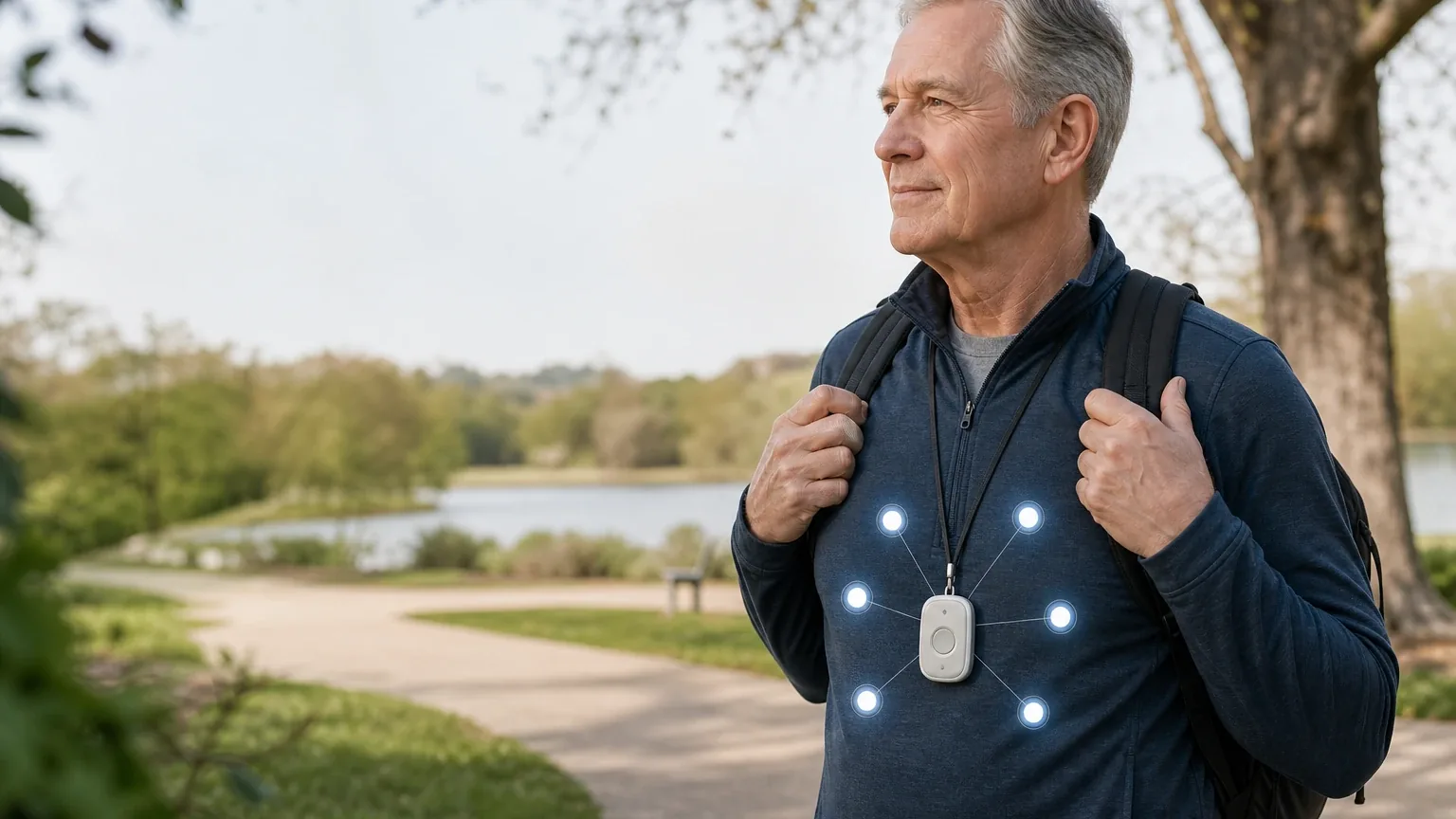
The relevant configuration is the MGMini mobile medical alert device with 24/7 monitoring and optional fall detection. Platforms described it as a small pendant-style wearable that can also be clipped to a belt, with cellular connectivity, GPS location support, two-way voice, and water resistance [1]. Several platforms also referenced adjacent Medical Guardian products in the same response, including MGMini Lite, MGMove, and Guardian Flex, but those are separate devices with different pricing and battery characteristics and should not be treated as the same product [2].
Platform-reported product descriptions vary in detail. One platform described the device as weighing 1.72 ounces (deepseek:MG1); another described it as 1.28 ounces and roughly 2.15 by 1.3 by 0.57 inches (grok:0, grok:2); another described it as under two inches high and lighter than a small egg (anthropic:26-8). These are platform-reported figures and were not independently reconciled.
What the AI Platforms Agreed About
Questions This Section Answers
- What do AI platforms agree the Medical Guardian MGMini does well for active seniors?
- Do AI platforms agree the Medical Guardian MGMini has multi-day battery life?
Platforms broadly agreed on the core capability set for on-the-go use. Agreement was strong on portability, location technology, two-way voice, and water resistance; it was weaker on battery duration and pricing.
- Portability. Platforms consistently described MGMini as small, lightweight, and wearable as a pendant or belt clip, suited to walking, driving, errands, and travel [3].
- Location technology. Multiple platforms reported GPS combined with Wi-Fi and cellular positioning [5].
- Two-way voice. Platforms agreed the device has an integrated microphone and speaker for communication with a monitoring center [7].
- Water resistance. Platforms agreed on an IP67 rating suitable for shower use but not submersion or swimming [5].
- Monitoring. Platforms agreed the device connects to 24/7 monitoring, with one platform citing TMA Five Diamond certification for Medical Guardian's monitoring centers [9].
- No smartphone required. One platform stated the device operates independently with an embedded cellular SIM and does not require a smartphone (anthropic:4-16, anthropic:2-3).
Where the AI Platforms Disagreed or Were Uncertain
Questions This Section Answers
- Why do AI platforms disagree about Medical Guardian MGMini battery life and pricing?
- Is Medical Guardian MGMini fall detection reliable enough for an active senior living alone?
Disagreement and uncertainty clustered around five areas. These conflicts are material for a buyer and should be resolved directly with the seller.
Battery life. Claims ranged from 24 hours to five days. One platform reported a 24-hour standby figure (deepseek:MG1); another reported up to three days (anthropic:5-1, anthropic:8-1); others reported four days (anthropic:3-2, grok:0); and company documentation states up to five days [11]. One platform noted that company materials themselves list both three and five days [14]. Variation likely reflects signal strength, GPS polling, call frequency, and fall detection, but no standardized test was supplied.
Pricing. The ranking-stage figure was $199.95 for the device plus $38.95 per month, with fall detection adding $10 per month (deepseek:MG1). Other platforms reported $149.95 upfront with monitoring from $39.95 per month [15], and one reported device prices around $149.95 or $99.95 depending on source and date [16]. One platform reported a monthly range of $39.95 to $43.95 depending on billing frequency [15].
Fall detection. Company materials describe 6-axis fall detection marketed as high accuracy with minimal false alarms (anthropic:25-2). Independent testing reported poor results: one tester recorded activation in only one of three simulated falls (anthropic:5-12); another reported one response across roughly a dozen convincing falls (anthropic:20-6); another reported 80% accuracy for MGMini Lite, a different device (anthropic:21-1). Company documentation also warns the feature may not detect all falls [17].
Network assignment. Platforms referenced AT&T, Verizon, and dual-carrier OmniSIM technology (anthropic:42-1, grok:15, deepseek:MG1). One platform noted it is unclear whether the device switches networks automatically or requires manual selection (kimi:mg-site-unverified).
Contract and trial terms. One platform reported month-to-month billing with cancellation at any time without penalty (anthropic:26-20, anthropic:4-2); another reported no free trial (anthropic:14-10, anthropic:45-6); another could not verify contract, cancellation, refund, or trial terms for the exact plan [11]. Official-site excerpts retrieved for this study include a footnote stating cancellation fees may apply and that additional pendants are not free on certain annual orders (official:C1, official:C3).
Use-Case-Specific Features and Capabilities
Questions This Section Answers
- Does the Medical Guardian MGMini have GPS accurate enough for walking, driving, and travel?
- Is the Medical Guardian MGMini water-resistant enough to wear in the shower?
Cellular network reliability. MGMini uses 4G LTE cellular connectivity with a supplied SIM [18]. Company materials describe OmniSIM access to both AT&T and Verizon networks (anthropic:42-1). Coverage quality varies by location, and nationwide availability should not be treated as universal service [18].
GPS location precision. The device supports GPS, Wi-Fi, and cellular triangulation [20]. One independent tester described location tracking as accurate and reported that monitoring agents located users during test calls (anthropic:1-13). One platform reported hourly GPS updates (anthropic:5-1). A documented limitation: GPS cannot measure elevation, which complicates locating the correct floor in multi-story buildings (anthropic:1-15, anthropic:1-16). No published accuracy guarantee was found [18].
Two-way audio clarity. The device has an integrated microphone and speaker [18]. Independent reviewers generally described audio as clear or intelligible [21]. One tester reported an average response time of eight seconds across ten test calls (anthropic:11-6); another reported 15 seconds for Guardian Flex, a different device (anthropic:28-10). One platform could not locate independent audio-clarity testing for MGMini [22].
Water resistance. IP67, described as shower-safe but not for submersion, salt water, chlorinated water, or prolonged immersion [20].
Portability. Small, lightweight, wearable as a pendant or belt clip [24].
Battery life. Company documentation states up to five days with roughly three to four hours of charging time [18]. Independent testing reported approximately four days [24]. Actual life may decline with frequent calls, location use, weak signal, or fall detection [18].
Fall detection. Optional, listed at $10 per month [25]. Company materials warn it may not detect all falls [26].
Monitoring. 24/7 monitoring center connection via the help button or optional fall-detection alert [27]. No guaranteed emergency-response time or guaranteed dispatch was established in the supplied materials [27].
Pricing, Fees, Contracts, and Ongoing Costs
Questions This Section Answers
- How much does Medical Guardian MGMini cost per month, and are there setup or cancellation fees?
- What is the cheapest Medical Guardian MGMini plan for an active senior who travels?
Pricing is the least settled part of the evidence. The ranking-stage figure was $199.95 for the device plus $38.95 per month, with fall detection adding $10 per month (deepseek:MG1). Other platforms reported $149.95 upfront with monitoring from $39.95 per month [29], and one reported device prices around $149.95 or $99.95 depending on source and date [30]. One platform reported a monthly range of $39.95 to $43.95 depending on billing frequency [29].
| Cost item | Reported figure | Source |
|---|---|---|
| Device | $199.95 | (deepseek:MG1) |
| Device | $149.95 | (anthropic:20-1), (grok:1), [29] |
| Device | ~$99.95 or $149.95 depending on source/date | [30] |
| Base monitoring | $38.95/month | (deepseek:MG1) |
| Base monitoring | $39.95/month | (anthropic:23-9), (grok:1) |
| Base monitoring | $39.95–$43.95/month by billing frequency | [29], (grok:3) |
| Fall detection | +$10/month | [31], (anthropic:25-1), (deepseek:MG1) |
| OnGuard text alerts | $2.99/month | (anthropic:26-20), [29] |
| Protection plan | $6.99/month | (anthropic:26-20), [29] |
| Shipping | ~$12.50 cited by one reviewer | (anthropic:26-20), (grok:3) |
Contract terms are also inconsistent. One platform reported month-to-month billing with cancellation at any time without penalty (anthropic:26-20, anthropic:4-2). Another could not verify contract length, cancellation procedure, prorated refunds, or equipment-return requirements for the exact MGMini plan [32]. Official-site excerpts retrieved for this study include a footnote stating cancellation fees may apply and that additional pendants are not free on certain annual orders (official:C1, official:C3). One platform reported no free trial (anthropic:14-10, anthropic:45-6), while competitors were described as offering 15-day and 30-day trials (anthropic:45-7). Pricing confidence across platforms was low to moderate.
Best Suited For
Questions This Section Answers
- Who is the Medical Guardian MGMini best suited for among active older adults?
- Is Medical Guardian MGMini a good choice for a senior who travels and walks outdoors daily?
MGMini is best suited to active older adults who want a small pendant-style device rather than a smartwatch, who may be away from home for several days and prefer fewer charging cycles, and who want 24/7 professional monitoring with GPS/Wi-Fi/cellular location support and caregiver-app features [33]. It also suits buyers who will press the help button themselves rather than depend on automatic fall detection [34], and buyers with adequate AT&T or Verizon coverage in their regular travel areas (anthropic:42-1, anthropic:12-13). One platform noted the device does not require a smartphone (anthropic:4-16).
Probably Not Best Suited For
Questions This Section Answers
- Who should not choose the Medical Guardian MGMini for on-the-go and active mobility?
- Is Medical Guardian MGMini a poor choice for a senior in a rural area with weak cellular coverage?
Buyers who prioritize verified automatic fall-detection performance above portability and battery life should look elsewhere, given independent testing concerns (anthropic:5-12, anthropic:20-6, anthropic:29-6). Buyers who regularly enter areas with weak AT&T or Verizon coverage are also poorly served, since the device depends on cellular connectivity (anthropic:12-13, anthropic:12-17). Buyers seeking the lowest upfront and recurring cost, or a clearly documented risk-free trial, should compare alternatives (anthropic:12-14, anthropic:14-10). Buyers who want a smartwatch form factor with activity and health features should consider MGMove instead [35].
When Another Option May Be Better
Questions This Section Answers
- What is a better alternative to Medical Guardian MGMini for a buyer who needs reliable fall detection?
- When should a buyer choose MGMini Lite or MGMove instead of the standard MGMini?
Platforms identified several substitution scenarios. Choose MGMini Lite or another wrist-worn alert when the buyer dislikes pendants or wants a watch-like form factor, while noting its shorter battery life [36]. Choose a competing device when independent fall-detection testing matters more than multi-day battery [36]. Choose a lower-cost provider when the buyer has reliable smartphone access and does not need professional monitoring [36]. Choose a device on a different cellular network when travel routes have weak coverage on the assigned network [36]. Choose a smartwatch-oriented option when broader activity, communication, or health features matter more than simplicity [36]. For rural areas without adequate cellular coverage, a landline-based system may be more appropriate (anthropic:12-18).
Questions to Verify Before Buying
Questions This Section Answers
-
What should a buyer confirm with Medical Guardian before signing up for MGMini?
-
Which cellular network will the buyer's specific MGMini unit use?
-
Which cellular network, AT&T or Verizon, will the specific MGMini unit use, and can coverage be checked against the buyer's home, travel routes, and frequent destinations? [38]
-
What is the exact all-in price today, including device fee, monitoring, fall detection, taxes, shipping, activation, and any annual-payment requirements? [38]
-
Is there a contract, minimum term, early-cancellation charge, or prorated-refund restriction? [38]
-
What is the return window, and when does billing stop after cancellation and device return? [38]
-
What real-world location accuracy should be expected indoors, in a vehicle, in rural areas, and where cellular or GPS signals are weak? [38]
-
What battery life is expected with fall detection, frequent GPS use, repeated calls, and weak signal conditions? [38]
-
Can the buyer test two-way audio outdoors and in traffic or other noisy environments? [38]
-
Is the device approved for the buyer's intended water exposure, and what damage is excluded? [40]
-
What happens if the device loses cellular service, runs out of battery, is powered off, or cannot obtain a location fix? [38]
-
Does the exact plan include caregiver location and status features, and are there separate app charges? [38]
-
What documented fall-detection limitations and false-alarm procedures apply to the exact MGMini model? [42]
Final AI Consensus Verdict
Medical Guardian MGMini is a good fit for active older adults who need a portable, GPS-capable, professionally monitored alert device with strong claimed battery life and shower resistance. All seven platforms that named it in the ranking stage included it, with an average listed rank of 2.57 and a best rank of 1. The strongest reason to consider it is the combination of a compact wearable form factor, multi-technology location support, IP67 water resistance, and a claimed multi-day battery. The main reasons not to rate it strong are uncertain current pricing and terms, network dependence, no published GPS-accuracy guarantee, and independent concerns about automatic fall-detection reliability. Buyers should verify pricing, network assignment, contract terms, and fall-detection expectations directly before purchase.
How This Review Was Produced
This review was produced from platform fit-research responses collected on 2026-09-26 for the topic "Best Medical Alert Systems for Active Seniors," use case "On-the-Go & Active Mobility," geography United States. Seven platforms were configured and all seven named Medical Guardian MGMini during ranking discovery. Each platform supplied a fit rating, use-case findings, pricing and terms, limitations, and questions to verify. Ratings by platform were: anthropic good, deepseek mixed, google strong, grok strong, kimi good, openai good, perplexity good. Citations are platform-reported evidence and were not independently verified by the writer stage. The supplied URLs were collected from platform responses and were not independently validated. Platform-reported research dates are provenance metadata and do not independently prove freshness. Where a platform supplied no citation for a factual claim, that claim is labeled platform-reported or unverified.
Methodology Limitations
- All included platforms evaluated fit, but platform mentions count only platforms that named the entity during ranking discovery.
- Conflicting product names, pricing, and capabilities were not resolved by guessing; conflicts are described and buyers are directed to verify.
- Official-site retrieval failed for at least one mention, and no failed fetch was used as a verified domain key.
- Company-name variants were collapsed onto one canonical brand before minimum-mentions qualification.
- Battery-life claims conflict across sources, and no standardized test was supplied.
- Fall-detection accuracy lacks consistency across independent testers, and testing methodology differences were not resolved.
- Secondary pendant cost is not disclosed by the manufacturer in the supplied materials.
- One independent test reported an app location-loading failure in a park and a big-box store; whether this is systemic or isolated is unclear.
- A shipping fee cited by one reviewer may not be standard.
- OmniSIM dual-carrier access is described as a first by the company, and the technical implementation was not independently verified in the supplied materials.
- Certification claims conflict, with one source describing CE certification and no UL certification; which certifications apply to U.S. market operations is unclear.
- No personal testing, customer experience, medical benefit, or guaranteed performance is claimed in this review.
- Platform agreement on inclusion does not prove product quality.
Explore more medical alert systems guidance in the category directory.
Sources
Company-Owned Sources
- Medical Guardian MGMini Medical Alert Device for Seniors: https://www.amazon.com/Medical-Guardian-MGMini-Water-Resistant-Emergency/dp/B0CHGXYM2X
- Amazon.com: Medical Guardian MGMini Water-Resistant Emergency Device: https://www.amazon.com/Medical-Guardian-MGMini-Water-Resistant-Emergency/dp/B0CHH7DL4Z
- Medical Guardian MGMini Product Information (site retrieval failed: https://www.medicalguardian.com/
- Terms + Conditions: https://www.medicalguardian.com/legal/terms
- Best Medical Alert Necklace | Fall Detection | Medical Guardian: https://www.medicalguardian.com/medical-alert-systems/gps-button-fall-detection
- Best Medical Alert Necklace | Fall Detection: https://www.medicalguardian.com/medical-alert-systems/mgmini
- MGMini Lite : Wearable Medical Alert Smartwatch: https://www.medicalguardian.com/medical-alert-systems/mgmini-lite
- Best Medical Alert Smartwatch | MGMove: https://www.medicalguardian.com/medical-alert-systems/smart-watch-alert-app
- Which System Is Right For: https://www.medicalguardian.com/medical-alerts
- Buyer's Guide - Medical Guardian: https://www.medicalguardian.com/pdf/Medical-Guardian-Buyers-Guide.pdf
- Medical Guardian MGMini product page: https://www.medicalguardian.com/products/mgmini
- MGMini Lite Gen. 2 Support: https://www.medicalguardian.com/support/mgmini-lite-gen2/
- MGMini Support: https://www.medicalguardian.com/support/mgmini/
- MGMini Lite Support and Fall Detection: https://www.medicalguardian.com/support/mgminilite/
- Mini Guardian Support: https://www.medicalguardian.com/support/mobile-systems/mini-guardian
- MGMini Lite Manual: Fall Detection: https://www.medicalguardian.com/support/wp-content/uploads/sites/6/2025/07/MG_New-MGMini-Lite-Manual_BWM010000_Rev10.pdf
- Mini Guardian User Manual: https://www.medicalguardian.com/wp-content/uploads/2024/12/MG_Mini-Guardian-Manual_MIM010000-1.pdf
- Official pricing and terms source: https://www.medicalguardian.com/alert-system-pricing
- Official pricing and terms source: https://www.medicalguardian.com/mobile-terms-and-conditions
Additional AI research evidence42 records
- AI research evidence record openai:c1
- AI research evidence record perplexity:c10
- AI research evidence record openai:c4
- AI research evidence record google:1.2.2
- AI research evidence record openai:c2
- AI research evidence record google:1.2.8
- AI research evidence record openai:c1
- AI research evidence record google:1.2.6
- AI research evidence record openai:c8
- AI research evidence record perplexity:c2
- AI research evidence record openai:c1
- AI research evidence record openai:c2
- AI research evidence record google:1.1.4
- AI research evidence record google:1.2.2
- AI research evidence record google:1.1.5
- AI research evidence record perplexity:c15
- AI research evidence record openai:c7
- AI research evidence record openai:c1
- AI research evidence record openai:c3
- AI research evidence record openai:c2
- AI research evidence record openai:c5
- AI research evidence record perplexity:c4
- AI research evidence record google:1.2.6
- AI research evidence record openai:c4
- AI research evidence record openai:c6
- AI research evidence record openai:c7
- AI research evidence record openai:c8
- AI research evidence record perplexity:c2
- AI research evidence record google:1.1.5
- AI research evidence record perplexity:c15
- AI research evidence record openai:c6
- AI research evidence record openai:c1
- AI research evidence record openai:c1
- AI research evidence record openai:c7
- AI research evidence record perplexity:c10
- AI research evidence record openai:c1
- AI research evidence record perplexity:c10
- AI research evidence record openai:c1
- AI research evidence record perplexity:c4
- AI research evidence record openai:c2
- AI research evidence record google:1.1.9
- AI research evidence record openai:c7
Independent Sources
- Medical Guardian Review: Honest Pros, Cons & Verdict 2026: https://elderlivinghub.com/reviews/medical-guardian-review/
- Medical Guardian MGMini Medical Alert Device User Manual: https://manuals.plus/asin/B0CHGXYM2X
- Medical Guardian Manuals & User Guides: https://manuals.plus/category/medical-guardian
- Medical Guardian MGMini User Manual: https://manuals.plus/medical-guardian/mgmini-user-manual
- Medical Guardian MGMini – MedGrade: https://medgrade.org/devices/medical-guardian-mgmini/
- Medical Guardian Medical Alert System Review 2026 | U.S. News: https://realestate.usnews.com/home-services/medical-alert-system/medical-guardian
- Medical Guardian MGMini Review 2026 | SeniorsList: https://seniorslist.com/medical-alert-systems/medical-guardian/mgmini/
- What is the battery life of the Medical Guardian MGMini?: https://shopsavvy.com/answers/what-is-the-battery-life-of-the-medical-guardian-mgmini
- Medical Guardian Review 2024: Pros, Cons, and Pricing: https://www.aginginplace.org/medical-alert-systems/medical-guardian-review/
- Medical Guardian MGMini Review - Forbes Health: https://www.forbes.com/health/l/medical-guardian-mgmini-review/
- Medical Guardian MGMini Review: Tried And Tested: https://www.forbes.com/health/medical-alert-systems/medical-guardian-mgmini-review/
- Medical Guardian Review in 2026: https://www.ncoa.org/product-resources/medical-alert-systems/medical-guardian-review/
- Medical Guardian | Review and Pricing: https://www.retirementliving.com/reviews/medical-guardian-alert-systems
- Medical Guardian MGMini Review 2026 | SafeHome.org: https://www.safehome.org/medical-alert-systems/medical-guardian/mgmini/
- Medical Guardian Review 2026 | SafeWise: https://www.safewise.com/senior-safety/medical-alerts/medical-guardian/
- Medical Guardian Cost & Pricing in 2026: https://www.seniorliving.org/medical-alert-systems/medical-guardian/
- 2026 MGMini Lite and MGMini Review | SeniorLiving.org: https://www.seniorliving.org/medical-alert-systems/medical-guardian/mgmini/
- MGMini and MGMini Lite Review - SeniorLiving.org: https://www.seniorliving.org/medical-alerts/medical-guardian/mgmini-review/
- Medical Guardian MGMini Lite Review: https://www.theseniorlist.com/medical-alert-systems/medical-guardian/mgmini-lite/
- MGMini Medical Alert Review, Tested by Caregivers (2026) - The Senior List: https://www.theseniorlist.com/medical-alert-systems/medical-guardian/mgmini-review/
- MGMini Medical Alert Review, Tested by Caregivers (2026: https://www.theseniorlist.com/medical-alert-systems/medical-guardian/mgmini/
- TMA Five Diamond Monitoring Companies Database: https://www.tma.us/
Additional AI research evidence42 records
- AI research evidence record openai:c1
- AI research evidence record perplexity:c10
- AI research evidence record openai:c4
- AI research evidence record google:1.2.2
- AI research evidence record openai:c2
- AI research evidence record google:1.2.8
- AI research evidence record openai:c1
- AI research evidence record google:1.2.6
- AI research evidence record openai:c8
- AI research evidence record perplexity:c2
- AI research evidence record openai:c1
- AI research evidence record openai:c2
- AI research evidence record google:1.1.4
- AI research evidence record google:1.2.2
- AI research evidence record google:1.1.5
- AI research evidence record perplexity:c15
- AI research evidence record openai:c7
- AI research evidence record openai:c1
- AI research evidence record openai:c3
- AI research evidence record openai:c2
- AI research evidence record openai:c5
- AI research evidence record perplexity:c4
- AI research evidence record google:1.2.6
- AI research evidence record openai:c4
- AI research evidence record openai:c6
- AI research evidence record openai:c7
- AI research evidence record openai:c8
- AI research evidence record perplexity:c2
- AI research evidence record google:1.1.5
- AI research evidence record perplexity:c15
- AI research evidence record openai:c6
- AI research evidence record openai:c1
- AI research evidence record openai:c1
- AI research evidence record openai:c7
- AI research evidence record perplexity:c10
- AI research evidence record openai:c1
- AI research evidence record perplexity:c10
- AI research evidence record openai:c1
- AI research evidence record perplexity:c4
- AI research evidence record openai:c2
- AI research evidence record google:1.1.9
- AI research evidence record openai:c7
Other Sources
- Amazon.com: Medical Guardian MGMove – Medical Alert Smartwatch for Seniors: https://www.amazon.com/Medical-Guardian-MGMove-Smartwatch-Activate/dp/B0BYTGVP4G
Additional AI research evidence42 records
- AI research evidence record openai:c1
- AI research evidence record perplexity:c10
- AI research evidence record openai:c4
- AI research evidence record google:1.2.2
- AI research evidence record openai:c2
- AI research evidence record google:1.2.8
- AI research evidence record openai:c1
- AI research evidence record google:1.2.6
- AI research evidence record openai:c8
- AI research evidence record perplexity:c2
- AI research evidence record openai:c1
- AI research evidence record openai:c2
- AI research evidence record google:1.1.4
- AI research evidence record google:1.2.2
- AI research evidence record google:1.1.5
- AI research evidence record perplexity:c15
- AI research evidence record openai:c7
- AI research evidence record openai:c1
- AI research evidence record openai:c3
- AI research evidence record openai:c2
- AI research evidence record openai:c5
- AI research evidence record perplexity:c4
- AI research evidence record google:1.2.6
- AI research evidence record openai:c4
- AI research evidence record openai:c6
- AI research evidence record openai:c7
- AI research evidence record openai:c8
- AI research evidence record perplexity:c2
- AI research evidence record google:1.1.5
- AI research evidence record perplexity:c15
- AI research evidence record openai:c6
- AI research evidence record openai:c1
- AI research evidence record openai:c1
- AI research evidence record openai:c7
- AI research evidence record perplexity:c10
- AI research evidence record openai:c1
- AI research evidence record perplexity:c10
- AI research evidence record openai:c1
- AI research evidence record perplexity:c4
- AI research evidence record openai:c2
- AI research evidence record google:1.1.9
- AI research evidence record openai:c7
Verify This Research
Review the study details behind this page or download the public machine-readable verification record.
- Study date
- September 26, 2026
- Platforms analyzed
- 7
- Source records
- 44
- Ranking mentions
- 7 of 7
- Platform share
- 100%
- Final consensus rank
- #2
Research trail and source mix
Configured platforms
openai, anthropic, deepseek, grok, perplexity, kimi, google
Source mix
22 independent · 21 company-owned · 1 unclear
Evidence support
33 direct · 10 partial
Important limitation
Use the run research_date as the study date. Platform-reported dates are provenance metadata and do not independently prove freshness.
Source snapshot SHA-256 f799efbf3fbb3f3bdb713d483d104a61d75745e4aac70ae658dce49cb7075e7e