
Answer Capsule
Yeasound RIC800 is a mixed fit for Over-the-Counter Hearing Assistance. Two of seven platforms named it during the ranking stage, at an average listed rank of 3.5 and a best rank of 3. The strongest reason to consider it is independent laboratory sound performance: HearAdvisor testing produced an A SoundGrade with a 5.0/5 feedback-handling score and strong speech-in-quiet and music-streaming results at a sub-$1,000 pair price. The main limitation is self-fitting depth: the RIC800 does not accept direct audiogram input, relies on preset-based fitting, and independent reviewers reported app and Bluetooth disconnections that required repeated resets.
Research Snapshot
| Field | Finding |
|---|---|
| Platform mentions in ranking stage | 2 of 7 platforms (anthropic, grok) |
| Share of included platform responses | 28.6% |
| Average listed rank | 3.5 |
| Best listed rank | 3 |
| Relevant product/model/plan | Yeasound RIC800 standard hearing-aid pair |
| Overall use-case fit | Mixed |
| Research date | 2026-09-27 |
What Changed Since August 2026
Yeasound RIC800 moved down from No. 6 to No. 9, and platform mentions were unchanged at 2. The September 2026 review still treats Yeasound RIC800 as a mixed fit for over-the-counter hearing assistance, with the same strongest point: independent laboratory sound performance and a sub-$1,000 pair price. The buyer-facing substance has not materially changed. Reported pricing evidence shifted, with $599 newly reported (or $1,000 as a pair figure) while the $249 to $699 range is no longer repeated. Battery expectations are also described differently: a 23-hour per-charge figure is newly reported alongside a 1–2 day shipping estimate, while the 279-hour total-with-case figure is no longer repeated. Self-fitting depth remains the main limitation. Differences between the two editions reflect what each article reports; they do not by themselves prove that the product, service, or price changed.
The August 2026 review preserves the earlier article for reference.
Why Yeasound RIC800 Qualified for This Study
Questions This Section Answers
- Is Yeasound RIC800 a good choice for Over-the-Counter Hearing Assistance for a senior buyer?
- How many AI platforms named Yeasound RIC800 in the ranking stage of this study?
Yeasound RIC800 qualified because it met the study's minimum-mention threshold of two platforms during ranking discovery, not because every platform endorsed it. Two of seven included platforms named the entity in their ranked lists: anthropic placed it at rank 4 and grok placed it at rank 3, producing an average listed rank of 3.5 and a best listed rank of 3 [1]. Its share of included platform responses was 28.6%.
The remaining five platforms — openai, deepseek, perplexity, kimi, and google — evaluated the RIC800 for fit but did not name it during the ranking stage. That distinction matters: fit evaluation and ranking discovery are separate steps, and a platform can assess a product without placing it in a ranked list. The study counted only ranking-stage mentions toward qualification.
Qualification also reflects the product's stated category position. The RIC800 is presented as an FDA-registered, non-prescription OTC hearing aid intended for adults with perceived mild-to-moderate hearing loss [2]. The FDA established the OTC hearing aid category for adults with perceived mild-to-moderate hearing loss, which is the regulatory context this use case sits inside (deepseek:fda-otc). OTC status does not establish that the device suits every hearing profile or medical situation.
The Product, Model, Plan, or Service Most Relevant to Over-the-Counter Hearing Assistance
Questions This Section Answers
- Which Yeasound RIC800 configuration is the one evaluated for Over-the-Counter Hearing Assistance?
- Does the Yeasound RIC800 standard pair include a charging case and ear domes at the listed price?
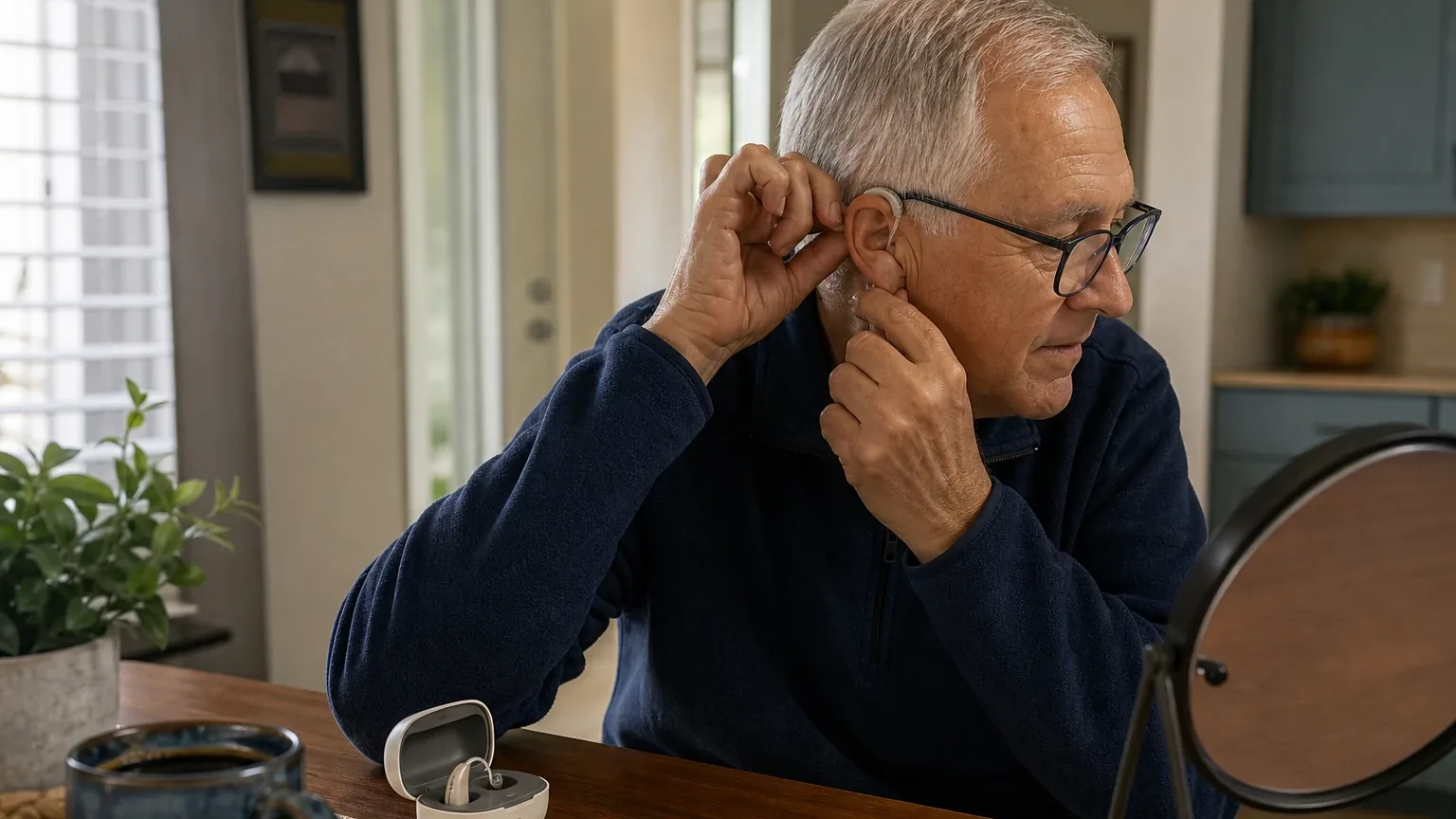
The relevant configuration is the Yeasound RIC800 standard hearing-aid pair — a rechargeable receiver-in-canal (RIC) device sold direct to consumers, with no subscription tier or multi-plan structure identified in the sources checked [4]. Every platform that named a product named this same pair; there is no separate premium hardware SKU in the supplied evidence.
The RIC800 is a lightweight receiver-in-canal design that independent reviewers described as discreet and generally comfortable for extended wear [7]. It supports iOS and Android Bluetooth streaming, with a dual-chip architecture that dedicates one chip to hearing processing and another to Bluetooth [9]. Company materials claim Bluetooth range up to 10 meters [9].
Included accessories reported across sources include a USB-C charging case, multiple dome sizes, wax guards, a cleaning brush, a receiver-wire sizing tool, and a USB-C cable [5]. The charging case reportedly provides approximately three full recharges [4]. The device carries an IPX8 waterproof rating, and company materials state it is designed without metal charging contacts to reduce rust and skin-irritation risk [5].
One naming caveat: the entity is consistently called "Yeasound RIC800," but the companion app is referred to as the "iYeasound app" in one platform's findings (openai). Buyers should confirm the current app name at setup.
What the AI Platforms Agreed About
Questions This Section Answers
- What did the AI platforms agree on about Yeasound RIC800 sound performance for over-the-counter hearing assistance?
- Do the platforms agree that Yeasound RIC800 supports both iPhone and Android Bluetooth streaming?
Platforms broadly agreed on four points: independent laboratory sound performance is strong, the hardware is a rechargeable RIC with dual-platform Bluetooth, the pair price sits in the low-to-mid OTC range, and self-fitting is preset-based rather than audiogram-based.
On sound performance, HearAdvisor laboratory testing produced an A SoundGrade with a SoundScore reported at 4.7/5, including speech-in-quiet at 4.4/5, music streaming at 4.3/5, and feedback handling at 5.0/5 [11]. HearAdvisor reportedly placed the device in the top 2% of OTC hearing aids tested [11]; one platform reported a top-5% placement instead (google:cit_headsetadvisor_review). Both figures come from the same review ecosystem and should be treated as approximate.
On connectivity, platforms agreed the RIC800 supports iOS MFi and Android ASHA streaming [14]. On price, the official product page displayed $549 for the pair at the time checked [16], with other public listings reported between $599 and $699 (openai, anthropic, perplexity). On fitting, platforms agreed the device uses preset profiles rather than audiogram import [17].
Agreement among AI platforms is not evidence of product quality. It reflects overlapping source material, much of which traces back to the same independent review sites.
Where the AI Platforms Disagreed or Were Uncertain
Questions This Section Answers
- Is the Yeasound RIC800 return window 100 days or 45 days, and why do sources conflict?
- How long does the Yeasound RIC800 battery actually last with Bluetooth streaming?
Platforms disagreed or reported unresolved conflicts on four material points: return window, battery runtime, price, and overall fit rating.
Return window. Yeasound's product page advertises a 100-day no-reason return period [19]. Yeasound's own after-sales policy page states a 45-day trial/return window and notes Amazon-channel differences [22]. Consumer Reports lists a 45-day trial [23]. The official terms-of-service page retrieved for this study references a 100-day trial period applicable once per device model, with refunds not credited back to a credit card in at least one stated condition (official:C2). This is a direct conflict between company-owned pages, not merely a company-versus-reviewer dispute.
Battery runtime. Yeasound advertises up to 31 hours per charge, while the product specification section also lists 23 hours [19]. WIRED measured a maximum of approximately 18 hours under mixed hearing-enhancement and Bluetooth use [25]. HearingTracker reportedly confirmed the 31-hour claim is achievable for hearing-only use but degrades with streaming [27]. One platform reported 18 hours streaming within a 100-hour total-with-case figure (google:cit_earcandy_product).
Price. Reported figures include $549 [19], $599 (anthropic), $659–$699 [28], and a $799 list price with $549–$699 promotional range (google). Pricing confidence was rated moderate by two platforms and low by two others.
Fit rating. Platforms split: grok rated the fit "strong," anthropic, google, and perplexity rated it "good," openai rated it "mixed," and deepseek and kimi rated it "uncertain" (fit_ratings_by_platform). Kimi reported finding no independent reviews of the RIC800 at all, which conflicts with the independent coverage other platforms cited (kimi:search_gap_1). That discrepancy most likely reflects search coverage differences rather than the absence of reviews.
Use-Case-Specific Features and Capabilities
Questions This Section Answers
- Does the Yeasound RIC800 app support audiogram import for personalized fitting?
- What sound customization controls does the Yeasound RIC800 app offer for a senior with mild-to-moderate hearing loss?
Self-fitting is the RIC800's weakest area relative to this use case. The app includes an in-app hearing test that can establish a baseline in approximately five minutes, which makes initial self-fitting relatively accessible [29]. However, the device does not accept direct audiogram input, and independent reviewers describe it as preset-based with limited optimization range [29]. HearAdvisor testing reportedly showed no difference between initial and tuned fits, indicating limited room for personalization beyond the preset baseline [31].
Sound customization in manual modes includes five programs (Adaptive, General, Noisy, Music, Outdoors), a 3-band equalizer, speech-focus mode, microphone directionality, and a fine-tuning wizard [30]. The Adaptive mode performed well in independent testing but omits some manual controls, including the equalizer [29]. One platform described three default frequency-response shapes rather than five programs (anthropic), a minor internal inconsistency in the supplied findings.
App and Bluetooth reliability is a documented limitation. Independent testing found pairing manageable but somewhat involved, while WIRED reported frequent app and Bluetooth disconnections that sometimes required three to four resets per day and app force-quits [32]. HearingTracker noted the app is not the snappiest for constant tweaking [30].
Comfort and form factor drew positive assessments. Reviewers described the RIC800 as lightweight, discreet, and generally comfortable over lengthy sessions [34]. Own-voice perception (occlusion) scored 2.1/5 in HearAdvisor lab testing, below the reported category average of 2.51, meaning some users may perceive a plugged-up quality during speech [31]. Dome choice — open versus closed — reportedly affects this (anthropic).
Speech-in-noise performance was above the category average but only mixed in absolute terms, at 2.4/5 in HearAdvisor testing [31]. This limits suitability for loud restaurants, traffic, and crowds.
Pricing, Fees, Contracts, and Ongoing Costs
Questions This Section Answers
- How much does the Yeasound RIC800 cost per pair, and are there subscription or cancellation fees?
- What ongoing replacement costs should a senior expect after buying the Yeasound RIC800?
The RIC800 is a one-time purchase with no subscription fee identified in the sources checked (openai, anthropic). The official product page displayed $549 for the pair at the time checked [35]. Other public listings and reviews reported approximately $599 to $699 depending on seller, promotion, and date [36]. One platform reported a $799 list price with a $549–$699 promotional range (google). Buyers should confirm the checkout price on their purchase date.
Shipping is advertised as free by Yeasound, but taxes and any seller-specific charges should be confirmed at checkout (openai). One platform reported free 1–2 day US shipping (anthropic). No restocking fee was identified, though one platform flagged possible restocking fees as unclear (deepseek).
Ongoing costs include replacement consumables. An independent Consumer Reports listing estimated approximately $48 annually for domes, wax guards, and similar items, though actual prices vary [37]. Electricity and USB-C charging are minor ongoing costs (openai).
The official terms-of-service page retrieved for this study lists specific out-of-warranty service fees: minor repairs at $18 and major repairs at $45, with the customer paying shipping and Yeasound covering return shipping (official:C2). The same page lists a hearing-aid replacement fee of $307 per unit under the basic plan, limited to one paid replacement within the warranty period, and a $66 premium protection plan extending warranty coverage to three years with a lower $239-per-unit replacement fee for the RIC700 (official:C2). These figures come from a retrieved official page that was not independently verified, and they should be confirmed against current terms before purchase.
Warranty terms are stated as one year on the device [35]. The official terms page also states that the agreement is governed by the laws of the People's Republic of China, excluding conflict-of-laws principles (official:C2) — a term US buyers should read carefully.
Best Suited For
Questions This Section Answers
- Who gets the most value from the Yeasound RIC800 for over-the-counter hearing assistance?
- Is the Yeasound RIC800 a good fit for a senior who wants Bluetooth calls and music streaming?
The RIC800 best suits tech-comfortable adults with perceived mild-to-moderate hearing loss who want a discreet, rechargeable RIC pair with Bluetooth streaming at a sub-$1,000 price and are willing to self-fit with presets (openai, anthropic, grok, google).
Specific fits named across platforms:
- Adults with perceived mild-to-moderate loss who want a discreet rechargeable RIC design (openai).
- Buyers who value Bluetooth calls and music on both iOS and Android (openai, anthropic).
- Buyers prioritizing measured speech-in-quiet, feedback handling, and streaming performance at a low pair price [39].
- Users willing to rely on self-fitting, presets, and limited remote support rather than in-person fitting (openai).
- Budget-conscious seniors comfortable with DIY app-based fitting (anthropic).
- Seniors who want high water resistance, since the device carries an IPX8 rating (google, anthropic).
Probably Not Best Suited For
Questions This Section Answers
- Who should not choose the Yeasound RIC800 for over-the-counter hearing assistance?
- Is the Yeasound RIC800 a poor choice for a senior who cannot troubleshoot Bluetooth disconnections?
The RIC800 is probably not the best choice for buyers whose needs center on simplicity, verified battery performance, or precise fitting.
Named exclusions across platforms:
- Seniors who need the simplest possible setup and are unlikely to troubleshoot app or Bluetooth disconnections (openai, anthropic).
- Buyers requiring precise audiogram-based programming or extensive professional onboarding (openai, anthropic, google).
- Buyers for whom independently verified battery performance close to the advertised maximum is essential (openai, anthropic).
- People with suspected severe, asymmetric, rapidly worsening, painful, or medically complicated hearing loss (openai).
- Users in very loud environments, given mixed speech-in-noise performance (anthropic, grok).
- Buyers who need verified, conflict-free return terms before purchase (perplexity).
- Buyers who rely on independently verified performance data, per the platform that found no independent reviews (kimi).
When Another Option May Be Better
Questions This Section Answers
- What is a better alternative to the Yeasound RIC800 for a senior who needs audiogram-based fitting?
- Is a cheaper OTC hearing aid than the Yeasound RIC800 available for a budget under $400?
Several platforms named specific alternatives and the conditions that favor them.
For audiogram-based fitting and professional verification, prescription hearing aids from Costco or a local audiologist were suggested, with prescription devices reported at roughly $1,500–$2,500 at Costco and $2,000–$7,000 generally (anthropic, kimi:forbes_costs). Prescription devices include customized fitting and ongoing support (kimi:forbes_costs, kimi:audiology_guide).
For buyers uncomfortable with app-based technology, earbud-style OTC aids such as Jabra Enhance or button-only devices without heavy app dependency were suggested (anthropic). JLab HEAR was cited as a preset-program alternative with a 30-day trial and roughly 10-hour battery, but with no professional support and an IPX4 rating (kimi:jlab_review).
For budget under $400, the Yeasound RIC700 Plus was named at $399 on sale, described as offering nearly identical features except iOS-only Bluetooth, AI noise reduction, and tinnitus relief for about $200 less (anthropic). MDHearing NEO was cited at $297 per pair with a 60-day trial, one-year warranty, and free lifetime support (kimi:mdhearing_neo). ELEHEAR Beyond Pro was cited at $599 with app customization, a 24-hour battery, Bluetooth 5.3, and a HearAdvisor A SoundGrade (kimi:elehear_review). Go Ultra OTC BTE was cited with a 20-hour battery, four preset programs, a 45-day return, and Bluetooth streaming (kimi:go_ultra).
For extended trial confidence, NCOA guidance recommends trial periods of at least 45 days and preferably 100 days (kimi:ncoa_roundup).
Questions to Verify Before Buying
Questions This Section Answers
- What should a buyer confirm with Yeasound about the RIC800 return window before ordering?
- Which Yeasound RIC800 support and programming services cost extra beyond the purchase price?
The supplied research produced a consistent list of verification items. Buyers should confirm each in writing before ordering.
- What is the exact pair price, including tax and shipping, on the checkout date? (openai, anthropic, perplexity)
- Is the applicable return period 100 days or 45 days, and are all accessories, packaging, and usage conditions covered? (openai, anthropic, perplexity, official:C2)
- Who pays return shipping, and are there restocking or nonrefundable fees? (openai, deepseek)
- What battery runtime should be expected with Bluetooth streaming, phone calls, and high amplification? (openai, anthropic)
- Does the buyer's exact iPhone or Android model support all advertised Bluetooth functions, including ASHA streaming? (openai, anthropic, google)
- Can Yeasound accept and use an audiogram remotely, despite the app not supporting direct audiogram entry? (openai, anthropic)
- What professional support is included at no charge, and what support or programming incurs additional fees? (openai, anthropic)
- What are the replacement prices and availability for receivers, domes, wax guards, and charging cases? (openai, official:C2)
- What warranty exclusions apply to battery degradation, water exposure, loss, accidental damage, and accessories? (openai, official:C2)
- What is the procedure if the buyer experiences feedback, discomfort, poor speech understanding, or suspected worsening hearing? (openai)
- Have recent firmware updates resolved the app disconnection issues reported in independent testing? (anthropic)
- Does the app support the buyer's phone model and current OS version? (perplexity)
Final AI Consensus Verdict
The consensus is a mixed fit, not a clear recommendation. Yeasound RIC800 offers strong independent laboratory sound performance, a rechargeable RIC form factor, dual-platform Bluetooth streaming, and a relatively low pair price. It falls short for this use case on self-fitting depth, app reliability, battery-claim accuracy, and return-term clarity.
Platform fit ratings split across the range: one strong, three good, one mixed, and two uncertain. That spread is itself the finding. Buyers who are comfortable troubleshooting Bluetooth and app issues, accept preset-based fitting without audiogram programming, and verify the return window in writing before ordering have a defensible option. Buyers who need simple setup, precise audiogram-based customization, verified battery performance, or unambiguous return terms should look at better-documented alternatives first.
The two internal reference points for this category are the Over-the-Counter Hearing Assistance consensus index and the broader senior technology directory.
How This Review Was Produced
This review synthesizes fit-research responses from seven AI platforms — openai, anthropic, deepseek, grok, kimi, google, and perplexity — each of which evaluated Yeasound RIC800 against the Over-the-Counter Hearing Assistance use case and the category criteria: self-fitting ease, app setup quality, sound customization, return window, rechargeable battery life, comfort, price, and customer support access. Two of the seven named the entity during the ranking stage, which is the qualification threshold for this study. Platform responses were collected on the research date of 2026-09-27. All factual claims are cited to the platform that supplied them. Company-owned sources are distinguished from independent sources in the Sources section below.
Methodology Limitations
Several limitations apply to this review.
Platform-reported research dates differ from the authoritative run date. Anthropic and deepseek reported a research date of 2026-01-15, while the remaining platforms reported 2026-09-27. Platform-reported dates are provenance metadata and do not independently prove freshness.
Platform mentions count only platforms that named the entity during ranking discovery. Five of the seven included platforms evaluated fit without naming the RIC800 in a ranked list. Missing research is not disagreement.
Conflicting product details, pricing, and capabilities were not resolved by guessing. Where sources conflict — return window, battery runtime, price, and app program count — the conflict is described and the buyer is directed to verify.
The supplied URLs were collected from platform responses and were not independently validated by the writer stage. Citations are platform-reported evidence, not independently verified facts.
One platform (deepseek) ran without search enabled, so its findings rest on model knowledge rather than retrieved sources and require explicit verification before being treated as current facts. One platform (kimi) reported finding no independent reviews of the RIC800, which conflicts with independent coverage cited by other platforms; this most likely reflects search coverage differences.
Public review scores and customer testimonials are not equivalent to controlled evidence of individual hearing outcomes. No personal testing, customer experience, medical benefit, or guaranteed performance is claimed in this review.
See the broader Seniors consensus index for comparisons across qualified options.
Sources
Company-Owned Sources
- YeaSound After-Sales Policy: https://support.yeasound.com/After-Sales-Policy
- Shop the MDHearing® NEO - Tiny Rechargeable Hearing Aid: https://www.mdhearingaid.com/hearing-aids/mdhearing-neo-vip
- Yeasound Official Website: https://www.yeasound.com/
- HearingTracker named Yeasound RIC800 2025 Best OTC Hearing: https://www.yeasound.com/blogs/news/hearingtracker-named-yeasound-ric800-2025-best-otc-hearing-aids
- RIC800 Dual-Chip: A Dedicated Bluetooth Chip: https://www.yeasound.com/blogs/news/ric800-dual-chip
- RIC800 Dual-Chip: A Dedicated Bluetooth Chip - Yeasound Blog: https://www.yeasound.com/blogs/yeasound-audio-technology/ric800-dual-chip-a-dedicated-bluetooth-chip
- Yeasound RIC800 OTC Hearing Aids with AI Noise Reduction: https://www.yeasound.com/products/yeasound-ric800-otc-hearing-aids
- Official pricing and terms source: https://www.yeasound.com/policies/terms-of-service
Additional AI research evidence39 records
- AI research evidence record anthropic:c2
- AI research evidence record openai:c4
- AI research evidence record anthropic:c1
- AI research evidence record openai:c4
- AI research evidence record anthropic:c1
- AI research evidence record perplexity:c1
- AI research evidence record openai:c2
- AI research evidence record openai:c3
- AI research evidence record anthropic:c6
- AI research evidence record anthropic:c2
- AI research evidence record anthropic:c4
- AI research evidence record openai:c2
- AI research evidence record perplexity:c4
- AI research evidence record anthropic:c1
- AI research evidence record anthropic:c6
- AI research evidence record openai:c4
- AI research evidence record openai:c1
- AI research evidence record anthropic:c2
- AI research evidence record openai:c4
- AI research evidence record anthropic:c1
- AI research evidence record perplexity:c1
- AI research evidence record perplexity:c2
- AI research evidence record openai:c5
- AI research evidence record anthropic:c5
- AI research evidence record openai:c3
- AI research evidence record anthropic:c3
- AI research evidence record anthropic:c2
- AI research evidence record perplexity:c4
- AI research evidence record openai:c1
- AI research evidence record anthropic:c2
- AI research evidence record anthropic:c4
- AI research evidence record openai:c3
- AI research evidence record anthropic:c3
- AI research evidence record openai:c2
- AI research evidence record openai:c4
- AI research evidence record perplexity:c4
- AI research evidence record openai:c5
- AI research evidence record anthropic:c1
- AI research evidence record anthropic:c4
Independent Sources
- Bargain: Auracast hearing aids for under £600 thanks to Yeasound RIC800: https://aurahear.com/yeasound-ric800-launch/
- Yeasound RIC 800 OTC Hearing Aids: Affordable Clarity for Everyday Life: https://headsetadvisor.com/blogs/blog/yeasound-ric-800-otc-hearing-aids
- The Audiologist's Guide to Hearing Aids, Personal Sound Amplification Products, Hearables, and Over-the-Counter Devices: https://www.audiology.org/wp-content/uploads/2022/03/Audiologists-Guide-to-OTCs_Updated-March-2022.pdf
- FDA - Over-the-Counter (OTC) Hearing Aids: https://www.fda.gov/medical-devices/hearing-aids/over-counter-otc-hearing-aids
- Hearing Aids Costs And Financing Options – Forbes Health: https://www.forbes.com/health/hearing-aids/actual-cost-of-hearing-aids/
- Yeasound RIC800 Expert Review: https://www.hearadvisor.com/products/yeasound-ric800
- Yeasound RIC800 comparison pages: https://www.hearingtracker.com/hearing-aids/compare/philips-hearlink-9050-minirite-vs-yeasound-ric800
- Yeasound RIC700 vs. Yeasound RIC800 - Hearing Tracker: https://www.hearingtracker.com/hearing-aids/compare/yeasound-ric700-vs-yeasound-ric800
- Elehear Beyond Pro Review: Top OTC Hearing Aid, Lab Tested: https://www.hearingtracker.com/hearing-aids/elehear-beyond-pro
- JLab Hear OTC Hearing Aid | Reviews, Prices & Sound Samples: https://www.hearingtracker.com/hearing-aids/jlab-hear-otc
- Yeasound RIC800: Audiologist and Lab Reviewed: https://www.hearingtracker.com/hearing-aids/yeasound-ric800
- The 4 Best Over-the-Counter (OTC) Hearing Aids in 2026: https://www.ncoa.org/product-resources/hearing-aids/best-over-the-counter-hearing-aids/
- Yeasound Hearing Aid Review (2026): Yeasound RIC800: https://www.ncoa.org/product-resources/hearing-aids/yeasound-review/
- Review: Yeasound RIC800 Hearing Aids: https://www.wired.com/review/yeasound-ric800-hearing-aids/
Additional AI research evidence39 records
- AI research evidence record anthropic:c2
- AI research evidence record openai:c4
- AI research evidence record anthropic:c1
- AI research evidence record openai:c4
- AI research evidence record anthropic:c1
- AI research evidence record perplexity:c1
- AI research evidence record openai:c2
- AI research evidence record openai:c3
- AI research evidence record anthropic:c6
- AI research evidence record anthropic:c2
- AI research evidence record anthropic:c4
- AI research evidence record openai:c2
- AI research evidence record perplexity:c4
- AI research evidence record anthropic:c1
- AI research evidence record anthropic:c6
- AI research evidence record openai:c4
- AI research evidence record openai:c1
- AI research evidence record anthropic:c2
- AI research evidence record openai:c4
- AI research evidence record anthropic:c1
- AI research evidence record perplexity:c1
- AI research evidence record perplexity:c2
- AI research evidence record openai:c5
- AI research evidence record anthropic:c5
- AI research evidence record openai:c3
- AI research evidence record anthropic:c3
- AI research evidence record anthropic:c2
- AI research evidence record perplexity:c4
- AI research evidence record openai:c1
- AI research evidence record anthropic:c2
- AI research evidence record anthropic:c4
- AI research evidence record openai:c3
- AI research evidence record anthropic:c3
- AI research evidence record openai:c2
- AI research evidence record openai:c4
- AI research evidence record perplexity:c4
- AI research evidence record openai:c5
- AI research evidence record anthropic:c1
- AI research evidence record anthropic:c4
Other Sources
- Yeasound RIC800 - EarCandy: https://myearcandy.com/products/yeasound-ric800
- Go Ultra OTC BTE Hearing Aids | AARP® Hearing Solutions™ provided by UnitedHealthcare Hearing: https://www.aarphearingsolutions.com/PDT-40631.html
Additional AI research evidence39 records
- AI research evidence record anthropic:c2
- AI research evidence record openai:c4
- AI research evidence record anthropic:c1
- AI research evidence record openai:c4
- AI research evidence record anthropic:c1
- AI research evidence record perplexity:c1
- AI research evidence record openai:c2
- AI research evidence record openai:c3
- AI research evidence record anthropic:c6
- AI research evidence record anthropic:c2
- AI research evidence record anthropic:c4
- AI research evidence record openai:c2
- AI research evidence record perplexity:c4
- AI research evidence record anthropic:c1
- AI research evidence record anthropic:c6
- AI research evidence record openai:c4
- AI research evidence record openai:c1
- AI research evidence record anthropic:c2
- AI research evidence record openai:c4
- AI research evidence record anthropic:c1
- AI research evidence record perplexity:c1
- AI research evidence record perplexity:c2
- AI research evidence record openai:c5
- AI research evidence record anthropic:c5
- AI research evidence record openai:c3
- AI research evidence record anthropic:c3
- AI research evidence record anthropic:c2
- AI research evidence record perplexity:c4
- AI research evidence record openai:c1
- AI research evidence record anthropic:c2
- AI research evidence record anthropic:c4
- AI research evidence record openai:c3
- AI research evidence record anthropic:c3
- AI research evidence record openai:c2
- AI research evidence record openai:c4
- AI research evidence record perplexity:c4
- AI research evidence record openai:c5
- AI research evidence record anthropic:c1
- AI research evidence record anthropic:c4
Verify This Research
Review the study details behind this page or download the public machine-readable verification record.
- Study date
- September 27, 2026
- Platforms analyzed
- 7
- Source records
- 25
- Ranking mentions
- 2 of 7
- Platform share
- 29%
- Final consensus rank
- #9
Research trail and source mix
Configured platforms
openai, anthropic, deepseek, grok, perplexity, kimi, google
Source mix
15 independent · 8 company-owned · 2 unclear
Evidence support
22 direct · 3 partial
Important limitation
Use the run research_date as the study date. Platform-reported dates are provenance metadata and do not independently prove freshness.
Source snapshot SHA-256 5bd0159d193d789a87bfb8277b565915ea98643e187e575bd455e7f2bca6906d
Archived editions
Browse earlier published research snapshots for this article. The latest edition remains at the current URL.