
Answer Capsule
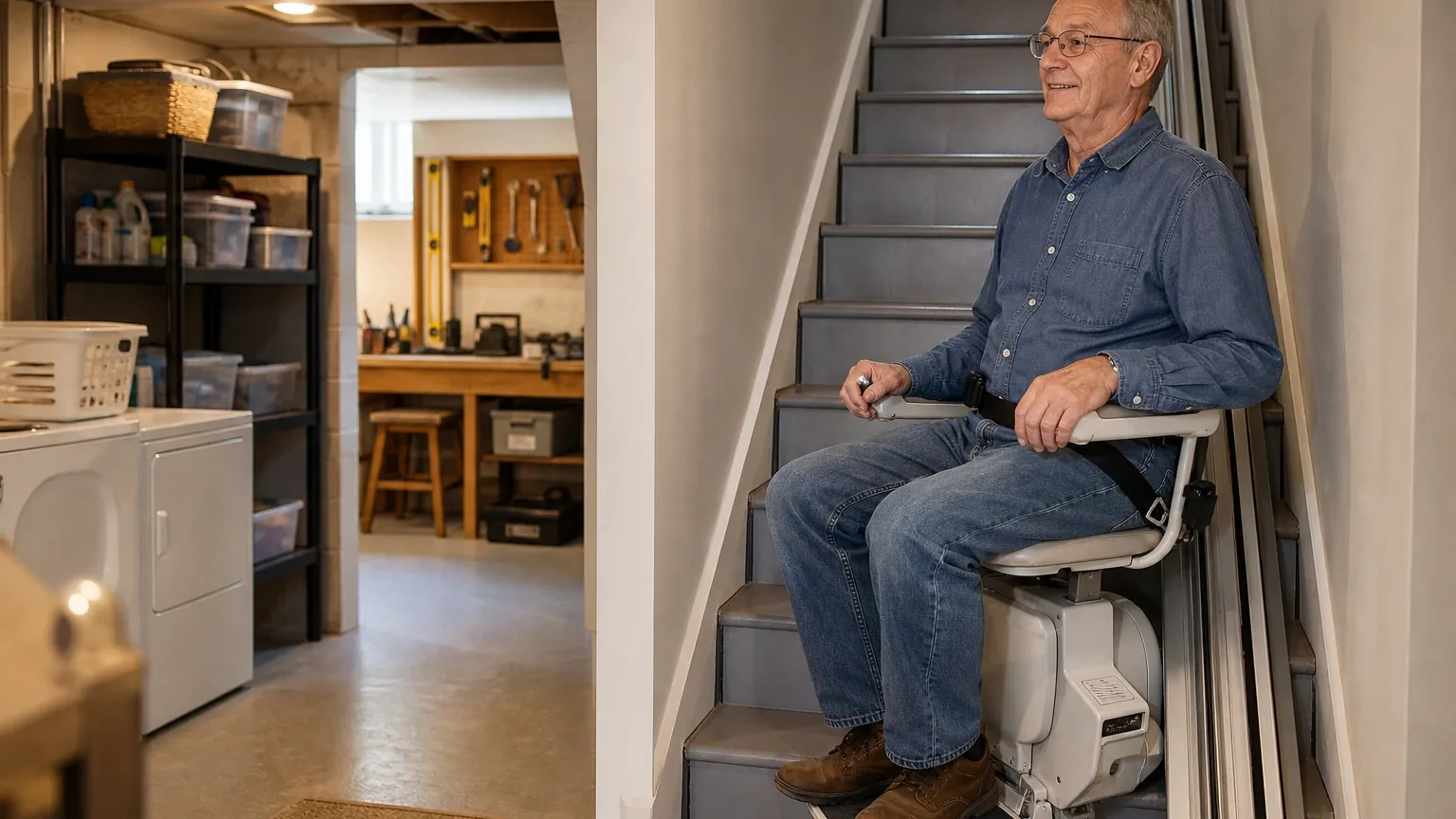
The Acorn 130 Straight Stairlift is a good fit for a dry, indoor basement with one straight stair flight and adequate landing and headroom clearance. Three of seven platforms named it during the ranking stage, at an average listed rank of 2.33 and a best rank of 2. Its strongest case rests on straight-stair compatibility, tread-mounted rail installation, obstruction detection, battery operation, and an optional hinged rail for doorway obstructions. The main limitation is that Acorn does not publish a maximum stair pitch, a low-ceiling clearance calculation, or a moisture or damp-environment rating for the indoor 130, so steep-stair fit, damp-basement durability, and total installed cost remain unresolved until the home survey and written quote.
Research Snapshot
| Field | Finding |
|---|---|
| Platform mentions in ranking stage | 3 of 7 platforms (deepseek, openai, perplexity) |
| Share of included platform responses | 42.9% |
| Average listed rank | 2.33 |
| Best listed rank | 2 |
| Relevant product/model/plan | Acorn 130 Straight Stairlift, with optional hinged rail where a basement doorway or walkway obstruction exists |
| Overall use-case fit | Good for dry, straight, indoor basement stairs; mixed or unclear for damp, steep, low-ceiling, or turning staircases |
| Research date | 2026-09-27 |
What Changed Since August 2026
Acorn 130 Straight Stairlift moved down from No. 3 to No. 4, and platform mentions decreased from 6 to 3. The September 2026 review still describes the Acorn 130 Straight Stairlift as a good fit for a dry, straight, indoor basement staircase, so buyer fit and the recommended configuration are unchanged. The main substantive shift is pricing transparency: roughly $350 for the optional hinged rail is newly reported, while an installed estimate of $2,500 to $5,500 is no longer repeated. Installation time is now given as 1 to 2 hours for typical jobs and 4 to 5 hours for complex ones, and quote validity is described as 30 days, replacing the earlier rail-length mention. Unresolved dampness, pitch, headroom, and total-cost questions remain. Differences between the two editions reflect what each article reports; they do not by themselves prove that the product, service, or price changed.
The August 2026 review preserves the earlier article for reference.
Why Acorn 130 Straight Stairlift Qualified for This Study
Questions This Section Answers
- Why did Acorn 130 Straight Stairlift qualify for a basement stairlift study instead of a general stairlift review?
- How many AI platforms named Acorn 130 Straight Stairlift for basement stairs, and at what rank?
The Acorn 130 Straight Stairlift qualified because it is a straight-rail model aimed at exactly the staircase type most basement utility access involves: a single, continuous flight. Three of the seven included platforms named it during the ranking stage — deepseek at rank 3, openai at rank 2, and perplexity at rank 2 — producing an average listed rank of 2.33 and a best listed rank of 2. Its platform share was 42.9%, meaning a minority of included platforms surfaced it by name in the ranking stage even though all seven platforms evaluated fit for this use case.
The model's relevance to basement access is structural rather than marketing-driven. Acorn describes the 130 as designed for straight staircases, with the rail mounted to the staircase rather than the wall and no structural changes required [1]. That matters in basements where wall finishes, foundation walls, or structural conditions make wall anchoring unattractive. Acorn also publishes an optional hinged rail intended to clear a doorway or walkway obstruction at the foot of the stairs, which is a common basement landing condition [1].
Qualification does not equal endorsement. Every platform that evaluated the 130 for this use case flagged at least one unresolved basement-specific factor, most often damp-environment durability, steep-stair pitch limits, or low-ceiling clearance. The model earned its place in the study because it is a plausible straight-stair candidate, not because the evidence establishes it as the best basement stairlift.
The Product, Model, Plan, or Service Most Relevant to Basement Access & Utility Stairs
Questions This Section Answers
- Which Acorn 130 Straight Stairlift configuration should a buyer choose for a basement landing with a doorway obstruction?
- Is the Acorn 130 Straight Stairlift or the Acorn 180 Curved Stairlift the right model for a basement staircase with turns or landings?
The relevant configuration is the Acorn 130 Straight Stairlift, optionally specified with a hinged rail when the basement landing has a doorway or walkway obstruction. Every platform that named a product for this use case named the 130 as the primary option, and five of seven also named the Acorn 180 Curved Stairlift as the alternative when the basement staircase turns, bends, or includes an intermediate landing [3].
Published dimensions for the 130 include an overall height of 38.5 inches, a seat height of 17.25 inches, an overall width of 23.25 inches, and a folded depth of 12.25 inches [5]. Acorn states that approximately 26 inches of stair width is needed for comfortable swiveling at the top landing [6], and one regional Acorn site states a minimum staircase width of 66.04 centimeters, or 26.25 inches, for the same purpose [7]. Acorn's Canadian site lists supported staircase angles by seat post: short seat post 40–55 degrees, standard seat post 29–55 degrees, and tall seat post 23–55 degrees [8].
The hinged rail is the configuration detail most specific to basement utility access. Acorn describes it as a folding rail option that removes an obstacle or trip hazard at the foot of the stairs [9], and independent reseller material lists the manual hinged rail at approximately $350 [10]. Whether a hinged rail is required, and what it costs in a given home, is a quote item rather than a published price.
What the AI Platforms Agreed About
Questions This Section Answers
- What did the AI platforms agree on about Acorn 130 Straight Stairlift for basement stairs?
- Does the Acorn 130 Straight Stairlift work during a power outage on a basement staircase?
Agreement was strong but not unanimous on four points. First, the 130 is a straight-stair-only model, and a basement staircase with turns, curves, or intermediate landings falls outside its intended application and points to the Acorn 180 [11]. Second, the lift runs on a 24V DC battery system with backup operation, so it can continue working during a mains power interruption [13]. Third, obstruction detection is a published safety feature: the 130 manual describes carriage safety pads and footrest safety edges that stop the stairlift on contact, along with seat-swivel, final-limit, overspeed, and arm-interlock systems [16], and independent reseller material describes five safety sensors on the carriage and footrest [17]. Fourth, the rail attaches to the stairs rather than the wall and requires no structural changes [13].
Platforms also converged on the practical value of the hinged rail for basement landings with a door or corridor at the foot of the stairs [13]. On pricing structure, platforms agreed that Acorn does not publish a fixed U.S. installed price and instead routes buyers through a free home survey and personalized quote [20].
Agreement among platforms reflects shared source material more than independent verification. Company-owned citations materially outnumber independent citations in this evidence set, and several platforms relied on Acorn's own pages for the features they described.
Where the AI Platforms Disagreed or Were Uncertain
Questions This Section Answers
- What is the maximum stair pitch the Acorn 130 Straight Stairlift supports on steep basement stairs?
- Is the Acorn 130 Straight Stairlift rated for a damp or humid basement?
The largest unresolved question is steep-stair fit. Acorn's U.S. materials reviewed do not specify a maximum stair pitch, minimum tread depth, or tested steep-stair range for the 130 [21], and deepseek reported that it could not verify a supported pitch or angle range from public sources (deepseek:acorn-straight). Acorn's Canadian site does publish seat-post-dependent angle ranges of 23–55 degrees [23], but whether that range applies to the U.S. configuration and to steeper basement flights is not established in the reviewed material. One platform noted that Basement Stairs commonly exceed 45–50 degrees and that exact angle fit requires surveyor assessment [23].
Damp-environment durability is the second unresolved question. The 130 is presented as an indoor stairlift, and Acorn publishes weather-resistant language for its separate outdoor model rather than establishing equivalent protection for the indoor 130 [21]. No platform located a moisture, condensation, humidity, flood, or ingress-protection rating for the indoor 130 [26]. One user manual instructs dry-cloth cleaning only and prohibits damp cloth with abrasive cleaner [26].
Low-ceiling clearance is the third. Acorn publishes lift dimensions but not a low-ceiling clearance calculation or minimum overhead height [21], and multiple platforms reported that headroom requirements are not publicly disclosed and require on-site measurement (kimi:acorn_site_2026, deepseek:acorn-straight).
Weight capacity produced a direct factual conflict. Acorn's product page lists a 280-pound maximum capacity [21], while some independent sources report 300 pounds [29] and others reference an HD version at 350 pounds [29]. The official product specification should control, and the quoted configuration's capacity should be confirmed in writing.
Warranty terms also conflicted. Acorn describes a 12-month manufacturer warranty covering parts, labor, callouts, and a first-year scheduled service, subject to terms [32], while some dealer listings reference a 5-year warranty [26]. Whether the longer term is standard or retailer-specific is unclear.
Use-Case-Specific Features and Capabilities
Questions This Section Answers
- Does the Acorn 130 Straight Stairlift have obstruction sensors suitable for a basement staircase with stored items?
- How much stair width does the Acorn 130 Straight Stairlift need for a basement installation?
Straight-stair compatibility and rail installation are the 130's core advantages for basement access. The rail mounts to the staircase rather than the wall and is advertised as requiring no structural changes, which suits basements where wall finishes or structural conditions are a concern [34]. The model is purpose-built for straight stairs and is described as suitable for many narrow stairways [34].
Narrow-stair and landing clearance is documented but conditional. Acorn states the 130 needs approximately 26 inches of stair width for comfortable swiveling [36], with a regional site stating 26.25 inches [37]. Published dimensions list approximately 23.25 inches overall width and 12.25 inches folded depth [34]. Actual basement landing clearance still requires an on-site survey.
Obstruction detection is a documented advantage. The 130 manual describes carriage safety pads and footrest safety edges that stop the stairlift when they contact obstructions, plus seat-swivel, final-limit, overspeed, and arm-interlock safety systems [39]. Independent reseller material describes five safety sensors on the carriage and footrest [40]. This matters on basement stairs where laundry baskets, storage items, or clutter may encroach on the rail.
Battery backup and charging are documented. The 130 uses a 24V DC battery system with backup-battery operation, and the user guide instructs users to keep the lift switched on while parked at a charging point and to move it to a charge point to avoid battery drain [34]. Public materials describe backup-battery operation but do not provide a guaranteed number of trips during an outage [34].
Seat belt and seating are neutral findings. A retractable seat belt is standard and must be worn during operation [39], and Acorn describes an inertia seatbelt fitted as standard [43]. The available documentation confirms the belt requirement but does not independently establish comfort across body sizes, dexterity limitations, or clothing [39].
Service access is a documented advantage with an unresolved cost. Acorn states that its U.S. technicians service lifts, recommends annual servicing, and offers 365-day help-desk access [45]. The standard new-lift warranty is described as 12 months and includes callouts, parts, labor, and a first-year scheduled service, subject to terms and conditions [46]. One independent source cites an annual service agreement of approximately $890 per year after the first year [47], but Acorn does not publish U.S. service or extended-warranty pricing in the reviewed materials.
Installation timing is a company estimate. Acorn states that typical installation takes 1 to 2 hours, with more complex installations taking 4 to 5 hours [48]. Independent sources describe straight-staircase installations completing in 2–4 hours, same day [49]. These are estimates rather than guaranteed schedules for a particular basement.
Pricing, Fees, Contracts, and Ongoing Costs
Questions This Section Answers
- How much does Acorn 130 Straight Stairlift cost installed for a basement staircase, and is the price published?
- What ongoing service, battery, and extended-warranty costs should a basement stairlift buyer expect after the Acorn 130 warranty ends?
Acorn does not publish a fixed U.S. installed price for the 130. Acorn's official position is that pricing depends on staircase configuration and requires a survey and quotation [50], and the company promotes a free home assessment and personalized quote rather than a published list price (deepseek:acorn-cost). The home survey and quote are described as no-obligation [50].
Independent installed-price estimates vary widely and should be treated as quote-based market estimates rather than Acorn price guarantees. One independent 2026 review reported approximately $2,800–$3,600 installed for a typical straight staircase [51]. Other independent sources cite $3,000–$5,000 installed [52], a starting price of $2,488 [55], and a range of $2,500–$5,000 fully installed [56]. One source itemized a unit at $4,595 plus $300 installation and roughly $459 sales tax, totaling about $5,354, with a quote valid for 30 days [57]. Another cited base unit ranges of $3,000–$8,000 plus installation labor of $1,000–$5,000 [58]. The spread across these figures is itself the finding: buyers cannot budget from published numbers alone.
Known and potential additional costs include the optional hinged rail, estimated at approximately $350 [55]; potential charges for nonstandard electrical, access, landing, or remediation work [50]; sales tax of roughly 5–10% depending on state [59]; and possible permit or licensed-engineer inspection fees that are state-dependent and typically the homeowner's responsibility [59]. Certified pre-owned units have been listed at approximately 50% discount [57].
Ongoing costs are the least transparent part of the purchase. Acorn recommends annual servicing [60], and one user manual describes mandatory annual professional inspection and bimonthly user inspections [59]. One independent source cites an extended service plan at approximately $890 per year after the first year and battery replacements at approximately $300 every two years [56]. Acorn does not publish U.S. annual service or extended-warranty prices in the reviewed materials [61].
Contract and cancellation terms were not verified. The standard manufacturer warranty is 12 months from installation, subject to terms and conditions [61]. Specific purchase cancellation, refund, removal, relocation, finance, and service-contract terms were not verified in the reviewed public sources [50]. One Acorn page states quoted pricing can remain valid for up to 12 months [62], while another source describes a 30-day quote validity [57] — a conflict buyers should resolve in writing.
Best Suited For
Questions This Section Answers
- Who is the Acorn 130 Straight Stairlift best suited for in a basement access situation?
- Is the Acorn 130 Straight Stairlift a good choice for a senior who needs routine access to a basement laundry room or workshop?
The 130 is best suited to a dry, indoor basement with a single straight stair flight, adequate stair width, and adequate headroom, where the buyer wants a battery-backed lift with obstruction sensing and manufacturer service. Acorn's own materials support straight-stair compatibility, tread-mounted rail installation without structural changes, battery operation, obstruction detection, and an optional hinged rail for landing obstructions [63].
It also suits homes where the rail should attach to stair treads rather than the wall, and where a hinged rail can clear a doorway or walkway obstruction at the basement stair foot [63]. Buyers who value manufacturer-employed installation and service over third-party subcontracting are a reasonable match, since Acorn states its U.S. technicians service lifts and offers 365-day help-desk access [66].
Seniors needing routine access to laundry rooms, storage areas, workshops, or lower-level living spaces on a straight staircase are the target buyer for this configuration [65]. The fit is strongest when the basement is dry, the stair geometry is standard, and the buyer is prepared to confirm pitch, headroom, width, and moisture conditions during the survey.
Probably Not Best Suited For
Questions This Section Answers
- Who should not choose the Acorn 130 Straight Stairlift for a damp or flood-prone basement?
- Is the Acorn 130 Straight Stairlift a poor choice for a basement staircase with turns, landings, or very low headroom?
The 130 is probably not the right choice for a basement staircase with turns, bends, or intermediate landings. The Acorn 180 is the relevant Acorn alternative for curved stairs, turns, and landings [68].
It is also a weak fit for damp, condensating, flood-prone, or unheated basements unless Acorn confirms environmental suitability in writing. The 130 is presented as an indoor stairlift, and the reviewed materials do not state a moisture-resistance, condensation, flood, or humidity rating [70]. One user manual prohibits damp-cloth cleaning [72].
Buyers who need published installed pricing or detailed low-ceiling and steep-stair clearance data before requesting a survey are poorly served by this model, because Acorn routes pricing through a survey and quote [73] and does not publish a low-ceiling clearance calculation or maximum stair pitch for the U.S. 130 [70].
Users whose weight, body dimensions, transfer needs, or low-ceiling geometry exceed the 130's verified fit should look elsewhere or confirm an HD configuration, given the 280-pound product-page capacity and the conflicting 300-pound and 350-pound figures in independent and reseller sources [70]. Buyers who require a longer standard warranty than 12 months, or who want transparent annual service pricing before purchase, should weigh competing options [77].
When Another Option May Be Better
Questions This Section Answers
- When is the Acorn 180 Curved Stairlift a better choice than the Acorn 130 for a basement staircase?
- What should a buyer choose instead of the Acorn 130 Straight Stairlift if their basement is damp or their stairs are exceptionally steep?
Choose the Acorn 180 Curved Stairlift when the basement staircase has turns, bends, or intermediate landings. Acorn describes the 180 as using a modular rail configured for curved staircases and offering a hinged-rail option where an opening or doorway creates an obstruction [79]. Independent sources place curved Acorn pricing substantially higher, at roughly $8,000–$15,000 or more installed [80].
Consider an outdoor-rated or explicitly moisture-resistant stairlift when the basement environment has persistent dampness, condensation, or flood exposure, because the indoor 130's environmental suitability is not established [82]. Acorn publishes weather-resistant features for its separate outdoor model rather than the indoor 130 [83].
Consider a different model or lift type when the user's weight, body dimensions, transfer needs, or low-ceiling geometry exceed the 130's verified fit [82]. One platform suggested a standing or perch stairlift or a platform lift where ceiling height is severely constrained, and a through-floor lift or home elevator where stair width is inadequate (kimi:acorn_site_2026).
Compare dealer-supported alternatives when independently serviceable local support, transparent pricing, or longer standard warranty coverage matters more than direct manufacturer sales. One platform noted that competitors offer higher standard weight capacities and longer base warranties, making brands such as Bruno or Handicare more attractive for those priorities [81]. Another noted that buyers who want a published, comparable price before installation or independently verified durability testing may prefer a different route (deepseek:acorn-cost).
Questions to Verify Before Buying
Questions This Section Answers
- What measurements and specifications should a buyer confirm with Acorn before signing a basement stairlift contract?
- What warranty, service, and cancellation terms should a buyer get in writing before purchasing an Acorn 130 Straight Stairlift?
The platforms converged on a verification list that buyers should resolve in writing before committing. Confirm the measured stair pitch, tread depth, narrowest width, and required head clearance at every point, and whether the 130 fits the basement stair geometry without reducing required walking or emergency egress space [87]. Confirm that the quoted rail length and configuration suit the exact top and bottom landings [87].
Confirm whether the basement's humidity, condensation, temperature, or flood risk requires an outdoor-rated or specially protected model, since no moisture rating is published for the indoor 130 [89]. Confirm whether a hinged rail is required, its exact installed price, and its folded position [91].
Confirm the exact maximum user weight for the quoted 130 configuration, including any HD version distinction, given the 280-pound product-page figure and conflicting 300-pound and 350-pound reports [91]. Confirm how many trips the battery provides during a power outage and where the charging points are [94]. Confirm seat, armrest, seat-belt, and swivel dimensions for the intended user [95].
Confirm what parts, labor, callouts, batteries, and travel charges are covered during and after the 12-month warranty, and what the annual service and extended-warranty prices, response-time commitments, exclusions, and cancellation terms are [97]. Confirm who will install and service the lift locally and the expected response time for a basement breakdown [99]. Confirm whether the quote includes electrical work, removal of an old lift, permits if applicable, delivery, installation, tax, and stair or landing modifications [100].
Final AI Consensus Verdict
The Acorn 130 Straight Stairlift is a good fit for a dry, indoor basement with one straight stair flight and adequate landing and headroom clearance, and a mixed or unclear fit for damp, steep, low-ceiling, or turning staircases. Three of seven platforms named it during the ranking stage at an average listed rank of 2.33 and a best rank of 2. Platform fit ratings split four good (openai, deepseek, perplexity, google) to three mixed (anthropic, grok, kimi), which reflects the same unresolved variables rather than a disagreement about the product's basic design.
The strongest reason to consider it is the combination of straight-stair compatibility, tread-mounted rail installation without structural changes, published obstruction detection, battery operation, and an optional hinged rail that addresses a common basement landing obstruction [101]. The main limitation is documentation, not design: Acorn does not publish a maximum stair pitch, a low-ceiling clearance calculation, or a moisture or damp-environment rating for the indoor 130, and installed pricing is quote-only [101].
Buyers should treat steep-stair fit, low-ceiling clearance, damp-environment durability, total installed cost, and long-term service pricing as unresolved until documented in the home survey and written quote. If the basement stairs turn, bend, or include an intermediate landing, the Acorn 180 is the relevant Acorn alternative [106]. This review covers the Acorn 130 only for Basement Access & Utility Stairs; the broader category comparison is maintained in the Basement Access & Utility Stairs consensus index, and additional model-level reviews are available in the stairlifts category directory.
How This Review Was Produced
This review was produced from platform-reported fit research collected for the Basement Access & Utility Stairs use case within the Best Stairlifts for Basement Stairs topic. Seven platforms evaluated fit: openai, anthropic, deepseek, grok, perplexity, kimi, and google. Three of those seven — deepseek, openai, and perplexity — named the Acorn 130 Straight Stairlift during the ranking stage, which is why the entity qualified under the study's minimum-mentions threshold.
Each platform supplied a fit rating, use-case findings by criterion, pricing and terms information, limitations, alternative recommendations, and questions to verify before buying. The criteria assessed were rail fit on steep stairs, low-ceiling clearance, damp-environment durability, obstruction sensors, seat belt comfort, battery backup, service access, and installation price. Findings were consolidated by criterion, and disagreements were preserved rather than averaged.
Citations are platform-reported evidence, not independently verified facts. Company-owned citations materially outnumber independent citations in this evidence set, and several platform findings rest on Acorn's own product pages, manuals, and service pages. No platform reported physical testing of the Acorn 130 in a basement installation, and no independent durability or moisture testing was located.
Methodology Limitations
Several limitations apply to this review. Platform-reported research dates differ from the authoritative run date of 2026-09-27: anthropic reported 2026-01-10 and deepseek reported 2026-06-01, while openai, perplexity, grok, kimi, and google reported 2026-09-27. Platform-reported dates are provenance metadata and do not independently prove freshness.
The supplied URLs were collected from platform responses and were not independently validated by the writer stage. Citations are platform-reported evidence, not independently verified facts, and no-search model claims require explicit verification before being described as current facts. Deepseek's research ran with search disabled, so its findings are platform-reported rather than retrieved.
Platform mentions count only platforms that named the entity during ranking discovery; all seven included platforms evaluated fit, but only three named the entity in the ranking stage. Missing research was not treated as disagreement, and no platform's silence was interpreted as a negative finding.
Conflicting product names, pricing, and capabilities were not resolved by guessing. The 280-pound versus 300-pound versus 350-pound capacity conflict, the 12-month versus 5-year warranty conflict, and the 30-day versus 12-month quote-validity conflict are described as conflicts and flagged for buyer verification. Independent installed-price ranges are based on reported quotes and submissions rather than a published Acorn price list. Acorn states that specifications may change without notice, so buyers should obtain the current written specification with the quote.
Sources
Company-Owned Sources
- Quick User Guide 130 Straight: https://acornstairlifts.com/F509.0.1-Quick-User-Guide.pdf
- Outdoor Stairlifts: https://acornstairlifts.com/stairlift/stairlift-outdoor-staircase
- Straight Stairlifts | Acorn 130 | Acorn Stairlifts AU: https://www.acorn-stairlifts.au/stairlift/straight
- Straight Stairlift | Acorn 130 | Acorn Stairlifts USA: https://www.acorn-stairlifts.com/stairlift/straight
- Straight Stairlifts | Acorn 130 Straight Stairlift | Acorn Stairlifts CA: https://www.acornstairlifts.ca/stairlift/stairlift-straight-staircase
- Acorn Stairlifts — Free Home Assessment: https://www.acornstairlifts.com/
- Acorn 130 User Manual: https://www.acornstairlifts.com/assets/130/22-078_AC_TC_130%20user%20manual_0225_ENG.pdf
- Acorn Stairlift Spotlight of the Week: Acorn 130 Straight Stairlift: https://www.acornstairlifts.com/blog/post/3903/FAQ/Acorn-Stairlift-Spotlight-of-the-Week:-Acorn-130-Straight-Stairlift
- How Wide Do Staircases Need to Be for a Stairlift?: https://www.acornstairlifts.com/blog/post/4831/Tips-and-Advice/Acorn-Stairlift-FAQ-of-the-Week%E2%80%94How-Wide-Do-Staircases-Need-to-Be-for-a-Stairlift
- How to Measure Stairs for a Stairlift: https://www.acornstairlifts.com/blog/post/6802/Tips-and-Advice/How-to-Measure-Stairs-for-a-Straight-vs-Curved-Stairlift-
- How Much Are Stairlifts?: https://www.acornstairlifts.com/faqs/how-much-are-stairlifts
- How Much Does it Cost to Install a Stairlift?: https://www.acornstairlifts.com/faqs/how-much-does-it-cost-to-install-a-stairlift
- Leading Stairlift Manufacturer - Acorn Stairlifts: https://www.acornstairlifts.com/stairlift/acorn-stairlifts
- Curved Stairlifts | Acorn 180 Curved Stairlift: https://www.acornstairlifts.com/stairlift/stairlift-curved-staircase
- Stairlift Warranties & Guarantees: https://www.acornstairlifts.com/stairlift/stairlift-extended-warranties/
- Outdoor Stairlifts: Costs & Installation: https://www.acornstairlifts.com/stairlift/stairlift-outdoor-staircase
- Stairlift Service & Repairs: https://www.acornstairlifts.com/stairlift/stairlift-servicing
- Acorn 130 Straight Stairlift: https://www.acornstairlifts.com/stairlift/stairlift-straight-staircase
- Acorn 130 Straight Stairlift: https://www.acornstairlifts.com/stairlift/stairlift-straight-staircase/scid/11020
- Acorn Stairlifts — Curved Stairlifts: https://www.acornstairlifts.com/stairlifts/curved-stairlifts/
- Acorn Stairlifts — Straight Stairlifts: https://www.acornstairlifts.com/stairlifts/straight-stairlifts/
Additional AI research evidence106 records
- AI research evidence record openai:c1
- AI research evidence record perplexity:c1
- AI research evidence record openai:c10
- AI research evidence record perplexity:c7
- AI research evidence record anthropic:c1
- AI research evidence record openai:c8
- AI research evidence record anthropic:c5
- AI research evidence record anthropic:c3
- AI research evidence record perplexity:c1
- AI research evidence record anthropic:c7
- AI research evidence record openai:c10
- AI research evidence record perplexity:c7
- AI research evidence record openai:c1
- AI research evidence record anthropic:c2
- AI research evidence record grok:c3
- AI research evidence record openai:c2
- AI research evidence record anthropic:c6
- AI research evidence record anthropic:c7
- AI research evidence record perplexity:c1
- AI research evidence record openai:c12
- AI research evidence record openai:c1
- AI research evidence record openai:c9
- AI research evidence record anthropic:c3
- AI research evidence record anthropic:c8
- AI research evidence record openai:c7
- AI research evidence record anthropic:c2
- AI research evidence record perplexity:c4
- AI research evidence record anthropic:c1
- AI research evidence record anthropic:c6
- AI research evidence record anthropic:c7
- AI research evidence record google:1.2.3
- AI research evidence record openai:c5
- AI research evidence record google:1.2.1
- AI research evidence record openai:c1
- AI research evidence record perplexity:c1
- AI research evidence record openai:c8
- AI research evidence record anthropic:c5
- AI research evidence record anthropic:c1
- AI research evidence record openai:c2
- AI research evidence record anthropic:c6
- AI research evidence record anthropic:c7
- AI research evidence record openai:c3
- AI research evidence record perplexity:c4
- AI research evidence record anthropic:c2
- AI research evidence record openai:c4
- AI research evidence record openai:c5
- AI research evidence record google:1.2.1
- AI research evidence record openai:c6
- AI research evidence record anthropic:c10
- AI research evidence record openai:c12
- AI research evidence record openai:c11
- AI research evidence record anthropic:c10
- AI research evidence record perplexity:c2
- AI research evidence record google:1.2.2
- AI research evidence record anthropic:c7
- AI research evidence record google:1.2.1
- AI research evidence record anthropic:c9
- AI research evidence record anthropic:c8
- AI research evidence record anthropic:c2
- AI research evidence record openai:c4
- AI research evidence record openai:c5
- AI research evidence record perplexity:c1
- AI research evidence record openai:c1
- AI research evidence record openai:c2
- AI research evidence record perplexity:c1
- AI research evidence record openai:c4
- AI research evidence record anthropic:c6
- AI research evidence record openai:c10
- AI research evidence record perplexity:c7
- AI research evidence record openai:c1
- AI research evidence record openai:c7
- AI research evidence record anthropic:c2
- AI research evidence record openai:c12
- AI research evidence record openai:c9
- AI research evidence record anthropic:c6
- AI research evidence record anthropic:c7
- AI research evidence record openai:c5
- AI research evidence record google:1.2.1
- AI research evidence record openai:c10
- AI research evidence record anthropic:c10
- AI research evidence record google:1.2.1
- AI research evidence record openai:c1
- AI research evidence record openai:c7
- AI research evidence record perplexity:c5
- AI research evidence record anthropic:c1
- AI research evidence record google:1.2.3
- AI research evidence record openai:c9
- AI research evidence record anthropic:c3
- AI research evidence record openai:c7
- AI research evidence record anthropic:c2
- AI research evidence record openai:c1
- AI research evidence record anthropic:c7
- AI research evidence record anthropic:c6
- AI research evidence record openai:c3
- AI research evidence record openai:c2
- AI research evidence record anthropic:c1
- AI research evidence record openai:c5
- AI research evidence record google:1.2.1
- AI research evidence record openai:c4
- AI research evidence record openai:c12
- AI research evidence record openai:c1
- AI research evidence record openai:c2
- AI research evidence record perplexity:c1
- AI research evidence record openai:c9
- AI research evidence record openai:c12
- AI research evidence record openai:c10
Independent Sources
- Acorn 130 Stairlift User Manual: https://ableplus.ie/wp-content/uploads/2022/04/Acorn-Stairlifts-User-Manuals-130.pdf
- Affordable Acorn Stairlifts: https://aplusstairlifts.net/acorn-stairlifts-pittsburgh/
- Acorn Stair Lift Cost: Price Guide for U.S. Buyers – Current Cost: https://currentcost.org/acorn-stair-lift-cost-price-u-s-buyers/
- Discount Stair Lifts | Vertical Mobility Lifts - Acorn 130 Indoor: https://discountmobilitylifts.com/acorn_130_indoor
- Acorn 130 Stair Lift Review (2026): Price, Warranty, Verdict: https://homeaccessadvisor.com/stair-lifts/acorn-130-review
- Best Brands Acorn: https://modernize.com/stair-lifts/best-brands/acorn
- Acorn Stairlifts Review: https://seniorsbulletin.ca/acorn-stairlifts-review/
- AmeriGlide Stairlifts Acorn 130 Dimensions and Standards: https://vertexaisearch.cloud.google.com/grounding-api-redirect/AUZIYQGmkUvAogenzAv2Lf06VHOyLLGwzTK3MByDMcPM11J3LBp4J7HUQTKdg5v3VZkEYz3_-Yf3cDMqhcDCnX6Lrx72NhcdiwjUXWVhL2XHDtk_OYZlrcZbf9msbqGnaL9UxDudKbM5PbuDS0gmvg==
- Acorn 130 Superglide User Manual Catalog: https://vertexaisearch.cloud.google.com/grounding-api-redirect/AUZIYQHQZ9Jw3lMefgRxdTZT1XrVFH6LR0cQ9ArFZ01WKksdjTQ788b3RQL_WJ5c8C_Idk2zIVtOEKCnZS8LS2ArUyZwgWutGq-3drvJfV8l-CJtboZSa27szwubY3dlB6CMDBVj2JBAHv9yaWbUmKWgsbw0X6v-WyjAkRzvy72No6-EnQZ7Uq016UQ4L579-YigmKhS_uWkc0xBbaqJSEd67Nc=
- Acorn Stairlift Review (2026): 130, 180, and Outdoor Models | AgeInPlaceGuide.com: https://www.ageinplaceguide.com/acorn-stairlift-review
- Used Acorn Stair Lifts 1/2 OFF Regular Price | Latexpedic: https://www.latexpedic.com/Acorn.html
- Bruno vs. Acorn Stair Lifts – Which is the Better ... - Lifeway Mobility: https://www.lifewaymobility.com/resources/product-guides/bruno-vs-acorn-stair-lifts/
- Acorn Stair Lifts Review 2025: https://www.ncoa.org/adviser/mobility/acorn-stair-lifts-review/
- How Much Do Stair Lifts Cost?: https://www.retirementliving.com/stair-lifts/cost
Additional AI research evidence106 records
- AI research evidence record openai:c1
- AI research evidence record perplexity:c1
- AI research evidence record openai:c10
- AI research evidence record perplexity:c7
- AI research evidence record anthropic:c1
- AI research evidence record openai:c8
- AI research evidence record anthropic:c5
- AI research evidence record anthropic:c3
- AI research evidence record perplexity:c1
- AI research evidence record anthropic:c7
- AI research evidence record openai:c10
- AI research evidence record perplexity:c7
- AI research evidence record openai:c1
- AI research evidence record anthropic:c2
- AI research evidence record grok:c3
- AI research evidence record openai:c2
- AI research evidence record anthropic:c6
- AI research evidence record anthropic:c7
- AI research evidence record perplexity:c1
- AI research evidence record openai:c12
- AI research evidence record openai:c1
- AI research evidence record openai:c9
- AI research evidence record anthropic:c3
- AI research evidence record anthropic:c8
- AI research evidence record openai:c7
- AI research evidence record anthropic:c2
- AI research evidence record perplexity:c4
- AI research evidence record anthropic:c1
- AI research evidence record anthropic:c6
- AI research evidence record anthropic:c7
- AI research evidence record google:1.2.3
- AI research evidence record openai:c5
- AI research evidence record google:1.2.1
- AI research evidence record openai:c1
- AI research evidence record perplexity:c1
- AI research evidence record openai:c8
- AI research evidence record anthropic:c5
- AI research evidence record anthropic:c1
- AI research evidence record openai:c2
- AI research evidence record anthropic:c6
- AI research evidence record anthropic:c7
- AI research evidence record openai:c3
- AI research evidence record perplexity:c4
- AI research evidence record anthropic:c2
- AI research evidence record openai:c4
- AI research evidence record openai:c5
- AI research evidence record google:1.2.1
- AI research evidence record openai:c6
- AI research evidence record anthropic:c10
- AI research evidence record openai:c12
- AI research evidence record openai:c11
- AI research evidence record anthropic:c10
- AI research evidence record perplexity:c2
- AI research evidence record google:1.2.2
- AI research evidence record anthropic:c7
- AI research evidence record google:1.2.1
- AI research evidence record anthropic:c9
- AI research evidence record anthropic:c8
- AI research evidence record anthropic:c2
- AI research evidence record openai:c4
- AI research evidence record openai:c5
- AI research evidence record perplexity:c1
- AI research evidence record openai:c1
- AI research evidence record openai:c2
- AI research evidence record perplexity:c1
- AI research evidence record openai:c4
- AI research evidence record anthropic:c6
- AI research evidence record openai:c10
- AI research evidence record perplexity:c7
- AI research evidence record openai:c1
- AI research evidence record openai:c7
- AI research evidence record anthropic:c2
- AI research evidence record openai:c12
- AI research evidence record openai:c9
- AI research evidence record anthropic:c6
- AI research evidence record anthropic:c7
- AI research evidence record openai:c5
- AI research evidence record google:1.2.1
- AI research evidence record openai:c10
- AI research evidence record anthropic:c10
- AI research evidence record google:1.2.1
- AI research evidence record openai:c1
- AI research evidence record openai:c7
- AI research evidence record perplexity:c5
- AI research evidence record anthropic:c1
- AI research evidence record google:1.2.3
- AI research evidence record openai:c9
- AI research evidence record anthropic:c3
- AI research evidence record openai:c7
- AI research evidence record anthropic:c2
- AI research evidence record openai:c1
- AI research evidence record anthropic:c7
- AI research evidence record anthropic:c6
- AI research evidence record openai:c3
- AI research evidence record openai:c2
- AI research evidence record anthropic:c1
- AI research evidence record openai:c5
- AI research evidence record google:1.2.1
- AI research evidence record openai:c4
- AI research evidence record openai:c12
- AI research evidence record openai:c1
- AI research evidence record openai:c2
- AI research evidence record perplexity:c1
- AI research evidence record openai:c9
- AI research evidence record openai:c12
- AI research evidence record openai:c10
Verify This Research
Review the study details behind this page or download the public machine-readable verification record.
- Study date
- September 27, 2026
- Platforms analyzed
- 7
- Source records
- 42
- Ranking mentions
- 3 of 7
- Platform share
- 43%
- Final consensus rank
- #4
Research trail and source mix
Configured platforms
openai, anthropic, deepseek, grok, perplexity, kimi, google
Source mix
20 independent · 22 company-owned
Evidence support
29 direct · 10 partial
Important limitation
Use the run research_date as the study date. Platform-reported dates are provenance metadata and do not independently prove freshness.
Source snapshot SHA-256 e2245f3af86d43c3307ae6572c04e17c1c94565ee8c78f883268c906598ee3a9