
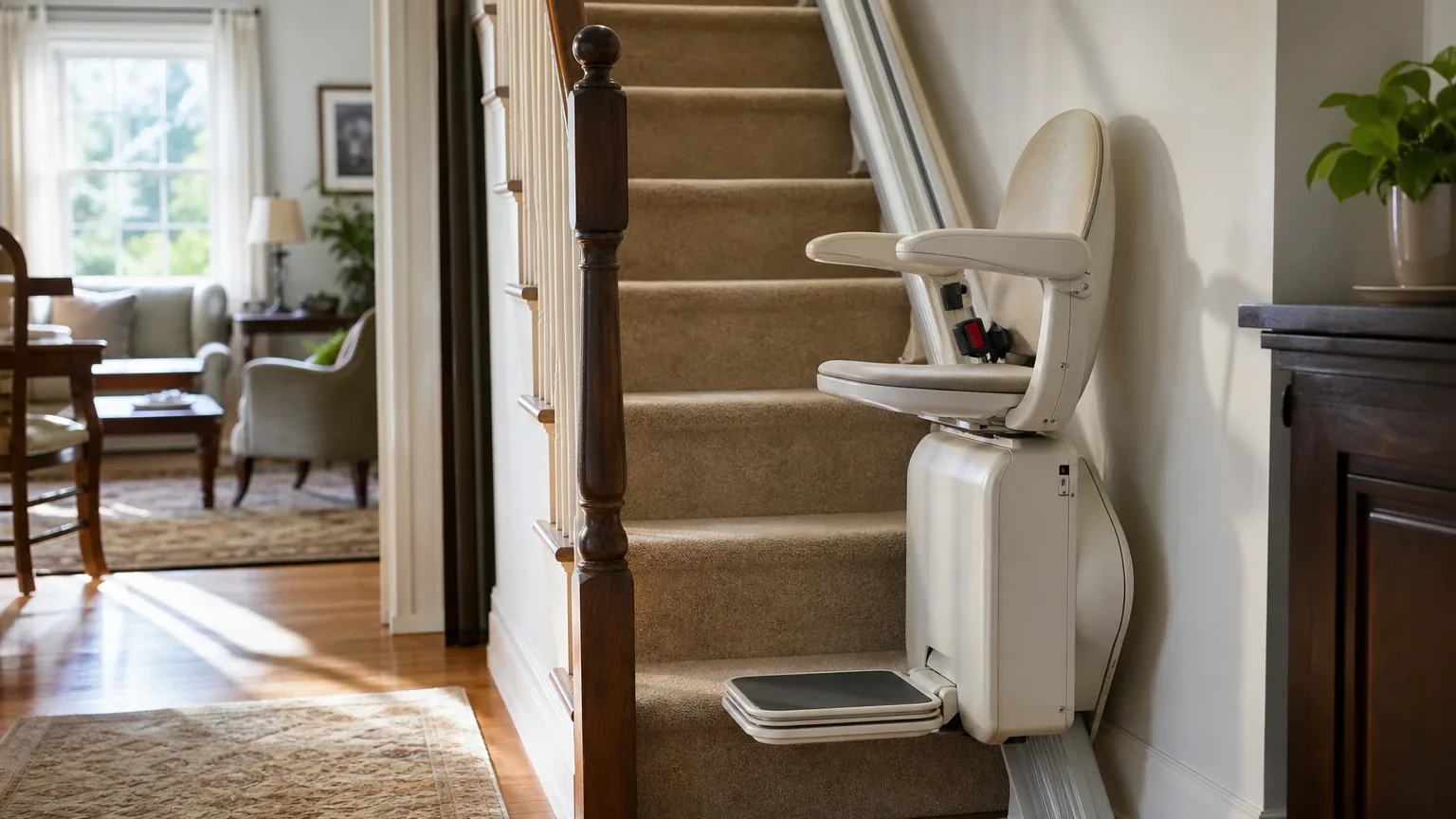
Answer Capsule
The Handicare 1100 is a good fit for a dry, straight basement staircase where narrow-stair clearance, foldability, obstruction sensors, and battery backup matter most. It is not a safe assumption for damp, flood-prone, or curved basement routes. Three of the seven platforms in this study named it during the ranking stage (anthropic, deepseek, google), an average listed rank of 3.0 and a best rank of 2. The strongest reason to consider it is its slim folded profile combined with a published 30–50° incline range and battery operation during outages. The main limitation is unresolved damp-environment suitability: the user manual says not to expose the lift to damp conditions, and no reviewed source verifies a moisture rating for basement use.
Research Snapshot
| Field | Detail |
|---|---|
| Platform mentions in ranking stage | 3 of 7 platforms (anthropic, deepseek, google) |
| Share of included platform responses | 42.9% |
| Average listed rank | 3.0 |
| Best listed rank | 2 (google) |
| Relevant product/model/plan | Handicare 1100 Straight Stairlift |
| Overall use-case fit | Good for dry, straight basement stairs; mixed where moisture, curves, or very low ceilings apply |
| Research date | 2026-11-10 |
Why Handicare 1100 Qualified for This Study
Questions This Section Answers
- Why did only three of seven AI platforms name the Handicare 1100 for basement stairs?
- Does the Handicare 1100's slim rail profile make it a better pick than wider straight stairlifts for narrow basement stairs?
The Handicare 1100 qualified because three platforms named it during ranking discovery and all seven platforms that produced fit research evaluated it against the basement criteria. Qualification required at least two ranking-stage mentions, and the 1100 cleared that threshold with three (anthropic, deepseek, google).
The strongest qualification signal is physical fit. Handicare markets the 1100 as the slimmest straight stairlift, with a rail described as the narrowest on the market [9]. The brochure lists a minimum folded width of 12.6 inches and minimum track intrusion of 6.3 inches [27]. For a basement stair that also serves as the household's laundry or storage route, that folded footprint is the feature most likely to decide whether the lift is tolerable for other users.
A second signal is the basement-specific accessory set. Handicare's brochure describes Zero Intrusion for stairs ending at a doorway, including basements, alongside Slide Track and Easy Hinge options for clearing landing or hallway obstructions [27]. A dealer listing independently describes Zero Intrusion as eliminating rail overrun without home modifications and calls it a solution for Basement Stairs and underground garages [5].
The qualification is not a quality endorsement. Ranking-stage mentions measure whether platforms surfaced the model for this use case, not whether it performs well in a damp basement. The 1100 is a straight-rail indoor model [32], and the ranking stage also surfaced "Handicare 1000 Outdoor" as a recommended product for this entity — a separate model that should not be treated as the same product [27].
The Product, Model, Plan, or Service Most Relevant to Basement Access & Utility Stairs
Questions This Section Answers
- Is the Handicare 1100 Straight Stairlift the right model for a straight basement staircase, or should a buyer ask about the Handicare 1000 Outdoor instead?
- What stair angle range does the Handicare 1100 support for a basement installation?
The relevant product is the Handicare 1100 Straight Stairlift, an indoor straight-rail model. Every platform that produced fit research identified this same product, though the ranking stage's recommended-product list mixed in "Handicare 1000 Outdoor," which is a separate outdoor variant [24].
The 1100 is designed for straight staircases only [32]. Published incline coverage is 30° to 50° [27]. One platform reported coverage up to 52° (anthropic), which conflicts with the 50° figure in the brochure-based sources; buyers should confirm the angle limit for their measured staircase rather than rely on either number.
The model is battery-powered with continuous charging along the rail, so it charges wherever it is parked rather than only at the top or bottom [14]. It uses a friction-drive system with no gear rack, described as grease-free and easier to maintain [11].
For basement buyers, the configuration matters as much as the model. Zero Intrusion, Slide Track, and Easy Hinge are configuration-dependent accessories, not necessarily standard equipment [27]. A quote for a bare 1100 may not solve a doorway obstruction at the bottom of the stairs.
What the AI Platforms Agreed About
Questions This Section Answers
- Do all major AI platforms agree that the Handicare 1100 has obstruction sensors and battery backup for basement stairs?
- Is the Handicare 1100's slim folded profile a genuine advantage on narrow basement stairs according to AI platform research?
Agreement was strong, though not unanimous, on the core hardware. All seven platforms described obstruction sensors that stop the lift on contact with an obstacle [27]. The footrest safety edges are described as stopping the lift mid-journey if an object becomes jammed [31].
All seven platforms also described battery backup or battery-powered operation with continuous charging [27]. The brochure states the batteries provide at least 10 rides up and down during a power failure and generally last about three years depending on use [27].
Six platforms treated the slim folded profile as an advantage for narrow stairs [27]. The 12.6-inch folded width and 6.3-inch track intrusion appear consistently across brochure-derived sources [27].
Platforms also converged on the straight-rail limitation: the 1100 does not serve curved, multi-flight, or landing-interrupted basement stairs [27].
Agreement among platforms is not evidence of product quality. It reflects that the same brochure-derived specifications circulated across dealer and review sites.
Where the AI Platforms Disagreed or Were Uncertain
Questions This Section Answers
- Is the Handicare 1100 safe to install in a basement with mild humidity, or does the manual's damp warning rule it out?
- Which warranty applies to the Handicare 1100 — two years on parts or a lifetime motor and gearbox warranty?
The sharpest disagreement concerns moisture. The user manual states the lift is for indoor use only and instructs users not to expose it to damp or extreme sunlight [30]. One platform concluded that a damp basement installation "violates manufacturer specifications" and rated fit as mixed (anthropic). Another platform rated fit as good while noting the model is "indoor-only with no confirmed damp durability" (grok). A third rated it good and described it as "not rated for outdoor exposure or wet/flooded basement conditions" [16]. The remaining platforms treated damp suitability as unverified rather than disqualifying (openai, deepseek, kimi, perplexity).
No reviewed source supplies a humidity threshold, an IP rating, or a corrosion rating. The manufacturer's warning does not quantify what "damp" means, so whether a climate-controlled basement at moderate humidity falls inside or outside the limit is unresolved (anthropic).
Warranty terms conflict. The brochure states two years for the 1100 and ten years for the motor and gearbox [27]. One dealer states 24 months on parts with a limited lifetime powertrain warranty [11]. Another dealer states a lifetime warranty on the motor and gearbox [14]. Google's summary describes 24 months on parts plus a limited lifetime warranty on the rail and powertrain [16]. These are not reconcilable from the supplied evidence.
Weight capacity is mostly consistent but not perfectly so. The brochure lists 309 lb at 30–45° and 287 lb at 46–50° [27]. One platform noted a source listing 350 lb and flagged the discrepancy (anthropic). Dealer summaries sometimes simplify the figures to a 280–300 lb range (openai).
Seat swivel configuration is inconsistent: some sources describe a standard swivel seat, others describe powered swivel as an optional upgrade [34].
Low-ceiling clearance is undocumented across every platform. The brochure provides seat, folded-width, footplate, and rail-intrusion dimensions but no universal minimum basement ceiling height [27]. One platform cited a general 6'8" basement headroom code minimum as context, not as a Handicare specification [6].
Use-Case-Specific Features and Capabilities
Questions This Section Answers
- Does the Handicare 1100's 287 lb weight limit on steep basement stairs rule it out for heavier users?
- How does the Handicare 1100's Zero Intrusion option help when basement stairs end at a doorway?
On rail fit for steep stairs, the 1100 covers 30–50° with a reduced load rating above 46° [27]. Basement stairs frequently sit in the steeper part of that range, so the 287 lb tier is the figure that matters for many installations.
On low-ceiling clearance, no platform found published headroom data. The folded depth is 12.6 inches and the fold-out depth is 20.9 inches [21], but neither establishes whether a seated user clears an overhead obstruction at the lower landing. This requires measurement.
On damp-environment durability, the manual's indoor-only and no-damp instructions are the controlling evidence [30]. One platform noted that persistent moisture and mildew are the primary threats to indoor equipment in humid environments and that weather-sealed hardware with sealed motors is required for damp settings [4]. The Handicare 1100 Outdoor was identified as the high-moisture alternative [4].
On obstruction sensors, multiple safety sensors stop the lift on contact, and footrest safety edges stop it mid-journey if something is jammed [27]. For a utility stair where items get left on steps, this is directly relevant.
On seat belt comfort, a retractable seat belt is standard [27]. Seat height adjusts approximately 16.9–20.5 inches [27]. No platform supplied independent comfort testing, so belt fit and seat geometry must be assessed in person.
On battery backup, continuous charging works anywhere on the track and the batteries support at least 10 rides up and down during a power failure [27]. For a below-grade route, that matters during an outage.
On service access, the friction drive is described as grease-free and maintenance-friendly with a fault display for dealer diagnosis [27]. Service availability remains dealer-dependent; no reviewed source establishes a uniform U.S. response time or service-fee schedule [35]. One manual notes that suppliers other than certified dealers are not qualified to install the rail for users other than the original [8].
On installation price, no manufacturer-published U.S. installed price was verified. Dealer examples are covered in the next section.
Pricing, Fees, Contracts, and Ongoing Costs
Questions This Section Answers
- How much does a Handicare 1100 cost installed for a basement staircase in the U.S.?
- Which add-ons, such as Zero Intrusion or a powered swivel seat, increase the Handicare 1100's installed price?
Pricing is dealer-quoted, not standardized, and confidence is low across platforms. Reviewed listings show a base unit around $3,190–$3,299 [13]. One independent review puts installed pricing at $3,200–$4,800 in 2026, including rail, unit, labor, and standard accessories [3]. One platform reported a wider installed range of $2,500–$4,800 [3]. A Michigan-only eBay listing showed $3,500 including installation [22]. Google summarized installed pricing at roughly $2,995 to $3,500+ depending on stair length and options [16].
Reported add-on examples vary by source and should be treated as illustrations, not a price list:
| Item | Reported example | Source |
|---|---|---|
| Evaluation and installation labor | $745 | [13] |
| 7-meter (approx. 22 ft) track | ~$500 | (openai) |
| Zero Intrusion kit | $360 | (openai) |
| Powered swivel seat | $650–$1,050 | (openai, anthropic) |
| Powered footrest | $650 | (openai) |
| Slide Track | $1,350 | (anthropic) |
| Manual Easy-Hinge folding rail | $750–$950 | (anthropic) |
| Removal and disposal of existing lift | $150 | (openai, anthropic) |
| Concrete or tile installation surcharge | $195 | (openai, anthropic) |
| Indoor outlet installation | $295 | (anthropic) |
| After-hours installation | $200 | (anthropic) |
| Battery replacement set (12V 2.6 Ah) | $124 | (anthropic) |
Contract and cancellation terms are not standardized. No verified Handicare U.S. installation contract, cancellation policy, or national service-fee schedule was found [2]. Warranty language conflicts as described above. Any dealer service plan, financing, return policy, or labor coverage should be reviewed separately from the manufacturer warranty (openai).
Ongoing costs likely include battery replacement, post-warranty service, parts, and dealer travel charges [1]. Verified public U.S. figures for those items were not consistently published [1].
Best Suited For
Questions This Section Answers
- Is the Handicare 1100 a good choice for a senior who needs a stairlift on a narrow, straight basement staircase to reach laundry or storage?
- Does the Handicare 1100 suit a basement staircase with a doorway at the bottom landing?
The 1100 is best suited to a dry, straight basement staircase in a conditioned home, particularly where the stair is narrow and other household members still need to pass [26]. It fits users within the published load rating for their measured stair angle — 309 lb at 30–45° and 287 lb at 46–50° [27].
It suits basement stairs ending near a doorway when Zero Intrusion, Slide Track, or a hinge solution is quoted [27]. It suits buyers who value quiet operation; one independent review measured 49–52 dB and called it the quietest straight-rail lift on the U.S. market [3], a platform-reported claim not independently verified here.
It suits users who benefit from a retractable seat belt, foldable components, an optional powered swivel, and battery operation during power loss [27]. It also suits buyers who want a grease-free rail that will not track lubricant into living spaces [24].
Probably Not Best Suited For
Questions This Section Answers
- Is the Handicare 1100 a poor choice for a damp or flood-prone basement?
- Can the Handicare 1100 be installed on a curved or landing-interrupted basement staircase?
It is probably not the right choice for basements with persistent moisture, condensation, sump-pump areas, flooding risk, or outdoor-like exposure, unless a dealer confirms environmental suitability in writing [30]. The manual's no-damp instruction is the clearest evidence against assuming it is safe there.
It is not suited to curved, multi-flight, or landing-interrupted basement stairs [27]. It is not suited to very low-ceiling installations where the user's head clearance has not been measured [6].
It is a weaker choice for buyers prioritizing the lowest total installed price or a standardized nationwide service contract [35]. It is also a weaker choice for users whose weight exceeds the applicable tier for their stair angle [27].
When Another Option May Be Better
Questions This Section Answers
- When should a basement stairlift buyer choose the Handicare 1000 Outdoor over the Handicare 1100?
- Is a curved stairlift or residential elevator a better option than the Handicare 1100 for a basement with a landing or multiple flights?
Choose the Handicare 1000 Outdoor or another explicitly outdoor-rated model when the installation is exposed to weather or sustained outdoor-like moisture, and verify the selected model is actually rated for the site [4]. One platform specifically recommended the 1100 Outdoor for high-moisture environments with sealed motors and marine-grade rail [4].
Choose a curved stairlift when the basement route includes a turn, intermediate landing, or multiple flights [32]. Platforms named Handicare Freecurve and Savaria Stairfriend as curved alternatives [7].
Choose a competing straight lift when a local dealer offers a materially clearer installed quote, stronger local service coverage, or more suitable low-clearance measurements (openai). One platform noted the 1100 wins on noise and price against Bruno on straight installs, a platform-reported comparison [3].
Consider residential elevators, wheelchair lifts, or ramps for multi-floor basement access needs [28]. For bulkhead or exterior basement entrances, an outdoor-rated stairlift or weather-protected system is the relevant category [15].
Questions to Verify Before Buying
Questions This Section Answers
- What measurements should a buyer confirm before signing a Handicare 1100 contract for a basement staircase?
- What should a buyer ask a Handicare dealer about moisture, warranty, and local service before purchase?
Confirm the staircase is completely straight and record its measured angle, total rise, tread depth, width, and landing dimensions (openai). Confirm measured head clearance for the user at every point, especially the lower landing and steepest section [6].
Confirm whether the quoted configuration includes Zero Intrusion, Slide Track, Easy Hinge, or another solution for a basement doorway or hallway [5]. Confirm whether the 1100 is approved for this basement's humidity, condensation, sump-pump area, or flood-risk conditions, and what environmental exclusions apply [30].
Confirm the exact safe working load for the measured stair angle and selected options [27]. Confirm seat height suitability and whether the user can safely sit, buckle, swivel, and stand at both landings (openai).
Confirm that the seat belt, obstruction sensors, emergency stop, key lock, and remote controls are included in the quoted configuration [12]. Confirm battery type, expected replacement interval, replacement price, labor charge, and power-outage operating capacity (openai, anthropic).
Confirm what the installed price includes and what charges apply for rail length, concrete or tile, outlets, stair modifications, removal, travel, and after-hours work (openai, anthropic). Confirm who provides service locally, the expected response time, and whether parts and labor are covered after the initial warranty period [35].
Confirm which written warranty applies to the exact model and serial number, and whether batteries, travel, labor, moisture damage, and misuse are excluded [11]. Confirm cancellation, return, removal, relocation, financing, and service-contract terms [2].
Final AI Consensus Verdict
The consensus is a qualified yes for dry, straight basement stairs and a no for damp or curved ones. Four of seven platforms rated fit as good (openai, google, grok, perplexity) and three rated it mixed (anthropic, deepseek, kimi). The split tracks moisture: platforms that weighted the manual's no-damp instruction most heavily landed on mixed.
The strongest case for the 1100 is physical: a 12.6-inch folded width, 6.3-inch track intrusion, 30–50° incline coverage, obstruction sensors, retractable belt, and battery backup with at least 10 rides during an outage [27]. The strongest case against is unresolved environmental suitability plus dealer-dependent pricing and warranty terms that conflict across sources.
No purchase should proceed without a measured site survey and written confirmation of ceiling clearance, moisture suitability, total installed cost, warranty terms, and local service coverage (openai). Buyers comparing this model against others in the category can start with the full Basement Access & Utility Stairs consensus index, and buyers still scoping the category can browse the broader stairlifts directory.
How This Review Was Produced
This review used the supplied platform fit-research responses for the Basement Access & Utility Stairs use case, dated 2026-11-10. Seven platforms produced fit research: openai, anthropic, deepseek, google, grok, kimi, and perplexity. Three of those seven named the Handicare 1100 during ranking discovery (anthropic, deepseek, google), which is the basis for the 42.9% share figure.
Each platform's use-case findings were mapped against the eight category criteria: rail fit on steep stairs, low-ceiling clearance, damp-environment durability, obstruction sensors, seat belt comfort, battery backup, service access, and installation price. Agreement was described as unanimous, strong, majority, mixed, or limited based on how many of the seven responses supported a finding.
Company-owned sources include Handicare and Savaria product pages, brochures, and user manuals. Independent sources include dealer listings and third-party reviews. Where a claim rested only on a platform's summary without a retrieved citation, it is labeled platform-reported.
Methodology Limitations
Platform-reported research dates differ from the authoritative run date. DeepSeek reported 2026-05-22 while the run date is 2026-11-10; the other six platforms reported 2026-11-10. These dates are provenance metadata and do not independently prove freshness.
DeepSeek's research was conducted with search disabled, so its findings are model-reported rather than retrieved. Its conclusions about the 1100's specifications should be treated as lower-confidence than platforms with search enabled.
The manufacturer's current U.S. product, warranty, and dealer materials were not all available from the supplied official website during this review; the principal product evidence came from a Handicare-branded brochure hosted by a mobility dealer (openai). One platform's official-site retrieval failed at normalization (deepseek).
The supplied URLs were collected from platform responses and were not independently validated by the writer stage. Citations are platform-reported evidence, not independently verified facts.
No reviewed source independently verified long-term reliability, user outcomes, damp-environment performance, or guaranteed service response times (openai). No platform supplied personal testing, customer experience data, or medical benefit claims.
The ranking stage's recommended-product list mixed "Handicare 1000 Outdoor" with "Handicare 1100," and the two are separate models [27]. This review evaluates the 1100 only.
Sources
Company-Owned Sources
- Stair Lifts: Safe and Comfortable Mobility Solutions: https://bullockaccess.com/stairlift/
- Handicare 1100 User Manual Manual Style seat Powered Style seat: https://dmastairlifts.co.uk/wp-content/uploads/2022/04/DMA-1100-Manual.pdf
- Handicare 1100 stairlift: https://handicare-stairlifts.com/stairlifts/straight-stairlifts/1100/
- Bulkhead Stairs: A Guide to Installation and Benefits: https://resconsolutions.com/articles/bulkhead-stairs-a-guide-to-installation-and-benefits/
- Handicare 1100 Straight Stairlift Specifications: https://savariahomeaccess.com
- Handicare 1100 stairlift FOR STRAIGHT STAIRCASES: https://www.calgarycoop.com/wp-content/uploads/2025/04/Savaria_Handicare1100Brochure_web.pdf
- Basement Stair Stringers by Fast-Stairs.com: https://www.fast-stairs.com/realizations/basement-stairs/
- Handicare stairlifts product overview: https://www.handicaregroup.com/handicare/
- Stair Lifts: 2026 Ultimate Stairlift Guide: https://www.lifewaymobility.com/resources/product-guides/the-ultimate-home-stair-lift-guide/
- HANDICARE 1100 Manual Style seat Powered Style seat U S E R M A N U A L US CA: https://www.rehabmart.com/pdfs/1100-user-manual.pdf
- Handicare 1100 Style Sales guide: https://www.rehabmart.com/pdfs/1100_product_guide.pdf
- Handicare 1100 Straight Stairlift: https://www.savaria.com/stairlifts/products/straight-handicare-1100
Independent Sources
- Handicare Review for Arthritis-Friendly Stairlift Use: https://aginginplaceindex.com/stairlifts/arthritis-friendly-controls-seating/handicare-1100/archive/2026-09
- Handicare Review for Budget-Friendly Stair Mobility: https://aginginplaceindex.com/stairlifts/budget-friendly-stair-mobility/handicare
- Handicare Stairlift Review 2026: The Quiet Alternative: https://allamericanstairlifts.com/brands/handicare-stairlift-review/
- Outdoor Stairlifts: Weather-Proof Models & Prices (2026: https://allamericanstairlifts.com/stairlifts/outdoor/
- Handicare 1100 Straight Stairlift: https://brandonmobility.com/products/handicare-1100-straight-stairlift
- Basement Stairs Cost Guide 2026: https://buildsandbuys.com/basement-stairs-cost-guide-2/
- Handicare 1100 Stairlift - Island Mediquip: https://islandmediquip.com/product/handicare-1100-stairlift/
- Handicare 1100 Stairlift Specs: https://medmartonline.com/handicare-1100-stairlift
- Handicare 1100 Stairlift: https://medmartonline.com/handicare-1100-straight-stairlift
- Handicare 1100 Stair Lift - Options HME Stair Lifts: https://optionshme.com/handicare-1100-stair-lift/
- Handicare 1100 Indoor Straight Stairlift: https://thealbanyliftcompany.com/products/handicare-1100-indoor-straight-stairlift
- Handicare 1100: Sleek and Slim Straight Stairlift for Narrow Spaces: https://www.101mobility.com/products/handicare-1100/
- Handicare 1100 Features & Options: https://www.101mobility.com/products/stairlifts/
- Savaria_Handicare1100Brochure: https://www.101mobility.com/wp-content/uploads/2024/11/Savaria_Handicare1100Brochure_web.pdf
- Handicare 1100, Includes Installation, MICHIGAN ONLY!: https://www.ebay.com/itm/197227546479
- Handicare 1100 stairlift review and features: https://www.stairliftreviews.com/handicare-1100/
- Handicare stairlift cost and dealer network: https://www.stairlifts.com/handicare/
Other Sources
- handicare 1100 - Stairlifts: https://www.hudsonsurgical.com/product/1100-stairlift
- Handicare 1100 Straight Stairlift - Advanced Features: https://www.multicare.co.uk/products/handicare-1100-straight-stairlift
- Handicare 950 / 1000 / 1100: https://www.stairlifts-salvatec.com/pdf/Handicare_1100_straight_salvatec.pdf
Verify This Research
Review the study details behind this page or download the public machine-readable verification record.
- Study date
- November 10, 2026
- Platforms analyzed
- 7
- Source records
- 35
- Ranking mentions
- 3 of 7
- Platform share
- 43%
- Final consensus rank
- #7
Research trail and source mix
Configured platforms
openai, anthropic, deepseek, grok, perplexity, kimi, google
Source mix
17 independent · 12 company-owned · 6 unclear
Evidence support
21 direct · 14 partial
Important limitation
Use the run research_date as the study date. Platform-reported dates are provenance metadata and do not independently prove freshness.
Source snapshot SHA-256 6443eec54110a961966b2ade089ea9f1ae1b6fb6f5d9373c91cf652e41c64733