
Answer Capsule
Harmar is a good fit for budget-conscious U.S. buyers with a standard straight staircase who want a dealer-installed lift without paying for curved-rail customization. Five of the seven platforms in this study named Harmar during the ranking stage, and six of seven rated it a "good" fit for this use case, with one rating it "mixed." The strongest reason to consider it is a published planning range of roughly $2,500–$5,000 installed for straight stairlifts, paired with model-specific warranty coverage that includes a 10-year gear-rack term. The main limitation is that Harmar publishes no fixed model price, no standardized financing, and no national service-response commitment, so the final cost and service experience depend entirely on the local authorized dealer.
Research Snapshot
| Measure | Result |
|---|---|
| Platform mentions in ranking stage | 5 of 7 platforms (anthropic, deepseek, google, grok, perplexity) |
| Share of included platform responses | 71.4% |
| Average listed rank | 6.6 |
| Best listed rank | 3 (google) |
| Relevant product/model/plan | Harmar Pinnacle SL300 (budget-oriented) or SL600 (higher capacity/coverage) straight stairlift |
| Overall use-case fit | Good — six platforms rated "good," one rated "mixed" |
| Research date | 2026-11-10 |
What Changed Since September 2026
Harmar moved down from No. 2 to No. 4, and platform mentions decreased from 7 to 5. The November 2026 review reframes Harmar as a good fit for budget-conscious buyers with a standard straight staircase who want dealer-installed equipment without curved-rail costs, and it now treats the SL300 as the budget starting point with the SL600 as a justified step-up. Buyer fit and limitations are largely unchanged: pricing, financing, and service still depend on the local authorized dealer. Reported pricing shifts, with a $3,700 straight-lift starting price newly reported. Track-extension lengths are now reported per option, replacing the prior long-track maximum, while installation labor figures are no longer repeated. Differences between the two editions reflect what each article reports; they do not by themselves prove that the product, service, or price changed.
The September 2026 review preserves the earlier article for reference.
Why Harmar Qualified for This Study
Questions This Section Answers
- Why did Harmar qualify for a budget-friendly stair mobility ranking when it does not publish fixed model prices?
- Is Harmar a mainstream enough stairlift brand to compare against other affordable options for a straight staircase?
Harmar qualified because it is a U.S.-based manufacturer of stairlifts and accessibility equipment that sells straight-stairlift models through authorized dealers, which places it inside the lower-complexity, lower-cost segment this study targets [1]. Five of the seven platforms named it during ranking discovery, and its best placement was third (google). Its average listed rank of 6.6 is mid-pack, which is consistent with the platform consensus that Harmar is credible but not the automatic budget leader.
The company's own materials describe a dealer-based model: Harmar products are available through local dealers who assess the home and handle installation, and LiftSquad-certified dealers complete ongoing factory training, carry insurance, and pass annual background checks (official:C1). Independent review evidence likewise states that Harmar sells through authorized dealers throughout the United States and that dealers conduct home assessments, provide quotes, install, and service the lifts [3].
One qualification matters for readers: the ranking stage referenced several model names, including AL500, AL600, and SL350. The clearest current straight-stairlift evidence reviewed concerned the Pinnacle SL300 and SL600, and one platform explicitly could not locate the AL500/AL600 names on Harmar's official site [1]. Buyers should confirm the exact current model name with a dealer rather than relying on the ranking-stage labels.
The Product, Model, Plan, or Service Most Relevant to Budget-Friendly Stair Mobility
Questions This Section Answers
- Which Harmar stairlift model should a budget-conscious buyer ask a dealer to quote first?
- Is the Harmar SL600 worth the higher price over the SL300 for a cost-focused buyer?
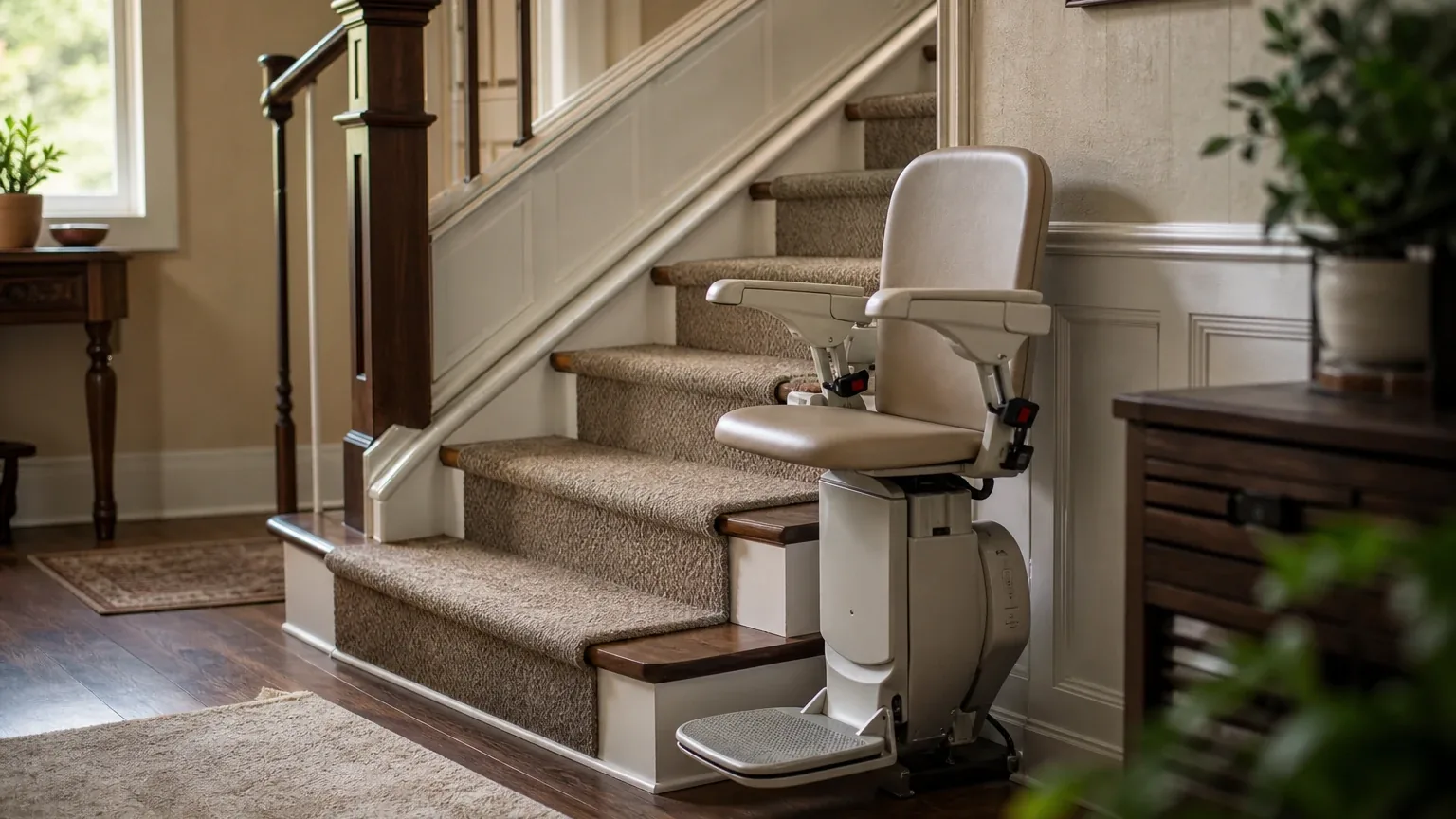
The Pinnacle SL300 is the most budget-relevant Harmar product for this use case, with the SL600 as the step-up option when higher capacity or stronger drivetrain coverage is actually needed. Harmar describes the SL300 and SL600 as straight indoor stairlift models, positioning the SL300 as the more streamlined option and the SL600 as the premium straight model (perplexity:2, perplexity:4).
Published specifications separate them clearly. The SL300 carries a 300-pound capacity rating, 20 feet-per-minute speed, an 11-inch folded profile from the wall, 60 emergency cycles on battery, and a patented nylon polymer gear rack that requires no grease [4]. The SL600 is rated 350 pounds, folds to 10.5 inches from the wall, includes a retractable seat belt as standard, adds a chassis obstruction sensor, and is ETL listed and certified to ASME A17.5 and A18.1 [5]. A heavy-duty SL600HD variant is rated to 600 pounds but sits outside a budget-first buyer's default choice unless that capacity is required (perplexity:5).
The practical decision is straightforward: the SL300 is the lower-cost starting point, and the SL600 is justified when the household needs the extra 50 pounds of rated capacity, the standard retractable belt, or the longer motor coverage described below.
What the AI Platforms Agreed About
Questions This Section Answers
- Do the AI platforms agree that Harmar is a good fit for budget-friendly stair mobility?
- What do the platforms consistently say about Harmar's installed price range for a straight staircase?
The platforms largely agreed that Harmar is a good fit for this use case, with six of seven rating it "good" and one rating it "mixed." They also converged on a planning price band and on the dealer-dependent nature of the purchase.
On price, multiple platforms reported the same published planning range. Harmar's buyer guide gives an estimated installed range of approximately $2,500–$5,000 for straight stairlifts while stating that the final dealer quote depends on the staircase, model, options, and installation requirements [6]. A separate Harmar FAQ estimate places straight stairlifts around $4,000–$5,000 (perplexity:11). Independent reviews repeat the same band, describing straight models at roughly $2,500–$5,000 installed [7].
On the buying model, the platforms agreed that Harmar does not sell direct and that pricing, installation, and service are set by local dealers [8]. On maintenance, they agreed that the lubrication-free gear-rack design reduces ongoing upkeep [10]. On safety, they agreed that entry models include obstruction sensors, a swivel seat with interlock, an overspeed brake, and battery backup capable of dozens of trips during an outage [10].
Agreement among AI platforms is not evidence of product quality. It reflects that the same published and dealer sources were available to each platform.
Where the AI Platforms Disagreed or Were Uncertain
Questions This Section Answers
- Why do the AI platforms disagree about whether Harmar is genuinely affordable for budget-conscious buyers?
- Is Harmar's warranty a limited lifetime warranty or a shorter model-specific warranty?
The platforms disagreed on how affordable Harmar actually is and on how its warranty should be described. Both conflicts are material to a budget buyer.
On affordability, one platform rated Harmar "mixed" and reported that its $3,700 straight-lift starting price was the highest among five brands compared in a 2026 review, above Bruno at $3,000, Lifeway Mobility at $3,000, Access BDD at $2,500, and Stannah at $3,400 [12]. The same platform noted that reconditioned units from dealers start near $2,500 installed [13]. Other platforms treated the $2,500–$5,000 band as evidence of budget alignment (grok:0, perplexity:12). These positions are not fully reconcilable from the supplied evidence: "starting price" figures, equipment-only prices, sale prices, and installed prices are mixed together across sources and should not be treated as directly comparable [14].
On warranty, descriptions vary by model and by source. The SL300 manual requires warranty registration within ten days of installation and describes parts coverage terms [15]. A dealer comparison reports two years for major components and parts on the SL300, and lifetime major-component coverage with three years of parts coverage on the SL600 [16]. Another platform reported a 10-year gear-rack term with 2-year parts and 1-year battery coverage on the SL300 [17], while a separate review described a "limited lifetime" warranty [12]. The most defensible reading is that coverage is model-specific and that labor, batteries, and exclusions must be confirmed in the written warranty certificate for the serial-numbered unit.
A further uncertainty concerns real-world capacity. One independent dealer reported recommending the SL300 for riders under roughly 225 pounds and the SL600 up to about 225 pounds despite their 300- and 350-pound ratings, citing increased wear and service calls for heavier users [18]. That is a single dealer's observation, not a manufacturer statement, and it conflicts with the published ratings.
Use-Case-Specific Features and Capabilities
Questions This Section Answers
- Which safety features come standard on a Harmar straight stairlift, and which cost extra?
- Does a Harmar stairlift still work during a power outage?
Standard safety equipment is a genuine strength of the Harmar straight-lift line, but some commonly expected items are options rather than included features. Harmar models are described as including broad safety functionality, while retractable seatbelts and key locking may be upgrade options on most models [19]. The SL600 lists a retractable seat belt as standard [20], so buyers should confirm the exact included configuration for the specific quoted model.
Documented standard features across the straight line include footrest obstruction sensors, an overspeed brake, a swivel seat with interlock, an audible and LED alert system, and a seat belt [21]. The SL600 adds a chassis obstruction sensor [20]. Harmar's straight-lift materials also reference a status indicator LED, padded armrests, and a low-maintenance worm-gear drive (perplexity:2, perplexity:8).
Battery backup is standard and meaningful for outage planning. The SL300 provides 60 emergency cycles on battery [22], and one dealer listing describes 40-trip backup (google:cit_1). The discrepancy between 40 and 60 cycles is unresolved in the supplied evidence; buyers should confirm the figure for the exact model.
Compactness matters in shared stairwells. The SL300 folds to 11 inches from the wall and the SL600 to 10.5 inches [22], and one platform described the Pinnacle series as installing within about half an inch of walls or obstructions [23]. The lubrication-free nylon polymer gear rack eliminates greasing and track maintenance [22].
Pricing, Fees, Contracts, and Ongoing Costs
Questions This Section Answers
- What should a budget-conscious buyer expect to pay in total for a Harmar straight stairlift installed at home?
- Does Harmar offer manufacturer financing for a stairlift purchase?
Budget roughly $2,500–$5,000 installed for a straight Harmar stairlift as a planning range, not a guaranteed quote. Independent dealer examples cited in a 2026 review placed the SL300 near $3,515 on sale and the SL600 around $4,495 installed in one example, with a listed $5,375 MSRP [24]. One dealer advertised the SL600 installed at approximately $4,495–$5,375 with free professional installation and a one-year in-home service inclusion [26]. Another dealer promoted the SL300 at $3,995 with free standard installation [27]. These are dealer-specific offers, not Harmar prices.
Add-on costs can erode the budget advantage. Reported examples include track extensions at roughly $249 for 3 feet, $399 for 5 feet, and $649 for 8 feet, and a folding rail option at about $1,650 on the SL300 [25]. Professional installation, where not bundled, has been reported in a range of roughly $399–$925 depending on complexity [25], and another platform reported installation labor of $500–$1,200 typical (grok:0). Possible additional charges include electrical work, permits, difficult mounting surfaces, travel, after-hours work, and removal of an existing lift [28].
Financing is the weakest documented area. Harmar's buyer guide advises asking dealers about financing [29], but no standardized manufacturer program, rate, fee schedule, or eligibility rule was verified [28]. One platform stated flatly that Harmar does not offer financing and that buyers must arrange third-party payment plans or pay in full [30]. Some dealers may accept third-party financing such as CareCredit, but this is dealer-dependent [30].
Ongoing costs include battery replacement, service calls, and optional service plans. Battery replacement has been estimated at roughly $200–$400 but is not published by the manufacturer [25]. Dealers have been reported to include one year of in-home service and to offer a two-year add-on for about $99 [26]. No standardized Harmar-wide cancellation, return, rental, relocation, or buyback terms were verified [28]. Rental exists through some dealers at roughly $150 per month after an installation and removal fee of about $845 [33].
Insurance and public-benefit reimbursement should not be assumed. Harmar states that most insurance plans and Medicare generally do not cover stairlifts because they are treated as home modifications, although limited assistance may exist through certain programs [29].
Best Suited For
Questions This Section Answers
- Is Harmar a good choice for a cost-conscious senior with a standard straight staircase and a tight budget?
- Which households get the most value from the Harmar SL300 rather than a premium stairlift?
Harmar suits a cost-conscious buyer with a standard straight staircase who wants dealer-installed equipment and meaningful model-specific warranty coverage. The platforms' best-considered-for lists converge on straight indoor staircases with standard layout and adequate landing space, buyers seeking a mainstream manufacturer with authorized-dealer installation and service, and households needing roughly 300 pounds of capacity with the SL300 or higher capacity with the SL600 (openai, anthropic, perplexity).
It also fits buyers who value longer component or drivetrain coverage more than the absolute lowest initial quote, since the 10-year gear-rack term is a documented strength [34]. Households with narrow stairwells benefit from the compact folded profile [35]. Buyers who want a U.S.-manufactured product with domestic parts and dealer support are also a reasonable match [37].
Probably Not Best Suited For
Questions This Section Answers
- Who should avoid buying a Harmar stairlift for budget reasons?
- Is Harmar a poor fit for a buyer who needs a guaranteed all-in price before an in-home visit?
Harmar is a poor fit for buyers who need a guaranteed all-in price before an in-home assessment, because Harmar does not publish model-specific retail pricing and installation and service costs vary by dealer [38]. It is also weak for buyers prioritizing the lowest possible equipment-only price or transparent online purchasing, since Harmar sells exclusively through dealers [39].
Buyers needing a curved staircase should look elsewhere within the budget segment, because custom-rail pricing is substantially higher and curved models sit well above the budget target [40]. Buyers who require verified manufacturer financing, rental, cancellation, or relocation terms will not find standardized programs [38]. Households in rural or underserved areas without a nearby Harmar dealer face service-continuity risk, since the network relies entirely on independent dealers [42]. Finally, users well above the practical weight range reported by one dealer should discuss durability expectations before committing [42].
When Another Option May Be Better
Questions This Section Answers
- When is a competing stairlift brand a better budget choice than Harmar?
- Should a buyer choose a reconditioned or rental stairlift instead of a new Harmar unit?
Another option may be better in four recurring situations the platforms identified. First, when a competitor provides a lower written all-in installed quote with comparable capacity, warranty, and local service, the buyer should take it — Harmar's value case depends on the local quote, not on a national price (openai). Second, when the need is temporary, used, refurbished, rental, or short-term programs with clearly documented terms may cost less than a purchase [43].
Third, when the buyer cannot obtain a firm Harmar quote or needs predictable financing, a more transparent direct-price provider may be preferable [45]. Fourth, when the staircase is curved or has multiple landings and Harmar's custom quote is materially higher, a specialized curved-stairlift provider may fit better [46]. Buyers who prioritize manufacturer-direct support and faster response times should also compare, since Harmar relies on its dealer network (anthropic).
For heavier users, one independent dealer recommended a competing high-capacity model for riders above roughly 225 pounds [47]. That recommendation comes from a single dealer and should be weighed against the published 300- and 350-pound ratings rather than treated as settled.
Questions to Verify Before Buying
Questions This Section Answers
- What should a buyer confirm in writing with a Harmar dealer before paying a deposit?
- Which warranty and service details are most likely to be misstated in a Harmar quote?
Confirm these items in writing before paying:
- The exact model, capacity, rail length, and included standard equipment (openai).
- Whether the quote is fully installed and includes freight, taxes, electrical work, difficult-surface mounting, permits, removal, and travel (openai, perplexity:6).
- Which safety features are included versus optional, including seatbelt type, swivel seat, obstruction sensors, key lock, and battery backup [48].
- The exact parts, motor, gearbox, gear-rack, battery, and labor warranty periods for the serial-numbered model [49].
- Whether the warranty covers labor and service calls, and what maintenance or authorized-service conditions apply [50].
- Who the installing dealer is, how far away the service team sits, typical response times, and after-warranty service-call charges [52].
- Financing availability, APR, fees, deposit, term, cancellation rights, and whether the lender is the dealer or a third party (openai, perplexity:6).
- Rental, refurbished, used, return, relocation, or buyback options [53].
- What happens if the buyer moves, the user no longer needs the lift, or the staircase requires removal (openai).
- Whether the dealer will provide an itemized written quote and a copy of the applicable warranty before payment (openai, perplexity:11).
Final AI Consensus Verdict
Harmar is a good fit for a cost-conscious buyer with a standard straight staircase who wants dealer-installed equipment and meaningful model-specific warranty coverage. It is not an automatic best buy. The buyer should compare at least two itemized local quotes because installation, optional features, financing, labor coverage, and ongoing service costs are not standardized. The SL300 is the most budget-oriented starting point; the SL600 is better justified when its higher capacity or stronger component coverage is actually needed.
The consensus is strong but not unanimous. Six of seven platforms rated the fit "good," and one rated it "mixed" on the grounds that Harmar's starting price sits above several competitors. That disagreement is best resolved locally: the same lift can be a good deal or a poor one depending on the dealer quote in front of the buyer. Readers comparing brands across this segment can review the full Budget-Friendly Stair Mobility index before requesting quotes.
How This Review Was Produced
This review was produced from a seven-platform AI research run dated 2026-11-10. Each platform independently evaluated whether Harmar fits the Budget-Friendly Stair Mobility use case and returned a fit rating, use-case findings, pricing and terms, limitations, and questions to verify before buying. Five of the seven platforms named Harmar during ranking discovery, and all seven returned a fit assessment.
Platform responses were treated as platform-reported evidence, not independently verified fact. Company-owned sources such as Harmar product pages, owner manuals, sell sheets, and buyer guides were distinguished from independent sources such as dealer pages, third-party reviews, and nonprofit comparisons. Where platforms cited the same underlying source, that source appears once in the Sources list. The broader category context is available in the stairlifts directory.
Methodology Limitations
Several limitations apply. Platform-reported research dates differ from the authoritative run date: two platforms returned earlier dates (2026-01-15 and 2026-05-12) while the remaining five matched 2026-11-10, so some findings may reflect older source snapshots. One platform ran without search enabled, so its claims rest on model knowledge rather than retrieved pages and should be treated as unverified.
The supplied URLs were collected from platform responses and were not independently validated at the writing stage. Official-site retrieval was incomplete for some product mentions, and the ranking stage referenced model names (AL500, AL600, SL350) that could not be confirmed on Harmar's official site. Public sources conflict on exact warranty descriptions, particularly how major components, parts, batteries, and labor are separated. Some independent price figures mix equipment-only, sale, MSRP, and installed prices and are not directly comparable. Harmar's current materials do not verify a universal financing program, a fixed installation fee, a national service response time, or a standardized maintenance plan.
No platform agreement in this review should be read as proof of product quality, and no personal testing, customer experience, medical benefit, or guaranteed performance is claimed.
Sources
Company-Owned Sources
- Harmar Official Website — Stairlifts: https://www.harmar.com/
- Harmar About/Company information: https://www.harmar.com/about-harmar/
- Stairlift FAQs: 20 Common Questions Answered: https://www.harmar.com/blog/product-buyers-guide-stairlift-faqs/
- Stairlift Buyers Guide: Pinnacle, Summit, and Helix: https://www.harmar.com/blog/product-buyers-guide-stairlift-options-models-and-features-pinnacle-summit-and-helix/
- Stairlift Buyer’s Guide: How to Choose the Right Lift for Your Home: https://www.harmar.com/blog/the-ultimate-stairlift-buyers-guide/
- Straight Stairlifts - Harmar Products: https://www.harmar.com/products/home-access/straight-stairlifts/
- SL300 Pinnacle Stairlifts – Harmar official product page: https://www.harmar.com/products/sl300/
- SL600 Pinnacle Premium Stairlifts – Harmar official product page: https://www.harmar.com/products/sl600/
- SL600HD Pinnacle Heavy-Duty Stairlift – Harmar: https://www.harmar.com/products/SL600HD/
- Straight Stairlifts – Harmar Products: https://www.harmar.com/products/straight-stairlifts/
- Stairlift Buyer’s Guide: Costs, Types & Installation | Harmar: https://www.harmar.com/stairlift-guide/
- PINNACLE STAIRLIFT: SECTION 6: https://www.harmar.com/wp-content/uploads/2025/01/SL300_Owners-Manual.pdf
- PINNACLE SL300 STRAIGHT STAIRLIFT - harmar.com: https://www.harmar.com/wp-content/uploads/2025/01/SL300_Sell-Sheet.pdf
- PINNACLE STAIRLIFT: SL600 OWNER’S MANUAL: https://www.harmar.com/wp-content/uploads/2025/01/SL600_Owners-Manual.pdf
- PINNACLE STAIRLIFTS - harmar.com: https://www.harmar.com/wp-content/uploads/2025/02/Pinnacle-Brochure.pdf
- How to Choose the Best Stairlift for Seniors - Savaria: https://www.savaria.com/news/how-to-choose-the-best-stairlift-for-seniors
Additional AI research evidence53 records
- AI research evidence record deepseek:c1
- AI research evidence record deepseek:c3
- AI research evidence record openai:c8
- AI research evidence record anthropic:c4
- AI research evidence record anthropic:c5
- AI research evidence record openai:c1
- AI research evidence record anthropic:c3
- AI research evidence record openai:c8
- AI research evidence record deepseek:c1
- AI research evidence record anthropic:c4
- AI research evidence record anthropic:c5
- AI research evidence record kimi:c1
- AI research evidence record kimi:c4
- AI research evidence record openai:c4
- AI research evidence record openai:c2
- AI research evidence record openai:c7
- AI research evidence record anthropic:c3
- AI research evidence record anthropic:c6
- AI research evidence record openai:c6
- AI research evidence record anthropic:c5
- AI research evidence record anthropic:c3
- AI research evidence record anthropic:c4
- AI research evidence record kimi:c5
- AI research evidence record openai:c4
- AI research evidence record anthropic:c3
- AI research evidence record anthropic:c1
- AI research evidence record kimi:c2
- AI research evidence record openai:c5
- AI research evidence record openai:c1
- AI research evidence record anthropic:c2
- AI research evidence record kimi:c1
- AI research evidence record deepseek:c1
- AI research evidence record kimi:c3
- AI research evidence record anthropic:c3
- AI research evidence record anthropic:c4
- AI research evidence record anthropic:c5
- AI research evidence record deepseek:c3
- AI research evidence record openai:c5
- AI research evidence record deepseek:c1
- AI research evidence record anthropic:c3
- AI research evidence record anthropic:c2
- AI research evidence record anthropic:c6
- AI research evidence record kimi:c3
- AI research evidence record kimi:c4
- AI research evidence record anthropic:c2
- AI research evidence record anthropic:c3
- AI research evidence record anthropic:c6
- AI research evidence record openai:c6
- AI research evidence record anthropic:c3
- AI research evidence record openai:c2
- AI research evidence record openai:c3
- AI research evidence record anthropic:c6
- AI research evidence record kimi:c3
Independent Sources
- Harmar Stairlift Review for Budget-Friendly Stair Mobility: https://aginginplaceindex.com/stairlifts/budget-friendly-stair-mobility/harmar
- Harmar Stairlift Review 2026: Heavy-Duty & Outdoor Expert: https://allamericanstairlifts.com/brands/harmar-stairlift-review/
- Harmar Pinnacle Stair Lift - Bellevue Healthcare: https://bellevuehealthcare.com/product/harmar-pinnacle-stair-lift/
- Harmar Stair Lift Price: Installed Costs and Options 2026: https://latestcost.com/harmar-stair-lift-price-installed-costs-options/
- Harmar SL600 Stair Lift INSTALLED - Southern Mobility Online: https://shop.southernmobilityonline.com/lifts/stair-lifts/harmar-sl600-stair-lift-installed/
- Affordable Stairlifts in Maryland, DC & Virginia - Bedco Mobility: https://www.bedcomobility.com/affordable-stairlifts/
- The Best Stairlifts of 2024: https://www.caring.com/senior-products/best-stairlifts
- Harmar Stairlift Cost (2026): Prices & Models: https://www.chairliftforstairs.com/harmar-stairlift-cost
- Harmar Stairlifts - Keystone Accessibility (PA/MD dealer: https://www.keystoneaccessibility.com/harmar-stairlift
- Affordable Stairlift Rentals | Keystone Accessibility - Hassle-Free Installation & Removal: https://www.keystoneaccessibility.com/stairlift-rental
- Harmar vs. Acorn Stair Lift Comparison Guide: https://www.lifewaymobility.com/erie/resources/product-guides/harmar-vs-acorn-stair-lift-comparison-guide/
- Harmar Pinnacle SL300 Straight Stair Lift - Lifeway Mobility: https://www.lifewaymobility.com/our-products/stair-lifts/straight-stair-lifts/harmar-pinnacle-sl300-straight-stair-lift/
- 2026 Ultimate Stair Lift Guide: https://www.lifewaymobility.com/resources/product-guides/the-ultimate-home-stair-lift-guide/
- Compare the Best Stair Lift Brands of 2026 - NCOA: https://www.ncoa.org/product-resources/mobility/best-stair-lifts/
- Harmar Stairlift Review: With Costs - Retirement Living: https://www.retirementliving.com/harmar-stair-lifts
- Harmar Stairlift Review (2026): With Costs: https://www.retirementliving.com/reviews/harmar-stairlifts
- Pinnacle SL300 Stair Lift, Free chair lift Installation, Stair Chair: https://www.solanoma.com/products/harmar-pinnacle-sl-300
- Harmar Mobility Reviews: https://www.trustpilot.com/review/harmar.com
Additional AI research evidence53 records
- AI research evidence record deepseek:c1
- AI research evidence record deepseek:c3
- AI research evidence record openai:c8
- AI research evidence record anthropic:c4
- AI research evidence record anthropic:c5
- AI research evidence record openai:c1
- AI research evidence record anthropic:c3
- AI research evidence record openai:c8
- AI research evidence record deepseek:c1
- AI research evidence record anthropic:c4
- AI research evidence record anthropic:c5
- AI research evidence record kimi:c1
- AI research evidence record kimi:c4
- AI research evidence record openai:c4
- AI research evidence record openai:c2
- AI research evidence record openai:c7
- AI research evidence record anthropic:c3
- AI research evidence record anthropic:c6
- AI research evidence record openai:c6
- AI research evidence record anthropic:c5
- AI research evidence record anthropic:c3
- AI research evidence record anthropic:c4
- AI research evidence record kimi:c5
- AI research evidence record openai:c4
- AI research evidence record anthropic:c3
- AI research evidence record anthropic:c1
- AI research evidence record kimi:c2
- AI research evidence record openai:c5
- AI research evidence record openai:c1
- AI research evidence record anthropic:c2
- AI research evidence record kimi:c1
- AI research evidence record deepseek:c1
- AI research evidence record kimi:c3
- AI research evidence record anthropic:c3
- AI research evidence record anthropic:c4
- AI research evidence record anthropic:c5
- AI research evidence record deepseek:c3
- AI research evidence record openai:c5
- AI research evidence record deepseek:c1
- AI research evidence record anthropic:c3
- AI research evidence record anthropic:c2
- AI research evidence record anthropic:c6
- AI research evidence record kimi:c3
- AI research evidence record kimi:c4
- AI research evidence record anthropic:c2
- AI research evidence record anthropic:c3
- AI research evidence record anthropic:c6
- AI research evidence record openai:c6
- AI research evidence record anthropic:c3
- AI research evidence record openai:c2
- AI research evidence record openai:c3
- AI research evidence record anthropic:c6
- AI research evidence record kimi:c3
Other Sources
- Consumer stairlift buying guides and reviews referencing Harmar: https://www.google.com/search?q=Harmar+stairlift+price+review
Additional AI research evidence53 records
- AI research evidence record deepseek:c1
- AI research evidence record deepseek:c3
- AI research evidence record openai:c8
- AI research evidence record anthropic:c4
- AI research evidence record anthropic:c5
- AI research evidence record openai:c1
- AI research evidence record anthropic:c3
- AI research evidence record openai:c8
- AI research evidence record deepseek:c1
- AI research evidence record anthropic:c4
- AI research evidence record anthropic:c5
- AI research evidence record kimi:c1
- AI research evidence record kimi:c4
- AI research evidence record openai:c4
- AI research evidence record openai:c2
- AI research evidence record openai:c7
- AI research evidence record anthropic:c3
- AI research evidence record anthropic:c6
- AI research evidence record openai:c6
- AI research evidence record anthropic:c5
- AI research evidence record anthropic:c3
- AI research evidence record anthropic:c4
- AI research evidence record kimi:c5
- AI research evidence record openai:c4
- AI research evidence record anthropic:c3
- AI research evidence record anthropic:c1
- AI research evidence record kimi:c2
- AI research evidence record openai:c5
- AI research evidence record openai:c1
- AI research evidence record anthropic:c2
- AI research evidence record kimi:c1
- AI research evidence record deepseek:c1
- AI research evidence record kimi:c3
- AI research evidence record anthropic:c3
- AI research evidence record anthropic:c4
- AI research evidence record anthropic:c5
- AI research evidence record deepseek:c3
- AI research evidence record openai:c5
- AI research evidence record deepseek:c1
- AI research evidence record anthropic:c3
- AI research evidence record anthropic:c2
- AI research evidence record anthropic:c6
- AI research evidence record kimi:c3
- AI research evidence record kimi:c4
- AI research evidence record anthropic:c2
- AI research evidence record anthropic:c3
- AI research evidence record anthropic:c6
- AI research evidence record openai:c6
- AI research evidence record anthropic:c3
- AI research evidence record openai:c2
- AI research evidence record openai:c3
- AI research evidence record anthropic:c6
- AI research evidence record kimi:c3
Verify This Research
Review the study details behind this page or download the public machine-readable verification record.
- Study date
- November 10, 2026
- Platforms analyzed
- 7
- Source records
- 35
- Ranking mentions
- 5 of 7
- Platform share
- 71%
- Final consensus rank
- #4
Research trail and source mix
Configured platforms
openai, anthropic, deepseek, grok, perplexity, kimi, google
Source mix
18 independent · 16 company-owned · 1 unclear
Evidence support
26 direct · 7 partial
Important limitation
Use the run research_date as the study date. Platform-reported dates are provenance metadata and do not independently prove freshness.
Source snapshot SHA-256 fe8477d094cff34d4207b4c3190512c831e681790284f03fadf148ad783dc22d
Archived editions
Browse earlier published research snapshots for this article. The latest edition remains at the current URL.