
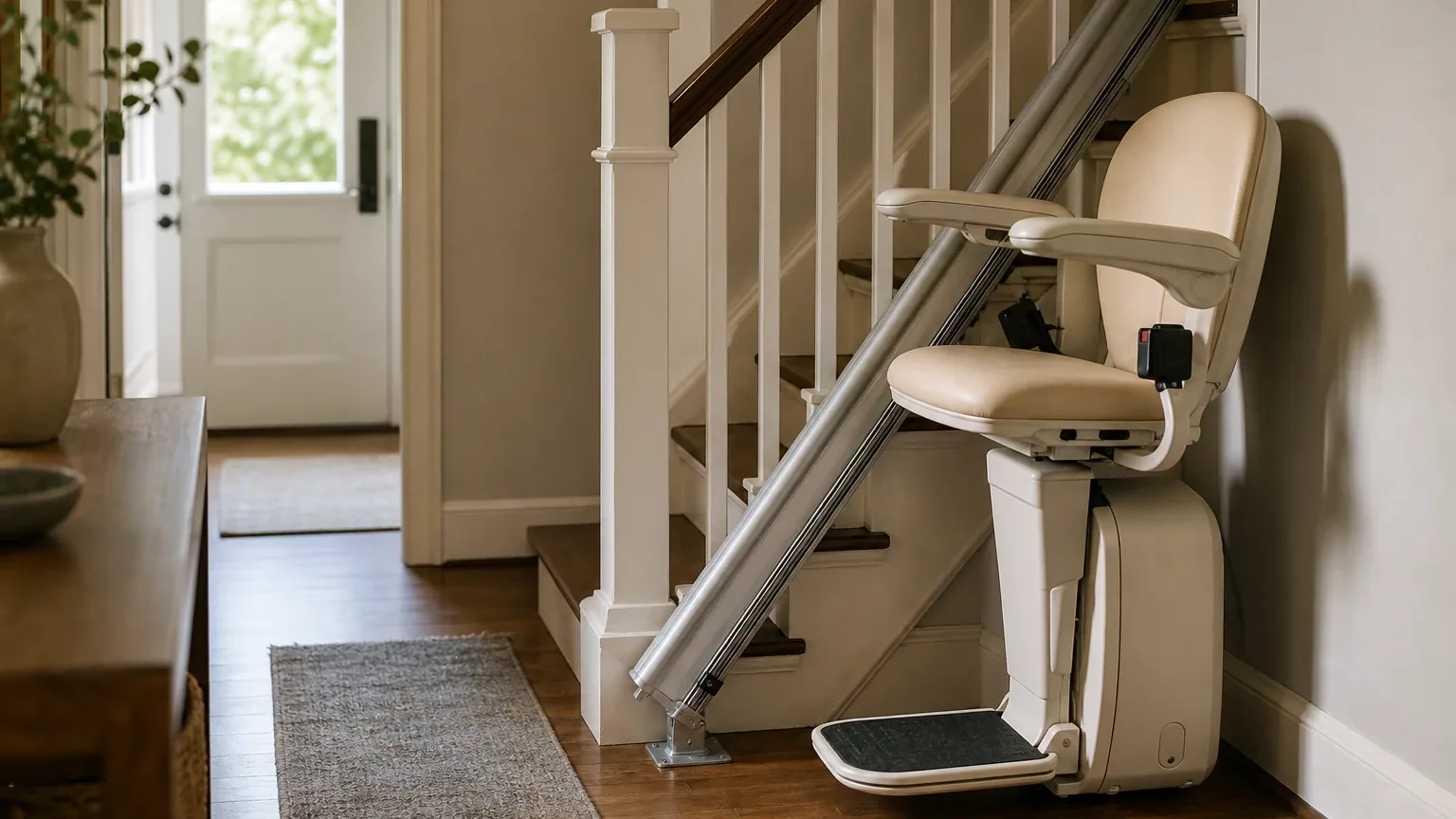
Answer Capsule
The Handicare 1100 is a good fit for compact and narrow straight stairways, with one condition: the fit must be confirmed by an on-site survey, not by the brochure. Four of the seven platforms in this study named it during the ranking stage, and five of seven rated it strong or good for this use case, while one rated it uncertain. The strongest reason to consider it is its published folded profile of 12.6 inches (320 mm) and minimum rail intrusion of 6.3 inches (160 mm), which preserve walking clearance on tight stairs [4]. The main limitation is that no platform located a verified manufacturer minimum stairway width, and the 25.4-inch swivel radius can be decisive on tight landings [28].
Research Snapshot
| Field | Detail |
|---|---|
| Platform mentions in ranking stage | 4 of 7 platforms (anthropic, deepseek, google, kimi) |
| Share of included platform responses | 57.1% |
| Average listed rank | 3.25 |
| Best listed rank | 1 (google) |
| Relevant product/model/plan | Handicare 1100 Straight Stairlift |
| Overall use-case fit | Strong-to-good across most platforms; one platform rated it uncertain |
| Research date | 2026-11-10 |
What Changed Since September 2026
Handicare 1100 remained at No. 4, and platform mentions decreased from 5 to 4. The November 2026 review keeps the same central judgment on the Handicare 1100: a good fit for compact straight stairways only when a dealer survey confirms it. The description is now more specific about the model and its narrow-stairway case, and platform evidence has consolidated around the published folded profile of 12.6 inches and rail intrusion of 6.3 inches. Reported pricing is more detailed but still dealer-quoted and inconsistent in scope; an installed range of $3,200–$4,800 is newly reported, while a $3,190 equipment-only figure is no longer repeated. Warranty labor coverage is now given as 30–90 days. Recommended configuration is unchanged. Differences between the two editions reflect what each article reports; they do not by themselves prove that the product, service, or price changed.
The September 2026 review preserves the earlier article for reference.
Why Handicare 1100 Qualified for This Study
Questions This Section Answers
- Why did Handicare 1100 qualify for this narrow-staircase stairlift study when other models were left out?
- Which AI platforms named Handicare 1100 for narrow stairways, and at what rank?
Handicare 1100 qualified because four of the seven platforms named it during ranking discovery, clearing the two-mention threshold, and because its published dimensions directly address the narrow-stairway criteria this study scores. Google ranked it first; Anthropic, DeepSeek, and Kimi each ranked it fourth [4].
The qualification is about relevance, not proof of quality. The platforms that named it did so on the strength of a slim enclosed rail, a compact folded profile, and a low track intrusion figure, all of which map onto the compact and narrow stairway use case [4]. Three platforms that evaluated fit did not name it in the ranking stage, so the mention count understates how many platforms actually examined the model.
The model is a straight-stairlift product. Every platform that addressed staircase shape treated curved, L-shaped, and multi-flight stairs as out of scope for the 1100, with the Handicare Freecurve named as the curved alternative [1]. That boundary is central to how this review should be read.
The Product, Model, Plan, or Service Most Relevant to Compact & Narrow Stairways
Questions This Section Answers
- Is the Handicare 1100 Straight Stairlift the right Handicare model for a narrow straight staircase, or should a buyer look at another Handicare product?
- What folded width and rail intrusion does the Handicare 1100 publish for narrow stairways?
The relevant product is the Handicare 1100 Straight Stairlift, a straight-run, indoor-oriented model. It is the only Handicare product in this study positioned for narrow straight stairways; the Freecurve is a curved-rail product and does not address a straight narrow run [1].
The published numbers that matter for this use case are consistent across most sources: a folded width to the footplate of 12.6 inches (320 mm), an open width of 20.9 inches, and a minimum track intrusion of 6.3 inches (160 mm) [28]. The rail is a covered, friction-drive design with no exposed gear rack, which Savaria describes as slim and low-intrusion [35].
Two naming cautions apply. DeepSeek noted that model numbering (1000 versus 1100) may vary by region and dealer, and that U.S. model naming and availability should be confirmed with a U.S. dealer [23]. Buyers should also confirm they are quoting the 1100 and not the Handicare 1000, which appears in some platform product lists as a separate model.
What the AI Platforms Agreed About
Questions This Section Answers
- What do AI platforms agree the Handicare 1100 does well on narrow staircases?
- Do the platforms agree on the Handicare 1100's folded profile and rail intrusion figures?
Agreement was strong on the physical compactness claims. Six of the seven platforms cited the 12.6-inch folded profile, and multiple platforms independently cited the 6.3-inch minimum track intrusion [28].
The platforms also agreed on the mechanism behind the slim profile: a multi-motor friction drive with no traditional gear rack, which removes the tooth-rack protrusion common to rack-and-pinion lifts [4]. Several described the rail as among the slimmest straight-stairlift rails available, though at least one platform flagged that "narrowest on the market" is an unverified absolute claim [13].
Agreement was also broad on the folding behavior: seat, armrests, and footrest fold when not in use, and the seat swivels at the top landing [6]. Platforms agreed the model is straight-stair only and unsuitable for curved or multi-flight stairs [1].
Agreement on weight capacity was consistent at roughly 309 pounds (140 kg) on 30–45 degree stairs, dropping to 287 pounds (130 kg) on 46–50 degree stairs [4].
Where the AI Platforms Disagreed or Were Uncertain
Questions This Section Answers
- Why do AI platforms disagree about the minimum staircase width the Handicare 1100 needs?
- Is the Handicare 1100 actually the slimmest straight stairlift, or is that claim unverified?
The sharpest disagreement is the minimum staircase width. Anthropic reported 25.4 inches (645 mm) per a Handicare specification and 28 inches per dealer guidance, and cited an independent dealer that completed installs on staircases as narrow as 26 inches [21]. Grok cited a listing at roughly 655 mm, about 25.8 inches [31]. OpenAI, Google, Perplexity, and Kimi all reported that no verified manufacturer minimum width was located, and Google stated that Handicare does not publish a formal minimum staircase width specification, relying instead on dealer home evaluations [28].
That is a genuine conflict, not a rounding difference. The 12.6-inch figure is a folded width to the footplate, not a minimum stairway width, and no platform supplied evidence that it can be read as an installation guarantee [28].
Folded-profile figures also conflict at the margins. Most sources cite 12.6 inches, but Anthropic noted some sources report 11.0 inches (280 mm), and Kimi cited a Savaria comparison table listing the 1100 at 12.75 inches [19]. One review claimed a 9.75-inch folded rail width, which Anthropic flagged as an apparent data error [19].
Swivel radius has a minor conflict: 25.4 inches (645 mm) is the common figure, but one product guide lists 625 mm with a shorter arm for Narrow Staircases [37]. Warranty terms also vary by source and dealer, with parts coverage reported as two years or 24 months and motor/gearbox coverage described as ten years or "limited lifetime" [8].
DeepSeek's assessment diverges from the rest: it rated fit uncertain because it could not verify the decisive dimensions from authoritative sources, and its research ran without search enabled [23]. That is a research-capability difference as much as a product judgment.
Use-Case-Specific Features and Capabilities
Questions This Section Answers
- Does the Handicare 1100 leave enough walking clearance on a narrow staircase for other household members?
- What swivel radius does the Handicare 1100 need at the top landing on a tight staircase?
The 1100's narrow-stairway case rests on four measurable features, and the evidence is strongest on the first two.
Folded profile. The published folded width to the footplate is 12.6 inches (320 mm), with the seat, armrests, and footrest raised [28]. Anthropic reported that on a 26-inch stairway this leaves roughly 13.4 to 16.25 inches of passable width, though those figures come from dealer and review sources rather than manufacturer testing [1].
Rail intrusion. Minimum track intrusion is 6.3 inches (160 mm) [28]. A zero-intrusion top bracket and optional slide-track solutions exist for some landing configurations, but suitability and price are installation-specific [35].
Folding footrest and armrest clearance. Folding is standard. Internal armrest width is 17.7 inches (450 mm) and external width 22.6 inches (575 mm); minimum footplate height is 2.75 inches (70 mm); wall-to-seat-back distance is 2.4 inches (60 mm) [6]. No platform supplied a universal remaining pedestrian-clearance measurement for every seat, wall, and staircase combination [28].
Swivel radius. Minimum swivel radius is 25.4 inches (645 mm), with a manual 80-degree swivel standard and a powered swivel available as an upgrade [2]. This is the feature most likely to fail on a tight landing even when the flight itself is wide enough.
Secondary features platforms noted: continuous charging along the rail, battery operation during power failure, obstruction sensors, a retractable seat belt, and a grease-free rail with self-cleaning brush heads [4]. Anthropic reported operating noise of 49–52 dB and described the model as the quietest straight-rail lift on the U.S. market; that is a single independent review's claim, not a manufacturer specification [1].
Pricing, Fees, Contracts, and Ongoing Costs
Questions This Section Answers
- How much does a Handicare 1100 cost installed for a narrow staircase, and is the $3,000 dealer listing a real installed price?
- What ongoing service costs should a Handicare 1100 buyer budget for after installation?
Pricing is the weakest evidence in this review. No manufacturer MSRP was located in the reviewed U.S. materials, and every platform that addressed price described it as dealer-quoted and installation-specific [20].
The known data points conflict in scope. OpenAI found a single U.S. dealer listing of $3,000 for a Handicare 1100 straight stairlift and cautioned it may represent a product or service configuration rather than a complete installed national price [20]. Anthropic reported a U.S. installed range of $3,200–$4,800, with base unit pricing of $3,190–$3,999 and installation labor around $745 [16]. Google reported equipment at roughly $3,190–$3,995 and installed totals of roughly $3,500–$5,500 [24]. Kimi cited one authorized dealer at $3,495 sale price, regularly $3,995, with free standard installation in the NY/NJ metro area [38]. Perplexity found only quote-based pricing and a $0.00 placeholder [7].
Optional and add-on costs reported by platforms, all dealer-dependent:
| Item | Reported cost | Source |
|---|---|---|
| Powered swivel seat | $650–$1,000 | [16] |
| Powered footrest | $650 | [16] |
| Zero-intrusion kit | $360–$498 | [16] |
| Easy hinge manual folding rail | $750–$1,000 | [16] |
| Extended rail (7 m vs. 4.7 m) | $500–$708 | [16] |
| Staircase modification (pie step / box step) | $295 / $395 | [16] |
| Indoor / outdoor outlet installation | $295 / $395 | [16] |
Contract and cancellation terms were not located by any platform. Warranty is reported as two years on parts for the original purchaser, with motor and gearbox covered for ten years, and the warranty is described as non-transferable [8]. Labor warranty is dealer-dependent, typically 30–90 days [1]. Anthropic also reported that annual servicing is required at minimum, twice yearly with more than two users, and that the warranty voids without documented maintenance or if non-original parts are used [3]. No platform supplied a verified annual service cost.
Best Suited For
Questions This Section Answers
- Who is the Handicare 1100 actually the right choice for on a narrow straight staircase?
The 1100 is best suited to a homeowner with an indoor, single-flight, straight staircase who wants to preserve walking clearance and is willing to let a dealer survey decide the final fit [4].
It fits best when the priority is a slim folded seat and an enclosed rail rather than heavy-duty capacity, and when the rider is comfortably under the 309-pound limit on a 30–45 degree stair [4]. It also suits buyers who want options such as a powered footrest, powered swivel, slide track, or zero-intrusion bracket available, even if priced separately [35].
Buyers who care about noise may find it attractive on the strength of one independent review's 49–52 dB measurement, but that claim should be treated as platform-reported rather than manufacturer-confirmed [1].
Probably Not Best Suited For
Questions This Section Answers
- When is the Handicare 1100 the wrong choice for a narrow staircase?
It is not suited to curved, L-shaped, intermediate-landing, or multi-flight staircases; those require a curved product such as the Handicare Freecurve [1].
It is not suited to riders above 309 pounds on 30–45 degree stairs, or above 287 pounds on 46–50 degree stairs. Anthropic reported that Handicare does not make a 400-plus-pound unit and pointed to the Bruno Elite and Harmar Pinnacle as higher-capacity alternatives [33].
It is a poor fit where a 25.4-inch swivel radius cannot be accommodated at the boarding or exit landing, and where the buyer needs a verified minimum stairway width before committing [28]. Buyers who need powered swivel or powered footrest included as standard, rather than as paid upgrades, should look elsewhere [27].
When Another Option May Be Better
Questions This Section Answers
- Is the Handicare 1100 or a slimmer competitor like the Savaria K2 or Harmar Pinnacle SL600 better for a very narrow staircase?
- When should a buyer choose a curved stairlift instead of the Handicare 1100 for a narrow staircase?
If absolute minimum folded depth is the deciding factor, competitors publish smaller numbers. Kimi reported the Savaria K2 folds to 10.75 inches and the Harmar Pinnacle SL600 to 10.5 inches, against the 1100's 12.6 inches [36]. Those figures come from manufacturer and comparison sources and were not independently tested in this study.
If the rider exceeds the 1100's capacity, higher-capacity alternatives include the Handicare 1000 HD at 440 pounds, the Savaria K2+ at 400 pounds, and the Harmar SL600HD at 600 pounds, per Kimi's comparison [13]. Anthropic separately named the Bruno Elite at 400 pounds and Harmar Pinnacle at 600 pounds [1].
If the staircase is curved, the Handicare Freecurve or another custom curved lift is the relevant category, subject to a separate site assessment [1]. If the buyer needs a verified minimum width before ordering, or wants independently tested dimensions rather than manufacturer figures, DeepSeek recommended comparing competitor spec sheets directly [23].
Questions to Verify Before Buying
Questions This Section Answers
- What should a buyer confirm with a Handicare 1100 dealer before signing a contract for a narrow staircase installation?
Confirm the measured minimum stairway width at every step, and the usable walking clearance that remains with the lift folded [28]. Ask whether the quoted 12.6-inch profile requires the seat, armrests, and footrest to be folded in a particular sequence [28].
Confirm the exact swivel radius required at the top and bottom landings in the specific home, and whether the standard rail intrudes into either landing or a zero-intrusion bracket or slide track is needed and included [28].
Get the written quote to state whether installation, delivery, electrical work, removal of packaging or an existing lift, and follow-up adjustment are included, and which options are bundled: powered swivel, powered footrest, easy hinge, slide track, zero-intrusion bracket [20].
Confirm warranty scope for parts, labor, batteries, motor, gearbox, rail, and service calls, whether it is transferable, and the dealer's cancellation, deposit, rental, removal, and refund terms [1]. Ask for the expected battery replacement interval and current service cost, and confirm the local dealer is authorized and able to provide emergency and scheduled service in the buyer's ZIP code [20].
Final AI Consensus Verdict
The consensus is a qualified yes. Five of seven platforms rated the Handicare 1100 strong or good for compact and narrow stairways, one rated it uncertain, and one supplied no fit rating. The strongest reason is measurable: a 12.6-inch folded profile and 6.3-inch minimum rail intrusion, corroborated across multiple platforms and source types [28].
The qualification is that the decisive number for a stairway under 30 inches — the minimum installed width — was not verified by any platform from a manufacturer source. The 25.4-inch swivel radius, landing geometry, and dealer-specific installation terms are what actually determine whether a specific narrow staircase works [28]. Buyers should treat the 12.6-inch figure as a reason to request a survey, not as a substitute for one.
For a broader comparison across models in this category, see the Compact & Narrow Stairways consensus index.
How This Review Was Produced
This is a niche fit review of one model for one use case, drawn from seven AI platform responses collected for a 2026-11-10 research run on stairlifts for narrow staircases. Each platform was asked to assess fit for compact and narrow stairways and to supply citations. Four platforms named the Handicare 1100 during ranking discovery; all seven supplied fit assessments.
Platform responses were treated as platform-reported evidence, not independently verified fact. Where a platform cited a company brochure or specification sheet, that is identified as company-owned evidence; where it cited a dealer, review site, or comparison chart, that is identified as independent or unclear. No product was tested, no dealer was contacted, and no installation was observed for this review.
The category directory for stairlifts lists the broader set of models and manufacturers covered by this research program.
Methodology Limitations
Platform-reported research dates differ from the authoritative run date. DeepSeek's response is dated 2026-02-06; all other platforms are dated 2026-11-10. Platform dates are provenance metadata and do not independently prove freshness.
DeepSeek's research ran with search disabled, which limits how much weight its uncertain rating should carry relative to platforms that retrieved sources. The official Handicare corporate page was retrieved but not verified, and one normalization note records that official-site retrieval failed for at least one mention.
The supplied URLs were collected from platform responses and were not independently validated at the writing stage. Several sources are dealer pages with unclear ownership, and some figures — notably the 26-inch installation claim, the 49–52 dB noise measurement, and the "narrowest rail" description — rest on single sources or unverified absolute claims.
Pricing evidence is incomplete and conflicting in scope. No manufacturer MSRP, no standard contract terms, and no verified annual service cost were located. The $3,000 dealer listing, the $3,200–$4,800 installed range, the $3,500–$5,500 installed range, and the $3,495 sale price describe different configurations and geographies and should not be averaged.
Agreement among AI platforms does not establish product quality. It establishes what the platforms reported from the sources they retrieved.
Sources
Company-Owned Sources
- Handicare 1100 Stairlift Brochure: https://files.savaria.com/wp-content/uploads/2026/01/Handicare-1100-straight-stairlift-Brochure.pdf
- Handicare 1100 stairlift: https://handicare-stairlifts.com/stairlifts/straight-stairlifts/1100/
- Stairlifts for narrow stairs | Companion Stairlift Advice: https://www.companionstairlifts.co.uk/stairlift-advice/narrow-stairlifts
- Handicare Group official website: https://www.handicaregroup.com/handicare/
- Handicare 1100 Straight Stairlift Specifications: https://www.handicareusa.com
- Comparing the Best Stairlift Brands: https://www.harmar.com/blog/compare-the-best-stairlifts-harmar-vs-handicare-stannah-bruno-and-acorn/
- 1100 Straight Stairlift Modern, unique and truly next-gen: https://www.savaria.asia/wp-content/uploads/2022/10/Handicare-1100-Stairlift-brochure.pdf
- Compare Savaria Straight and Curved Stairlifts: https://www.savaria.com/stairlifts/compare
- Handicare 1100 Straight Stairlift: https://www.savaria.com/stairlifts/products/straight-handicare-1100
- K2 Straight Stairlift | Best-Selling for Seniors - Savaria: https://www.savaria.com/stairlifts/products/straight-k2
- 1100 Straight Stair Lift with Free Customization & Lifetime Warranty: https://www.solanoma.com/products/1100-straight-stairlift-with-free-tech-installation-support-free-customization
- Your Guide to Compact Stairlifts for Narrow Stairs: https://www.stannah.com/en-us/resources/stairlifts-dont-get-way
Independent Sources
- Handicare Stairlift Review 2026: The Quiet Alternative: https://allamericanstairlifts.com/brands/handicare-stairlift-review/
- Handicare 1100 User Manual: https://dmastairlifts.co.uk/wp-content/uploads/2022/04/DMA-1100-Manual.pdf
- Handicare, 1100 Stair Lift, 1100: https://medicsmobility.ca/handicare-1100-stair-lift-1100.html
- Handicare 1100 Straight Stairlift in Toronto and GTA: https://mobilityspecialties.ca/handicare-1100-stairlift/
- Complete Stair Lift Buying Guide 2026: https://porchlightathome.com/stair-lift-guide/
- Handicare 1100 Straight Stairlift: https://savariastairlift.com/product/handicare-1100-straight-stairlift/
- Narrow Stair Lift Guide: Flow X, Platinum Ultimate & More Senior Stairlifts UK: https://seniorstairlifts.co.uk/news/what-is-the-most-narrow-stair-lift/
- Compare the top brands of straight stair lifts: https://silvercross.com/stair-lifts/compare-straight-stair-lifts/
- Acorn vs Handicare Stairlifts: A UK Comparison: https://stairliftguru.co.uk/stairlift-companies/acorn-vs-handicare-stairlifts/
- Handicare 1100 Review: Specs & Prices 2026: https://stairliftguru.co.uk/stairlift-reviews/handicare-1100/
- Handicare 1100 Indoor Straight Stairlift: https://thealbanyliftcompany.com/products/handicare-1100-indoor-straight-stairlift
- Handicare 1100 Straight Stairlift: https://www.accesssolutionsonline.com/stairlifts/handicare-1100
- Stairlift and Accessibility Service Listings: https://www.alleghenyaccessibility.com/book-online
- Handicare 1100 Stairlift Specifications: https://www.beechfieldstairlifts.ie/straight-stairlifts/handicare-1100/
- 1100 Straight Stairlift The Stairlift Designed for Your Everyday: https://www.lifewaymobility.com/Customer-Content/www/CMS/files/Savaria/Handicare_SLs/Handicare-1100-Stairlift-Brochure-Lifeway-Mobility.pdf
- Handicare USA 1100 Stairlift Seat Dimensions: https://www.lifewaymobility.com/Customer-Content/www/CMS/files/Savaria/Handicare_SLs/Handicare-1100-Stairlift-Seat-Dimensions-Lifeway-Mobility.pdf
- Handicare 1100 Straight Stairlift: https://www.lifewaymobility.com/stair-lifts/straight-stair-lifts/handicare-1100-stairlift/
- Handicare 1100 Stairlift - Slim Straight Stair Lift: https://www.nationalstairlifts.com.au/handicare-1100-lift/
- Handicare 1100 Style Dimensions: https://www.rehabmart.com/pdfs/handicare-1100-sales-guide.pdf
Other Sources
- Handicare, 1100 Straight Stairlift, 1100 - Liberty Care Mobility: https://libertycare.ca/product/handicare-1100-straight-stairlift-1100/
- Handicare 1100: Sleek and Slim Straight Stairlift for Narrow Spaces: https://www.101mobility.com/products/handicare-1100/
- PDF Handicare 1100 - 1st Choice Stairlifts: https://www.1stchoicestairlifts.com/wp-content/uploads/2021/12/handicare-1100-stairlift-dimensions.pdf
- Handicare 1100 Straight Stairlift - Advanced Features: https://www.multicare.co.uk/products/handicare-1100-straight-stairlift
- 1100 Product Guide: https://www.scribd.com/document/768631857/1100-Product-Guide
Verify This Research
Review the study details behind this page or download the public machine-readable verification record.
- Study date
- November 10, 2026
- Platforms analyzed
- 7
- Source records
- 39
- Ranking mentions
- 4 of 7
- Platform share
- 57%
- Final consensus rank
- #5
Research trail and source mix
Configured platforms
openai, anthropic, deepseek, grok, perplexity, kimi, google
Source mix
20 independent · 13 company-owned · 6 unclear
Evidence support
31 direct · 8 partial
Important limitation
Use the run research_date as the study date. Platform-reported dates are provenance metadata and do not independently prove freshness.
Source snapshot SHA-256 abe95c4aebe3dc35d459f31363be342ee02f311b753c45b422d8bbc3de062546
Archived editions
Browse earlier published research snapshots for this article. The latest edition remains at the current URL.