
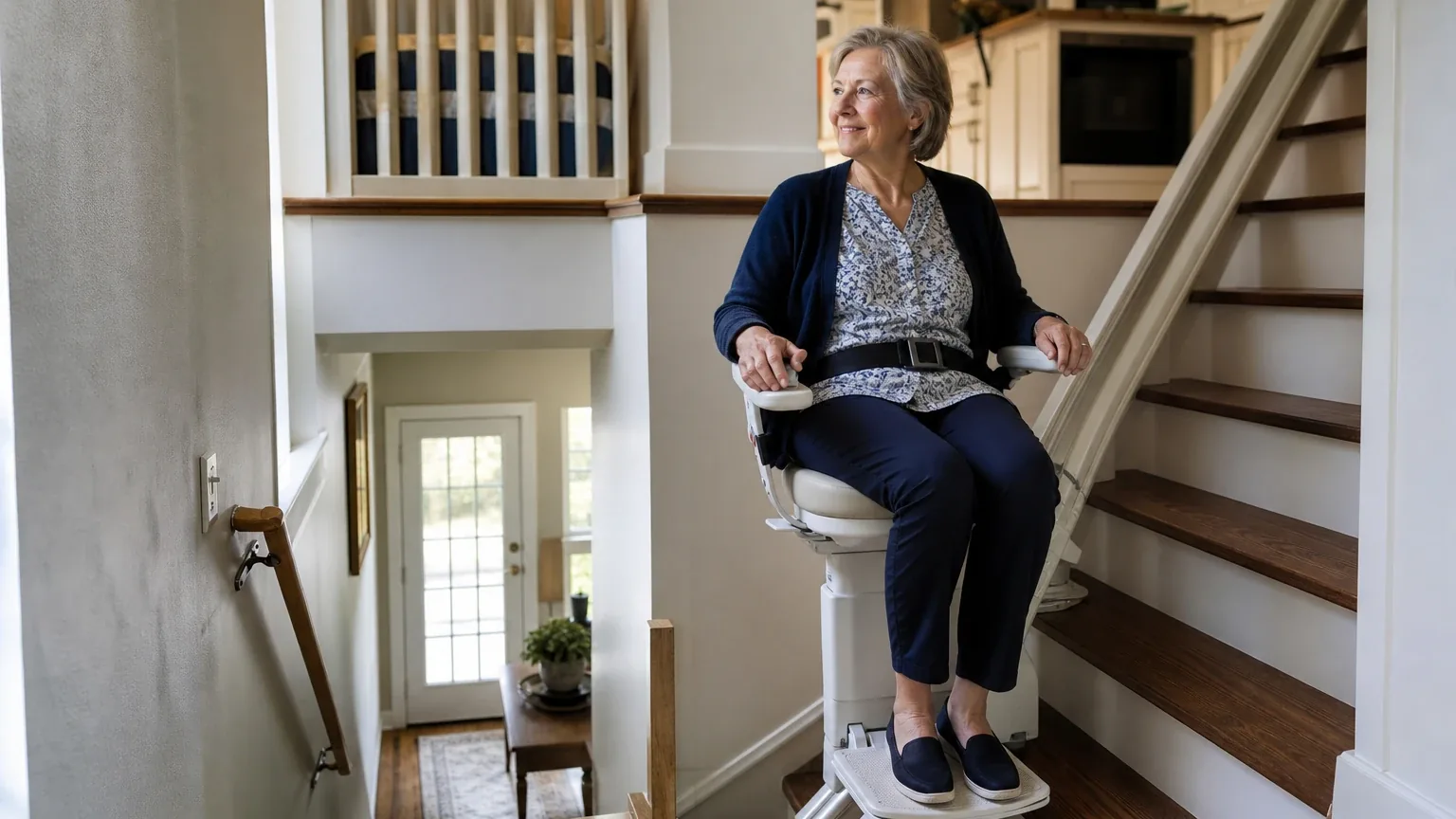
Answer Capsule
The Acorn 130 Straight Stairlift is a mixed fit for split-level and short-run staircases. Six of the seven platforms in this study named it during ranking discovery, and all six returned a usable fit assessment. Its strongest case is a single short, straight half-flight with adequate landing clearance, where an optional hinged rail can keep the lower landing clear and the compact folded profile preserves narrow stairs [21]. Its main limitation is structural: a straight rail cannot travel through a turn or serve multiple half-flights as one ride, so most split-level layouts need either two Acorn 130 units or the Acorn 180 curved system [17]. No platform verified a public U.S. installed price.
Research Snapshot
| Field | Finding |
|---|---|
| Platform mentions in ranking stage | 6 of 7 configured platforms (anthropic, deepseek, google, grok, kimi, perplexity) |
| Share of included platform responses | 85.7% (6 of 7) |
| Average listed rank | 4.83 |
| Best listed rank | 1 (kimi) |
| Relevant product/model/plan | Acorn 130 Straight Stairlift with optional hinged rail; Acorn 180 Curved Stairlift is the relevant Acorn alternative for turning or multi-flight layouts |
| Overall use-case fit | Mixed — strong for one straight short run, weak for turns and multiple half-flights |
| Research date | 2026-11-10 |
What Changed Since September 2026
Acorn 130 Straight Stairlift moved up from No. 5 to No. 4, and platform mentions increased from 4 to 6. The November 2026 review narrows the fit verdict to one named model, the Acorn 130 Straight Stairlift, where the September 2026 review assessed the Acorn brand and its two-path lineup more broadly. Buyers now get a clearer read: the 130 suits a single short, straight half-flight with room to swivel, while turns and multiple half-flights point to the Acorn 180 or two separate units. Pricing remains survey-based and third-party, with installed ranges of $3,000–$5,000 newly reported; the earlier curved estimate of $8,000-$15,000 is no longer repeated. Acorn's claimed straight-install time is now given as 1–2 hours. Differences between the two editions reflect what each article reports; they do not by themselves prove that the product, service, or price changed.
The September 2026 review preserves the earlier article for reference.
Why Acorn 130 Straight Stairlift Qualified for This Study
Questions This Section Answers
- Is the Acorn 130 Straight Stairlift a good choice for a split-level home with one short straight half-flight?
- Why did the Acorn 130 Straight Stairlift qualify for a split-level and short-run staircase study when it cannot handle turns?
The Acorn 130 qualified because it is the product Acorn itself positions for straight staircases, and a split-level home's individual half-flights are usually straight even when the overall layout is not [21]. Six of the seven configured platforms named it during ranking discovery, and all six that assessed it returned a usable fit rating. Kimi ranked it first; deepseek second, grok third, anthropic sixth, perplexity seventh, and google tenth.
It qualified on relevance, not on a clean fit verdict. Five of the six assessing platforms rated it a mixed fit for this use case, and only kimi rated it good [2]. The qualification rests on three things the platforms agreed on: the 130 is a straight-rail product, Acorn sells a hinged rail option aimed at lower-landing obstruction, and Acorn markets a separate curved product for layouts the 130 cannot serve [21].
The Product, Model, Plan, or Service Most Relevant to Split-Level & Short-Run Staircases
Questions This Section Answers
- Which Acorn product should a split-level homeowner compare against the Acorn 130 Straight Stairlift when the stairs turn?
- Does the Acorn 130 Straight Stairlift come with a hinged rail for tight split-level landings, and is that option standard?
The relevant configuration is the Acorn 130 Straight Stairlift fitted to the stairs rather than the wall, with the optional hinged rail at the lower landing [21]. Acorn lists a 280-pound maximum capacity, a 12.25-inch folded depth, and a 22.5-inch deployed depth from the wall [21]. The hinged rail is an option, not standard equipment, and Acorn describes it as designed to eliminate obstruction or trip hazard at the foot of the stairs [22].
For a split-level home whose route turns or crosses an intermediate landing, the relevant Acorn product is not the 130. It is the Acorn 180 Curved Stairlift, which uses a modular FastTrack rail that Acorn says can be assembled and custom-fitted on site to follow complex staircase profiles [17]. The 180 carries a lower published capacity of 265 pounds, so a heavier user may find the 130's higher rating matters more than the 180's routing flexibility [17].
One platform also flagged a heavy-duty 350-pound Acorn 130 variant, citing a UK retailer rather than Acorn's U.S. material [27]. Treat that variant as unconfirmed for the U.S. market until a quote states it.
What the AI Platforms Agreed About
Questions This Section Answers
- Do the AI platforms agree that the Acorn 130 Straight Stairlift is unsuitable for split-level homes with multiple half-flights?
- What stair width does the Acorn 130 Straight Stairlift need for a comfortable swivel at a split-level landing?
The platforms agreed, without exception among those that assessed it, that the Acorn 130 is a single-straight-run product and should not be assumed to serve a turn or a sequence of half-flights [21]. Grok put it plainly: the 130 is limited to straight stairs with no turns or landings [5].
They also agreed on the physical envelope. Acorn states the 130 needs 26 inches of width for the user to swivel comfortably, against 27.5 inches for the 180 [1]. Multiple platforms repeated the 12.25-inch folded depth as the reason the lift can preserve a narrow stair or landing when parked [21].
On installation, the platforms repeated Acorn's own claims rather than testing them: the rail attaches to the stairs, no structural changes are claimed, and a straight installation can take as little as one hour, with 1–2 hours the more commonly repeated figure [19]. These are company claims, not independent findings.
The platforms also converged on the absence of public U.S. pricing. Every platform that addressed cost described the purchase as quote-based after an in-home survey [14].
Where the AI Platforms Disagreed or Were Uncertain
Questions This Section Answers
- Is the Acorn 130 Straight Stairlift's weight capacity 280 or 300 pounds for a U.S. split-level installation?
- How much does an installed Acorn 130 Straight Stairlift cost for a short split-level run?
The platforms disagreed on capacity. Acorn's product page lists 280 pounds [21]. A manual search result referenced by one platform cites 300 pounds for the standard model, and grok noted some 2026 reviews also say 300 [21]. The applicable U.S. rating should be read off the signed quote and the manual shipped with the unit, not from marketing pages.
They disagreed on price. Grok reported $2,500–$3,500 installed for a straight Acorn 130, with $2,900–$3,200 the most common range, citing a 2026 cost guide [4]. Kimi cited independent 2026 estimates of roughly $3,000–$5,000 [2]. No platform found a published Acorn U.S. list price, and Acorn's own material says exact cost follows staircase measurement [14]. Treat both ranges as third-party estimates, not quotes.
They disagreed on short-run minimums. One platform reported a 3–4 step minimum for the 130, but that figure is not confirmed in Acorn's retrieved material; Acorn only states that most Acorn stairlifts can be shortened by an approved technician [8]. No platform found a published minimum rail length.
They disagreed on installation timing for curved alternatives, with one platform noting conflicting reports of fast FastTrack turnaround versus a 6–8 week custom build [2]. They also split on warranty characterization: one platform described a 12-month manufacturer's warranty covering callout, parts, and labor, with annual servicing required to keep a lifetime motor and gearbox warranty [18], while another described the base warranty as roughly 12 months and shorter than some competitors [2].
Landing depth, headroom, and door-clearance minimums were not published in any retrieved source. Every platform that addressed the question said a site survey is required.
Use-Case-Specific Features and Capabilities
Questions This Section Answers
- Does the Acorn 130 Straight Stairlift's hinged rail solve a blocked doorway at the bottom of a split-level staircase?
- What safety features does the Acorn 130 Straight Stairlift include for transferring on and off at a short-run landing?
The hinged rail is the feature most directly aimed at split-level problems, and it addresses obstruction rather than routing. Acorn says the rail is designed to eliminate obstruction or trip hazard at the foot of the stairs [22]. The user manual adds a practical constraint: a manual hinge must be moved only after the lift reaches a charge point, so the buyer should confirm whether a manual or powered hinge is proposed and who must operate it [11].
Transfer safety features are standard rather than optional. Acorn lists a seat belt, folding footrest, diagnostic display, backup battery, remote control, and swivel seat [16]. The manual instructs users to disembark only when the seat is locked and positioned safely [11]. Actual transfer safety still depends on the measured landing and the user's mobility, which no platform could assess remotely.
On short-run compatibility, the 130 is designed for straight staircases and can suit a short straight run, but no public specification states a minimum stair length [21]. One platform reported a maximum rail length of 10 meters, or 394 inches, which is far beyond any split-level half-flight [8].
On installation, Acorn claims direct-to-stair mounting without structural changes and installation in as little as one hour for straight lifts [19]. Site access, electrical conditions, landing geometry, and any hinge or multi-lift arrangement can change that.
On safety standards, Acorn's product page states the 130 was independently tested to listed standards including ASME A18.1 and A17.5 [21]. That is a company statement; no platform independently verified current certification scope or installation compliance.
Pricing, Fees, Contracts, and Ongoing Costs
Questions This Section Answers
- Is the Acorn 130 Straight Stairlift worth its installed price for a single short split-level half-flight compared with a curved alternative?
- What ongoing servicing does Acorn require to keep the Acorn 130 Straight Stairlift warranty valid?
No platform verified a public U.S. installed price for the Acorn 130, so a worth-it judgment cannot be made from published evidence. Acorn advertises a free home survey and free quote and provides exact pricing after staircase measurement [21]. Third-party 2026 estimates range from $2,500–$3,500 [4] to roughly $3,000–$5,000 [2], and neither is a quote.
Costs that may sit outside a base figure include the hinged rail, special rail termination, additional charging or parking arrangements, electrical work, service, batteries, and a second lift for a multi-flight layout [21]. No verified public fee schedule was found for maintenance, warranty extensions, cancellation, removal, or relocation.
On warranty and servicing, Acorn states every new stairlift includes a 12-month manufacturer's warranty from installation covering callout, parts, and labor, and that annual servicing by an Acorn engineer is required to maintain the lifetime motor and gearbox warranty [18]. Aftercare material mentions first-year scheduled service and additional coverage options after installation [12]. One platform reported quote validity of up to one year, but cancellation, deposit, refund, and return terms were not published in any retrieved source [2].
For a split-level home, the cost comparison that matters is two Acorn 130 units against one Acorn 180 curved installation. No platform could price either configuration without a survey, and one platform explicitly recommended obtaining that measured comparison in writing [21].
Best Suited For
Questions This Section Answers
- Is the Acorn 130 Straight Stairlift a good choice for a split-level home where only one half-flight needs a lift?
- Which split-level homeowners get the most value from the Acorn 130 Straight Stairlift's compact folded profile?
The Acorn 130 is best suited to a split-level home where exactly one short, straight half-flight needs a lift and both landings have room for the seat to swivel. Acorn states 26 inches of width is needed for a comfortable swivel [1]. Within that envelope, the 130 is the simpler and likely less costly option than a custom curved system [21].
It also suits homeowners who value a compact parked profile. The 12.25-inch folded depth can preserve a narrow stair or landing, which matters in older Split-Level Homes with tight halls [21].
It suits buyers who want minimal disruption: stair-mounted installation, no claimed structural changes, and a straight install that Acorn says can take as little as an hour [19]. It suits buyers who need more capacity than the 180's published 265 pounds, given the 130's 280-pound listing [21]. And it suits buyers willing to accept a survey-based quote rather than a published price [9].
Probably Not Best Suited For
Questions This Section Answers
- Is the Acorn 130 Straight Stairlift a poor choice for a split-level home with turns or an intermediate landing?
- Is the Acorn 130 Straight Stairlift unsuitable when a split-level landing is too narrow for a 26-inch swivel?
The Acorn 130 is a poor choice for a staircase with a turn, an intermediate landing, or multiple half-flights that one continuous straight rail cannot serve [21]. It is also a poor choice where the landing cannot provide the stated 26-inch swivel clearance, since that requirement may exclude or complicate compact landings [1].
It is a poor choice for buyers who need an advertised all-in price before an in-home survey, because no platform found one [14]. It is a poor choice for a user near or above the capacity limit while the 280-versus-300-pound discrepancy remains unresolved [21].
It is a poor choice for a split-level home where the rider cannot walk or transfer between two separate units at a landing, since two Acorn 130 installations would require exactly that [2]. And it is a poor choice for buyers who need the strongest documented warranty terms, given the 12-month base coverage and the annual-servicing condition on the lifetime drivetrain warranty [18].
When Another Option May Be Better
Questions This Section Answers
- When is the Acorn 180 Curved Stairlift a better buy than two Acorn 130 Straight Stairlifts for a split-level home?
- When should a split-level homeowner choose a different brand instead of the Acorn 130 Straight Stairlift?
Choose the Acorn 180 Curved Stairlift when the route includes a turn, a winding section, or multiple connected flights that need one continuous rail [17]. Its FastTrack modular rail is assembled and fitted on site to follow complex profiles, which is the capability the 130 lacks [10].
Consider two separate Acorn 130 units when each half-flight is straight and independent, provided the landings permit safe transfers and the combined cost is acceptable [21]. One platform recommended pricing both options in the same survey [2].
Consider a different manufacturer or local dealer when transparent installed pricing, independently documented service terms, or a specific low-clearance transfer solution matters more than Acorn's direct-sales model [21]. One platform noted that competitors such as Stannah publish estimated price ranges upfront, and another suggested a competitor with transparent list pricing may fit better when online comparison is essential [2].
Consider a platform lift or home elevator when the layout requires a lift on several half-flights and the rider cannot transfer between units [9]. For very short 2–3 step rises, ramps or step lifts may be more practical than a stairlift [2].
Questions to Verify Before Buying
Questions This Section Answers
- What should a buyer confirm about landing clearance and parking before signing an Acorn 130 Straight Stairlift contract for a split-level home?
- What should a buyer confirm about the Acorn 130 Straight Stairlift's total installed price before authorizing installation?
Confirm the geometry first. Ask whether the staircase is a single straight run or will require two lifts or an Acorn 180, and get a written diagram showing the proposed rail path, seat orientation at each landing, transfer points, and every parking position [21].
Confirm the measurements. Ask for the measured clearance at both transfer points and whether the 26-inch swivel statement applies to this installation, plus landing depth, headroom, and door clearance, none of which are published [1].
Confirm the rail termination. Ask whether the lower rail is manual, spring-assisted, or powered hinged, and whether it obstructs a doorway, hallway, or stair access when deployed [11].
Confirm the capacity. Ask for the exact rated capacity of the U.S. configuration in writing, given the 280-pound product-page figure versus the 300-pound manual reference [21].
Confirm the money. Ask for a complete installed price covering survey, rail customization, hinge, electrical work, tax, delivery, installation, training, warranty, maintenance, batteries, removal, and any second lift [21]. Ask separately for deposit, cancellation, refund, warranty, service-response, relocation, and removal terms, none of which are published [14].
Confirm the people. Ask who installs and services the lift in your ZIP code, whether parts and technicians are locally available, and whether the installer will demonstrate boarding, swiveling, disembarking, emergency stopping, and hinge operation for the intended user [21].
Final AI Consensus Verdict
The consensus is a mixed fit, and the split is narrow. Five of the six assessing platforms rated the Acorn 130 mixed for split-level and short-run staircases; only kimi rated it good [2]. No platform rated it poor, and no platform called it a complete split-level solution.
The strongest reason to consider it is a single short, straight half-flight with adequate landing clearance, where the hinged rail and compact folded profile do real work and the straight configuration is likely simpler and less costly than a custom curved system [21]. The main limitation is that the 130 cannot turn, so most split-level homes need two units or the Acorn 180, and the buyer cannot price either path without a survey [17].
Platform agreement here reflects shared reading of Acorn's own published material, not independent proof of product quality. Company-owned citations materially outnumber independent ones in this evidence set, and the pricing figures are third-party estimates rather than quotes.
For the wider field, see the Split-Level & Short-Run Staircases consensus index, which ranks every finalist on the same criteria.
Buyers comparing manufacturers across layouts can start from the stairlifts category directory.
How This Review Was Produced
This review used the supplied platform fit-research responses for the Acorn 130 Straight Stairlift against the Split-Level & Short-Run Staircases use case, plus the supplied ranking statistics and citation catalog. Seven platforms were configured; six named the entity during ranking discovery and six returned a usable fit assessment. Google named the entity at rank 10 but supplied no fit-research response in the inputs, so its reasoning is not represented here.
Each platform's fit rating, use-case findings, pricing summary, and verification questions were carried forward as platform-reported evidence. Company-owned pages were used for product specifications and were labeled as company claims. Independent sources were used for cost estimates and third-party commentary. No product was tested, no customer was interviewed, and no claim was independently verified.
Methodology Limitations
Six of seven included platforms returned a usable fit assessment, so the fit findings are not unanimous across the full platform set and should not be described as such. Platform mentions count only platforms that named the entity during ranking discovery, which is a different measure from platforms that assessed fit.
Platform-reported research dates differ from the authoritative run date of 2026-11-10; anthropic reported 2025-01-10 and deepseek reported 2026-06-15. Those dates are provenance metadata and do not independently prove freshness. Deepseek ran without search enabled, so its claims rest on model knowledge and require verification before being treated as current facts.
Company-owned citations materially outnumber independent citations in this evidence set, and company claims are not independently verified. The supplied URLs were collected from platform responses and were not independently validated at the writing stage. Official-site retrieval failed for one or more mentions during normalization, and no failed fetch was used as a verified domain key.
Unresolved conflicts carried into this review include the 280-versus-300-pound capacity discrepancy, the absence of any verified U.S. installed price, the unconfirmed 3–4 step minimum, conflicting curved-installation timelines, and differing characterizations of warranty duration. Landing depth, headroom, and door-clearance minimums were not published in any retrieved source.
Sources
Company-Owned Sources
- Stairlift FAQ: Common Stairlift Questions | Acorn Stairlifts US: https://acornstairlifts.com/about/acorn-stairlifts-faq
- Stairlifts for Split-Level Homes: Our Most Common Install (2026: https://allamericanstairlifts.com/guides/stairlifts-split-level-homes/
- Straight Stairlift | Acorn 130: https://www.acorn-stairlifts.co.uk/stairlift/straight
- Is a Stairlift Suitable for Any Staircase? - Acorn Stairlifts UK Blog: https://www.acornstairlifts.co.uk/blog/post/3164/Tips-and-Advice/Is-a-stairlift-suitable-for-any-staircase
- Acorn Stairlifts FAQ - Can a Stairlift Be Shortened?: https://www.acornstairlifts.com.au/about/acorn-stairlifts-faq
- Acorn Stairlifts official website: https://www.acornstairlifts.com/
- FastTrack: Unique Stairlift Installation | Acorn Stairlifts US: https://www.acornstairlifts.com/about/acorn-stairlifts-nextday-installation
- Acorn 130 User Manual: https://www.acornstairlifts.com/assets/130/22-078_AC_TC_130%20user%20manual_0225_ENG.pdf
- Acorn Stairlift Aftercare: What Happens After Installation?: https://www.acornstairlifts.com/blog/post/2944/Tips-and-Advice/Acorn-Stairlift-Aftercare:-What-Happens-After-Installation
- Acorn Stairlifts: Costs, Types & How They Work | 2026 Guide: https://www.acornstairlifts.com/blog/post/6794/Tips-and-Advice/Acorn-Stairlifts:-America
- How Much Does a Curved Stairlift Cost? | Acorn Stairlifts US: https://www.acornstairlifts.com/faqs/how-much-does-a-curved-stairlift-cost
- How Wide Do Staircases Need to Be for a Stairlift? - Acorn Stairlifts US: https://www.acornstairlifts.com/faqs/how-wide-do-stairs-need-to-be-for-a-stairlift
- Our Award-Winning Stairlifts: https://www.acornstairlifts.com/stairlift/acorn-stairlifts
- Curved Stairlifts | Acorn 180 Curved Stairlift | Acorn Stairlifts USA: https://www.acornstairlifts.com/stairlift/stairlift-curved-staircase
- Stairlift Warranties & Guarantees | Acorn Stairlifts US: https://www.acornstairlifts.com/stairlift/stairlift-extended-warranties/
- Stairlift Installation | Next Day Install | Acorn Stairlifts US: https://www.acornstairlifts.com/stairlift/stairlift-installation
- Stairlift Repairs & Servicing: https://www.acornstairlifts.com/stairlift/stairlift-servicing
- Acorn 130 Straight Stairlift | Acorn Stairlifts USA: https://www.acornstairlifts.com/stairlift/stairlift-straight-staircase
- The Newest Stairlift Safety Feature: https://www.acornstairlifts.com/stairlifts/straight
- Stairlift Solutions & Ideas for Split-Level Homes: https://www.mobilitypluscolorado.com/blogs/articles/stairlift-for-split-level-homes
Independent Sources
- Acorn Stairlifts Review for Split-Level Homes - Aging in Place Index Editorial Review: https://aginginplaceindex.com/stairlifts/split-level-short-run-staircases/acorn-stairlifts
- Acorn stairlift cost in 2026: $2,500 to $14,000 installed: https://feeguides.com/repair-cost/acorn-stairlift/
- Acorn 130 vs 180: Straight vs Curved, Which Fits?: https://stairliftresource.com/comparisons/acorn-130-vs-180/
- Best Stair Lifts of 2026 - ElderLife Financial: https://www.elderlifefinancial.com/best-stair-lifts-of-2026/
- Forbes Health: Best Stairlifts: https://www.forbes.com/health/healthy-aging/best-stairlifts/
- Bruno vs. Acorn Stair Lifts – Which is the Better Stair Lift?: https://www.lifewaymobility.com/resources/product-guides/bruno-vs-acorn-stair-lifts/
- Acorn 130 Straight Stairlift - Reliable UK Model: https://www.multicare.co.uk/products/acorn-130-straight-stairlift
Verify This Research
Review the study details behind this page or download the public machine-readable verification record.
- Study date
- November 10, 2026
- Platforms analyzed
- 7
- Source records
- 27
- Ranking mentions
- 6 of 7
- Platform share
- 86%
- Final consensus rank
- #4
Research trail and source mix
Configured platforms
openai, anthropic, deepseek, grok, perplexity, kimi, google
Source mix
7 independent · 20 company-owned
Evidence support
18 direct · 9 partial
Important limitation
Use the run research_date as the study date. Platform-reported dates are provenance metadata and do not independently prove freshness.
Source snapshot SHA-256 47733bc46f959d3a84adf6b8016130626ffd09d2ef5e26fb06a7421b9ceb0567