
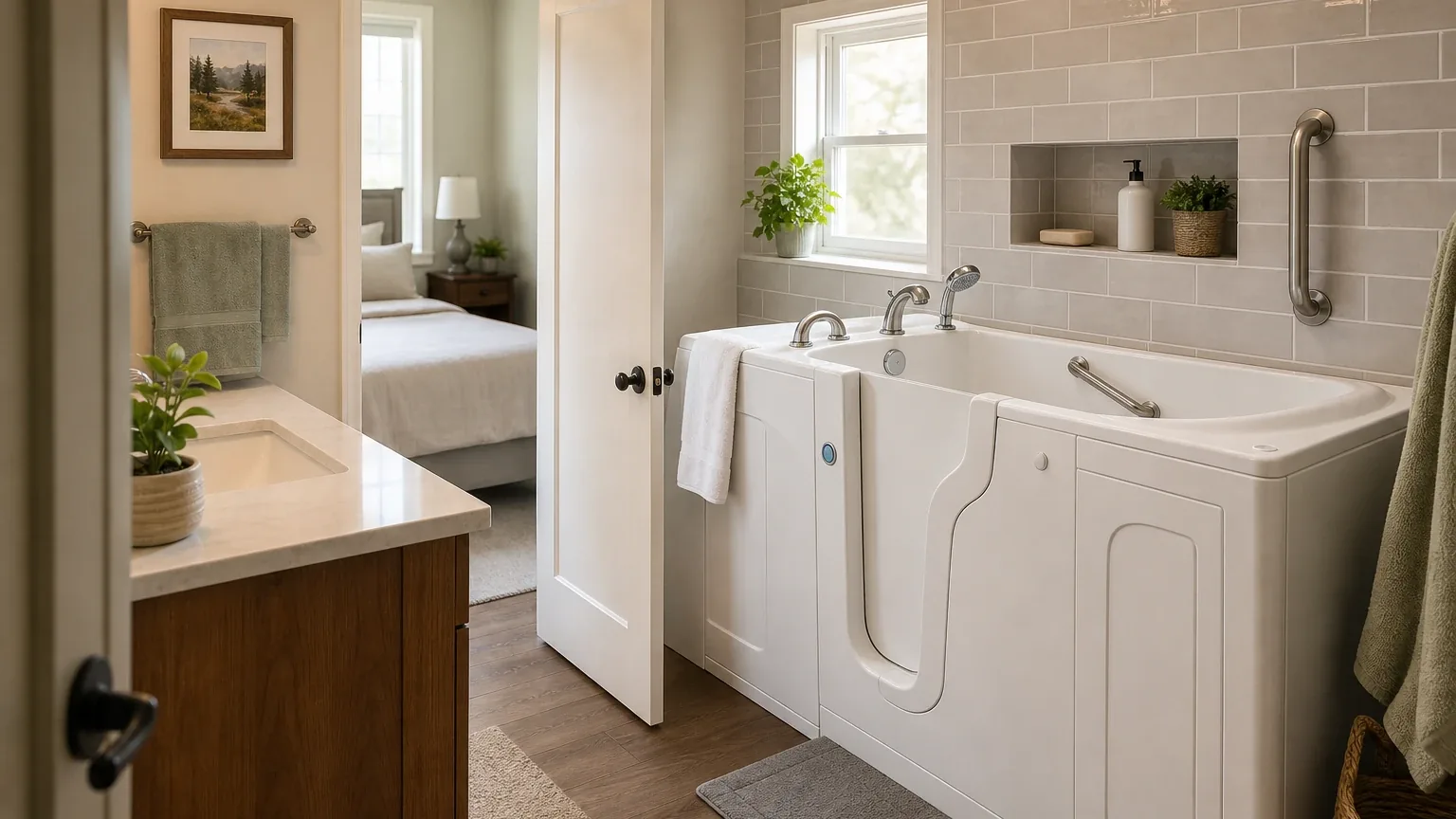
Answer Capsule
For most homeowners replacing a standard bathtub, the 60-inch walk-in tub is the better default. All seven AI platforms studied named it, and it ranked first on average (1.29) because a conventional U.S. alcove tub is typically 60 inches long, so a 60-inch walk-in tub is the option most likely to reuse the existing alcove footprint and plumbing wall without reworking the room. The buyer who should choose the 52-inch walk-in tub instead is the one whose finished alcove is genuinely shorter than 60 inches, whose bathroom is tight enough that length crowds a door, toilet, or vanity, or who needs to move a tub through a narrow doorway or hallway. The decision turns on the measured finished alcove, the bather's height and legroom needs, adjacent-fixture clearance, and budget priority. Seven platforms were studied. The principal limitation: this guide reports what AI platforms stated, not installed or measured results, and no reliable national installed-price premium for 60-inch over 52-inch is published.
Research Snapshot
- Topic: 52-inch vs. 60-inch walk-in tubs — tub size selection.
- Target buyer: Homeowners replacing a standard bathtub who must choose a walk-in tub length.
- Geography: United States.
- The two approaches compared: 60-inch walk-in tub (rank 1) and 52-inch walk-in tub (rank 2).
- Platforms included (7): openai, anthropic, deepseek, grok, perplexity, kimi, google.
- Research date: 2026-11-10.
- What the platforms were asked to decide: which walk-in tub length best fits a homeowner replacing a standard bathtub, weighing comfort, bathroom footprint, fitting and renovation work, and total cost.
- Ranking authority: the final ranking table. Both approaches were named by all seven platforms (100% platform share). The 60-inch tub averaged rank 1.29 with a best rank of 1; the 52-inch tub averaged rank 1.71 with a best rank of 1.
The Two Options Compared
Questions This Section Answers
- Should a homeowner replacing a standard bathtub choose a 60-inch or 52-inch walk-in tub when the existing alcove is a conventional 60-inch opening?
- Is a 52-inch or 60-inch walk-in tub better for a tight bathroom where adjacent fixtures and doorway clearance matter most?
- Why does a 52-inch walk-in tub sometimes need an extension panel that a 60-inch tub avoids?
The single most decision-relevant fact is that a conventional U.S. alcove bathtub is typically 60 inches long, so the 60-inch walk-in tub is the length most likely to drop into the existing opening without a filler. The 52-inch tub is the compact alternative, and in a standard 60-inch alcove it generally needs an extension panel or finished filler to close the gap.
| Decision dimension | 60-inch walk-in tub | 52-inch walk-in tub | Which the supplied evidence favours |
|---|---|---|---|
| Alcove fit in a standard opening | Matches a typical 60-inch alcove; no extension panel needed | Fits a standard 60-inch alcove only with an extension panel or filler | 60-inch |
| Fit in a short or nonstandard alcove | Requires a full 60-inch clear length | Fits alcoves and tight layouts a 60-inch tub cannot | 52-inch |
| Interior legroom and comfort | More longitudinal room; better for taller bathers and extended soaks | Less legroom; may feel cramped for users over roughly 5'8" | 60-inch |
| Model and feature choice | Widest selection of models, doors, and therapy packages | Narrower selection; some 52×32 outward-door models offer a 23-inch seat height | 60-inch |
| Installation and renovation work | Straightforward tub-out/tub-in swap in a standard alcove; fewer trim decisions | Extension panel adds a finishing step; custom fitting can offset savings | 60-inch |
| Water volume and water-heater demand | Higher water volume; may need larger heater capacity and longer fill/drain | Lower water volume; less demand on standard heaters, shorter waits | 52-inch |
| Maneuvering through doorways and hallways | Larger shell harder to clear doorways under 30 inches | Shorter length easier to move through tight doorways and hallways | 52-inch |
| Upfront unit cost | Generally higher list price than a same-series 52-inch model | Generally lower list price than a same-series 60-inch model | 52-inch |
| All-in installed cost | Not reliably separable from 52-inch by a published national figure | Not reliably separable from 60-inch by a published national figure | Does not separate them |
| Future flexibility and resale | Standard length preserves expected bathroom proportions | Non-standard length may read as a compromise unless saved space is visible | 60-inch |
Which Buyer Should Choose Each Option
Questions This Section Answers
- Which buyer should choose a 52-inch walk-in tub over a 60-inch tub when the bathroom alcove measures under 60 inches?
- Should a taller bather or someone with limited joint flexibility choose a 60-inch walk-in tub for legroom?
- Is a 52-inch walk-in tub the better choice when a narrow doorway or hallway makes moving a larger tub difficult?
The fastest way to settle the choice is to measure the finished alcove first, then weigh bather height and adjacent-fixture clearance. The table below maps buyer situations to the approach the supplied evidence supports.
| Buyer situation | Better choice | Why, from the supplied evidence |
|---|---|---|
| Standard 60-inch alcove, wants a straightforward swap | 60-inch | Reuses the existing alcove footprint and plumbing wall without a filler panel |
| Finished alcove under 60 inches (roughly 52–55 inches) | 52-inch | Fits compact alcoves without wall removal or plumbing relocation |
| Taller bather or one wanting to stretch out | 60-inch | More longitudinal legroom and footwell space |
| Bather over roughly 5'8" who dislikes cramped footwells | 60-inch | 52-inch footwell may feel constricted for taller users |
| Tight bathroom where length crowds a toilet or vanity | 52-inch | Shorter length preserves floor space and clearance |
| Narrow doorway or hallway (under 30 inches) during install | 52-inch | Shorter shell maneuvers more easily through tight openings |
| Wants the widest model, door, and therapy selection | 60-inch | Widest selection of models, features, and price points at 60-inch length |
| Wants a higher seat height on some outward-door models | 52-inch | Some 52×32 outward-door models offer a 23-inch seat height |
| Limited hot-water capacity or wants shorter fill/drain waits | 52-inch | Lower water volume reduces heater demand and wait times |
| Prioritizes resale-standard bathroom proportions | 60-inch | Standard length preserves expected bathroom proportions |
| Budget-conscious on the unit itself | 52-inch | Generally lower list price than a same-series 60-inch model |
1. 60-inch walk-in tub
Questions This Section Answers
- Should a homeowner replacing a standard bathtub in a conventional three-wall alcove install a 60-inch walk-in tub?
- Is a 60-inch walk-in tub better than a 52-inch tub for a taller bather who wants maximum legroom?
- What should a buyer check about their water heater before choosing a 60-inch walk-in tub?
The 60-inch walk-in tub is the default for a standard alcove because it usually matches the length of the tub being removed, avoiding the side gap that a shorter tub leaves behind. See the 60-inch walk-in tub fit review for the full fit assessment.
Who should choose it. Most homeowners replacing a standard bathtub in a conventional three-wall alcove. OpenAI frames it as best for most such buyers because a 60-inch configuration generally uses the existing length of a standard U.S. bathtub opening and avoids a side gap needing an extension panel. Anthropic recommends it for most buyers with standard-to-large bathrooms who can accommodate the additional 8 inches of length without structural modification. Deepseek calls it the most natural tub-for-tub substitution. Kimi names the homeowner with a true standard 60-inch alcove who prioritizes legroom, simpler installation without gap-fillers, and resale value. Google says it is the superior choice for most homeowners replacing a standard 60-inch alcove bathtub.
What it does well for this use case.
- Usually matches the length of a standard 60-inch bathtub alcove, so it is the most natural tub-for-tub substitution.
- Provides more room for leg position, seating clearance, and entry comfort than a shorter configuration when width and interior layout are otherwise comparable.
- Can avoid the extension-panel treatment required by many 52-inch tubs in a standard 60-inch opening.
- Offers the widest selection of models, features, and price points at 60-inch length.
- Google notes increased internal legroom and footwell space accommodating bathers over 5'10", and higher water volume for full-torso immersion during hydrotherapy.
- Grok notes space for up to four therapy systems and a seamless edge-to-edge look without an extension panel.
What it costs the buyer.
- Requires an adequately sized alcove; the nominal 60-inch label does not replace measuring the finished opening, framing, wall finish, drain location, and door swing.
- May require more demolition or wall modification than a 52-inch unit if the existing opening is unusually short or irregular.
- Anthropic notes slightly higher unit cost than comparable 52-inch models due to additional material, and increased water consumption and heating load.
- Google notes it demands larger water-heater capacity (often 60–80 gallons or fast tankless systems), and that the larger footprint makes tight doorways under 30 inches harder to clear during transport. It also takes longer to fill and drain.
- A longer tub may provide less flexibility if the homeowner later wants to reconfigure the bathroom around a shower or a smaller fixture.
Where platforms disagreed about it. Grok and perplexity each listed the 60-inch tub at position 2 rather than 1, while openai, anthropic, deepseek, kimi, and google placed it first. On cost, the platforms diverge sharply: deepseek calls the size-specific difference quote-only; grok estimates 60-inch models run $1,000–$3,000 more all-in; perplexity reports a $0–$4,000 premium; kimi cites published list-price gaps of $568 to $1,373 for the tub alone; and google says unit cost is comparable to 52-inch models with installation labor potentially lower. On water heating, google is the most specific about heater capacity; other platforms mention water volume more generally.
2. 52-inch walk-in tub
Questions This Section Answers
- Should a homeowner with a bathroom alcove under 60 inches install a 52-inch walk-in tub instead of a 60-inch tub?
- Is a 52-inch walk-in tub better than a 60-inch tub when preserving floor space and clearance around a toilet or vanity matters most?
- Why does a 52-inch walk-in tub need an extension panel in a standard 60-inch alcove?
The 52-inch walk-in tub is the compact option for constrained or nonstandard bathrooms, and in a standard 60-inch alcove it generally relies on an extension panel to close the gap. See the 52-inch walk-in tub fit review for the full fit assessment.
Who should choose it. Homeowners with a constrained or nonstandard bathroom, a shorter usable alcove, or a strong preference for reducing the tub's length while retaining a seated bathing configuration. Anthropic recommends it for smaller or older bathrooms, apartments, condos, or any home where the existing alcove measures less than 60 inches — the only viable choice for homes with 52–55 inch alcoves. Deepseek frames it for buyers whose bathroom cannot take a standard 60-inch alcove. Kimi names the homeowner with a smaller body frame, a bathroom where legroom matters less than preserving floor space, or an alcove under 60 inches finished where extensive retiling is undesirable. Grok and perplexity both rank it first for tighter bathrooms where limiting demolition and floor impacts matters more than maximizing interior space.
What it does well for this use case.
- Shorter overall length can help when the usable bathroom footprint is constrained, and can fit alcoves and tight layouts a 60-inch tub cannot.
- Can be installed in a standard 60-inch alcove with an extension panel on models designed for that arrangement.
- May reduce the fixture length occupying the room, helping preserve circulation or clearance at the entrance and nearby fixtures.
- Lower water volume than a longer tub, reducing demand on standard water heaters and shortening fill/drain wait times.
- Google notes the shorter length allows easier maneuvering through tight doorways and narrow hallways, and that the extension panel can create useful built-in shelf space.
- Kimi notes some 52×32 outward-door models offer an elevated 23-inch seat height not available on 60-inch models in the same series.
- A verified U.S. example is Acrit's Freedom configuration, documented at 52 by 30 by 40 inches and described as extendable to 60 inches.
What it costs the buyer.
- Typically offers less longitudinal bathing room than a comparable 60-inch configuration, which can matter for taller or larger users; kimi and google both flag that it may feel cramped for users over roughly 5'8".
- A standard 60-inch alcove may require an extension panel or other finished filler area, adding visual complexity and installation work.
- The shorter configuration does not automatically reduce total project cost because the tub, door, plumbing, electrical, demolition, waterproofing, and labor can be the major cost drivers.
- Some buyers may have fewer model, interior-layout, or future replacement choices than with the more common full-length alcove format.
- Kimi notes a trade-off between length and width: a 32-inch-wide 52-inch tub projects farther into the room than a 30-inch-wide 60-inch tub.
Where platforms disagreed about it. Grok and perplexity each ranked the 52-inch tub first, while openai, anthropic, deepseek, kimi, and google placed it second. On cost, grok estimates 52-inch models run $1,000–$3,000 less all-in; perplexity reports a $0–$4,000 lower range; kimi cites published list-price gaps of $500–$1,400 for the tub alone; anthropic reports roughly $500–$2,000 lower installed; deepseek calls it quote-only; and google says equipment is slightly lower but contractor labor for framing or extension panels can offset the savings. On whether the 52-inch tub is a "budget" choice, anthropic and grok treat it as lower-cost, while openai and deepseek stress it is not automatically cheaper once fitting and labor are included.
What the Cost Difference Looks Like
Questions This Section Answers
- Is a 60-inch walk-in tub more expensive to install than a 52-inch walk-in tub for a standard alcove replacement?
- Why can a 52-inch walk-in tub cost as much as or more than a 60-inch tub once extension-panel labor is included?
- What all-in installed cost ranges do the platforms report for 52-inch and 60-inch walk-in tubs?
No reliable national installed-price premium for 60-inch over 52-inch is published; the size-specific difference is generally quote-only, and the platforms disagree on the direction and size of the gap. The figures below are marked by how the supplied evidence characterizes them.
| Cost item | 60-inch walk-in tub | 52-inch walk-in tub | Status |
|---|---|---|---|
| Typical all-in project (Fixr, via openai) | Roughly $3,500–$10,000 | Roughly $3,500–$10,000 | Reported |
| Broader 2026 all-in estimates (via openai) | About $5,500–$14,200+ | About $5,500–$14,200+ | Reported |
| Installed project (anthropic) | $6,000–$10,000 typical; $4,600–$15,000 range | $4,000–$6,500 typical; $3,500–$8,000 range | Reported |
| Unit only (anthropic) | $2,000–$6,000 | $1,999–$4,500 | Reported |
| Unit only (google) | $3,000–$7,000; installed $6,000–$12,000+ | $2,500–$6,500; installed $5,500–$11,000 | Quote-only |
| All-in premium vs. the other size (grok) | $1,000–$3,000 more | $1,000–$3,000 less | Quote-only |
| All-in premium vs. the other size (perplexity) | $0–$4,000 more | $0–$4,000 less | Reported |
| All-in premium vs. the other size (kimi) | $500–$2,000 more | $500–$2,000 less | Published list prices |
| Same-series list-price gap (kimi) | American Standard Value 60×30 at $7,668; Premium 60×30 at $10,207 | Value 52×30 at $7,100; Premium 52×30 at $8,834 | Published list prices |
| Size-specific installed difference (deepseek) | Quote-only | Quote-only | Quote-only |
The clearest verifiable figure is kimi's published list-price comparison: a 60×30 Value soaker lists at $7,668 versus $7,100 for the 52×30 Value soaker — a $568 difference for the tub alone — and premium series show a $1,373 gap ($10,207 vs. $8,834). These are published list prices, though actual transaction prices often reflect unadvertised discounts or in-home quotes. Beyond the unit, no figure is verifiable as a national installed premium: deepseek states plainly that a uniform national figure is not published, and openai notes a 52-inch unit can be cheaper when it avoids structural changes in a short bathroom but can also require an extension panel in a standard alcove, so the final price may equal or exceed a comparable 60-inch installation.
Where the AI Platforms Agreed
All seven platforms named both approaches, and several points recur across the set. A conventional U.S. alcove bathtub is typically 60 inches long, so the 60-inch walk-in tub is the most natural tub-for-tub substitution and the 52-inch tub generally needs an extension panel or filler in a standard 60-inch opening. The 60-inch tub offers more interior legroom and better suits taller bathers, while the 52-inch tub fits shorter or tighter alcoves and preserves floor space. The 52-inch tub carries lower water volume, easing water-heater demand and shortening fill/drain waits. Both lengths are widely available in U.S. product lines. And on cost, the platforms broadly agree that installation labor, plumbing, electrical work, features, and bathroom modifications — not the length label — dominate the final quote.
Where the AI Platforms Disagreed
The platforms split on which length should rank first. Grok and perplexity each placed the 52-inch tub at position 1, favoring its smaller footprint and lower remodeling scope; openai, anthropic, deepseek, kimi, and google placed the 60-inch tub first. They also disagreed on the cost gap: grok and perplexity report the widest spreads ($1,000–$3,000 and $0–$4,000 respectively), kimi anchors to published list prices ($500–$2,000 all-in), anthropic reports $500–$2,000 lower installed for the 52-inch, and deepseek and google treat the size-specific difference as quote-only or offset by labor. On water heating, google is alone in specifying heater capacity (60–80 gallons or fast tankless). On seat height, kimi alone notes the 23-inch seat option on some 52×32 outward-door models. On extension panels, google and kimi describe them as creating useful shelf space, while openai and kimi also flag the added visual seam and finishing complexity.
How to Decide
Questions This Section Answers
- What should a homeowner measure about their bathroom before choosing between a 52-inch and 60-inch walk-in tub?
- Should a buyer choose a 60-inch walk-in tub if their finished alcove measures close to 60 inches but not exactly?
- When does a 52-inch walk-in tub become the better choice for a bathroom that could physically fit a 60-inch tub?
Answer these in order; the first two usually settle the decision.
- Measure the finished alcove length. If it is close to 60 inches, the 60-inch tub is the natural fit. If it is genuinely shorter (roughly 52–55 inches), the 52-inch tub is the only viable choice. Kimi warns that a 59 3/8-inch opening may still need trim work, so measure the finished opening, framing, wall finish, drain location, and door swing — not the nominal label.
- Check adjacent-fixture clearance and doorway width. If length would crowd a toilet, vanity, or walkway, or if a doorway under 30 inches must be cleared during transport, the 52-inch tub's shorter shell is the advantage.
- Weigh bather height and flexibility. Taller bathers, those over roughly 5'8", or anyone with limited joint flexibility benefit from the 60-inch tub's legroom; a smaller frame or a preference for preserved floor space favors the 52-inch.
- Confirm water-heater capacity. A 60-inch tub's higher water volume may call for larger heater capacity; a 52-inch tub places less demand on a standard heater.
- Decide whether an extension panel is acceptable. In a standard alcove, the 52-inch tub needs a filler; if a visible seam or extra finishing work is unwanted, the 60-inch avoids it.
- Get written quotes for both lengths in your own bathroom. Because the size-specific installed difference is quote-only, the quote — not a national average — is the number that matters.
Methodology
This guide reports what seven AI platforms — openai, anthropic, deepseek, grok, perplexity, kimi, and google — stated when asked to decide between a 52-inch and a 60-inch walk-in tub for a homeowner replacing a standard bathtub, weighing comfort, bathroom footprint, fitting and renovation work, and total cost. The research date is 2026-11-10 and the geography is the United States. Both approaches were named by all seven platforms. Rank, platform mentions, platform share, average rank, and best rank come solely from the final ranking table: the 60-inch tub at rank 1 (average rank 1.29, best rank 1) and the 52-inch tub at rank 2 (average rank 1.71, best rank 1). The study did not install, test, measure, or inspect any tub; it consolidates the platforms' stated positions and the sources they cited.
Methodology Limitations
The platforms were not asked to physically verify dimensions or pricing, and the URLs were collected from platform responses and were not independently validated. No reliable national installed-price premium for 60-inch over 52-inch is published, so cost comparisons rest on a mix of reported estimates, published list prices, and quote-only statements that the platforms themselves characterize differently. The platforms disagreed on which length should rank first and on the size of the cost gap. Brand names appear only to illustrate an approach where the supplied evidence carries their specifications — KOHLER's documented customizable lengths from 52 to 60 inches and widths from 28 to 32 inches, Acrit's 52×30×40-inch Freedom configuration described as extendable to 60 inches, and American Standard's published list prices — and are not recommendations. Where the decision depends on the buyer's own bathroom, budget, mobility, or household, this guide says so rather than declaring one approach universally better.
Final Verdict
For most homeowners replacing a standard bathtub, the 60-inch walk-in tub is the better default: it matches the typical 60-inch alcove, avoids an extension panel, and offers more legroom and model choice. The 52-inch walk-in tub remains the right choice — not a fallback — for buyers with a genuinely short alcove, a tight bathroom where length crowds adjacent fixtures, a narrow doorway to clear, or a preference for lower water volume and a lower unit price. The decision turns on the measured finished alcove first, then bather height, clearance, and water-heater capacity. Because the installed cost difference is quote-only, buyers should get written quotes for both lengths in their own bathroom before committing.
Frequently Asked Questions
Is a 60-inch walk-in tub better than a 52-inch tub for most homeowners?
Yes, per the supplied evidence: all seven platforms named it, and it ranked first on average because it usually matches a standard 60-inch alcove and avoids an extension panel.
When is a 52-inch walk-in tub the better choice?
When the finished alcove is genuinely shorter than 60 inches, when length would crowd a door, toilet, or vanity, when a narrow doorway must be cleared during install, or when lower water volume and a lower unit price matter most.
Does a 52-inch tub always cost less than a 60-inch tub?
No. Published list prices show the 52-inch lower, but the platforms disagree on the all-in gap, and a 52-inch tub in a standard alcove may need an extension panel whose labor offsets the savings.
Will a 52-inch walk-in tub fit a standard 60-inch alcove?
Yes, generally with an extension panel or finished filler to close the gap, on models designed for that arrangement.
Do I need a bigger water heater for a 60-inch tub?
Google states a 60-inch tub may demand larger water-heater capacity (often 60–80 gallons or fast tankless systems) because of higher water volume; a 52-inch tub places less demand on a standard heater.
Consolidated Sources
Company-owned sources
Independent sources
For the full set of walk-in tub buying guides, see the walk in tubs category directory.
Verify This Research
Review the study details behind this page or download the public machine-readable verification record.
- Study date
- November 10, 2026
- Platforms analyzed
- 7
- Source records
- 28
- Candidates reviewed
- 2
- Qualified finalists
- 2
Research trail and source mix
Configured platforms
openai, anthropic, deepseek, grok, perplexity, kimi, google
Source mix
0 independent · 0 company-owned · 28 unclear
Evidence support
0 direct · 0 partial
Important limitation
Exactly 7 platforms were included in this run: openai, anthropic, deepseek, grok, perplexity, kimi, google. The configured source value 7 is provenance only and must never be described as the number of platforms studied.
Source snapshot SHA-256 32dc55a49c80795b1d347a113eedba3b8a906b9f8e45cf8436519af54d847fbd