
Answer Capsule
Bay Alarm Medical SOS Home Cellular is a good fit for In-Home Base Station Coverage in a typical house and nearby yard, provided local cellular signal is adequate and the buyer verifies range on site. All six platforms that named it in the ranking stage included it, and it finished second overall with an average listed rank of 3.3. The strongest reason to consider it is a simple cellular base station with clear two-way audio, optional fall detection, and positive independent response testing. The main limitation is range: Bay Alarm states up to 1,000 feet, but one independent test measured 400 feet, and competitors publish 1,300 to 1,400 feet.
Research Snapshot
| Field | Detail |
|---|---|
| Platform mentions in ranking stage | 6 of 6 platforms that named it (anthropic, deepseek, google, grok, openai, perplexity) |
| Share of included platform responses | 100% (6 of 6) |
| Average listed rank | 3.33 |
| Best listed rank | 1 (google) |
| Relevant product/model/plan | Bay Alarm Medical SOS Home Cellular with optional Auto Fall Detection |
| Overall use-case fit | Good (four platforms rated good; google and grok rated strong) |
| Research date | 2026-11-10 |
What Changed Since September 2026
Bay Alarm Medical SOS Home Cellular remained at No. 2, and platform mentions decreased from 7 to 6. The November 2026 review keeps the same core verdict but sharpens the buyer picture on range and response time. The product name now specifies the cellular version, and the range discussion is more concrete: competitors publish 1,300 to 1,400 feet, while independent testing measured Bay Alarm's coverage at roughly 400 feet. Reported response times are now given as 47 to 50 seconds in some tests and 15 to 31 seconds in others. On cost, $44.95 per month for cellular with fall detection is newly reported, and $27.95 per month is no longer repeated. Fit, recommended configuration, strengths, and limitations are otherwise unchanged. Differences between the two editions reflect what each article reports; they do not by themselves prove that the product, service, or price changed.
The September 2026 review preserves the earlier article for reference.
Why Bay Alarm Medical SOS Home Cellular Qualified for This Study
Questions This Section Answers
- How did Bay Alarm Medical SOS Home Cellular rank across AI platforms for in-home base station coverage?
- Is Bay Alarm Medical SOS Home Cellular a good choice for in-home base station coverage at its published monthly price?
Bay Alarm Medical SOS Home Cellular qualified because every platform that named it in the ranking stage placed it in the top five, and it landed second overall. It was named by six platforms — anthropic, deepseek, google, grok, openai, and perplexity — with ranks of 5, 3, 1, 3, 3, and 5 respectively, producing an average listed rank of 3.33 and a best rank of 1 (google). The topic configuration set a minimum of two mentions for inclusion, so six mentions cleared that bar comfortably.
The platforms converged on the same product framing: an in-home base station with a wearable help button, available in cellular or landline versions, with optional fall detection [16]. That consistency in how the product was described — not just that it was listed — is why it is treated here as a genuine contender for this use case rather than a passing mention.
Whether it is a good choice at its published price depends on property size. At $34.95 per month for the cellular plan [16], it is competitive for a small or medium home where the stated 1,000-foot range is verified on site. It becomes a weaker value when a buyer needs coverage across a large yard, detached garage, or outbuilding, because independent testing found the actual range shorter than advertised [35].
The Product, Model, Plan, or Service Most Relevant to In-Home Base Station Coverage
Questions This Section Answers
- Which Bay Alarm Medical plan should a buyer choose for in-home base station coverage: SOS Home Cellular or SOS Home Landline?
- Does Bay Alarm Medical SOS Home Cellular include fall detection, or is it a separate pendant and monthly add-on?
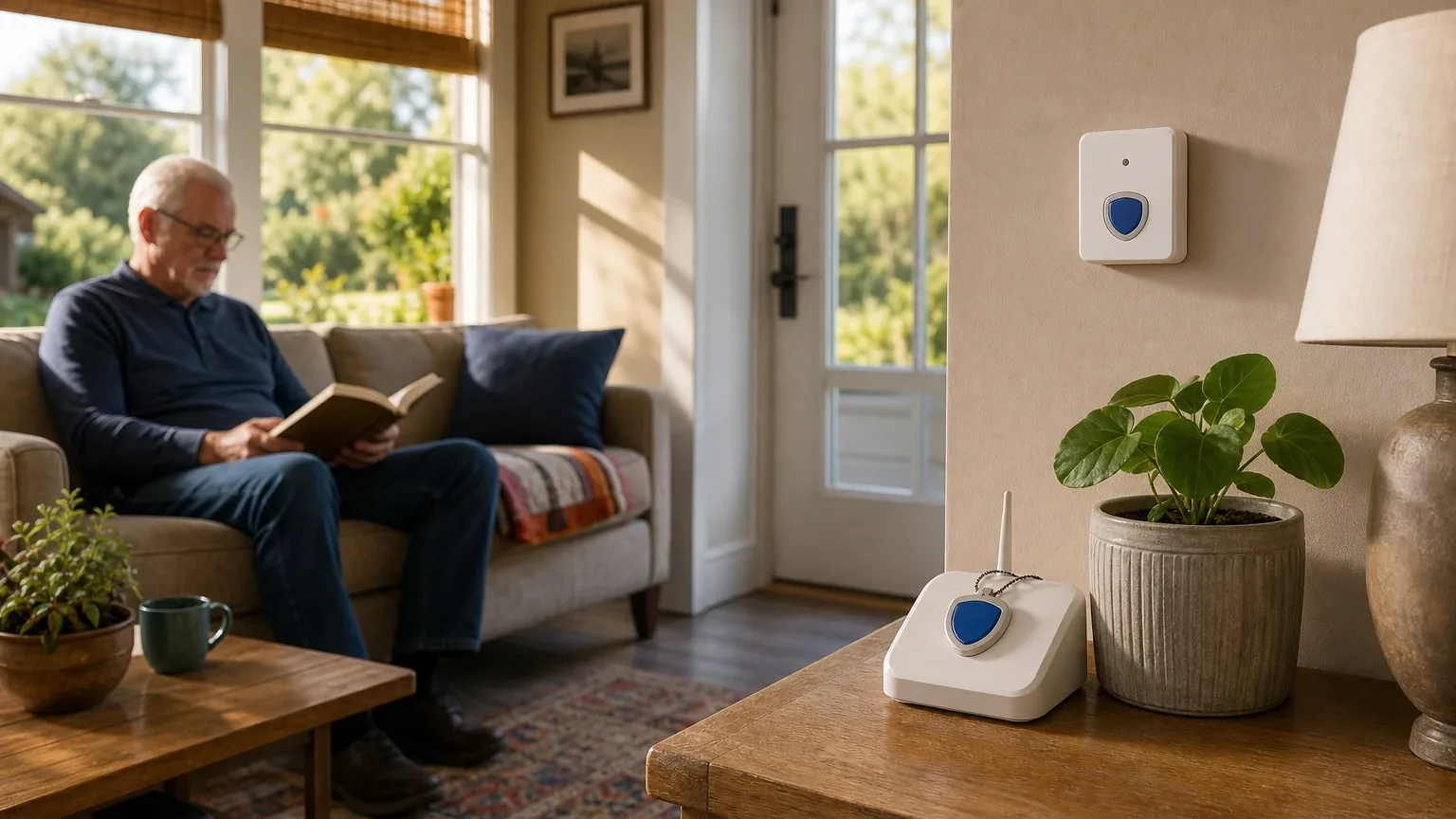
The relevant product is the SOS Home Cellular base station with a wearable help button, and the fall-detection configuration is a separate pendant sold as an add-on. Bay Alarm sells SOS Home in both cellular and landline versions [19]. The cellular version uses 4G LTE and does not require a home phone line, so the base unit can be placed wherever signal is good rather than tethered to a wall jack [13]. The landline version is the cheaper plan but depends on a working phone line.
Fall detection is not built into the standard help button. It requires a dedicated fall-detection pendant, priced at $10 per month on top of the base plan, with a one-time device fee reported at $30 [16]. Google's research adds that fall detection is not available on the landline version at all, making cellular a requirement if that feature matters [33]. The fall-detection pendant is also reported with a slightly shorter 800-foot range than the standard button [25].
Platforms described the plan under several names — "SOS Home Cellular," "In-Home Cellular plan," and "SOS Home with Fall Detection pendant" — but the underlying product is the same base-station system. Buyers should confirm the exact plan name and included hardware at checkout rather than relying on any single label.
What the AI Platforms Agreed About
Questions This Section Answers
- What do AI platforms agree are the strongest features of Bay Alarm Medical SOS Home Cellular for in-home base station coverage?
- Do AI platforms agree that Bay Alarm Medical SOS Home Cellular has clear two-way audio and reliable monitoring?
The platforms agreed most strongly on audio clarity, monitoring responsiveness, cellular setup, and backup power. On two-way speaker clarity, AARP's independent testing found the base speaker loud and clear and audible from much of a small home, and multiple reviewers praised its strength [9]. The platforms were consistent that the wearable button has no speaker and that conversation happens through the base unit [9].
On monitoring, Bay Alarm claims 24/7 U.S.-based centers with UL listing and CSAA 5-Diamond certification [16]. Independent testing reported quick, professional responses — roughly 47 to 50 seconds in some tests and 15 to 31 seconds in others depending on device and method [30]. The platforms agreed the service performed well in testing but noted that testing cannot guarantee performance in every emergency.
On setup, the platforms agreed the cellular version is plug-and-play and avoids landline dependency [18]. On backup power, the base unit includes a backup battery, and the most commonly cited figure is 32 hours [21], though one source reports approximately 36 hours [19]. On wearable battery life, Bay Alarm states up to five years for the standard button and two years for the fall-detection button [16].
Where the AI Platforms Disagreed or Were Uncertain
Questions This Section Answers
- Why do AI platforms disagree about the actual range of Bay Alarm Medical SOS Home Cellular?
- How long does the Bay Alarm Medical SOS Home Cellular backup battery actually last during a power outage?
The sharpest disagreement is range. Bay Alarm states up to 1,000 feet of button-to-base coverage [16], and some pages describe it as 800 to 1,000 feet [14]. But U.S. News testing reported an actual measured range of 400 feet for the cellular system, far short of the advertised figure [35]. Google and grok treated the 1,000-foot figure as a strength; anthropic and openai flagged the gap as a limitation. The platforms did not resolve why the tested figure differed — building layout, interference, or test method are all plausible but unconfirmed.
Backup battery runtime is a second uncertainty. The official pages confirm a backup battery but do not clearly state its current runtime [16]. Third-party reports range from approximately 32 hours [21] to approximately 36 hours [19]. Buyers should treat the exact figure as unconfirmed.
Pricing shows minor conflict. Most 2026 sources confirm $34.95 per month for cellular and $44.95 with fall detection [16], but older sources show lower figures around $27.95 to $29.95, suggesting possible price increases over time [4]. Deepseek reported low pricing confidence and could not confirm current figures [23]. Contract and cancellation terms were also inconsistently documented: some sources describe no long-term contract and a 15-day trial [2], google reported a 30-day trial [24], and perplexity could not verify cancellation terms at all [16].
Use-Case-Specific Features and Capabilities
Questions This Section Answers
- Will Bay Alarm Medical SOS Home Cellular cover a senior's yard, driveway, and detached garage?
- Can a caregiver rely on Bay Alarm Medical SOS Home Cellular notifications during an emergency?
For in-home base station coverage, the decisive capability is range from the base unit, and here the evidence is mixed. The stated 1,000-foot range can cover many typical homes plus a patio, driveway, or portion of an adjacent yard [16]. But the 400-foot tested figure means a large yard or detached structure may fall outside reliable coverage [35]. Bay Alarm's user guide includes a range-test procedure so buyers can check communication between button and base in and around the home before relying on it [18].
Two-way audio works through the base station, not the pendant. Testers could hear the base speaker from much of a small home, and one test found a dispatcher speaking through the speaker within 15 seconds of a button press 75 feet from the base [9]. The base unit is not waterproof, though the wearable button is [9]. The base has no volume control and stays at full volume to remain audible [30].
Fall detection is optional and imperfect. Forbes testing found the pendant detected three of three simulated falls in one round [7] but missed two of three in another [22], and the company itself cautions the motion sensor is not perfectly accurate [22]. Caregiver notifications were a clear weak point: U.S. News reported notifications failed to load in testing rounds [6], and the app lacks geofencing and activity tracking found in competitors [31].
Pricing, Fees, Contracts, and Ongoing Costs
Questions This Section Answers
- How much does Bay Alarm Medical SOS Home Cellular cost per month with and without fall detection?
- Are there equipment fees or a long-term contract with Bay Alarm Medical SOS Home Cellular?
Published pricing is $34.95 per month for SOS Home Cellular and $44.95 per month with fall detection, plus a $30 one-time device fee for the fall-detection pendant [16]. The base station and standard help button are leased at no upfront equipment cost, and the console must be returned when service is canceled [16]. Additional help buttons are reported at $30 to $40 each, and a lockbox at about $30 to $35 [27].
On contracts, Bay Alarm states subscriptions can be canceled at any time with unused months refunded less shipping, and billing is available monthly, quarterly, or annually [16]. No long-term contract was clearly stated on the reviewed pricing page [15], and no activation fees are advertised [19]. Trial length is reported inconsistently at 15 days [2] and 30 days [24]. Promotional free-month and free-shipping offers may be time-limited or eligibility-dependent [16]. Buyers should confirm the current monthly rate, the fall-detection device fee, trial length, and return-shipping responsibility before purchase.
Best Suited For
Questions This Section Answers
- Who gets the most value from Bay Alarm Medical SOS Home Cellular for in-home base station coverage?
- Is Bay Alarm Medical SOS Home Cellular a good fit for a senior without a landline who wants simple at-home monitoring?
It suits seniors who spend most of their time inside a small or medium home and want simple, monitored coverage without a landline. Buyers without a landline who want plug-and-play cellular setup are a strong match [18]. So are users who prioritize a loud, clear base-station speaker and straightforward operation [9], and households that want optional fall detection without buying a separate mobile system [16]. Budget-conscious buyers seeking no long-term contract and no upfront base-station equipment fee also fit [2].
Probably Not Best Suited For
Questions This Section Answers
- Is Bay Alarm Medical SOS Home Cellular a poor choice for a large property or a home with a detached garage?
- Does Bay Alarm Medical SOS Home Cellular work for a senior who needs two-way voice through the pendant itself?
It is a weaker choice for large homes, acreage, detached outbuildings, or yards requiring more than roughly 1,000 feet of coverage, and especially where the 400-foot tested figure is the realistic limit [10]. Buyers seeking the longest published in-home range should look at competitors with 1,300 to 1,400 feet [10]. Users who need two-way voice directly through the pendant will be disappointed, since the pendant only initiates the call and conversation happens through the base [9]. Families that depend on robust real-time caregiver notifications should weigh the reported notification failures [6].
When Another Option May Be Better
Questions This Section Answers
- When is a competing in-home system a better choice than Bay Alarm Medical SOS Home Cellular for yard and property coverage?
- Should a senior who spends time outdoors choose a mobile system instead of Bay Alarm Medical SOS Home Cellular?
A competing in-home system may be better when the senior regularly uses a large yard, driveway, detached garage, or expansive home, because competitors publish 1,300- to 1,400-foot ranges against Bay Alarm's stated 1,000 feet and tested 400 feet [10]. A mobile or all-in-one cellular device such as Bay Alarm's own SOS Micro may be better when coverage must extend beyond the fixed base-station area, though that is a different use case with different battery and equipment costs [16]. A system with pendant-based two-way audio or more advanced caregiver, medication, or environmental features may be better when those capabilities matter more than simple in-home operation [16]. Buyers who need GPS location tracking away from home should also look to mobile systems, since SOS Home has no GPS [31].
Questions to Verify Before Buying
Questions This Section Answers
- What should a buyer confirm about cellular signal and range before committing to Bay Alarm Medical SOS Home Cellular?
- Which fees and contract terms should a buyer verify before signing up for Bay Alarm Medical SOS Home Cellular?
Buyers should confirm several things before committing. First, which cellular network the specific unit uses at their address and whether Bay Alarm can verify signal strength there [16]. Second, whether the 1,000-foot range covers the exact house, yard, driveway, basement, and any detached structures after an on-site range test [18]. Third, the current tested backup-battery runtime and whether it supports both cellular communication and two-way voice during an outage [16]. Fourth, whether the $30 fall-detection device fee still applies and whether the $10 monthly fall-detection price is bundled or billed separately [16]. Fifth, any activation, shipping, return, replacement, restocking, or early-cancellation charges not shown in the headline price [16]. Sixth, what happens if the console is not returned after cancellation and who pays return shipping [16]. Seventh, which monitoring center handles the account and its current certification status [16]. Finally, whether the buyer can test the pendant from every intended indoor and outdoor location during the trial or return period [16].
Final AI Consensus Verdict
The consensus is that Bay Alarm Medical SOS Home Cellular is a good fit for reliable basic coverage in a typical home and nearby yard, provided local cellular service is adequate and the 1,000-foot range is verified at the property. Four platforms rated it good and two rated it strong, with no platform rating it poor. The strongest reasons to choose it are simple cellular installation, clear base-station audio, optional fall detection, and positive independent response testing. The principal reason to choose another system is the need for maximum outdoor or large-property range, where competitors publish longer coverage and one independent test measured Bay Alarm well below its advertised figure. Buyers should treat the range and backup-battery figures as items to verify rather than settled facts.
How This Review Was Produced
This review was produced from a ranking-stage study of in-home medical alert systems for the In-Home Base Station Coverage use case, with a research date of 2026-11-10. Six platforms — anthropic, deepseek, google, grok, openai, and perplexity — named Bay Alarm Medical SOS Home Cellular during ranking discovery, and each supplied fit-research responses, citations, and a fit rating. The article evaluates the entity only for this use case, not as a broad company review. All platform responses are platform-reported and were not independently verified by the writer stage. The supplied URLs were collected from platform responses and were not independently validated. For broader context on this category, see the In-Home Base Station Coverage consensus index and the medical alert systems category directory.
Methodology Limitations
Several limitations apply. Platform-reported research dates differ from the authoritative run date: deepseek reported 2026-02-10 while the others reported 2026-11-10, so deepseek's findings may be less current. Deepseek ran without search enabled, so its claims are model-reported rather than retrieved. Platform mentions count only platforms that named the entity during ranking discovery; all included platforms evaluated fit, but not all necessarily named it. Conflicting product names, pricing, and capabilities were described rather than resolved, and buyers should verify current figures directly. Citations are platform-reported evidence, not independently verified facts, and no-search model claims require explicit verification before being described as current facts. Agreement among AI platforms does not by itself prove product quality.
Sources
Company-Owned Sources
- Bay Alarm Medical - In-Home Cellular Medical Alert System: https://shop.bayalarmmedical.com/in-home-cellular
- #1 Rated Medical Alert Systems: Life-Saving Alert Buttons: https://www.bayalarmmedical.com/
- Frequently Asked Questions: https://www.bayalarmmedical.com/frequently-asked-questions/
- Cellular or Landline: Which In-Home Medical Alert System is Best for You?: https://www.bayalarmmedical.com/medical-alert-blog/cellular-or-landline-which-in-home-medical-alert-system-is-best-for-you/
- Award-Winning Medical Alert Systems for Seniors: https://www.bayalarmmedical.com/medical-alert-system/
- Personal Emergency Response System - Bay Alarm Medical: https://www.bayalarmmedical.com/medical-alert-system/in-home/
- Medical Alert Costs and SOS Home Pricing: https://www.bayalarmmedical.com/pricing/
- PDF In-Home Cellular - Bay Alarm Medical: https://www.bayalarmmedical.com/wp-content/uploads/2025_BAM_In_Home_Cellular_User_Guide.pdf
- In-Home System, Cellular User Guide: https://www.bayalarmmedical.com/wp-content/uploads/Web_2024_0220_BAM_SOS_Home_User_Guide.pdf
Independent Sources
- Bay Alarm Medical Cellular Home Monitoring Review: https://aginginplaceindex.com/medical-alert-systems/cellular-home-monitoring/bay-alarm-medical
- Bay Alarm Medical Review (2026): Cost & Verdict: https://elderhearth.com/posts/bay-alarm-medical-review
- Bay Alarm Medical SOS Home (Cellular) Review: https://medgrade.org/reviews/bay-alarm-medical-sos-home-cellular-review/
- Bay Alarm Medical Review 2026: https://medicalalertreview.com/bay-alarm-medical-review
- Bay Alarm Medical Alert Review: Does It Really Work?: https://millennialhawk.com/bay-alarm-medical-alert-review/
- Bay Alarm Medical Medical Alert System Review 2026: https://realestate.usnews.com/home-services/medical-alert-system/bay-alarm-medical
- Bay Alarm Medical Review 2026: Hidden Costs and Real Response Times: https://seniorsite.org/resource/bay-alarm-medical-review-2026-hidden-costs-and-real-response-times/
- Bay Alarm Medical Review (2026): Tested & Approved: https://www.aarp.org/caregiving/home-care/bay-alarm-medical-review/
- 6 Best Medical Alert Systems (2026: https://www.aarp.org/caregiving/home-care/best-medical-alert-systems/
- Bay Alarm Medical Medical Alert System Review 2026: https://www.caring.com/senior-products/best-medical-alert-systems/bay-alarm-medical
- Bay Alarm Medical Review - Medical Alert Systems: https://www.consumeraffairs.com/medical-alert/bay-alarm-medical.html
- Bay Alarm Medical Alert Systems Review: https://www.forbes.com/health/medical-alert-systems/bay-alarm-medical-review/
- Bay Alarm SOS Home System Review: Tried And Tested: https://www.forbes.com/health/medical-alert-systems/bay-alarm-sos-home-medical-alert-review/
- Bay Alarm Medical Review 2025 - Medical Alert Systems: https://www.medicalalertadvice.com/reviews/bay-alarm-medical/
- Bay Alarm Medical Review: https://www.ncoa.org/adviser/medical-alert-systems/bay-alarm-medical-review/
- Bay Alarm Medical SOS Home Review: https://www.pcmag.com/reviews/bay-alarm-medical-sos-home
- Medical Alert Range: How Far Can You Go From Home?: https://www.retirementliving.com/best-medical-alert-systems/medical-alert-range
- Bay Alarm Medical Alert Systems Cost & Packages: https://www.safehome.org/medical-alert-systems/bay-alarm-medical/
- Best Medical Alert Systems of 2026 - SafeHome.org: https://www.safehome.org/medical-alert-systems/best/
- Best Medical Alert Systems with Fall Detection in 2026: https://www.safehome.org/medical-alert-systems/best/fall-detection/
- Bay Alarm Medical Alert System Review: https://www.safewise.com/blog/bay-alarm-medical-alert-system-review/
- Bay Alarm Medical Review 2026: Pricing, Response Time & Full Analysis: https://www.senioralertguide.com/reviews/bay-alarm-medical/
- Bay Alarm Medical Alert System Review 2026: https://www.seniorliving.org/medical-alert-systems/bay-alarm-medical/reviews/
- Bay Alarm Medical Pricing and Review: https://www.seniorliving.org/medical-alerts/bay-alarm-medical/pricing/
- Bay Alarm Medical Review, Tested by Caregivers: https://www.theseniorlist.com/medical-alert-systems/bay-alarm-medical/reviews/
- Bay Alarm Medical Medical Alert System Review 2026: https://www.usnews.com/360-reviews/services/medical-alert-system/bay-alarm-medical
Verify This Research
Review the study details behind this page or download the public machine-readable verification record.
- Study date
- November 10, 2026
- Platforms analyzed
- 6
- Source records
- 35
- Ranking mentions
- 6 of 6
- Platform share
- 100%
- Final consensus rank
- #2
Research trail and source mix
Configured platforms
openai, anthropic, deepseek, grok, perplexity, kimi, google
Source mix
26 independent · 9 company-owned
Evidence support
11 direct · 6 partial
Important limitation
Use the run research_date as the study date. Platform-reported dates are provenance metadata and do not independently prove freshness.
Source snapshot SHA-256 c3f54475ef78db16f388486bf58450c4e1661a4a7d338fa55c3f2eb6c25d5cfb