
Answer Capsule
Nomo Smart Care is a good fit for long-distance caregivers who want camera-free monitoring of movement and daily routines, but it is not a unanimous pick. Four of the seven platforms in this study named it during the ranking stage, and its average listed rank was 3.25, with one platform placing it first. The strongest reason to consider it is the combination of camera-free motion sensing, AI routine-anomaly alerts, and shared caregiver access at a listed $199.99 kit price plus a required subscription. The main limitation is that the most important safety and AI-performance claims are company-reported, with no identified independent validation, and public pricing and trial terms conflict across sources.
Research Snapshot
| Field | Finding |
|---|---|
| Platform mentions in ranking stage | 4 of 7 platforms (anthropic, google, grok, openai) |
| Share of included platform responses | 57.1% |
| Average listed rank | 3.25 |
| Best listed rank | 1 (google) |
| Relevant product/model/plan | Nomo Smart Care Essential Care Kit with essential+ subscription |
| Overall use-case fit | Good (platform fit ratings: strong for anthropic, google, grok; good for openai, deepseek, perplexity; uncertain for kimi) |
| Research date | 2026-09-27 |
What Changed Since August 2026
Nomo Smart Care moved down from No. 1 to No. 2, and platform mentions decreased from 5 to 4. The September 2026 review rewrites the buyer-facing description of Nomo Smart Care without changing the recommended configuration, which remains the Essential Care Kit with the essential+ subscription. Buyers now see an alert-escalation detail that alerts may repeat over 35 minutes and a setup time of about 15 minutes. Reported pricing evidence shifted: $254.97 is newly reported, while $25 per month is no longer repeated, leaving the underlying pricing conflicts unresolved. Fit guidance, strengths, and limitations stay broadly consistent, so the change is mainly a description and evidence refresh rather than a demonstrated product change. Differences between the two editions reflect what each article reports; they do not by themselves prove that the product, service, or price changed.
The August 2026 review preserves the earlier article for reference.
Why Nomo Smart Care Qualified for This Study
Questions This Section Answers
- Is Nomo Smart Care a good choice for Non-Intrusive Ambient Safety Monitoring by a long-distance caregiver?
- How many AI platforms named Nomo Smart Care when ranking systems for camera-free senior monitoring?
Nomo Smart Care qualified because it was named by four of the seven platforms during ranking discovery, clearing the two-mention threshold, and because its camera-free sensor architecture maps directly onto the non-intrusive ambient safety monitoring use case. Google ranked it first, grok ranked it second, and openai ranked it second, while anthropic placed it eighth. Its 57.1% platform share and 3.25 average rank placed it second overall in the final ranking.
The system is marketed as privacy-first, camera-free motion-sensing technology for aging adults, individuals with special needs, and people recovering from illness (official:C1). Nomo states the product is currently available for use in the United States only, which matches the target geography for this study (openai:kit, anthropic:src9).
Qualification does not equal endorsement. Platform agreement reflects how often the system surfaced in AI-generated recommendations, not verified product quality. Company-owned citations materially outnumber independent citations in the supplied evidence, so most capability claims here remain company-reported.
The Product, Model, Plan, or Service Most Relevant to Non-Intrusive Ambient Safety Monitoring
Questions This Section Answers
- Which Nomo Smart Care kit and subscription should a buyer choose for camera-free routine monitoring of a senior living alone?
- What hardware does the Nomo Smart Care Essential Care Kit include, and is a bed sensor part of the kit?
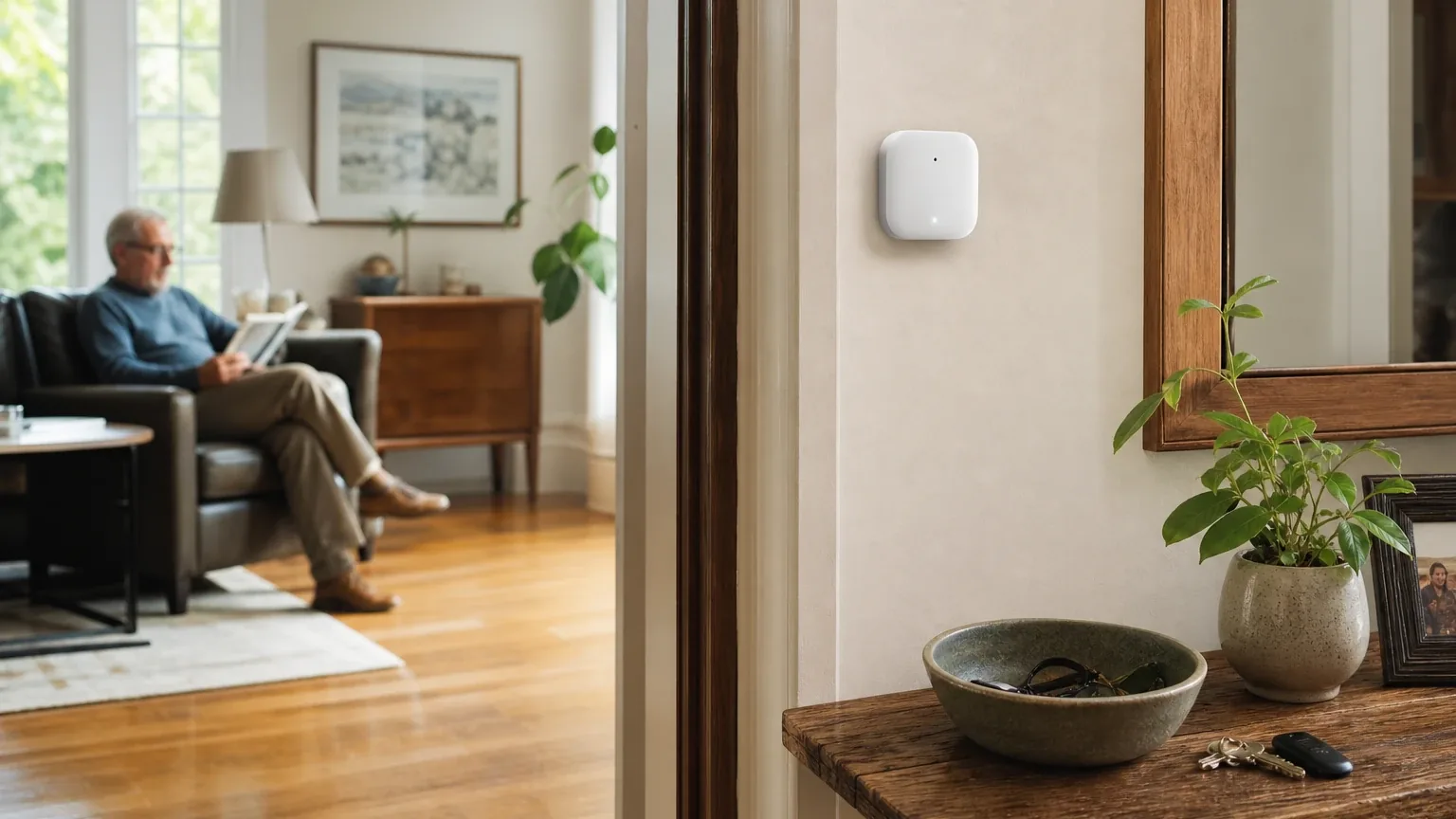
The relevant configuration is the Nomo Smart Care Essential Care Kit with the essential+ subscription. The kit is consistently described across platforms as one Hub, two Satellite sensors, and four Tags [1].
Satellites are plug-in motion sensors that extend room coverage; Tags are stick-on or wearable devices that can monitor doors, drawers, refrigerators, ovens, or medication cabinets and include a panic button (openai:kit). Anthropic reported that Tags use a 3-axis accelerometer for movement and fall detection, and that the Hub adds motion and sound sensing (anthropic:src8). Google reported that Tags can be worn on a lanyard as a manual panic button and automatic fall detector (google:walmart_listing).
A dedicated bed-occupancy sensor is not clearly documented. Openai stated that bedroom monitoring is described as movement monitoring and that the reviewed pages do not clearly specify whether a bed sensor is included (openai:kit). Perplexity reached the same conclusion, noting bed-sensor support is not clearly verified [1]. Buyers who need confirmed bed-exit sensing should verify this directly.
What the AI Platforms Agreed About
Questions This Section Answers
- What do AI platforms agree Nomo Smart Care does well for non-intrusive ambient safety monitoring?
- Is Nomo Smart Care camera-free, and does it avoid capturing images or audio?
The clearest cross-platform agreement is that Nomo Smart Care is camera-free and built around ambient motion sensing rather than video. Openai, anthropic, grok, perplexity, and google all described the system as camera-free or privacy-first [3]. Anthropic reported that the system uses passive infrared sensors that detect heat signatures and that no images or visual outlines are captured, transmitted, or stored (anthropic:src6, anthropic:src7).
Platforms also agreed on the core hardware bundle and on AI-based routine learning. Openai, anthropic, grok, and google all described AI that learns daily patterns such as waking, meals, bathroom trips, and medication routines, then alerts caregivers when patterns shift (openai:kit, anthropic:src4, grok:web2, google:nomo_product_page). Anthropic described time-based anomalies, duration changes such as extended bathroom visits, and room-to-room transition patterns (anthropic:src4, anthropic:src5).
A third area of agreement is the caregiver app. Openai, anthropic, grok, and google all described app-based activity views, notifications, and multi-caregiver access through a Care Circle (openai:app, anthropic:src10, grok:web2, google:apple_store_nomo). Anthropic and google both reported two-way voice communication through the hub (anthropic:src10, google:nomo_product_page).
Agreement here reflects repeated company-sourced descriptions, not independent verification.
Where the AI Platforms Disagreed or Were Uncertain
Questions This Section Answers
- Do AI platforms disagree about Nomo Smart Care's monthly subscription price and free-trial length?
- Is Nomo Smart Care's AI routine-anomaly detection independently validated?
Pricing and trial terms are the sharpest conflict. Openai, grok, google, and the official page excerpts all list the essential+ subscription at $19.99 per month or $199.99 per year (openai:home, grok:web1, google:nomo_app_faq, official:C1). Perplexity found a Nomo support article stating $9.99 per month and a $249.99 kit price, alongside retail listings showing $199.99 and $19.99 per month [4]. Deepseek reported that exact current U.S. subscription prices were not verified from the sources it checked [8]. Kimi reported no published pricing at all (kimi:nomo-unverified).
Trial length also conflicts. Openai noted the homepage displays a 30-day free trial while the product and subscription sections state 60 days (openai:home, openai:kit). Google attributed the 30-day versus 60-day difference to purchase channel (google:nomo_app_faq). Perplexity found the same split across Nomo-owned and retail sources [4].
Kit price is disputed in one source. Grok noted the kit listed at $199.99 on the site and $249.99 in a support article (grok:web1). Perplexity also found $254.97 on a bundle page [5].
Independent validation is absent across platforms. Openai, anthropic, grok, deepseek, perplexity, and kimi all stated that fall-detection accuracy, false-alert rates, and AI anomaly-detection performance lack identified independent verification [8]. Kimi went further, rating overall fit as uncertain because public specifications could not be confirmed (kimi:nomo-unverified).
Use-Case-Specific Features and Capabilities
Questions This Section Answers
- Does Nomo Smart Care detect falls without a camera, and does the senior need to wear a device?
- Can Nomo Smart Care track medication, meal, and bathroom routines for a caregiver monitoring from another city?
Sensor variety is moderate. The kit covers motion through Satellites and event sensing through Tags placed on doors, drawers, refrigerators, ovens, or medication cabinets (openai:kit). Anthropic reported the Hub also includes sound sensing (anthropic:src8). No platform confirmed a dedicated bed or pressure-mat sensor [10].
AI routine anomaly detection is a stated strength but company-reported. Nomo states its AI learns routines such as getting out of bed and going to the kitchen, then alerts caregivers when patterns shift (openai:kit, anthropic:src4). The app supports personalized goals and pattern-shift notifications (openai:app). No independent accuracy data was identified.
Caregiver app design drew consistent positive descriptions. The app provides routine and activity views, real-time notifications, personalized goals, Care Circle access, notes, messaging, and emergency alerts via calls, texts, and push notifications (openai:app, anthropic:src10, anthropic:src11). Anthropic reported alerts may repeat up to seven times in 35 minutes if unresolved (anthropic:src2). Google reported an unlimited Care Circle including family, neighbors, and doctors (google:apple_store_nomo).
Privacy protection is the strongest alignment with this use case. Nomo markets the system as camera-free and privacy-first (openai:home, anthropic:src6). Anthropic reported the company states data is encrypted, aligned with SOC 2 standards and HIPAA privacy and security guidelines, and processed with PCI-DSS compliant payment handling (anthropic:src14). However, anthropic also noted Nomo is not independently certified as a HIPAA-covered entity, and openai found the reviewed privacy material did not establish specific certifications, encryption standards, retention periods, or deletion processes (anthropic:src14, openai:privacy). Perplexity noted the privacy policy references motion events, recognized acoustic signatures, and location tracking, and that the app may collect location data even when closed [12].
Fall detection carries a qualification. Nomo lists automatic fall detection with an asterisk on its product page without explaining the qualification in the reviewed material (openai:home, openai:kit). Google reported automatic fall detection only functions if the senior actively wears a Tag as a pendant, and that passive room sensors do not detect falls (google:walmart_listing, google:graying_with_grace). Anthropic reported fall detection sensitivity is adjustable in the app (anthropic:src3).
Care-recipient burden is low for routine monitoring. The care recipient does not need a cell phone or app (openai:home). Anthropic noted one independent review flagged the bright orange lanyard as potentially uncomfortable and intrusive, which could limit wearable acceptance (anthropic:src16).
Installation depends on home conditions. The Hub connects through Wi-Fi; Satellites require visible outlets with unobstructed views; the app requires Bluetooth, Wi-Fi, and Location Services permissions (openai:kit). Anthropic reported setup takes about 15 minutes with video guidance and hub voice prompts (anthropic:src12, anthropic:src19). No cellular backup was identified by any platform [13].
Pricing, Fees, Contracts, and Ongoing Costs
Questions This Section Answers
- How much does Nomo Smart Care cost per month, and is the essential+ subscription required?
- Are there setup, activation, or cancellation fees with Nomo Smart Care?
The most commonly listed pricing is $199.99 for the Essential Care Kit plus $19.99 per month or $199.99 per year for essential+, but this is not consistent across all sources. Openai, grok, google, and the official page excerpts support the $199.99 kit and $19.99 monthly figure (openai:home, grok:web1, google:nomo_app_faq, official:C1). The annual plan is described as saving 15% (openai:home, google:nomo_app_faq).
Conflicting figures exist. Perplexity found a Nomo support article listing $249.99 for the kit and $9.99 per month, plus a bundle page at $254.97 [14]. Grok noted the $199.99 versus $249.99 kit discrepancy (grok:web1). Deepseek could not verify current U.S. prices [16], and kimi found no published pricing (kimi:nomo-unverified).
The subscription appears required for core functionality. Openai stated an active essential+ subscription is required for monitoring insights (openai:kit). Grok stated the subscription is mandatory for advanced features and emergency escalation (grok:web0). Google stated essential+ is required to access app-based routine insights, alerts, and 24/7 emergency services (google:nomo_product_page).
Accessory costs are listed by Nomo. Tag accessory packs are $24.99 and Satellite accessory packs are $39.99 (openai:home, official:C1). Optional health devices include a blood pressure monitor at $54.98 and a non-contact thermometer at $34.98 (openai:home, official:C1). Grok also reported an optional $99 installation service (grok:web0).
Contract terms are described as month-to-month. Google reported no long-term contracts, cancel-anytime terms, no activation or termination fees, and 30-day free returns on hardware purchased directly (google:nomo_product_page). Perplexity found one Nomo source stating no contracts and anytime cancellation [14]. Openai noted that cancellation timing, post-trial billing mechanics, prorated refunds, and annual-plan cancellation terms remain unclear from the reviewed pages (openai:terms).
Taxes, shipping, and emergency-service fees are not clearly disclosed. Openai listed taxes as unspecified and emergency-service terms or separate response fees as not clearly disclosed (openai:terms). Perplexity noted potential retail taxes and shipping were not verified [15].
Best Suited For
Questions This Section Answers
- Who gets the most value from Nomo Smart Care for non-intrusive ambient safety monitoring?
- Is Nomo Smart Care a good fit for a long-distance caregiver who wants routine alerts without cameras?
Nomo Smart Care is best suited to long-distance caregivers monitoring an independent senior living alone who will accept sensor-based monitoring but not cameras. Openai, anthropic, grok, and google all identified this profile as the core fit (openai:home, anthropic:src2, grok:web0, google:nomo_product_page).
It also suits households where the senior refuses cameras or hot microphones. Google reported the camera-free design promotes higher user adoption among privacy-conscious Seniors (google:nomo_product_page). Anthropic noted the design is intended to avoid the surveillance effect that seniors may reject (anthropic:src6).
Families wanting shared caregiver coordination are a good match. The Care Circle supports multiple caregivers with shared activity views, notes, messaging, and alerts (openai:app, anthropic:src10, google:apple_store_nomo).
Buyers who want a low upfront hardware cost with a month-to-month plan also fit, assuming the listed $199.99 kit price and $19.99 monthly subscription apply at purchase (openai:home, google:nomo_product_page).
Probably Not Best Suited For
Questions This Section Answers
- Who should not choose Nomo Smart Care for non-intrusive ambient safety monitoring?
- Is Nomo Smart Care unsuitable for a household without reliable Wi-Fi?
Buyers who need clinically validated fall detection or guaranteed emergency response should look elsewhere. Openai, anthropic, deepseek, and kimi all flagged the absence of independent validation for fall-detection and anomaly-detection performance [17].
Households without reliable Wi-Fi are a poor fit. Anthropic and deepseek both reported the system requires home Wi-Fi with no cellular backup or offline functionality identified [18]. Grok listed unreliable Wi-Fi as a disqualifying condition (grok:web0).
Seniors who will not wear or place Tags are a weak fit for fall detection specifically. Google reported automatic fall detection requires wearing a Tag as a pendant (google:walmart_listing). Anthropic noted the orange lanyard may be rejected as intrusive (anthropic:src16).
Multi-person or multi-pet households face accuracy limits. Google reported passive motion sensors cannot distinguish who triggered movement in multi-person or active pet households (google:nomo_product_page). Anthropic noted large pets can occasionally trigger sensors, though the system attempts to filter through room-to-room transition patterns (anthropic:src15).
Buyers needing video confirmation, outdoor tracking, or HIPAA-certified covered-entity status should not choose this system. Anthropic listed all three as disqualifying conditions (anthropic:src2, anthropic:src10).
When Another Option May Be Better
Questions This Section Answers
- What is a better alternative to Nomo Smart Care for a buyer who needs verified bed-exit sensing?
- When should a buyer choose a different ambient monitoring system instead of Nomo Smart Care?
Another option may be better when verified bed or door sensing is required. Openai, deepseek, perplexity, and kimi all flagged bed-sensor support as unclear or unsupported [19]. Kimi named Alerta Home, IvedaCare, Butlr Care, RoomMate, nami, and VirtuSense VSTAlert as alternatives with published camera-free specifications and, in several cases, published pricing (kimi:alertahome, kimi:iveda, kimi:butlr, kimi:sensio, kimi:nami, kimi:virtusense).
Another option may be better when transparent pricing is a purchase requirement. Perplexity and deepseek both reported pricing conflicts or gaps that prevent confident cost comparison [20]. Kimi noted Alerta Home publishes $189 hardware and IvedaCare publishes $500 MSRP (kimi:alertahome, kimi:iveda).
Another option may be better when video verification is acceptable or required. Anthropic and grok both listed video confirmation as a reason to choose a different system (anthropic:src2, grok:web0).
Another option may be better when the senior refuses all monitoring technology. Anthropic listed this as a disqualifying condition (anthropic:src2).
Another option may be better when clinical-grade or professionally monitored oversight is needed. Perplexity and deepseek both stated Nomo should not be treated as a clinical or emergency detection system [20].
Questions to Verify Before Buying
Questions This Section Answers
- What should a buyer confirm with Nomo Smart Care before signing up for the essential+ subscription?
- Which Nomo Smart Care details are unresolved in public sources and must be verified directly?
Confirm the controlling trial length and billing start date, since public pages show both 30-day and 60-day trials (openai:home, openai:kit, google:nomo_app_faq).
Confirm the current kit price and monthly subscription price, since sources list $199.99 or $249.99 for the kit and $9.99 or $19.99 per month [21].
Confirm whether essential+ can be canceled online, whether annual plans are refundable or prorated, and what happens to app access, historical data, and alerts if the subscription lapses [21].
Confirm independent fall-detection and routine-anomaly accuracy and false-alert rates, since no platform identified third-party validation (openai:kit, anthropic:src3, kimi:nomo-unverified).
Confirm whether a dedicated bed-occupancy sensor is included or whether bed and sleep insights are inferred from room motion [22].
Confirm Hub, Satellite, and Tag detection ranges, maximum supported devices, and placement limits (openai:kit, anthropic:src15).
Confirm what data are collected, including sound or environmental data, where they are stored, how long they are retained, and how deletion works [23].
Confirm whether data is encrypted in transit and at rest and whether customer data is used for analytics, model training, advertising, or third-party sharing (anthropic:src14, openai:privacy).
Confirm what 24/7 emergency service does, what triggers escalation, and whether additional fees or geographic exclusions apply [24].
Confirm warranty duration, replacement process, battery-replacement policy, and U.S. service coverage (openai:terms, anthropic:src9).
Final AI Consensus Verdict
Nomo Smart Care is a good, not unanimous, fit for non-intrusive ambient safety monitoring. Four of seven platforms named it during ranking, with an average listed rank of 3.25 and a best rank of 1. Platform fit ratings ranged from strong (anthropic, google, grok) to good (openai, deepseek, perplexity) to uncertain (kimi).
The strongest case for it is the camera-free sensor architecture combined with AI routine-anomaly alerts and shared caregiver access, at a commonly listed $199.99 kit price plus a required subscription (openai:home, anthropic:src2, google:nomo_product_page). The strongest case against it is the absence of identified independent validation for fall detection and anomaly accuracy, unresolved bed-sensor support, conflicting pricing and trial terms, and mandatory Wi-Fi with no cellular backup [25].
Buyers who prioritize privacy, accept company-reported performance claims, and will verify pricing and trial terms directly should find it a reasonable choice. Buyers who need clinically validated detection, guaranteed emergency response, or fully transparent published pricing should compare alternatives first.
How This Review Was Produced
This review was generated from seven AI platform responses collected for the Non-Intrusive Ambient Safety Monitoring use case within the Best Remote Monitoring Systems for Seniors topic. Each platform independently evaluated Nomo Smart Care against five category criteria: sensor variety, AI routine anomaly detection, caregiver app design, privacy protection, and monthly subscription pricing. The study date is 2026-09-27.
Platform mentions in the ranking stage count only platforms that named the entity during ranking discovery. All seven included platforms evaluated fit, but only four named Nomo Smart Care during ranking. Fit ratings and capability findings are platform-reported and were not independently verified by the writer stage.
Methodology Limitations
Platform-reported research dates differ from the authoritative run date. Deepseek reported a research date of 2026-01-08, while the remaining platforms reported 2026-09-27. Platform-reported dates are provenance metadata and do not independently prove freshness.
Company-owned citations materially outnumber independent citations in the supplied evidence. Most capability, pricing, and privacy claims trace to Nomo-owned pages, so they should not be described as independently verified.
Pricing, trial length, and kit price conflict across sources and were not resolved. Buyers should verify current terms directly with Nomo before purchase.
Deepseek ran without search enabled, so its findings reflect model knowledge rather than retrieved pages. Kimi reported that Nomo product details were not publicly verifiable from the sources it checked.
The supplied URLs were collected from platform responses and were not independently validated by the writer stage. No platform reported personal testing, clinical evaluation, or guaranteed performance.
Explore more senior technology guidance in the category directory.
Sources
Company-Owned Sources
- Introduction to Butlr Care - 2024 Solution Overview: https://21077839.fs1.hubspotusercontent-na1.net/hubfs/21077839/Brochures/2024-ButlrCare_SolutionOverview-010201-S.pdf
- Fall Detection for Senior Living Without Cameras: https://arqaios.com/solutions/fall-detection
- IvedaCare - Iveda - AI Video, Smart Sensors, IoT Solutions: https://iveda.com/technology/ivedacare/
- Independent Living Awareness | nami: https://nami.ai/independent-living-awareness/
- How does Nomo stack up against the competition?: https://nomocare.zendesk.com/hc/en-us/articles/32497607629837-How-does-Nomo-stack-up-against-the-competition
- Nomo Smart Care Elderly Monitoring System: https://nomosmartcare.com/
- Nomo Smart Care Empowers with Normal Motion Monitoring: https://nomosmartcare.com/blogs/company-news/nomo-smart-care-empowers-mom-and-her-caregivers-with-comprehensive-normal-motion-monitoring
- Home Monitoring Systems for Elderly - without the Cameras: https://nomosmartcare.com/blogs/nomo-blog/tech-without-cameras
- Nomo Smart Care FAQs - Security and Privacy: https://nomosmartcare.com/pages/faqs
- Nomo Monitoring System for Elderly in the Home: https://nomosmartcare.com/pages/home-monitoring-systems-for-the-elderly
- Nomo Caregiver Alert System: https://nomosmartcare.com/pages/nomo-caregiver-alert-system
- Privacy Policy - Nomo Smart Care: https://nomosmartcare.com/pages/privacy-policy
- The Nomo Smart Care App: https://nomosmartcare.com/pages/the-nomo-app
- Privacy policy – Nomo Smart Care: https://nomosmartcare.com/policies/privacy-policy
- Terms of service – Nomo Smart Care: https://nomosmartcare.com/policies/terms-of-service
- Nomo Smart Care Essential Care Kit: https://nomosmartcare.com/products/essential-care-kit
- What is the price for the Nomo system and monthly subscription?: https://support.nomosmartcare.com/hc/en-us/articles/32209950819597-What-is-the-price-for-the-Nomo-system-and-monthly-subscription
- When I buy the Nomo system, what's in the box?: https://support.nomosmartcare.com/hc/en-us/articles/32825536148877-When-I-buy-the-Nomo-system-what-s-in-the-box
- Alerta Home | Continuous Caregiving Awareness: https://www.alertahome.com/
- Ambient Room Sensors for Fall Prevention, No Camera: https://www.intrexis.com/products/in-apartment-sensing
- Nomo Smart Care Brings AI-Powered Caregiving Technology to BrandsMart USA Stores: https://www.prnewswire.com/news-releases/nomo-smart-care-brings-ai-powered-caregiving-technology-to-brandsmart-usa-stores-across-south-florida-302808044.html
- Nomo Smart Care Empowers 'Mom' and Her Caregivers with Comprehensive Normal Motion Monitoring: https://www.prnewswire.com/news-releases/nomo-smart-care-empowers-mom-and-her-caregivers-with-comprehensive-normal-motiona-monitoring-302147397.html
- RoomMate | Safety sensor that reduces and detects falls: https://www.sensio.com/products/roommate
- VSTAlert by VirtuSense | Ambient Vision AI Fall Prevention: https://www.virtusense.ai/products/vstalert
- Official pricing and terms source: https://nomosmartcare.com/pages/terms-of-service
Additional AI research evidence26 records
- AI research evidence record perplexity:c6
- AI research evidence record perplexity:c14
- AI research evidence record perplexity:c6
- AI research evidence record perplexity:c1
- AI research evidence record perplexity:c14
- AI research evidence record perplexity:c8
- AI research evidence record perplexity:c15
- AI research evidence record deepseek:c1
- AI research evidence record perplexity:c5
- AI research evidence record perplexity:c14
- AI research evidence record deepseek:c1
- AI research evidence record perplexity:c5
- AI research evidence record deepseek:c2
- AI research evidence record perplexity:c1
- AI research evidence record perplexity:c14
- AI research evidence record deepseek:c1
- AI research evidence record deepseek:c1
- AI research evidence record deepseek:c2
- AI research evidence record deepseek:c1
- AI research evidence record perplexity:c14
- AI research evidence record perplexity:c1
- AI research evidence record perplexity:c14
- AI research evidence record perplexity:c5
- AI research evidence record perplexity:c8
- AI research evidence record perplexity:c14
- AI research evidence record deepseek:c2
Independent Sources
- Nomo Smart Care on the Apple App Store: https://apps.apple.com/
- Nomo Smart Care App Store: https://apps.apple.com/us/app/nomo-smart-care/id6448199844
- Nomo Smart Care - Google Play Reviews: https://play.google.com/store/apps/details?id=com.ohc.nomo&hl=en_US
- NOMO Smart Care Medical Alert System on Amazon: https://www.amazon.com/Smart-Detection-Emergency-Subscription-Monitoring/dp/B0CNS9FJ12
- Nomo Smart Care Essential Care Kit 2 tone gray - Best Buy: https://www.bestbuy.com/product/nomo-smart-care-essential-care-kit-2-tone-gray/J3R84ZRYHC
- Customer Reviews: Nomo Smart Care Essential Care Kit: https://www.bestbuy.com/site/reviews/nomo-smart-care-essential-care-kit-gray/6571962
- NOMO Smart Care Review: Fall Detection Without Cameras: https://www.grayingwithgrace.com/
- Nomo Smart Care Brings AI-Powered Caregiving Technology to BrandsMart USA Stores Across South Florida: https://www.morningstar.com/news/pr-newswire/20260623la89649/nomo-smart-care-brings-ai-powered-caregiving-technology-to-brandsmart-usa-stores-across-south-florida
- Nomo Smart Care Essential Care Kit: https://www.target.com/p/nomo-smart-care-essential-care-kit/-/A-1012257015
- Nomo Smart Care Satellite Accessory Packs: https://www.target.com/p/nomo-smart-care-satellite-accessory-packs/-/A-1012254714
- Nomo Smart Care 24/7 Medical Alert System on Walmart: https://www.walmart.com/
Additional AI research evidence26 records
- AI research evidence record perplexity:c6
- AI research evidence record perplexity:c14
- AI research evidence record perplexity:c6
- AI research evidence record perplexity:c1
- AI research evidence record perplexity:c14
- AI research evidence record perplexity:c8
- AI research evidence record perplexity:c15
- AI research evidence record deepseek:c1
- AI research evidence record perplexity:c5
- AI research evidence record perplexity:c14
- AI research evidence record deepseek:c1
- AI research evidence record perplexity:c5
- AI research evidence record deepseek:c2
- AI research evidence record perplexity:c1
- AI research evidence record perplexity:c14
- AI research evidence record deepseek:c1
- AI research evidence record deepseek:c1
- AI research evidence record deepseek:c2
- AI research evidence record deepseek:c1
- AI research evidence record perplexity:c14
- AI research evidence record perplexity:c1
- AI research evidence record perplexity:c14
- AI research evidence record perplexity:c5
- AI research evidence record perplexity:c8
- AI research evidence record perplexity:c14
- AI research evidence record deepseek:c2
Verify This Research
Review the study details behind this page or download the public machine-readable verification record.
- Study date
- September 27, 2026
- Platforms analyzed
- 7
- Source records
- 37
- Ranking mentions
- 4 of 7
- Platform share
- 57%
- Final consensus rank
- #2
Research trail and source mix
Configured platforms
openai, anthropic, deepseek, grok, perplexity, kimi, google
Source mix
11 independent · 26 company-owned
Evidence support
21 direct · 3 partial
Important limitation
Use the run research_date as the study date. Platform-reported dates are provenance metadata and do not independently prove freshness.
Source snapshot SHA-256 07c8abcb2d55849562cacf6bbded5f72897bdcba1cac4ade7ffa53aca6dfb892
Archived editions
Browse earlier published research snapshots for this article. The latest edition remains at the current URL.