
Answer Capsule
Medical Guardian is a mixed fit for Portable GPS & Wander Management. Five of seven platforms named it during the ranking stage, with an average listed rank of 3.8 and a best rank of 2. The strongest reason to consider it is the MGMini: a standalone 4G LTE wearable with 24/7 professional monitoring, two-way voice, caregiver app visibility, and advertised multi-day battery life. The main limitation is that geofence boundary alerts are not clearly documented in official materials, and public sources conflict on whether location updates hourly or only when the help button is pressed. Buyers whose core need is automatic elopement alerts should verify geofencing in writing before purchase.
Research Snapshot
| Field | Finding |
|---|---|
| Platform mentions in ranking stage | 5 of 7 platforms (google, grok, kimi, openai, perplexity) |
| Share of included platform responses | 71.4% |
| Average listed rank | 3.8 |
| Best listed rank | 2 (kimi) |
| Relevant product/model/plan | MGMini with Medical Guardian 24/7 monitoring service; optional fall-detection add-on |
| Overall use-case fit | Mixed |
| Research date | 2026-09-26 |
What Changed Since August 2026
Medical Guardian moved down from No. 2 to No. 3, and platform mentions increased from 4 to 5. The September 2026 review keeps Medical Guardian as a mixed fit, but the buyer-facing substance shifted from the MGMini specifically to Medical Guardian and its monitoring service. Emergency response is now framed more favorably, with call-connection times reported around 8 to 15 seconds, while battery expectations remain unsettled between roughly two and three days and longer claims. Geofencing stays unverified. Pricing evidence also changed: $199.95 is newly reported as a device cost, and $10 per month is no longer repeated as a fall-detection add-on price. Wearability, caregiver app visibility, and the absence of a documented tamper-resistant strap carry over largely unchanged. Differences between the two editions reflect what each article reports; they do not by themselves prove that the product, service, or price changed.
The August 2026 review preserves the earlier article for reference.
Why Medical Guardian Qualified for This Study
Questions This Section Answers
- Is Medical Guardian a good choice for Portable GPS & Wander Management?
- Which Medical Guardian device did AI platforms rank for senior GPS tracking?
Medical Guardian qualified because five of seven platforms named it during ranking discovery, and every platform that evaluated it selected the MGMini as the relevant product for this use case [1]. The MGMini is a wearable GPS medical alert device marketed for on-the-go use and caregiver monitoring, which places it directly inside the portable GPS and wander-management category even though it is not purpose-built for dementia elopement prevention (deepseek:mg-gps, kimi:mg-site-2024).
Platforms ranked it between second and fifth. Kimi placed it highest at second; perplexity placed it third; openai fourth; google and grok both fifth. DeepSeek evaluated fit but did not name the entity in its ranking output, so it is excluded from the mention count. The ranking unit was the tracking device model and service platform, meaning platforms judged the MGMini hardware together with the required monitoring subscription, not the hardware alone.
Medical Guardian's own materials describe the device as a medical alert system with location capability rather than a wander-management platform [1]. That distinction shaped every platform's fit rating: two platforms rated the fit "good" and five rated it "mixed."
The Product, Model, Plan, or Service Most Relevant to Portable GPS & Wander Management
Questions This Section Answers
- Which Medical Guardian plan should a caregiver choose for a senior who wanders?
- Does the Medical Guardian MGMini work without a smartphone?
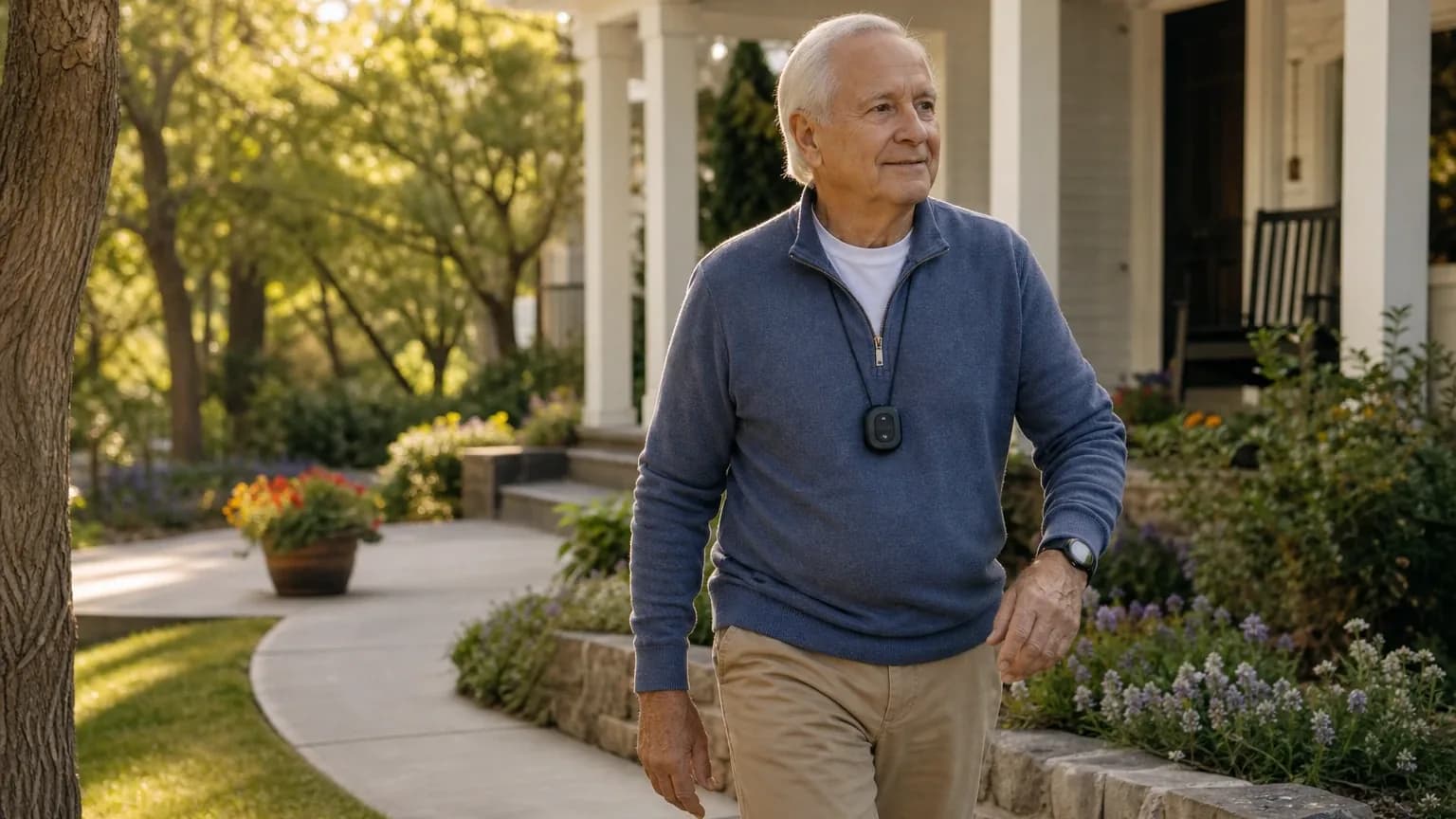
The MGMini with Medical Guardian's 24/7 monitoring service is the product every platform identified for this use case [4]. It is a small pendant-style wearable — roughly 2 inches tall and 1 inch wide, under 1 ounce — worn on an adjustable or non-adjustable lanyard or clipped to a belt [4]. It uses 4G LTE with GPS and Wi-Fi positioning backup, and Medical Guardian states it carries OmniSIM technology giving access to both AT&T and Verizon networks [4].
The device requires no smartphone for basic emergency operation. The wearer presses and holds a physical help button to reach a monitoring operator through a built-in two-way speaker [4]. Caregivers use the separate MyGuardian portal and app to view location information, battery level, signal strength, and step activity [8].
Medical Guardian also sells the MGMove smartwatch and the MGMini Lite, and platforms mentioned both as adjacent options. The MGMove is a watch-form device with roughly 24 hours of battery life; the MGMini Lite is a wrist-worn device advertised at 36 hours (anthropic:25-22, anthropic:25-2). For wander management specifically, the MGMini's longer battery life makes it the more frequently cited choice, but the MGMove's watch form factor may suit wearers who refuse a pendant [4].
Naming is inconsistent across public sources: MGMini, MG Mini, and Mini Guardian appear interchangeably, and some listings conflate MGMini with MGMove [4]. Buyers should confirm the exact model number and firmware before purchase.
What the AI Platforms Agreed About
Questions This Section Answers
- What do reviewers agree the Medical Guardian MGMini does well for senior GPS tracking?
- How fast is Medical Guardian's emergency response compared with other senior GPS trackers?
Platforms agreed unanimously on several points. First, the MGMini is a legitimate standalone wearable with cellular connectivity that does not require the wearer to carry a phone [10]. Second, professional monitoring is a genuine strength: operators are 911-trained, U.S.-based, and Medical Guardian's monitoring centers hold the Five Diamond designation from The Monitoring Association (anthropic:7-21, anthropic:36-12).
Third, response speed is fast. Independent testing reported average call-connection times of about 8 seconds, with other tests reporting 8 to 15 seconds and one reporting under 30 seconds [13]. Fourth, the MyGuardian caregiver app is well regarded for usability: reviewers described it as intuitive and designed with Seniors in mind, and one reviewer said testers liked the app more than the watch itself (anthropic:16-5, anthropic:16-6, anthropic:16-7).
Fifth, contract terms are flexible. Medical Guardian states it does not require long-term contracts and does not charge activation or cancellation fees, and independent reviewers repeated that customers can cancel anytime without penalty [14]. Sixth, wearability is a strength: lightweight, water-resistant, and available in multiple wearing configurations (anthropic:3-2, anthropic:3-3, anthropic:22-6).
Agreement among platforms reflects shared source material and similar evaluation criteria. It does not establish product quality or real-world performance.
Where the AI Platforms Disagreed or Were Uncertain
Questions This Section Answers
- Does the Medical Guardian MGMini support geofence alerts for dementia wandering?
- How long does the Medical Guardian MGMini battery actually last with tracking enabled?
The sharpest disagreement concerns geofencing. Google reported that the MyGuardian app features geofencing alerts that notify caregivers when someone leaves a designated safe zone [15]. OpenAI, anthropic, kimi, perplexity, grok, and deepseek all reported that geofence boundary alerts are not clearly documented in Medical Guardian's official product or support materials and should be treated as unverified [16]. This is a direct conflict between one platform's independent review citation and six platforms' reading of official documentation. Buyers must confirm geofencing in writing for the exact account and app version.
Location-update behavior is also unresolved. Medical Guardian's current MGMini product page advertises hourly GPS location updates, while its support documentation for the mobile device says GPS information is reported when the help button is pressed [16]. Forbes reported on-demand GPS updates (anthropic:9-1). These are materially different behaviors for wander management.
Battery life claims conflict across sources. Medical Guardian's product page states up to 3 days; Forbes and other reviews report up to 5 days; one independent review reports up to 3 days [20]. Forbes also reported that enabling fall detection can reduce battery life to 2 to 3 days (anthropic:27-9). The MGMove is consistently reported at about 24 hours and the MGMini Lite at 36 hours (anthropic:25-22, anthropic:25-2).
Fall detection performance is the most serious uncertainty. Medical Guardian claims 6-axis fall detection with high accuracy and minimum false alarms (anthropic:23-11). Independent testing detected only 1 of 10 simulated falls, and Forbes Health concluded the MGMini "might not be the best device for reliable fall detection" (anthropic:22-10, anthropic:9-5). These are limited sample tests, not guarantees of future performance, but the gap between marketing and testing is wide.
App location accuracy is mixed. Some reviewers praised accuracy and reported that an operator confirmed location via coordinates and cross streets; others reported inaccurate location display and slow updates (anthropic:1-5, anthropic:20-4, anthropic:4-3).
Pricing conflicts across official pages. One Medical Guardian pricing PDF lists MGMini at $199.95 device cost and $42.95 per month; a caregiver page lists MG Mini from $39.95 per month; a separate buyer guide lists $149.95 device cost with $39.95 monthly, $116.85 quarterly, or $443.40 annually [21]. Perplexity also reported a 90-day minimum commitment and potential restocking fee up to $50, while OpenAI and anthropic reported no long-term contract and no cancellation fees [24]. These terms may apply to different products or plan types and must be verified for the specific MGMini order.
Use-Case-Specific Features and Capabilities
Questions This Section Answers
- Does the Medical Guardian MGMini have the features a dementia caregiver needs for wander management?
- Can multiple caregivers track a Medical Guardian device at the same time?
Against the six criteria used in this study, the MGMini's profile is uneven.
| Criterion | Assessment | Evidence |
|---|---|---|
| Real-time GPS accuracy | Mixed | Outdoor accuracy reported in testing; some reviewers reported slow or inaccurate app updates (anthropic:1-5, anthropic:4-3) |
| Geofence boundary alerts | Unverified | Not documented in official materials; one platform cited app geofencing [26] |
| Battery longevity | Advantage | Advertised up to 5 days; conflicts with 3-day company claim; fall detection may reduce to 2–3 days (anthropic:9-1, anthropic:5-6, anthropic:27-9) |
| Wearability options | Advantage | Lanyard, belt clip, purse clip; under 1 ounce; water-resistant (anthropic:3-3, anthropic:22-6, anthropic:22-17) |
| Monthly subscription cost | Neutral | $39.95–$43.95/month reported; device $149.95–$199.95 [28] |
| Caregiver app usability | Advantage | MyGuardian praised as intuitive; supports multiple caregivers (anthropic:16-6, anthropic:44-9) |
The MyGuardian portal accommodates multiple caregivers and shows location, battery level, signal strength, and step counts [30]. Available add-ons include fall detection, extra buttons, voice-activated buttons, a lockbox, a protection plan, and OnGuard alerts [31].
What the MGMini does not provide, based on reviewed materials, is a documented tamper-resistant strap, indoor positioning or beacon integration, breadcrumb location history, or automatic caregiver notification when the wearer leaves a defined zone [32]. Competitors such as AngelSense, Zembro, Lifeline's wandering product, and Securitas WanderGuard BLUE explicitly advertise configurable geofences, beacon-based indoor boundaries, or schedule-learning detour alerts (kimi:angelsense-specs-2024, kimi:zembro-wander-2024, kimi:lifeline-wandering-2024, kimi:securitas-wanderguard-2024). Those are company-owned claims from competing vendors, not independent verification, but they describe features Medical Guardian's materials do not.
Pricing, Fees, Contracts, and Ongoing Costs
Questions This Section Answers
- How much does Medical Guardian cost per month for the MGMini, and are there setup or cancellation fees?
- Is the Medical Guardian MGMini device fee refundable if the senior refuses to wear it?
Published pricing is inconsistent across Medical Guardian's own materials, so buyers should treat any single figure as a starting point for a quote.
| Cost item | Reported amount | Source |
|---|---|---|
| MGMini monitoring (starting) | $39.95/month | [33] |
| MGMini monitoring (month-to-month) | $43.95/month | (anthropic:2-13) |
| MGMini monitoring (pricing PDF) | $42.95/month | [35] |
| Quarterly / annual (buyer guide) | $116.85 / $443.40 | [33] |
| MGMini device | $149.95 or $199.95 | [33] |
| Fall detection add-on | $10/month | [36] |
| Social Circle apps | $5/month | [37] |
| OnGuard alerts | $2.99/month | [38] |
| Shipping | Up to $12.50 | [39] |
Contract terms also conflict. Medical Guardian states it does not require long-term contracts, does not charge activation or cancellation fees, and may provide prorated refunds for unused service [40]. Independent reviewers repeated the no-contract, no-cancellation-fee position and noted a 30-day money-back guarantee on equipment for new customers (anthropic:2-12, anthropic:32-4). Perplexity, however, cited Medical Guardian terms describing a 90-day minimum commitment, cancellation processing up to 30 days, a restocking fee up to $50, and a potential $350 charge if leased equipment is not returned within 30 days [41]. These may reflect different products, lease versus purchase arrangements, or older terms.
The equipment fee is reported as nonrefundable, and no free trial period was identified (anthropic:2-14). A one-year manufacturer warranty covers defects but not spills, drops, or normal wear and tear (anthropic:3-20, anthropic:3-21). A protection plan for loss, theft, or damage is available at unspecified cost (anthropic:43-4).
A realistic first-year estimate for the MGMini with fall detection, using the lower published figures, is roughly $149.95 in equipment plus about $600 in monitoring and fall detection — before shipping, taxes, or promotions. Buyers should confirm current checkout pricing, promotion expiration terms, and the refund calculation for annual plans before committing.
Best Suited For
Questions This Section Answers
- Who gets the most value from the Medical Guardian MGMini for senior location safety?
The MGMini fits best when the primary need is emergency response with location backup, not automated boundary enforcement. Specifically:
- Active seniors who want a standalone cellular GPS emergency pendant and will reliably wear and charge it [44].
- Caregivers who value 24/7 professional monitoring, two-way voice, and caregiver app visibility over automatic geofence alerts [44].
- Households managing multiple devices, since the MyGuardian portal supports multiple caregivers and wearables (anthropic:44-9).
- Buyers who want no long-term contract and the ability to cancel without penalty [45].
- Wearers who prefer a lightweight pendant over a watch or phone, including those with limited dexterity who can manage a single button (anthropic:3-2, anthropic:22-17).
Probably Not Best Suited For
Questions This Section Answers
-
Who should not choose Medical Guardian for dementia wander management?
-
Caregivers who require verified geofence entry and exit alerts for elopement prevention [46].
-
Buyers who need continuous live location refresh or breadcrumb history rather than periodic updates [48].
-
Wearers with advanced cognitive decline who remove devices or forget to charge them; no lockable strap or tamper-resistant design was identified [48].
-
Buyers whose primary safety requirement is highly reliable automatic fall detection, given independent testing detected 1 of 10 simulated falls (anthropic:22-10, anthropic:9-5).
-
Budget-constrained buyers, since equipment plus monitoring plus add-ons can exceed $600 in year one [49].
-
Anyone who needs indoor positioning or beacon-based room-level accuracy (kimi:mg-site-2024).
When Another Option May Be Better
Questions This Section Answers
- What is a better alternative to Medical Guardian for a caregiver who needs automatic geofence alerts?
- When should a buyer choose a dedicated dementia tracker instead of the Medical Guardian MGMini?
Choose a dedicated wander-management product when automatic boundary alerts are non-negotiable. AngelSense advertises auto-learning schedules and intelligent alerts for unexpected detours; Zembro advertises configurable safety zones with BLE beacons for indoor tracking and per-minute GPS updates; Lifeline's On the Go with Wandering advertises away/home triggers with caregiver SMS alerts and breadcrumb tracking; Securitas WanderGuard BLUE advertises geofencing and BLE-based indoor boundaries for memory care (kimi:angelsense-specs-2024, kimi:zembro-wander-2024, kimi:lifeline-wandering-2024, kimi:securitas-wanderguard-2024). These are vendor-owned claims and were not independently verified in this study.
Choose a tracker-only device when professional monitoring and two-way voice are unnecessary and lower ongoing cost matters more [50]. Choose a different medical alert device when automatic fall detection is the primary requirement and independently tested performance matters more than battery life (anthropic:9-5, anthropic:22-10). Choose the MGMove or MGMini Lite when the wearer will not tolerate a pendant, accepting shorter battery life of about 24 to 36 hours (anthropic:25-22, anthropic:25-2).
Questions to Verify Before Buying
Questions This Section Answers
-
What should a caregiver confirm with Medical Guardian before signing up for the MGMini?
-
Does the exact MGMini model and current MyGuardian app support configurable geofence entry and exit alerts [51]?
-
How often does the caregiver see a new location when the wearer does not press the help button [53]?
-
Can caregivers request an on-demand location refresh, and is there a limit or extra charge [51]?
-
What location accuracy should be expected indoors, in assisted-living buildings, and in rural areas [51]?
-
What are the current device price, monthly, quarterly, and annual rates, shipping, taxes, and promotion expiration terms [54]?
-
If paid annually, exactly how is a prorated refund calculated after cancellation [56]?
-
Is there a 90-day minimum commitment, a restocking fee, or a lease-return obligation for the MGMini [58]?
-
What is the current fall-detection price and the return or replacement policy [60]?
-
What happens if the device is forgotten, removed, powered off, or left charging while the wearer wanders [61]?
Final AI Consensus Verdict
Medical Guardian is a mixed fit for Portable GPS & Wander Management. Five of seven platforms named it in the ranking stage, and all seven evaluated its fit. Two platforms rated the fit "good" and five rated it "mixed."
The consensus case for Medical Guardian rests on emergency response and caregiver visibility: fast monitored response, two-way voice, a well-reviewed caregiver app, flexible wearability, multi-day advertised battery life on the MGMini, and no long-term contract. The consensus case against it for this specific use case rests on unverified geofencing, conflicting location-update behavior, conflicting battery claims, weak independent fall-detection results, and pricing that varies across the company's own materials.
For a caregiver whose core requirement is automatic notification when a person with dementia leaves a safe zone, the reviewed evidence does not support choosing the MGMini without written confirmation of geofencing. For a caregiver who wants a wearable monitored emergency device with location visibility as a secondary layer, the MGMini is competitive. Buyers should verify geofence capability, update frequency, total first-year cost, and contract terms directly with Medical Guardian before purchase.
How This Review Was Produced
This review was produced from a structured multi-platform research run dated 2026-09-26. Seven AI platforms evaluated Medical Guardian for the Portable GPS & Wander Management use case: openai, anthropic, google, grok, kimi, perplexity, and deepseek. Five of the seven named Medical Guardian during ranking discovery. Each platform supplied fit ratings, use-case findings, pricing and terms, limitations, and questions to verify before buying, along with citation IDs mapped to source URLs.
The report evaluates Medical Guardian only for this use case. It is not a broad company review. Fit ratings, pricing figures, and capability claims are platform-reported evidence and were not independently verified by the writer stage. Where platforms disagreed, both positions are presented. Where official documentation was silent, the gap is labeled unverified rather than treated as proof of absence.
Methodology Limitations
- Platform-reported research dates differ from the authoritative run date. DeepSeek's response is dated 2026-01-29; all other platforms are dated 2026-09-26. Platform-reported dates are provenance metadata and do not independently prove freshness.
- DeepSeek ran without search enabled, so its claims are model-reported and require verification before being described as current facts.
- All included platforms evaluated fit, but the platform mention count reflects only platforms that named the entity during ranking discovery.
- Conflicting product names, pricing, and capabilities were not resolved by guessing; conflicts are described and buyers are directed to verify.
- The supplied URLs were collected from platform responses and were not independently validated by the writer stage.
- Citations are platform-reported evidence, not independently verified facts.
- Independent fall-detection and GPS tests cited here are limited sample tests and are not guarantees of future performance.
- Geofence functionality was not verified in reviewed official materials; absence of documentation is not proof that the feature does not exist.
- Pricing and promotional terms change frequently; figures cited from 2025 buyer guides may not reflect current checkout pricing.
Explore more senior technology guidance in the category directory.
Sources
Company-Owned Sources
- On-the-Go Devices Buyer Guide: https://cdn.medicalguardian.com/assets/downloads/pdf/2025-Buyers-Guide-With-Pricing-updated-compressed.pdf
- Device Specifications - AngelSense: https://www.angelsense.com/help/device-options/
- On The Go with Wandering | GPS Tracker for Seniors | Lifeline: https://www.lifeline.ca/en/products/on-the-go-with-wandering/
- Buyer's Guide - Medical Guardian: https://www.medicalguardian.com
- Buying Advice for Medical Alert Systems: https://www.medicalguardian.com/alert-system-pricing
- SIGN HERE ↓ - Medical Guardian: https://www.medicalguardian.com/assets/pdf/medical_guardian_service_agreement_lease.pdf
- MGMove smartwatch keeps you safe, active, and confident | Medical Guardian: https://www.medicalguardian.com/blog/mgmove-smartwatch-keeps-you-safe-active-and-confident
- Caregivers: https://www.medicalguardian.com/caregivers
- Shipping + Returns: https://www.medicalguardian.com/legal/policies
- Terms + Conditions: https://www.medicalguardian.com/legal/terms
- Best Medical Alert Necklace | Fall Detection | Medical Guardian: https://www.medicalguardian.com/medical-alert-systems/gps-button-fall-detection
- MGMini Guardian: GPS Fall Detection: https://www.medicalguardian.com/medical-alert-systems/gps-button-fall-detection/annual
- Medical Guardian GPS Medical Alert Systems: https://www.medicalguardian.com/medical-alert-systems/gps-medical-alert
- Best Medical Alert Smartwatch | MGMove: https://www.medicalguardian.com/medical-alert-systems/smartwatch-medical-alert
- Medical Guardian MGMini GPS Medical Alert: https://www.medicalguardian.com/products/mgmini
- FAQs | Medical Guardian Support: https://www.medicalguardian.com/support/faqs/
- MGMini Support: https://www.medicalguardian.com/support/mgmini/
- Mini Guardian Support: https://www.medicalguardian.com/support/miniguardian/
- WanderGuard BLUE Wander Management System: https://www.securitashealthcare.com/solutions/wander-management
- Wander Alert with 4 BLE Beacons – Zembro: https://www.zembro.com/products/wander-alert
- Official pricing and terms source: https://www.medicalguardian.com/mobile-terms-and-conditions
Additional AI research evidence61 records
- AI research evidence record openai:c1
- AI research evidence record perplexity:c4
- AI research evidence record google:1.1.1
- AI research evidence record openai:c1
- AI research evidence record perplexity:c4
- AI research evidence record google:1.1.1
- AI research evidence record openai:c5
- AI research evidence record openai:c3
- AI research evidence record google:1.2.8
- AI research evidence record openai:c1
- AI research evidence record perplexity:c4
- AI research evidence record google:1.1.1
- AI research evidence record google:1.2.3
- AI research evidence record openai:c8
- AI research evidence record google:2.1.2
- AI research evidence record openai:c1
- AI research evidence record perplexity:c1
- AI research evidence record grok:web:2
- AI research evidence record openai:c3
- AI research evidence record perplexity:c14
- AI research evidence record perplexity:c3
- AI research evidence record perplexity:c4
- AI research evidence record openai:c4
- AI research evidence record perplexity:c2
- AI research evidence record openai:c8
- AI research evidence record openai:c1
- AI research evidence record google:2.1.2
- AI research evidence record openai:c4
- AI research evidence record perplexity:c3
- AI research evidence record openai:c3
- AI research evidence record grok:web:1
- AI research evidence record google:1.1.1
- AI research evidence record openai:c4
- AI research evidence record perplexity:c4
- AI research evidence record perplexity:c3
- AI research evidence record openai:c5
- AI research evidence record google:3.2.6
- AI research evidence record grok:web:1
- AI research evidence record google:1.1.6
- AI research evidence record openai:c8
- AI research evidence record perplexity:c2
- AI research evidence record perplexity:c5
- AI research evidence record perplexity:c11
- AI research evidence record openai:c1
- AI research evidence record openai:c8
- AI research evidence record openai:c1
- AI research evidence record perplexity:c1
- AI research evidence record google:1.1.1
- AI research evidence record openai:c4
- AI research evidence record openai:c1
- AI research evidence record openai:c1
- AI research evidence record perplexity:c1
- AI research evidence record openai:c3
- AI research evidence record perplexity:c3
- AI research evidence record openai:c4
- AI research evidence record openai:c8
- AI research evidence record perplexity:c5
- AI research evidence record perplexity:c2
- AI research evidence record perplexity:c11
- AI research evidence record openai:c5
- AI research evidence record google:1.1.1
Independent Sources
- Medical Guardian Reviews 2026: Proven Tech for Aging In Place: https://dailycaring.com/medical-guardian-reviews/
- Medical Guardian MGMini Lite Review: Discreet Wrist-Worn Protection – MedGrade: https://medgrade.org/reviews/medical-guardian-mgmini-lite-review/
- Medical Guardian Cost: $27.95–$46.95/mo, Checked Sept 2026: https://medicalalertreview.com/medical-guardian-cost
- What is the battery life of the Medical Guardian MGMini?: https://shopsavvy.com/answers/what-is-the-battery-life-of-the-medical-guardian-mgmini
- 3 Best Medical Alert Watches of 2026: Tested and Approved - AARP: https://www.aarp.org/caregiving/home-care/medical-alerts/best-medical-alert-watches/
- Medical Guardian Review (2026): Tested - AARP: https://www.aarp.org/caregiving/home-care/medical-alerts/medical-guardian-review/
- Amazon.com: Medical Guardian MGMini Medical Alert Device for Seniors: https://www.amazon.com/Medical-Guardian-MGMini-Water-Resistant-Emergency/dp/B0CHGXYM2X
- Amazon.com: Medical Guardian MGMove Wearable Senior Safety Smartwatch: https://www.amazon.com/Medical-Guardian-MGMove-Smartwatch-Activate/dp/B0BYTGVP4G
- Medical Guardian Reviews & Complaints: https://www.consumeraffairs.com/medical-alert-systems/medical-guardian.html
- Medical Guardian MGMini Review - Forbes Health: https://www.forbes.com/health/l/medical-guardian-mgmini-review/
- Medical Guardian MGMini Review: Tried And Tested: https://www.forbes.com/health/medical-alert-systems/medical-guardian-mgmini-review/
- Medical Guardian MGMini Review - Medical Alert Buyer's Guide: https://www.medicalalertbuyersguide.org/mobile-medical-alert-system/medical-guardian-mobile-2-0-review/
- Medical Guardian Review in 2026 - The National Council on Aging (NCOA: https://www.ncoa.org/adviser/medical-alert-systems/medical-guardian-review/
- Medical Guardian Review: Our Testers Love This Medical Alert System: https://www.ncoa.org/product-resources/medical-alert-systems/medical-guardian-review/
- 6 Best Medical Alert Apps for Seniors in 2026 - Retirement Living: https://www.retirementliving.com/best-medical-alert-apps-for-seniors/
- Medical Guardian Cost, Pricing, Packages & Monthly Plans: https://www.safehome.org/medical-alert-systems/medical-guardian/
- Medical Guardian Cost, Pricing, Packages & Monthly Plans - SafeHome.org: https://www.safehome.org/medical-alert-systems/medical-guardian/costs/
- Medical Guardian MGMini Review 2026 | SafeHome.org: https://www.safehome.org/medical-alert-systems/medical-guardian/mgmini-review/
- Medical Guardian MGMini Review 2026 | SafeHome.org: https://www.safehome.org/medical-alert-systems/medical-guardian/mgmini/
- Medical Guardian MGMove Review 2026 | SafeHome.org: https://www.safehome.org/medical-alert-systems/medical-guardian/mgmove/
- Medical Guardian Reviews 2026 | SafeHome: https://www.safehome.org/medical-alert-systems/medical-guardian/reviews/
- Medical Guardian Review 2026 | SafeWise: https://www.safewise.com/senior-safety/medical-alerts/medical-guardian/
- Best Medical Alert Systems With Fall Detection for Seniors - SeniorLiving.org: https://www.seniorliving.org/medical-alert-systems/best/fall-detection/
- Medical Guardian Cost & Pricing in 2026: https://www.seniorliving.org/medical-alert-systems/medical-guardian/
- 2026 MGMini Lite and MGMini Review | SeniorLiving.org: https://www.seniorliving.org/medical-alert-systems/medical-guardian/mgmini/
- MGMove Medical Alert Smartwatch Cost & Review 2026: https://www.seniorliving.org/medical-alert-systems/medical-guardian/mgmove/
- Medical Guardian Alert System Review for 2026: https://www.seniorliving.org/medical-alert-systems/medical-guardian/reviews/
- Medical Guardian MGMini Review 2026: https://www.seniorslist.com/medical-alert-systems/medical-guardian/mgmini/
- Medical Guardian Costs, Our Hands-On Analysis: https://www.theseniorlist.com/medical-alert-systems/medical-guardian/
- Medical Guardian MGMini Lite Review │The Senior List: https://www.theseniorlist.com/medical-alert-systems/medical-guardian/mgmini-lite/
- MGMini Medical Alert Review, Tested by Caregivers (2026) - The Senior List: https://www.theseniorlist.com/medical-alert-systems/medical-guardian/mgmini-review/
- MGMini Medical Alert Review, Tested by Caregivers: https://www.theseniorlist.com/medical-alert-systems/medical-guardian/mgmini/
- Medical Guardian MGMove Watch Review - The Senior List: https://www.theseniorlist.com/medical-alert-systems/medical-guardian/mgmove-watch-review/
- Medical Guardian Reviews: Our Hands-On Test (2026: https://www.theseniorlist.com/medical-alert-systems/medical-guardian/reviews/
Additional AI research evidence61 records
- AI research evidence record openai:c1
- AI research evidence record perplexity:c4
- AI research evidence record google:1.1.1
- AI research evidence record openai:c1
- AI research evidence record perplexity:c4
- AI research evidence record google:1.1.1
- AI research evidence record openai:c5
- AI research evidence record openai:c3
- AI research evidence record google:1.2.8
- AI research evidence record openai:c1
- AI research evidence record perplexity:c4
- AI research evidence record google:1.1.1
- AI research evidence record google:1.2.3
- AI research evidence record openai:c8
- AI research evidence record google:2.1.2
- AI research evidence record openai:c1
- AI research evidence record perplexity:c1
- AI research evidence record grok:web:2
- AI research evidence record openai:c3
- AI research evidence record perplexity:c14
- AI research evidence record perplexity:c3
- AI research evidence record perplexity:c4
- AI research evidence record openai:c4
- AI research evidence record perplexity:c2
- AI research evidence record openai:c8
- AI research evidence record openai:c1
- AI research evidence record google:2.1.2
- AI research evidence record openai:c4
- AI research evidence record perplexity:c3
- AI research evidence record openai:c3
- AI research evidence record grok:web:1
- AI research evidence record google:1.1.1
- AI research evidence record openai:c4
- AI research evidence record perplexity:c4
- AI research evidence record perplexity:c3
- AI research evidence record openai:c5
- AI research evidence record google:3.2.6
- AI research evidence record grok:web:1
- AI research evidence record google:1.1.6
- AI research evidence record openai:c8
- AI research evidence record perplexity:c2
- AI research evidence record perplexity:c5
- AI research evidence record perplexity:c11
- AI research evidence record openai:c1
- AI research evidence record openai:c8
- AI research evidence record openai:c1
- AI research evidence record perplexity:c1
- AI research evidence record google:1.1.1
- AI research evidence record openai:c4
- AI research evidence record openai:c1
- AI research evidence record openai:c1
- AI research evidence record perplexity:c1
- AI research evidence record openai:c3
- AI research evidence record perplexity:c3
- AI research evidence record openai:c4
- AI research evidence record openai:c8
- AI research evidence record perplexity:c5
- AI research evidence record perplexity:c2
- AI research evidence record perplexity:c11
- AI research evidence record openai:c5
- AI research evidence record google:1.1.1
Verify This Research
Review the study details behind this page or download the public machine-readable verification record.
- Study date
- September 26, 2026
- Platforms analyzed
- 7
- Source records
- 55
- Ranking mentions
- 5 of 7
- Platform share
- 71%
- Final consensus rank
- #3
Research trail and source mix
Configured platforms
openai, anthropic, deepseek, grok, perplexity, kimi, google
Source mix
34 independent · 21 company-owned
Evidence support
51 direct · 4 partial
Important limitation
Use the run research_date as the study date. Platform-reported dates are provenance metadata and do not independently prove freshness.
Source snapshot SHA-256 5bc163a4ae8979db43db8cc36af24cbea4f445d773bde374b7f8f9c80d2253bb