
Answer Capsule
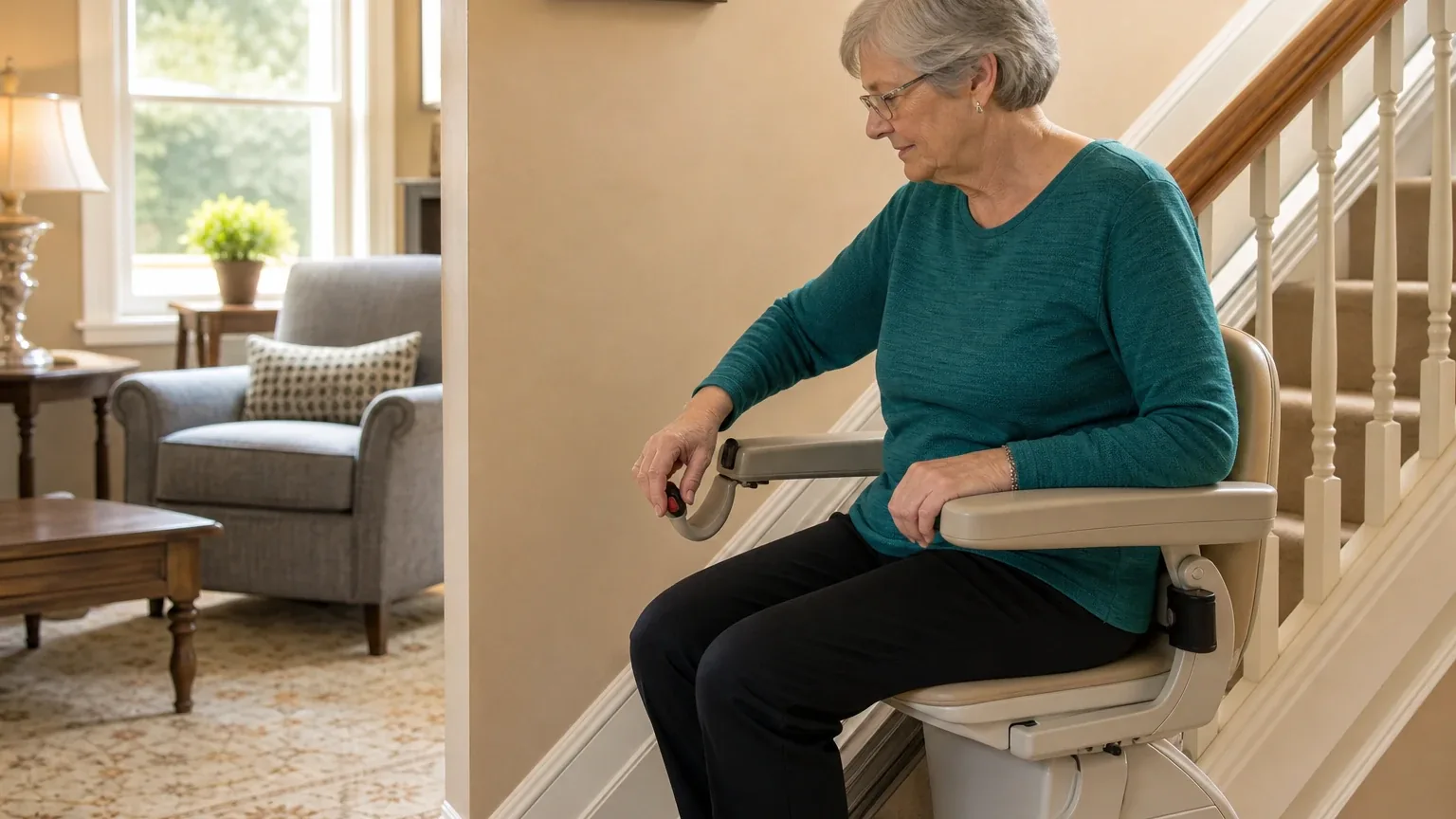
Acorn stairlifts is a good—but not unequivocally strong—fit for arthritis-friendly controls and seating. Five of the seven platforms in this study named Acorn during the ranking stage, and four of those five rated it a good or strong fit. The strongest reason to consider it is the combination of large armrest paddle/toggle controls, included remote controls, a lockable swivel seat, and folding components—features Acorn markets specifically for arthritis users and ties to an Arthritis Foundation Ease-of-Use Commendation [1]. The main limitation is evidence quality: most supporting material is manufacturer-owned, no platform found published control-force, seat-comfort, or independent ergonomic testing, and no public U.S. installed price exists for the Acorn 130 or 180 [36].
Research Snapshot
| Field | Detail |
|---|---|
| Platform mentions in ranking stage | 5 of 7 configured platforms (anthropic, deepseek, google, grok, perplexity) |
| Share of included platform responses | 71.4% |
| Average listed rank | 1.6 |
| Best listed rank | 1 (anthropic, grok, perplexity) |
| Relevant product/model/plan | Acorn 130 Straight Stairlift (straight stairs); Acorn 180 Curved Stairlift (curved stairs) |
| Overall use-case fit | Strong (1 platform); Good (3 platforms); Mixed (3 platforms) — 7 platforms analyzed |
| Research date | 2026-11-10 |
What Changed Since September 2026
Acorn Stairlifts moved down from No. 2 to No. 3, and platform mentions decreased from 6 to 5. The November 2026 review broadens its focus from the Acorn 130 Stairlift to Acorn Stairlifts overall, pairing the 130 straight-stair model with the 180 for curved stairs and no longer treating a powered swivel seat and powered footrest as the key configuration question. Instead, it weighs whether the standard manual lever swivel is workable for arthritic hands, and fit now hinges on that. Pricing evidence shifted: installed straight-stairlift estimates of $2,500–$3,500 are newly reported, while the earlier $3,000 to $5,000 range is no longer repeated. Acorn's expected service life is now described as 8–12 years, shorter than competitors' 15–18. Differences between the two editions reflect what each article reports; they do not by themselves prove that the product, service, or price changed.
The September 2026 review preserves the earlier article for reference.
Why Acorn Stairlifts Qualified for This Study
Questions This Section Answers
- Why did Acorn Stairlifts qualify for a 2026 ranking of stairlifts for arthritis-friendly controls and seating?
- How consistently did AI platforms rank Acorn Stairlifts for arthritis-friendly stairlift controls?
Acorn qualified because it was named by five of the seven platforms during ranking discovery and placed first by three of them. Its ranks by platform were 1 (anthropic), 2 (deepseek), 3 (google), 1 (grok), and 1 (perplexity), producing an average listed rank of 1.6 and a best rank of 1. The two platforms that did not name Acorn in the ranking stage were kimi and openai, though both still produced a full fit assessment of Acorn when asked directly.
Qualification also rests on topical relevance rather than rank alone. Acorn is the only stairlift company that multiple sources describe as holding the Arthritis Foundation's Ease-of-Use Commendation [1]. Acorn's own arthritis-focused article identifies paddle controls, remote controls, swivel seating, and folding components as arthritis-relevant features [28]. That combination—named by most platforms and directly tied to the use case—is why Acorn appears in this arthritis-friendly controls and seating comparison rather than a general stairlift ranking.
The ranking stage is a discovery signal, not a quality verdict. Being named by five platforms shows Acorn is a commonly surfaced option for this buyer profile; it does not establish that Acorn outperforms alternatives on control force, seating comfort, or durability.
The Product, Model, Plan, or Service Most Relevant to Arthritis-Friendly Controls & Seating
Questions This Section Answers
- Which Acorn Stairlifts model should a senior with arthritis compare for straight versus curved stairs?
- Does the Acorn 130 Straight Stairlift include the swivel seat and remote controls that arthritis buyers need?
The Acorn 130 Straight Stairlift is the model most platforms tied to this use case, with the Acorn 180 Curved Stairlift as the curved-stair equivalent. Six of the seven platforms named the 130 specifically; five also named the 180 for curved staircases (openai, anthropic, deepseek, perplexity, kimi). Grok focused on the 130 alone.
The Acorn 130 is built for straight staircases only [14]. Its product page lists remote control, folding footrest, seat belt, backup battery, and smooth-start/smooth-stop operation, plus a 17.25-inch seat height, 16-inch seat depth, 12.25-inch footrest width, and 280-pound capacity [36]. The Acorn 180 is the customizable curved-rail model, listed at a 17.25-inch seat height, 16-inch seat depth, 14.75-inch footrest width, and 265-pound capacity [32]. Acorn describes the 180 as one of few curved models requiring no structural changes before installation [48].
For arthritis buyers, the relevant configuration details are the control type, swivel seat, and footrest. Acorn describes a simple switch or paddle control on the armrest and states the lift can also be operated by remote control [30]. Both models use a manual swivel seat operated by a lever: the 130 manual states the seat locks at 45 and 90 degrees, and the 180 guide states it locks at 45 and 80 degrees [20]. A powered footrest operated by buttons on both sides of the seat is documented as an option in the 130 manual, but the product page does not establish that it is included in every U.S. installation [20].
What the AI Platforms Agreed About
Questions This Section Answers
- What do AI platforms agree the Acorn 130 and 180 offer seniors with arthritis?
- Do AI platforms agree that Acorn Stairlifts has arthritis-friendly controls?
Platforms broadly agreed on the feature set and on the Arthritis Foundation recognition, but not on overall fit strength. The clearest unanimous points were the control design, the swivel seat, remote controls, and the Arthritis Foundation commendation.
On controls, platforms converged on large armrest paddles or toggles that respond to light pressure. Acorn's own materials describe large paddle controls on each arm that move the lift "at the lightest touch" [24], and third-party reviewers repeat that people with limited dexterity benefit from sensitive controls [42]. Grok tied this directly to the Arthritis Foundation Ease-of-Use Commendation confirming minimal hand strength is needed [11].
On the swivel seat, platforms agreed it exists and supports seated transfers. Acorn states the large paddles that operate the lockable swivel function sit on both sides of the seat so users can use whichever hand they prefer [29]. Third-party sources describe the manual swivel as helping users exit safely at the top of stairs [6].
On remotes, platforms agreed Acorn includes remote controls. Acorn states every model includes a remote control [26], and the 130 and 180 product pages list remote control as a standard feature [36]. One source notes two infrared handsets are supplied [39].
On recognition, multiple sources—company and third-party—state Acorn holds the Arthritis Foundation's Ease-of-Use Commendation [1]. This is a repeated claim, not an independently re-verified certification in this study.
Where the AI Platforms Disagreed or Were Uncertain
Questions This Section Answers
- Why do AI platforms disagree on whether Acorn Stairlifts is a strong or only mixed fit for arthritis-friendly seating?
- Is the Acorn swivel seat powered or manual, and why does that matter for a senior with arthritis?
Platforms disagreed most on overall fit strength and on whether the manual swivel and footrest are arthritis-friendly. Fit ratings split: anthropic, deepseek, and openai rated Acorn "good"; grok rated it "strong"; google, kimi, and perplexity rated it "mixed." That spread reflects genuine evidence gaps rather than a settled consensus.
The sharpest disagreement is the swivel seat. Some platforms treat the manual lever swivel as adequate; others flag it as a limitation. Google states the standard manual swivel lever "requires upper body and hip effort that can strain arthritis sufferers unless a power swivel option is fitted" [16]. Anthropic notes the manual swivel "requires sustained hand pressure to hold lever during rotation; may be challenging for users with severe hand arthritis." Perplexity's source page shows a "Power Swivel 130" option, indicating a powered variant may exist, but the standard configuration is manual [3]. Buyers should confirm which swivel their quote includes.
The footrest is a second conflict. The 130 manual documents an optional powered footrest [20], but platforms disagree on whether it is standard. Anthropic states the 130 offers a manual footrest only and that a powered footrest is available on the curved model but not standard. Google states the lack of a standard powered footrest means users must bend to fold it. OpenAI notes standard inclusion and U.S. pricing are unclear. This is unresolved in the public evidence.
Weight capacity is a third conflict. The 130 product page lists 280 pounds [36], while a third-party source cites 300 pounds standard with a 350-pound option [53], and another rounds the 180 to 266 pounds [48]. Platforms could not reconcile whether the variance reflects product generations or regional configurations. Buyers should confirm the exact rating that controls their contract.
Use-Case-Specific Features and Capabilities
Questions This Section Answers
- How easy are the Acorn 130 controls to operate for someone with hand arthritis?
- Does the Acorn Stairlift seat height and swivel seat make sitting down and standing up easier for arthritis in the hips or knees?
Acorn's core arthritis-relevant features are present, but the public evidence does not quantify how easy they are to operate. The table below summarizes what platforms found for each category criterion.
| Criterion | What the evidence shows | Assessment |
|---|---|---|
| Joystick/button ease of use | Large armrest paddles/toggles; "lightest touch" claims; Arthritis Foundation commendation [24] | Advantage, but no published control force |
| Seat height | 17.25 inches on both 130 and 180 [36]; one source cites adjustable posts to 19.75 inches [15] | Neutral; test in person |
| Swivel seat operation | Manual lever, locks at 45/90 degrees (130) and 45/80 degrees (180) [20] | Mixed; effort not quantified |
| Armrest comfort | Padded, folding armrests [4]; padding not specified | Neutral |
| Footrest controls | Folding footrest; powered option documented but standard inclusion unclear [20] | Unclear |
| Ride smoothness | Smooth-start/smooth-stop claims [36]; one reviewer calls ride "steady rather than perfectly smooth" [48] | Mixed; manufacturer claim |
| Remote control availability | Included on every model; two handsets supplied [26] | Advantage |
| Warranty terms | 12-month manufacturer warranty; conditional lifetime motor/gearbox [33] | Neutral |
On controls, Acorn's own arthritis article and multiple third-party sources describe light-touch paddles, but none publish the required operating force, paddle dimensions, or arthritis-specific usability testing [28]. On seating, the 17.25-inch seat height and 16-inch seat depth are published, but whether they suit a particular user's hips, knees, or back must be tested in person [36]. On ride smoothness, Acorn claims smooth start and stop, but no independent ride-smoothness testing was identified, and one reviewer described the ride as steady rather than perfectly smooth [36].
Pricing, Fees, Contracts, and Ongoing Costs
Questions This Section Answers
- How much does an Acorn 130 or 180 stairlift cost installed in the U.S.?
- What ongoing warranty and service costs should an arthritis buyer budget for after the first year with Acorn Stairlifts?
Acorn does not publish a U.S. installed price, so any figure is a third-party estimate. Acorn promotes a free, no-obligation home survey and quote, and says cost depends on home measurements and needs [30]. Third-party estimates vary widely and were not verified against Acorn quotes.
| Cost item | Reported figure | Source type |
|---|---|---|
| Acorn 130 straight, installed | $2,500–$3,500 (typically $2,900–$3,200) | Third-party review [8] |
| Acorn 130 straight, installed | $2,500–$4,500 | Third-party review [16] |
| Acorn 180 curved, installed | $8,000–$14,000 | Third-party review [8] |
| Acorn 180 curved, installed | $6,000–$10,000+ | Third-party review [16] |
| Extended warranty after year one | $595/year | Third-party review [49] |
| Service call (post-warranty) | $250 plus parts | Third-party review [49] |
| One-year warranty alternative | $375 | Third-party review [49] |
On warranty terms, Acorn states new stairlifts include a 12-month manufacturer warranty covering callouts, parts, and labor subject to terms, and that the motor and gearbox have lifetime coverage for the original purchaser conditional on annual Acorn servicing [33]. The cost of that mandatory annual servicing is not publicly disclosed. Extended warranty and service plans are offered, but their prices and detailed terms are not published on the reviewed pages [33].
Contract and cancellation terms were not identified on the reviewed public pages. One source notes in-home quotes may remain valid for up to 12 months and that custom curved-rail sections may carry non-refundable deposit terms once manufactured [16]. Buyers should request written cancellation, return, and removal terms before signing.
Best Suited For
Questions This Section Answers
- Who is the Acorn 130 Straight Stairlift best suited for among seniors with arthritis?
- Is Acorn Stairlifts a good choice for a senior with mild hand arthritis who needs low-effort controls?
Acorn is best suited for seniors with mild to moderate arthritis who can operate a simple paddle or toggle with one hand and who want a swivel seat to turn away from the stairs before standing. Platforms converged on this profile: users who can manage standard controls, need seated transfers, and value included remotes and manufacturer-backed service (openai, anthropic, deepseek, grok).
Specifically, Acorn fits:
- Straight-stair users considering the Acorn 130, or curved-stair users considering the Acorn 180 [36].
- Users who need a swivel seat to face the landing before standing, reducing torso twisting for hip and back arthritis [6].
- Buyers who value included remote controls and manufacturer-backed service options [26].
- Households able to commit to annual servicing to maintain the conditional lifetime motor/gearbox warranty [35].
Probably Not Best Suited For
Questions This Section Answers
- Who should avoid the Acorn Stairlifts manual swivel seat because of severe hand or hip arthritis?
- Is Acorn Stairlifts unsuitable for a senior who needs a powered swivel seat or powered footrest as standard?
Acorn is probably not best suited for users with severe hand arthritis who cannot reliably press or move a paddle/toggle, or who need a powered swivel seat or powered footrest as standard. Google states the manual swivel lever can strain arthritis sufferers unless a power swivel is fitted [16], and anthropic notes the manual swivel requires sustained hand pressure. OpenAI lists users unable to reliably press a paddle/toggle among those Acorn is not best for.
It is also a weaker fit for:
- Buyers who require a firm all-in price before scheduling an in-home survey (openai, deepseek, perplexity).
- Users whose weight, stair width, or seating needs fall outside the model specifications—the 130 requires roughly 26 inches of stair width and the 180 roughly 27.5 inches [5].
- Buyers prioritizing a 15+ year service life; one third-party review puts Acorn's average at 8–12 years versus 15–18 for Bruno [8].
- Households needing 24/7 support; one source notes telephone hours limited to 9 am–5 pm EST [17].
When Another Option May Be Better
Questions This Section Answers
- When is another stairlift brand a better choice than Acorn Stairlifts for arthritis-friendly controls?
- Should a buyer choose a competitor over Acorn Stairlifts if they need a powered swivel seat or higher weight capacity?
Another option may be better when a buyer needs a powered swivel seat or powered footrest as standard, higher weight capacity, longer service life, or more transparent published pricing. Platforms named these as the main reasons to look elsewhere.
Google suggests alternatives such as the Bruno Elan/Elite or Stannah Sierra when an automatic power swivel or power folding footrest is required as standard, and a standing/perch-style seat such as the Stannah Sadler for severe knee arthritis [52]. Anthropic notes Bruno and Harmar offer higher capacity as standard and that competitors average 15–18 years of service life versus Acorn's 8–12 [8]. OpenAI suggests another manufacturer when a powered swivel or powered footrest is standard or clearly priced, or when the user needs demonstrably lower-force controls. Deepseek and perplexity suggest alternatives when documented control-force data or transparent public pricing is required before purchase.
These are platform-reported suggestions, not independently tested comparisons. Buyers should verify any competitor's arthritis-specific features and pricing directly.
Questions to Verify Before Buying
Questions This Section Answers
- What should a buyer confirm with Acorn Stairlifts about control force and swivel operation before signing?
- What pricing and warranty details should be confirmed in writing before buying an Acorn stairlift for arthritis?
Before signing, confirm the following in writing, because the public evidence leaves each item unresolved:
- The exact installed price, including survey, installation, taxes, delivery, rail configuration, and removal of any existing lift (openai, perplexity).
- Whether the quoted 130 or 180 is rated for the user's actual weight, and which capacity figure controls the contract—280, 300, or another figure [36].
- Whether the swivel seat is manual or powered, how much force the lever requires, and whether a Power Swivel 130 option is available and at what cost [3].
- Whether the user can operate the paddle/toggle repeatedly with their hand limitations, and what operating force is required (openai).
- Whether a powered footrest is available, what it costs, and whether it is standard or optional [20].
- What the 12-month warranty covers, what exclusions apply, and what annual service is required to preserve the lifetime motor/gearbox warranty [33].
- The annual service, extended-warranty, battery-replacement, repair, cancellation, rental, and removal costs [49].
- Whether the Arthritis Foundation Ease-of-Use Commendation applies to the specific model and configuration being quoted [1].
- Whether an in-home demonstration using the exact seat, control, and footrest configuration can be arranged before signing (openai).
Final AI Consensus Verdict
The consensus is a qualified yes: Acorn Stairlifts is a good fit for arthritis-friendly controls and seating, but not an unequivocally strong one. Five of seven platforms named Acorn in the ranking stage, and four of five fit assessments landed at good or strong, with three at mixed. The strongest support is the combination of large light-touch paddles, included remotes, a lockable swivel seat, folding components, and the Arthritis Foundation Ease-of-Use Commendation [1].
The consensus breaks down on three points: whether the manual swivel and footrest are arthritis-friendly enough without power upgrades, whether Acorn's weight capacity and 8–12 year service life justify its cost, and whether the mostly manufacturer-owned evidence is sufficient. No platform found independent control-force, seat-comfort, or ride-smoothness testing, and no public U.S. installed price exists. The practical verdict: Acorn is a reasonable choice for a senior with mild to moderate arthritis on straight or curved stairs who can test the controls in person and get a written quote covering warranty, service, and swivel configuration—but buyers with severe hand arthritis or a need for powered transfers should compare alternatives first.
How This Review Was Produced
This review was produced from a ranking study of seven AI platforms (anthropic, deepseek, google, grok, kimi, openai, perplexity) evaluating stairlifts for arthritis-friendly controls and seating for U.S. seniors. Each platform reported which entities it named during ranking discovery and produced a structured fit assessment with citations. Acorn Stairlifts was named by five of the seven platforms and received a full fit assessment from all seven. The study used the run research date of 2026-11-10. Platform-reported research dates are provenance metadata and do not independently prove freshness. All citations are platform-reported evidence, not independently verified facts, and company-owned citations materially outnumber independent ones. No personal testing, customer experience, or medical benefit was assessed.
Methodology Limitations
- Company-owned citations materially outnumber independent citations; company claims are not described as independently verified.
- No platform found published control-force, seat-comfort, or independent ergonomic testing for arthritis users.
- No public U.S. installed price exists for the Acorn 130 or 180; all price figures are third-party estimates not verified against Acorn quotes.
- Weight capacity, footrest inclusion, and swivel power status conflict across sources and were not resolved.
- Platform-reported research dates differ from the authoritative run date (deepseek reported 2026-02-06); this is disclosed as a provenance limitation.
- Deepseek's research was reported with search disabled, so its claims require explicit verification before being treated as current facts.
- The supplied URLs were collected from platform responses and were not independently validated by the writer stage.
- Platform agreement on features does not prove product quality or arthritis-specific performance.
See the broader Seniors With Arthritis consensus index for comparisons across qualified options.
Sources
Company-Owned Sources
- Straight Stairlift | Acorn 130: https://acorn-stairlifts.com/stairlift/straight
- Stairlift FAQ: Common Stairlift Questions: https://acornstairlifts.com/about/acorn-stairlifts-faq
- Straight Stairlifts | Prices, Costs, & Installation: https://www.acornstairlifts.co.za/stairlifts/straight-stairlifts
- Acorn Stairlifts – Official Website: https://www.acornstairlifts.com/
- Acorn 130 User Manual: https://www.acornstairlifts.com/assets/130/22-078_AC_TC_130%20user%20manual_0225_ENG.pdf
- Acorn 180 User Manual: https://www.acornstairlifts.com/assets/180/22-078_AC_TC_180%20user%20manual_0225_ENG.pdf
- Acorn Stairlift Aftercare: What Happens After Installation?: https://www.acornstairlifts.com/blog/post/2944/Tips-and-Advice/Acorn-Stairlift-Aftercare:-What-Happens-After-Installation
- Remote and Chair-controls stairlifts: https://www.acornstairlifts.com/blog/post/4346/Tips-and-Advice/Acorn-Stairlifts-Cares-About-Your-Comfort-Remote-Controls-Vs-Chair-Controls
- Acorn Stairlifts & Arthritis: Ease of Use Certification: https://www.acornstairlifts.com/blog/post/5770/Tips-and-Advice/What-Makes-Acorn-Stairlifts-Arthritis-Friendly
- How do stairlifts work?: https://www.acornstairlifts.com/faqs/how-do-stairlifts-work/
- Our Award-Winning Stairlifts: https://www.acornstairlifts.com/stairlift/acorn-stairlifts
- Acorn 180 Curved Stairlift: https://www.acornstairlifts.com/stairlift/stairlift-curved-staircase
- Stairlift Warranties & Guarantees: https://www.acornstairlifts.com/stairlift/stairlift-extended-warranties/
- Stairlift Features & Solutions: https://www.acornstairlifts.com/stairlift/stairlift-features
- Stairlift Service & Repairs: https://www.acornstairlifts.com/stairlift/stairlift-servicing
- Acorn 130 Straight Stairlift: https://www.acornstairlifts.com/stairlift/stairlift-straight-staircase
- Straight Stairlift | Acorn 130 | Acorn Stairlifts USA: https://www.acornstairlifts.com/stairlift/straight
- Acorn 130 Straight Stairlift: https://www.acornstairlifts.com/stairlifts/acorn-130/
Independent Sources
- Acorn Stairlift Review: Does It Live Up to the Hype?: https://millennialhawk.com/acorn-stairlift-review/
- Acorn 130 Stairlift Review: Specs & Prices UK 2026: https://stairliftguru.co.uk/stairlift-companies/acorn-130/
- Acorn Stairlifts Review: Prices, Models and Warranty 2026: https://stairliftguru.co.uk/stairlift-companies/acorn-stairlifts/
- Stairlifts | How they help and buying advice: https://www.arthritis-uk.org/information-and-support/living-with-arthritis/home-and-garden/stairlifts/
- EOU Certification: https://www.arthritis.org/partnership/ease-of-use-certification
- The Best Stairlifts of 2024 - Caring.com: https://www.caring.com/best-stairlifts/
- Acorn Stairlifts Review – Consumer Source: https://www.consumeraffairs.com/homeowners/acorn-stairlifts.html
- How Much Do Stair Lifts Cost? | 2026 Stairlift Prices from Experts: https://www.stairliftexperts.co.uk/stairlift-cost/
Other Sources
- Our Stairlift Options: https://acorn-stairlifts.com/stairlift
- Curved Stairlift: https://acorn-stairlifts.com/stairlift/curved
- User Manual PCB T700 Acorn Superglide 130 Straight Stairlift: https://acornstairlifts.co.uk/Acorn-Stairlifts-User-Manuals-130.pdf
- AC 130 Reconditioned Straight Stairlift - Affordable Stairlifts: https://affordablestairlifts.co.uk/product/acorn-130-reconditioned-straight-stairlift/
- Acorn Stairlift Prices 2026: Models & Installation Costs: https://agingauthority.org/acorn-stairlift-prices/
- Acorn Stairlift Review 2026: Honest Pros, Cons & Pricing: https://allamericanstairlifts.com/brands/acorn-stairlift-review/
- Acorn 130 Stairlift - Atlas Stairlifts: https://atlasstairliftz.com/acorn-stairlift/
- The Acorn 180 Stairlift - San Diego Used Stair Lift Specialists: https://electroease-stair-lifts.com/Acorn-180.html
- ACORN STRAIGHT STAIRLIFT 130 - Acorn Mobility Services - PDF Catalogs: https://pdf.medicalexpo.com/pdf/acorn-mobility-services/acorn-straight-stairlift-130/88515-249433.html
- Acorn Stairlift Review: True Prices & Money-Saving Tips: https://seniorsite.org/resource/acorn-stairlift-review-true-prices-money-saving-tips
- Acorn Stairlifts ACORN 130 STAIRLIFT: https://shop.apexpharm.com/acorn-stairlifts-acorn-130-stairlift-detail.htm?productid=22563246
- Acorn Stair Lift Review (Cost, Models & Problems Revealed!: https://trustedcompanyreviews.com/brand/acorn-stair-lift-review/
- Acorn 180 Curved Stairlift Spotlight: https://www.acornstairlifts.com/blog/post/3914/Tips-and-Advice/Acorn-Stairlift-Spotlight-of-the-Week:-Acorn-180-Curved-Stairlift
- 6 Acorn Stairlift Features - Acorn Stairlifts USA: https://www.acornstairlifts.com/blog/post/4085/Tips-and-Advice/6-Stairlift-Features-That-Make-Acorn-Stairlifts-Stand-Out-from-the-Chairlift-Crowd
- How Long Do Acorn Stairlifts Last? 2026 Guide: https://www.acornstairlifts.com/blog/post/5630/Tips-and-Advice/How-Long-Does-a-Stairlift-Last
- Acorn Stairlift FAQ of the Week—What is Acorn's Folding Footrest?: https://www.acornstairlifts.com/blog/post/6300/Tips-and-Advice/Acorn-Stairlift-FAQ-of-the-Week%E2%80%94What-is-Acorn%E2%80%99s-Folding-Footrest
- Acorn 130 Stairlift for Straight Stairs - Trusted Mobility Solution: https://www.amwstairlifts.co.uk/acorn-130-straight-stairlift
- Acorn 130 Stair Lift: https://www.beststairliftreviews.com/the-acorn-130-stair-lift/
- Acorn Stairlifts Reviews (From First-hand Experiences: https://www.consumeraffairs.com/age/acorn-stairlifts.html?page=2
- The Acorn 130 Indoor Stairlift: https://www.electroease-stair-lifts.com/Acorn-130.html
- ACORN 130 INSTALLATION MANUAL Pdf Download: https://www.manualslib.com/manual/997238/Acorn-130.html
- Acorn Stair Lifts Reviews (with Cost: https://www.retirementliving.com/reviews/acorn-stair-lifts
- Acorn Stair Lifts Review (2026): With Costs: https://www.retirementliving.com/reviews/acorn-stair-lifts/2
- Acorn Stair Lifts Reviews (with Cost: https://www.retirementliving.com/reviews/acorn-stair-lifts/3
- Acorn Stairlifts Overview: https://www.stairlift.org/acorn/
- Acorn 130 Stairlift: https://www.tristatestairlifts.com/stairlifts/acorn-superglide-120/
Verify This Research
Review the study details behind this page or download the public machine-readable verification record.
- Study date
- November 10, 2026
- Platforms analyzed
- 7
- Source records
- 53
- Ranking mentions
- 5 of 7
- Platform share
- 71%
- Final consensus rank
- #3
Research trail and source mix
Configured platforms
openai, anthropic, deepseek, grok, perplexity, kimi, google
Source mix
8 independent · 19 company-owned · 26 unclear
Evidence support
20 direct · 7 partial
Important limitation
Use the run research_date as the study date. Platform-reported dates are provenance metadata and do not independently prove freshness.
Source snapshot SHA-256 5aa3410ec6104047bf648492e004ff7ba1e09860070aa3eacd7dfd91248bcec1