
Answer Capsule
Access BDD is a good fit, with caveats, for homeowners who want a manufacturer-supported local dealer to handle measurement, installation, maintenance, and service. Three of the seven platforms in this study named Access BDD during the ranking stage (deepseek, grok, kimi), and it finished sixth overall with an average listed rank of 5.3 and a best rank of 4. The strongest reason to consider it is structural: Access BDD sells only through authorized dealers who assess the home, install the lift, and provide ongoing service, backed by a U.S. training facility and a published dealer locator [28]. The main limitation is that installation quality, response times, pricing, and warranty handling are dealer-dependent, and the company does not publish U.S.-wide service standards or a clear warranty schedule [24].
Research Snapshot
| Field | Detail |
|---|---|
| Platform mentions in ranking stage | 3 of 7 platforms (deepseek, grok, kimi) |
| Share of included platform responses | 42.9% |
| Average listed rank | 5.33 |
| Best listed rank | 4 (grok) |
| Relevant product/model/plan | Access BDD HomeGlide straight stair lift, Flow X curved or straight stair lift, and HomeGlide Outdoor stair lift purchased and installed through an authorized U.S. dealer [32] |
| Overall use-case fit | Good, with dealer-dependent caveats (openai, anthropic, grok, perplexity, google rated good; deepseek mixed; kimi uncertain) |
| Research date | 2026-11-10 |
What Changed Since September 2026
Access BDD moved up from No. 7 to No. 6, and platform mentions were unchanged at 3. The November 2026 review broadens how Access BDD's dealer-installed path is described, naming the HomeGlide, Flow X, and HomeGlide Outdoor families rather than focusing on the Flow X alone, and it now frames warranty and dealer-certification terms as unresolved in the public record. Buyer fit and the recommended configuration are unchanged: it remains a good fit with caveats for homeowners who want an authorized local dealer to handle assessment, installation, and service. On cost, the review newly reports a $3,000 starting figure for outdoor stairlifts; these remain dealer quotes, not published installed prices. Installation timing is now put at 2 to 4 hours for most homes. Differences between the two editions reflect what each article reports; they do not by themselves prove that the product, service, or price changed.
The September 2026 review preserves the earlier article for reference.
Why Access BDD Qualified for This Study
Questions This Section Answers
- Why did Access BDD qualify for a dealer network and installation quality study when only three platforms named it?
- Does Access BDD's authorized-dealer model make it a legitimate contender for homeowners who want professional installation?
Access BDD qualified because its entire U.S. distribution model is built around the exact criteria this study measures: dealer network coverage, in-home assessment, installation, maintenance, and warranty coordination. The company operates as a business-to-business supplier and sells through a network of dealers rather than direct to consumers [21]. It publishes a U.S. dealer locator with authorized dealers listed by state and describes a North American network covering the United States and Canada [28].
That structure is why platforms that named it treated it as a relevant option even though its ranking position was mid-pack. Access BDD describes local dealers as trained to assess homes, recommend products, install lifts, and provide ongoing support [25]. It also states that dealers receive structured commercial and technical training covering products and installation methods [8], and grok reported a dedicated U.S. training facility in Florida opened in 2025 to support dealers [10].
The qualification is not a quality endorsement. Only three of seven platforms surfaced Access BDD during ranking discovery, and its average listed rank of 5.33 places it in the lower half of this study's field. The company's own pages supply most of the evidence, and independent verification of dealer performance was not identified [28].
The Product, Model, Plan, or Service Most Relevant to Dealer Network & Installation Quality
Questions This Section Answers
- Which Access BDD stairlift models should a homeowner compare when professional dealer installation is the priority?
- Is Access BDD's dealer-installed purchase path a better fit than buying equipment directly for a homeowner who wants in-home measurement and service?
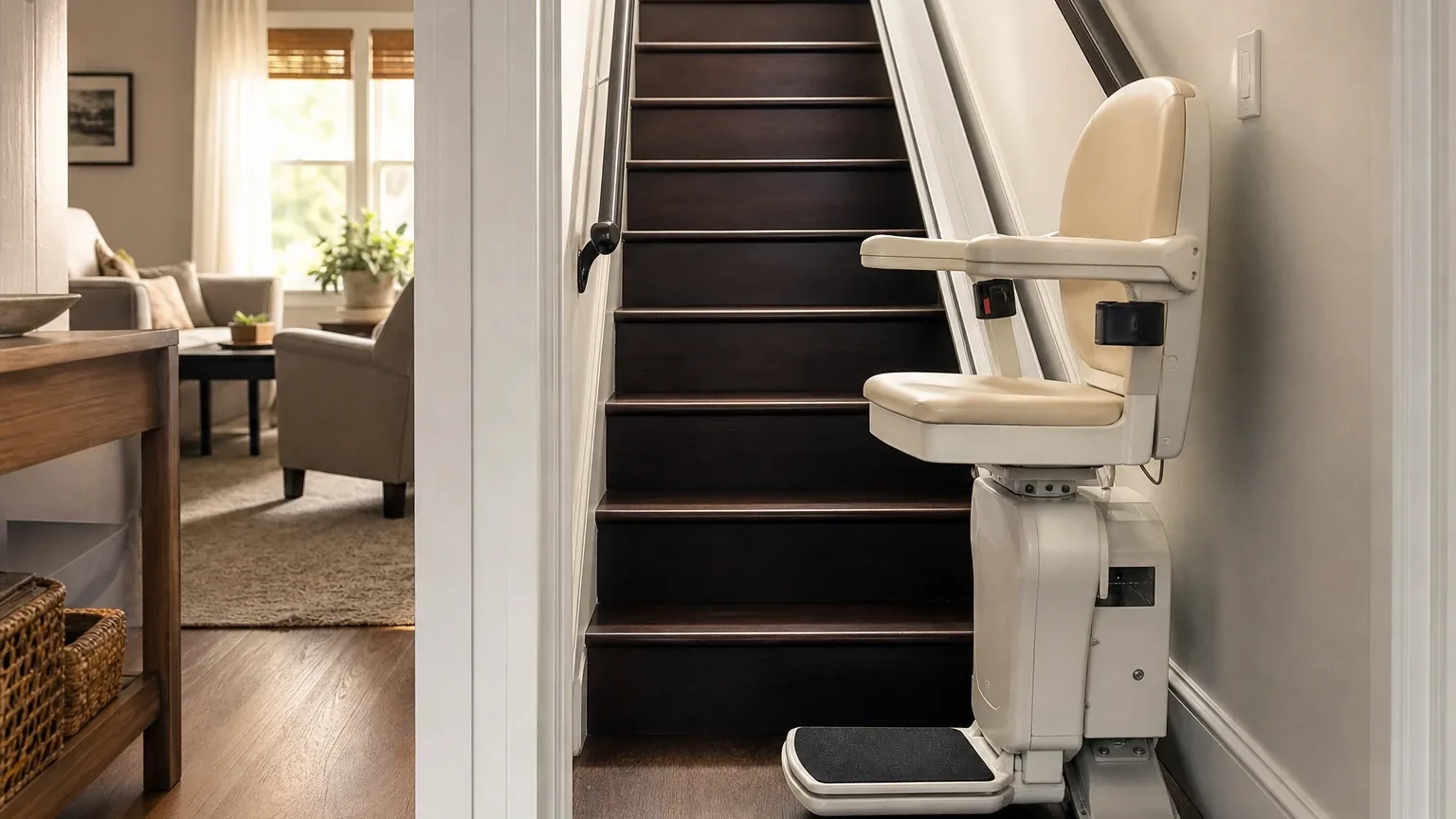
The most relevant offering is not a single model but the dealer-installed purchase path applied to three product families. The HomeGlide is positioned for straight stairs, the Flow X for curved or complex stairs and some straight configurations, and the HomeGlide Outdoor for exterior stairs [32]. All three are sold and installed through authorized local dealers rather than direct [21].
For this use case, the model matters less than the dealer relationship. Access BDD states that its stairlifts are professionally installed by approved dealers and that installation is included in the overall stairlift cost [31]. Dealers visit the home, assess the staircase and mobility needs, recommend the appropriate model, and measure the installation environment [25].
Platforms described the relevant product differently. OpenAI, anthropic, google, and perplexity named the HomeGlide and Flow X families; deepseek, grok, and kimi referenced an "Excel" model that does not appear in the other platform outputs [7]. Buyers should confirm the current U.S. model name and configuration with their dealer rather than relying on any single platform's product label.
What the AI Platforms Agreed About
Questions This Section Answers
- What do the AI platforms agree Access BDD gets right for homeowners who need dealer-installed stairlifts?
- Do the platforms agree that Access BDD's dealer network is a genuine advantage for installation quality?
The platforms agreed on four points, though not unanimously on every detail. First, Access BDD sells exclusively through authorized dealers, so the local dealer—not the manufacturer—controls the homeowner's installation and service experience [21]. Second, dealers conduct in-home assessments and measurements before installation [25]. Third, straight installations are typically quick: Access states most straight HomeGlide installations take a few hours, and independent sources report under three hours for straight lifts and roughly half a day for curved [32]. Fourth, ongoing maintenance and repairs route through the local dealer, with at least annual servicing recommended [24].
Five of seven platforms rated Access BDD a good fit for this use case (openai, anthropic, grok, perplexity, google). Deepseek rated it mixed and kimi rated it uncertain, both citing thin public evidence on U.S. dealer coverage, certification, and warranty terms [7]. That split is itself a finding: the platforms agree on the structure of the dealer model but not on how well it is documented.
Where the AI Platforms Disagreed or Were Uncertain
Questions This Section Answers
- Why do some AI platforms rate Access BDD's dealer network as uncertain rather than good for installation quality?
- Which Access BDD warranty terms are disputed across platforms, and what should a buyer confirm in writing?
The sharpest disagreement concerns warranty. Anthropic reported a 2-year standard parts warranty with lifetime options on major components, citing independent reviews [35]. Google reported factory parts warranties including lifetime parts options on rails, motors, and gearboxes, but noted Access BDD explicitly disclaims responsibility for dealer service agreements [19]. OpenAI found that public U.S. pages do not clearly state warranty duration, labor coverage, exclusions, or transferability [24]. Independent sources add a 1-year labor warranty on new installations from one dealer directory [33]. These accounts are not reconcilable from the public record, and buyers should obtain written terms from the dealer.
Certification is the second uncertainty. Access BDD uses several terms—authorized, approved, trained, certified, and fully qualified—without publishing one consistently defined U.S. credential standard [28]. Anthropic noted that NAEC Certified Accessibility Technician status is not an Access BDD requirement, and that one similarly named but separate dealer advertises NAEC credentials [32]. Kimi could not verify whether dealers are exclusive or multi-brand, or whether they install directly or subcontract [7].
Coverage and responsiveness are the third. Grok cited limited independent U.S. homeowner review data, including a BBB A- rating with zero complaints and a thin Trustpilot record [2]. No platform identified a published nationwide installation-time guarantee or measurable service-response commitment [28]. Deepseek's research date was 2026-06-15, earlier than the other platforms, so its findings may be staler [7].
Use-Case-Specific Features and Capabilities
Questions This Section Answers
- How does Access BDD's dealer network perform on in-home assessment and installation timeline compared with what buyers should expect?
- Does Access BDD publish technician certification standards that a homeowner can verify before installation?
Access BDD performs well on assessment and installation speed and poorly on published certification and service standards. On assessment, the company states that home assessment and measurements are used to identify obstructions and create a suitable installation [13], and dealer pages describe visits to evaluate layouts and recommend models [25]. Google reported that dealers use camera and photo measurement systems to map complex or narrow staircases for the Flow X [37].
On installation timeline, Access states most straight installations take a few hours and curved Flow X installations typically take around half a day [32]. Another company page says installation typically takes 2 to 4 hours for most homes [14]. These are installation durations after equipment availability, not guaranteed times from order to completion.
On technician certification, Access describes dealers as trained and certified and says it provides commercial and technical training [8]. It does not publish a U.S. technician-certification register, minimum installer-hour requirement, expiration policy, or dealer-specific training records [28]. Grok reported the Florida training facility as a support hub for dealers [10].
On maintenance and support, owners are directed to local dealers for breakdowns, repairs, parts, servicing, and removal [24]. Access publishes a U.S. phone number, email address, and contact form [23], and states it maintains a customer support team for inquiries and maintenance needs [22]. No independently verified response-time target or complaint-resolution metric was identified [28].
Pricing, Fees, Contracts, and Ongoing Costs
Questions This Section Answers
- Is Access BDD worth it for dealer-installed stairlifts when the company publishes no standard U.S. installed price?
- What ongoing maintenance and warranty costs should a homeowner confirm with an Access BDD dealer before signing?
Access BDD does not publish a standard U.S. installed price, so budget certainty depends entirely on the dealer quote. The company directs buyers to an approved local dealer for a personalized quote and states that dealer installation is included in the overall stairlift cost [31]. Its U.S. pricing page gives an approximate starting price of $3,000 for outdoor stairlifts, which is not a binding quote [31].
Independent estimates vary widely. Anthropic reported straight models at $3,000–$10,000 installed and curved models at $10,000–$20,000 or more [36]. Google reported straight models often starting at $3,000–$4,500 installed [4]. Retirement Living estimated straight lifts at $2,500–$6,000, curved at $9,000–$15,000 or more, and outdoor at $4,000–$12,000 [36]. These ranges are platform-reported and not reconciled.
Ongoing costs are dealer-set. Potential charges include travel or assessment fees, custom curved-rail surcharges, annual maintenance plans, out-of-warranty service calls, batteries, and electrical work [31]. A lifetime warranty option is available for a one-time payment at purchase through dealers and requires at least annual servicing to retain coverage [6]. Standard U.S. purchase, cancellation, return, deposit, and service-contract terms were not found on the public pages checked [31]. Access BDD's terms page states the company is not responsible for warranty claims or service agreements made between the customer and the local dealer [19].
Best Suited For
Questions This Section Answers
- Who is Access BDD best suited for when local dealer installation and ongoing service matter most?
- Is Access BDD a good choice for a homeowner with a curved staircase who wants professional measurement and installation?
Access BDD is best suited for homeowners in well-served areas who want a local dealer to own the entire lifecycle: assessment, installation, maintenance, and warranty coordination. That includes buyers who prefer an in-home survey over direct-to-consumer equipment purchase [25], buyers with straight staircases needing a HomeGlide, curved or complex staircases needing a custom Flow X, or outdoor stairs needing HomeGlide Outdoor [32], and buyers who value access to a local dealer for servicing, repairs, removal, and warranty coordination [24].
It also suits buyers who want manufacturer-backed dealer training and a published dealer locator to vet their installer before committing [28]. Anthropic noted Which? Recommended Provider status for a third consecutive year with an 88% score, though that accreditation is brand-level and does not verify individual dealer performance [11].
Probably Not Best Suited For
Questions This Section Answers
- Who should avoid Access BDD when guaranteed installation timelines and published service standards are non-negotiable?
- Is Access BDD a poor fit for homeowners in rural areas without a confirmed local authorized dealer?
Access BDD is probably not best suited for buyers who require a published nationwide installation deadline, a guaranteed emergency response time, or centrally managed service rather than dealer-dependent support [28]. It is also a weak fit for buyers seeking a transparent online price, a standardized contract, or independently verified dealer-performance data [31].
Homeowners in rural or remote areas with limited local dealer availability should verify coverage before committing; no platform confirmed dealer availability in all U.S. counties [30]. Buyers who need NAEC-certified technicians specifically should note that most Access BDD dealers are not noted as NAEC-certified [32]. Buyers who prefer direct-to-consumer sales or DIY installation are outside this model entirely [20].
When Another Option May Be Better
Questions This Section Answers
- When is another stairlift brand or local installer a better choice than Access BDD for installation quality?
- Should a homeowner choose a provider with published installed pricing over Access BDD when budget certainty matters most?
Another option may be better in five situations. First, when a nearby dealer with stronger verified local reviews, written service-response commitments, and clearer warranty terms is available from another manufacturer [28]. Second, when transparent installed pricing matters more than manufacturer choice; some competitors publish price ranges online [36]. Third, when a homeowner cannot tolerate variability among independent local dealers and prefers a centrally managed service organization [21].
Fourth, when a buyer requires NAEC Certified Accessibility Technician certification as a standard; some regional dealers advertise NAEC credentials, but this is not an Access BDD requirement [32]. Fifth, when a curved staircase cannot wait multiple weeks for custom rail fabrication and a competitor offers faster curved timelines [3]. For short-term needs, a rental or reconditioned-dealer option may be better, subject to verifying inspection, warranty, removal, and service terms [31].
Questions to Verify Before Buying
Questions This Section Answers
- What should a homeowner confirm with an Access BDD dealer about technician training and warranty terms before signing?
- Which installation and service details should be put in writing before paying an Access BDD deposit?
Buyers should confirm the following in writing before committing. Which specific local dealer will perform the survey, installation, warranty work, and future service, and is that dealer currently listed as authorized in Access BDD's locator [28]? What current Access training or certification does the installing technician hold [8]? Who performs the in-home measurement, what is measured, and will the buyer receive a written staircase assessment and model recommendation [13]?
What is the promised calendar time from signed order and deposit to installation, and what happens if the date slips [32]? What exactly is included in the installed price: electrical work, custom rail, delivery, user training, removal of an old lift, and disposal [31]? What are the full manufacturer and dealer warranty terms, including duration, labor, batteries, travel, parts, exclusions, transferability, and claim escalation [12]?
What are normal and emergency service response times, including nights, weekends, and periods when the original dealer is unavailable [24]? Are annual maintenance visits required, recommended, or included, and what do they cost [6]? Are there recurring fees, financing charges, cancellation penalties, restocking charges, or nonrefundable deposits [31]? Can the dealer provide recent local references for comparable installations and written proof of insurance [29]?
Final AI Consensus Verdict
Access BDD earns a good-fit verdict for Dealer Network & Installation Quality, with an important caveat. Five of seven platforms rated it good, one mixed, and one uncertain. The consensus is that Access BDD is structurally well matched to homeowners seeking professional local-dealer installation and ongoing service, especially when a reputable nearby authorized dealer is available [28].
The consensus also holds that Access BDD should not be treated as a uniformly standardized nationwide service. Installation quality, response times, pricing, and warranty handling remain materially dealer-dependent, and several buyer-critical terms are not published clearly [24]. The local authorized dealer, not the manufacturer brand, is the decisive quality factor. Buyers should treat this as a strong structural fit that requires dealer-level due diligence before purchase.
How This Review Was Produced
This review was produced from seven AI platform responses collected for the 2026-11-10 research run on Dealer Network & Installation Quality. Each platform independently researched Access BDD and reported fit findings, citations, pricing notes, and verification questions. The writer stage synthesized those outputs without browsing, adding outside facts, or independently validating the supplied URLs.
Platform mentions in the ranking stage count only platforms that named Access BDD during ranking discovery; all seven platforms evaluated fit. Company-owned citations materially outnumber independent citations in the supplied evidence, so company claims are not described as independently verified. Where platforms conflicted on product names, warranty terms, or pricing, the conflict is reported rather than resolved.
Methodology Limitations
Several limitations apply. The supplied URLs were collected from platform responses and were not independently validated by the writer stage. Citations are platform-reported evidence, not independently verified facts. Deepseek's research date was 2026-06-15, earlier than the authoritative run date of 2026-11-10, and platform-reported dates are provenance metadata that do not independently prove freshness. Deepseek also ran without search enabled, so its claims require explicit verification before being described as current facts.
Company-owned sources dominate the evidence base, and no independent dealer-quality dataset, complaint-rate analysis, or customer-satisfaction benchmark was identified. Access BDD's public pages use several terms for dealer credentials without one consistently defined U.S. standard, and no published nationwide installation-time guarantee or service-response commitment was found. Pricing is dealer-set and not published as a standard U.S. installed price. AI-platform agreement on structure does not prove product quality or installation performance.
Sources
Company-Owned Sources
- Access BDD official website: https://www.accessbdd.com/
- Become an Access BDD Partner: https://www.accessbdd.com/become-a-partner/
- Stairlift FAQ Hub - Access BDD: https://www.accessbdd.com/faq-hub/
- Access BDD Establishes Permanent Presence in the US with New Tampa Facility: https://www.accessbdd.com/news/access-bdd-establishes-permanent-presence-in-the-us-with-new-tampa-facility/
- Access BDD Receives Which? Accreditation: https://www.accessbdd.com/news/acess-bdd-receives-which-accreditation/
- Buying from an Authorised Stairlift Dealer: https://www.accessbdd.com/news/buying-from-an-authorised-stairlift-dealer/
- How safe are stairlifts?: https://www.accessbdd.com/news/how-safe-are-stairlifts/
- Stairlift Installation: What to Expect: https://www.accessbdd.com/news/stairlift-installation/
- Stairlifts Edinburgh | Straight & Curved - Access BDD: https://www.accessbdd.com/stairlifts-edinburgh/
- Stairlifts London - Access BDD: https://www.accessbdd.com/stairlifts-london/
- Stairlifts Manchester | Straight & Curved - Access BDD: https://www.accessbdd.com/stairlifts-manchester/
- Find a local Access dealer near you: https://www.accessbdd.com/stairlifts-near-me/
- Access BDD Terms & Conditions: https://www.accessbdd.com/terms-conditions/
- Access BDD - Your Partner in Home Mobility Solutions: https://www.accessbdd.com/us/
- About Access BDD: https://www.accessbdd.com/us/about-access/
- Commitment to Quality: https://www.accessbdd.com/us/commitment-to-quality/
- Contact Access BDD: https://www.accessbdd.com/us/contact/
- Stair Lift FAQs: https://www.accessbdd.com/us/faq-hub/
- California Stair Lifts and Platform Lifts: https://www.accessbdd.com/us/find-a-dealer-california/
- Los Angeles Stair Lifts & Platform Lifts: https://www.accessbdd.com/us/find-a-dealer-los-angeles/
- San Francisco Stair Lifts & Platform Lifts: https://www.accessbdd.com/us/find-a-dealer-san-francisco/
- Find a Local Access Stair Lift Dealer: https://www.accessbdd.com/us/find-a-dealer-v2/
- Find a Local Access Stair Lift Dealer: https://www.accessbdd.com/us/find-a-dealer/
- Sacramento Stair Lifts and Platform Lifts: https://www.accessbdd.com/us/find-a-dealer_sacramento/
- Stair Lift Pricing: https://www.accessbdd.com/us/stair-lift-pricing/
- Stair Lifts - Find the Perfect Solution for Your Home: https://www.accessbdd.com/us/stair-lifts/
- An Introduction to Access BDD: https://www.youtube.com/watch?v=dQw4w9WgXcQ
- Official pricing and terms source: https://www.accessbdd.com/stairlift-pricing-and-finance-options/
- Official pricing and terms source: https://www.accessbdd.com/terms-and-conditions-of-website-use/
Independent Sources
- Access BDD Review for Dealer Network & Installation - aginginplaceindex.com: https://aginginplaceindex.com/stairlifts/dealer-network-installation-quality/access-bdd
- Access BDD Review 2026: Dealer Network & Stairlift Analysis | BestGuide: https://bestguide.com/review/access-bdd-stairlifts/
- ThyssenKrupp Stairlifts: https://ideal-stairlifts.com/thyssen-access-bdd-stairlifts-review/
- Access BDD Stairlifts - Lifecare Mobility: https://lifecaremobility.ca/
- Manufacturer introduces industry-first lifetime warranty on stairlifts: https://thiis.co.uk/access-bdd-lifetime-warranty/
- Manufacturer introduces industry-first lifetime warranty on straight and curved stairlifts: https://thiis.co.uk/manufacturer-introduces-industry-first-lifetime-warranty-on-straight-and-curved-stairlifts/
- Straight Stair Lifts: https://www.allaboutaccess.com/services/stair-lifts/straight/
- Access BDD Review 2026 - ConsumerAffairs: https://www.consumeraffairs.com/mobility-equipment/access-bdd.html
- Best Stairlift Brands 2026: Bruno vs Acorn vs Access BDD Comparison Guide: https://www.mobility123.com/blog/best-stairlift-brands-comparison-guide/
- Access BDD Review (2026: https://www.retirementliving.com/reviews/access-bdd
- Access BDD Stairlifts Overview - The Residential Lift Source: https://www.theresidentialliftsource.com/
Verify This Research
Review the study details behind this page or download the public machine-readable verification record.
- Study date
- November 10, 2026
- Platforms analyzed
- 7
- Source records
- 40
- Ranking mentions
- 3 of 7
- Platform share
- 43%
- Final consensus rank
- #6
Research trail and source mix
Configured platforms
openai, anthropic, deepseek, grok, perplexity, kimi, google
Source mix
11 independent · 29 company-owned
Evidence support
33 direct · 7 partial
Important limitation
Use the run research_date as the study date. Platform-reported dates are provenance metadata and do not independently prove freshness.
Source snapshot SHA-256 9c106e343a9fd58077f76182994413aa8edc58e779317895f0873bf4c245888d
Archived editions
Browse earlier published research snapshots for this article. The latest edition remains at the current URL.