
Answer Capsule
Aloe Care Health (Voice-Activated Medical Alert + Home Monitoring) is a good fit for Remote Caregiver Visibility & Alerts when a family wants a shared caregiver app, remote two-way check-ins, in-home motion and environmental sensing, and professional emergency response for a parent living independently. Two of the seven platforms in this study named it during the ranking stage, at ranks 7 and 8. The strongest reason to consider it is the combination of unlimited Care Circle app access with the Essentials Plus bundle's in-home Smart Hub and Mobile Companion 2. The main limitation is that it is not a camera-based or full home-security system, and granular alert customization and per-caregiver permissions are not clearly documented.
Research Snapshot
| Field | Detail |
|---|---|
| Platform mentions in ranking stage | 2 of 7 platforms (anthropic, perplexity) |
| Share of included platform responses | 28.6% |
| Average listed rank | 7.5 |
| Best listed rank | 7 (perplexity) |
| Relevant product/model/plan | Aloe Care Essentials, Mobile Companion 2, or Essentials Plus (in-home Smart Hub + Mobile Companion 2) |
| Overall use-case fit | Good — strong caregiver coordination and monitoring; weak as a home-security substitute |
| Research date | 2026-11-10 |
What Changed Since September 2026
Aloe Care Health (Voice-Activated Medical Alert + Home Monitoring) moved down from No. 8 to No. 10, and platform mentions were unchanged at 2. The November 2026 review substantially rewrites how Aloe Care Health (Voice-Activated Medical Alert + Home Monitoring) is described for buyers, with the capsule, plan guidance, platform agreement and disagreement sections, and most remaining passages reworked. Buyer fit is still good, and the recommended configuration is unchanged. Pricing evidence was revised: $39.99/month is newly reported, while $10 per month is no longer repeated. The review now notes the Care Button works within roughly 200 feet of the Smart Hub and that prepaying monitoring holds the rate for up to 12 months. Camera limitations and unresolved alert customization remain central caveats. Differences between the two editions reflect what each article reports; they do not by themselves prove that the product, service, or price changed.
The September 2026 review preserves the earlier article for reference.
Why Aloe Care Health (Voice-Activated Medical Alert + Home Monitoring) Qualified for This Study
Questions This Section Answers
- Why did only two of the seven platforms in this study name Aloe Care Health (Voice-Activated Medical Alert + Home Monitoring) for Remote Caregiver Visibility & Alerts?
- Does Aloe Care Health (Voice-Activated Medical Alert + Home Monitoring) qualify for a caregiver visibility study even though it is a medical alert system rather than a home security system?
Aloe Care Health qualified because two platforms named it during ranking discovery, meeting the study's two-mention minimum, even though it is a medical alert and caregiver-monitoring service rather than a conventional security package. Anthropic listed it at rank 8 and Perplexity at rank 7, producing an average listed rank of 7.5 [1].
The low mention count reflects category mismatch more than poor caregiver fit. The study ranks security system packages and service providers, and Aloe Care's public materials emphasize medical alerting, caregiver app access, and environmental sensing rather than cameras, intrusion detection, or broad smart-home integration [14]. Platforms that did name it generally treated it as a caregiver-visibility option adjacent to the security category.
All seven platforms evaluated fit for this use case, but only the two named above surfaced the entity in ranking. Fit ratings ranged from "mixed" (kimi) to "strong" (google, grok), with the remainder rating it "good" (openai, anthropic, perplexity, deepseek). Those ratings are platform-reported judgments, not independently verified performance findings.
The Product, Model, Plan, or Service Most Relevant to Remote Caregiver Visibility & Alerts
Questions This Section Answers
- Which Aloe Care Health plan should a family buy for Remote Caregiver Visibility & Alerts when the parent needs both in-home monitoring and coverage outside the home?
- Is the Aloe Care Essentials plan alone enough for Remote Caregiver Visibility & Alerts, or does a family need Mobile Companion 2?
Essentials Plus is the plan most directly aligned with this use case because it bundles the in-home Smart Hub with Mobile Companion 2, covering both at-home monitoring and on-the-go location and fall detection [17]. The Smart Hub includes a Care Button, voice-activated emergency access, motion sensing, temperature and air-quality sensing, and app-to-hub calling [14]. Mobile Companion 2 adds 4G connectivity, two-way conversations with emergency response and a programmed caregiver, Live Locator, Find My Device, and wearable fall detection that Aloe Care states is not guaranteed to detect all falls [15].
Essentials alone covers the in-home layer but does not include wearable fall detection; several platforms note that fall detection requires Mobile Companion 2 or the Essentials Plus bundle [21]. Mobile Companion 2 alone covers mobile visibility without the in-home hub sensors.
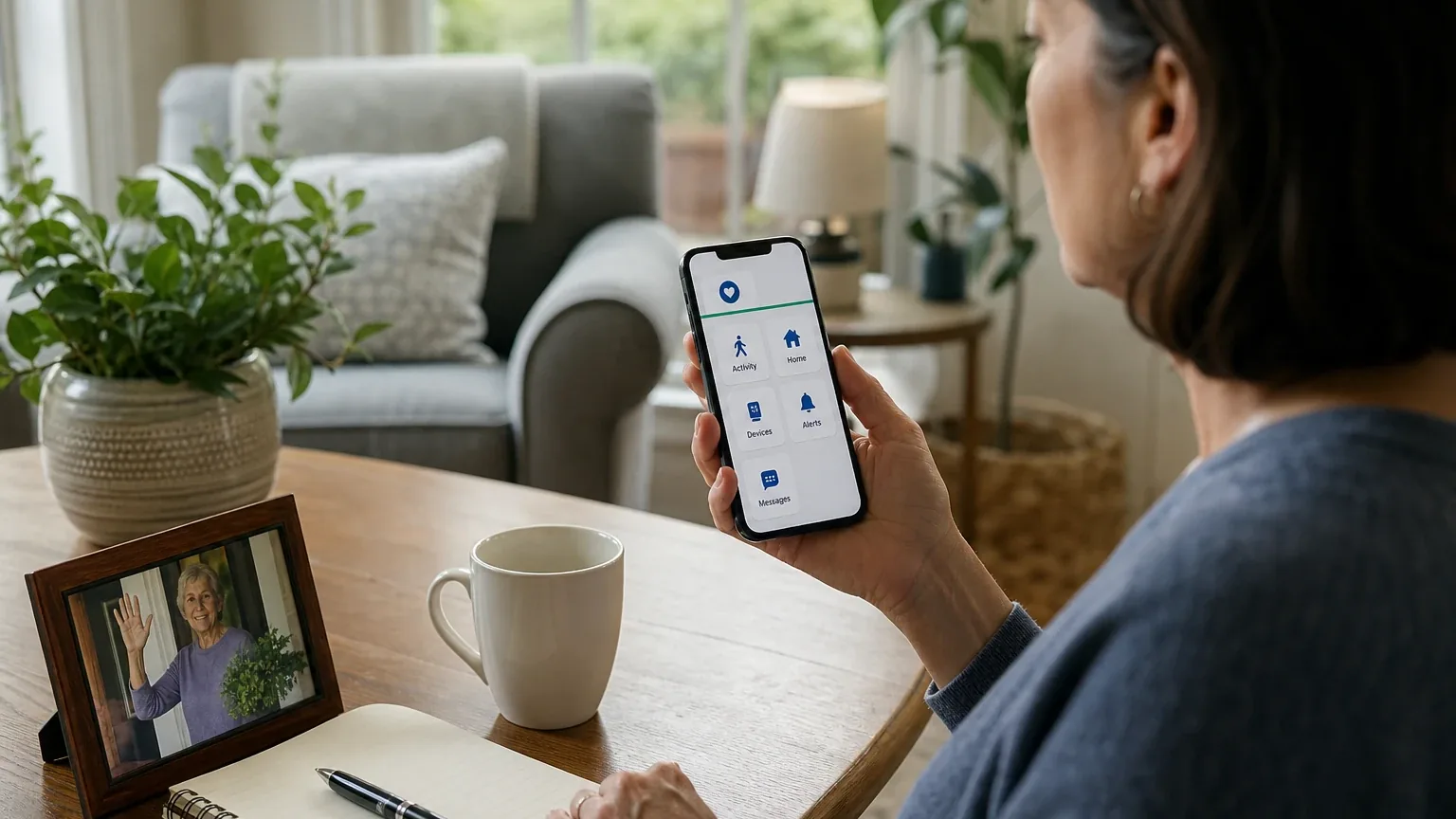
The caregiver app is the connective layer across plans. Aloe Care describes a secure app for caregiver teams with unlimited users, and independent reviews describe remote viewing of motion activity, indoor temperature, air quality, alerts, and check-in history [13]. Aloe Care recommends approximately five Care Circle members for optimal use while stating no hard limit [2].
What the AI Platforms Agreed About
Questions This Section Answers
- What do the AI platforms in this study agree Aloe Care Health (Voice-Activated Medical Alert + Home Monitoring) does well for Remote Caregiver Visibility & Alerts?
- Is multi-user caregiver app access a genuine strength of Aloe Care Health (Voice-Activated Medical Alert + Home Monitoring) for remote family coordination?
The clearest cross-platform agreement is that multi-user caregiver app access is Aloe Care's strongest documented capability for this use case. OpenAI, Anthropic, Perplexity, Grok, Google, DeepSeek, and Kimi all describe a caregiver app supporting multiple or unlimited users with shared alerts, status information, and check-in calls [14]. One independent review calls multi-user app access the strongest documented capability [1].
Platforms also broadly agree on the in-home sensing layer: the Smart Hub provides motion, temperature, and air-quality signals without requiring home Wi-Fi, using 4G connectivity [14]. Remote status checks and app-to-hub two-way calling are described consistently across OpenAI, Anthropic, Perplexity, and Google [14].
Professional monitoring is described as 24/7/365 with a response center Aloe Care calls "Five Diamond" [8]. Independent reviews repeat the Five Diamond certification claim, but no platform located independently verified response-time, uptime, or dispatch-outcome metrics [1].
Platforms agree that fall detection is explicitly not guaranteed to detect all falls, a disclaimer that appears in company materials and independent reviews alike [8].
Where the AI Platforms Disagreed or Were Uncertain
Questions This Section Answers
- Do the AI platforms agree on how customizable Aloe Care Health (Voice-Activated Medical Alert + Home Monitoring) alerts and caregiver permissions are for Remote Caregiver Visibility & Alerts?
- Is Aloe Care Health (Voice-Activated Medical Alert + Home Monitoring) a mixed or strong fit for Remote Caregiver Visibility & Alerts depending on which platform you ask?
Fit ratings diverged: Google and Grok rated Aloe Care a "strong" fit, OpenAI, Anthropic, Perplexity, and DeepSeek rated it "good," and Kimi rated it "mixed" [8]. Kimi's lower rating centered on voice-activation reliability at distance, hidden sensor add-ons, and the requirement to buy mobile hardware for fall detection [21].
Alert customization granularity is unresolved. OpenAI and Anthropic both state that reviewed materials do not clearly specify per-caregiver alert types, escalation order controls, notification channels, or role-based permissions [14]. DeepSeek describes adjustable voice-activation sensitivity and a configurable number of "Emergency" utterances, while Kimi reports that a "call my caregiver" button previously sent a push notification rather than placing a call before being updated [21]. These are not direct contradictions but different levels of documented detail.
Camera support is uncertain. No platform located verified camera integration, and OpenAI and Anthropic both state camera capability should not be assumed from published Essentials Plus materials [14]. DeepSeek reported that Aloe Care advertises sensor and camera add-ons but does not enumerate a compatibility list [21].
Pricing details conflict at the margins. Current official pages list Essentials at $39.99/month plus $199.99 hardware, Mobile Companion 2 at $44.99/month plus $149.99 hardware, and Essentials Plus at $59.99/month plus $349.99 hardware [13]. Some third-party sources show lower promotional prices, and one review lists Essentials Plus hardware at $349.95 rather than $349.99 [21]. The ranking-stage range of $45–$60/month is consistent with Mobile Companion 2 and Essentials Plus but sits above the Essentials monthly fee.
Cancellation terms conflict between company pages. Product pages state "Cancel Anytime," while the Terms of Service describe month-to-month terms with 30 days' written notice and conditional refunds for annual subscriptions [12]. One independent review states there is no cancellation penalty, which may conflict with the written terms for annual plans [21].
Use-Case-Specific Features and Capabilities
Questions This Section Answers
- Does Aloe Care Health (Voice-Activated Medical Alert + Home Monitoring) provide camera or video verification for Remote Caregiver Visibility & Alerts?
- How does the Aloe Care Health (Voice-Activated Medical Alert + Home Monitoring) Care Circle app support multiple family caregivers monitoring an aging parent?
Multi-user app access is the strongest documented capability. The caregiver app supports a Care Circle with unlimited users, invitations, alerts, status information, and check-in calls, with Aloe Care recommending approximately five people for optimal use [1]. Google describes the Family App as allowing unlimited circle-of-care members to receive real-time updates, log check-in notes, and monitor activity patterns [8].
Remote status checks work through the app. Caregivers can view recent motion activity, indoor temperature, air quality, alerts, and check-in history, and the Smart Hub supports hands-free two-way calling directly from the caregiver app [1].
In-home sensing covers motion, temperature, and air quality through the Smart Hub, without requiring home Wi-Fi [14]. Public materials do not establish that every alert is configurable at a granular per-caregiver or per-sensor level [14].
Mobile visibility comes through Mobile Companion 2: GPS-based location detection, nationwide location updates as advertised, Live Locator for emergencies, lost-device finding, and adjustable fall-detection sensitivity [15]. Fall detection is not guaranteed to detect all falls [8].
Voice activation and a wearable button provide hands-free emergency access. If the resident cannot press the Care Button, repeatedly saying "emergency" connects to an emergency response professional and alerts caregivers [22]. One independent test found voice activation failed to detect commands from an adjacent room in two of three attempts, though sensitivity is now adjustable [21].
Camera and security-sensor integration is a documented gap. Reviewed public materials describe motion, temperature, air-quality, voice, and location capabilities but do not document camera support, video monitoring, door/window sensors, intrusion detection, or broad third-party security-system integration [14]. A camera-centered caregiver platform is the better choice when visual verification or two-way video is essential [1].
Emergency routing connects the resident to a professional response team and, depending on the product and interaction, to programmed caregivers or family [8]. Public materials do not fully specify escalation order, dispatch protocols, false-alarm handling, or geographic exceptions [14].
Setup is advertised as plug-and-play and self-installable, with battery backup and no Wi-Fi requirement [14]. Perplexity notes that white-glove installation or in-home setup support is not clearly documented for all plans [17].
Pricing, Fees, Contracts, and Ongoing Costs
Questions This Section Answers
- What does Aloe Care Health (Voice-Activated Medical Alert + Home Monitoring) cost per month and upfront for the Essentials Plus plan used in Remote Caregiver Visibility & Alerts?
- Is Aloe Care Health (Voice-Activated Medical Alert + Home Monitoring) worth the higher upfront hardware cost compared with lower-cost alert options for Remote Caregiver Visibility & Alerts?
Published official pricing is $39.99/month plus $199.99 hardware for Essentials, $44.99/month plus $149.99 hardware for Mobile Companion 2, and $59.99/month plus $349.99 hardware for Essentials Plus [13]. Shipping is shown as free on reviewed checkout pages, and one review states shipping and device activation are included at no charge [13].
| Plan | Monthly fee | One-time hardware | Coverage |
|---|---|---|---|
| Essentials | $39.99 | $199.99 | In-home Smart Hub + Care Button |
| Mobile Companion 2 | $44.99 | $149.99 | Mobile 4G device with fall detection |
| Essentials Plus | $59.99 | $349.99 | In-home hub + Mobile Companion 2 |
Independent reviews describe the upfront prices as higher than most medical alert systems on the market [22]. Kimi estimates a first-year total of roughly $680–$1,070 depending on plan, and reports optional add-ons including a wall fall sensor at $99.99 plus $10/month and entry or motion sensor two-packs at $49.99, available only by phone inquiry [21]. Those add-on prices are platform-reported and not confirmed on current official product pages.
Contract terms are mixed. Product pages state "Cancel Anytime," and one review reports no minimum commitment or cancellation penalty [12]. The Terms of Service describe a month-to-month term unless a different term is agreed, 30 days' written notice for termination, a full refund for annual subscriptions canceled within the first month, a pro-rated refund within the first five months, and no refund after six months [11]. A 30-day money-back guarantee is advertised, but eligibility, return condition, and timing should be confirmed before purchase [12].
Additional fees are inconsistently documented. One review states there are no hidden cancellation, restocking, or activation fees [21]. DeepSeek and Kimi report a 1.5% monthly finance charge plus a 5% administrative late fee, and note the monthly rate may increase unless a full year is prepaid [21]. The Terms of Service confirm the finance and late charges and state the monitoring fee may be prepaid for up to 12 months to hold the rate [12]. The reviewed pages do not establish replacement-device, battery, damage, or expedited-support fees [13].
Best Suited For
Questions This Section Answers
- Is Aloe Care Health (Voice-Activated Medical Alert + Home Monitoring) a good choice for a dispersed family caregiving team that needs shared alerts for a parent living independently?
- Which caregivers get the most value from the Aloe Care Health (Voice-Activated Medical Alert + Home Monitoring) Care Circle app for Remote Caregiver Visibility & Alerts?
Aloe Care Health is best suited to multi-caregiver households — adult children, paid caregivers, and neighbors — that need shared app access and coordinated check-ins for a parent living independently [1]. Dispersed family caregivers who want real-time motion, temperature, and air-quality alerts without visual monitoring are a strong match [4].
Families prioritizing passive in-home sensors over video-based surveillance fit well, since the system delivers environmental and motion signals without cameras [1]. Households without dependable Wi-Fi also benefit because Essentials is advertised with 4G connectivity and no Wi-Fi requirement [14].
Caregivers seeking integrated voice activation, optional fall detection, and professional emergency routing in one plan are a reasonable fit, provided they accept that fall detection is not guaranteed [24]. One review describes Aloe Care as the right choice for tech-forward seniors and family caregivers who need real-time visibility into safety, activity, and home environment [4].
Probably Not Best Suited For
Questions This Section Answers
- Is Aloe Care Health (Voice-Activated Medical Alert + Home Monitoring) a poor choice for a caregiver who needs camera-based visual verification for Remote Caregiver Visibility & Alerts?
- Should a cost-sensitive family avoid Aloe Care Health (Voice-Activated Medical Alert + Home Monitoring) for Remote Caregiver Visibility & Alerts because of its hardware fees?
Buyers requiring cameras, video verification, door/window security, intrusion alarms, or extensive third-party smart-home integration should look elsewhere; public materials do not document those capabilities [14]. Caregivers needing visual confirmation of a fall or activity will not get it from this system [1].
Cost-sensitive buyers face higher upfront hardware fees than many competitors, with equipment ranging from $149.99 to $349.99 and monthly fees from $39.99 to $59.99 [22]. Families that can manage alerts directly and do not need a 24/7 professional response center may prefer a lower-cost unmonitored device [14].
Caregivers who need independently verified monitoring-center performance metrics or guaranteed fall detection will not find them here [1]. Households in areas with poor cellular coverage are also a poor fit, since the system depends on 4G LTE and the Care Button works within roughly 200 feet of the Smart Hub [19].
When Another Option May Be Better
Questions This Section Answers
- When is a camera-based system a better choice than Aloe Care Health (Voice-Activated Medical Alert + Home Monitoring) for Remote Caregiver Visibility & Alerts?
- When is a lower-cost medical alert option better than Aloe Care Health (Voice-Activated Medical Alert + Home Monitoring) for Remote Caregiver Visibility & Alerts?
Choose a camera-and-sensor home-security platform when video verification, door/window sensors, intrusion alerts, or third-party smart-home integration are primary requirements [14]. Camera-centered caregiver platforms are the better fit when visual verification, room-specific video, or two-way video is essential [1].
Choose a different medical-alert provider when independently published response-time metrics, stronger fall-detection evidence, or clearer caregiver permission controls are mandatory [1]. Choose a lower-cost unmonitored device when the family can manage alerts directly and does not need a 24/7 professional response center [14].
A simpler at-home-only system with a wearable fall-detection pendant may suffice when the senior spends little time outside the home, avoiding the cost of Mobile Companion 2 [21]. Buyers in areas with poor AT&T 4G LTE coverage should consider a provider with different network dependencies [7].
Questions to Verify Before Buying
Questions This Section Answers
- What should a buyer confirm with Aloe Care Health (Voice-Activated Medical Alert + Home Monitoring) about alert routing and caregiver permissions before signing up for Remote Caregiver Visibility & Alerts?
- What should a buyer confirm about cancellation terms and refunds before committing to Aloe Care Health (Voice-Activated Medical Alert + Home Monitoring) for Remote Caregiver Visibility & Alerts?
Confirm exactly which alerts can be enabled, muted, scheduled, or routed separately to primary caregivers versus all caregivers, and whether caregiver roles can be restricted so some users can view status but not change settings or contact the resident [14]. Ask what the escalation sequence is from device alert to caregiver notification to professional response to emergency services, and what happens during cellular or power failure [14].
Verify cellular-network coverage at the parent's address and along expected travel routes, and confirm whether Mobile Companion 2 is currently available for direct purchase at the stated prices [14]. Ask whether Essentials provides historical motion, temperature, and air-quality data and for how long it is retained [14].
Request written clarification on cancellation and refund terms, since the website and Terms of Service contain conflicting language on the 30-day notice requirement and annual-plan refund eligibility [12]. Ask about the 30-day guarantee's return conditions, restocking rules, refund timing, and any post-cancellation charges [12].
Confirm current data-sharing, recording, deletion, export, and caregiver-access controls for voice, location, health, and environmental data, since the privacy policy is dated July 3, 2020 and may not reflect current practices [10]. Ask whether the optional wall fall sensor, entry sensors, and motion sensors are still available and at what cost [21].
Final AI Consensus Verdict
Aloe Care Health (Voice-Activated Medical Alert + Home Monitoring) earns a good fit for Remote Caregiver Visibility & Alerts when a family wants a shared caregiver app, remote two-way check-ins, in-home environmental and motion sensing, mobile emergency coverage, and professional response escalation [1]. The strongest reason to consider it is the combination of unlimited Care Circle app access with the Essentials Plus bundle's in-home Smart Hub and Mobile Companion 2 [1].
The system delivers genuine strengths in multi-user caregiver coordination, passive environmental monitoring, voice-activated emergency access, and professional response infrastructure [14]. Material limitations remain: no camera-based monitoring, unresolved alert-customization granularity, high equipment costs, and conflicting cancellation terms [1].
It is most defensible for dispersed multi-caregiver households seeking integrated passive in-home sensing and shared app visibility, and less suitable for buyers requiring visual surveillance, tight alert routing controls, or budget-conscious implementations [1]. Families should verify alert customization options, cancellation policies, and fall-detection reliability before committing to the higher equipment and monthly investment [14]. For the broader field, see the Remote Caregiver Visibility & Alerts consensus index.
How This Review Was Produced
This review was produced from a ranking-stage study of seven AI platforms, each asked to evaluate fit for Remote Caregiver Visibility & Alerts for family caregivers of an aging parent living independently. The research date is 2026-11-10. Platform-reported dates are provenance metadata and do not independently prove freshness.
Two of the seven platforms named Aloe Care Health during ranking discovery, at ranks 7 and 8, meeting the study's two-mention minimum. All seven platforms supplied fit-research responses, which were used to describe agreement, disagreement, and uncertainty. Fit ratings are platform-reported judgments, not independently verified performance findings.
Citations are platform-reported evidence, not independently verified facts. The supplied URLs were collected from platform responses and were not independently validated by the writer stage. One or more official-site retrievals failed during normalization; no failed fetch was used as a verified domain key, and identity and current product availability should be verified directly before purchase. Company-name variants were collapsed onto one canonical brand before minimum-mention qualification.
Company-owned sources (Aloe Care product pages, Terms of Service, and privacy policy) were distinguished from independent reviews throughout. Where a platform supplied no citation for a factual claim, the claim is labeled platform-reported or unverified rather than presented as independently established.
Methodology Limitations
Platform agreement does not prove product quality. The two platforms that named Aloe Care in ranking represent 28.6% of included platform responses, and the remaining five evaluated fit without surfacing it in ranking, so the ranking signal is thin.
Several material facts could not be resolved from the supplied evidence. No platform located independently verified monitoring-center response-time, uptime, dispatch-outcome, or false-alarm-rate data [1]. Camera support could not be confirmed from checked sources [14]. Alert customization granularity and per-caregiver permission controls are not clearly documented [1].
Pricing conflicts persist across official pages, promotional pages, and third-party reviews, and current checkout pricing should control [13]. Cancellation terms conflict between product pages and the Terms of Service [12]. The privacy policy is dated July 3, 2020 and may not fully reflect current data practices [10].
Fall detection is explicitly not guaranteed to detect all falls, and cellular coverage, GPS availability, device charging, and resident compliance can affect alerts and visibility [15]. No personal testing, customer experience, medical benefit, or guaranteed performance is claimed in this review. For category context, see the home safety directory.
Sources
Company-Owned Sources
- Aloe Care Health Support - Mobile Companion 2 Overview: https://support.aloecare.com
- Aloe Care Health official website: https://www.aloecare.com/
- Privacy Policy: https://www.aloecare.com/legal/privacy-policy
- Privacy Policy | Aloe Care Health: https://www.aloecare.com/legal/privacy-policy?_content_only=1
- Terms of Service: https://www.aloecare.com/legal/terms-of-service
- Terms of Service | Aloe Care Health: https://www.aloecare.com/legal/terms-of-service?_content_only=1
- Products | Aloe Care Health: https://www.aloecare.com/products
- Essentials | Aloe Care Health: https://www.aloecare.com/products/essentials
- Mobile Companion 2 | Aloe Care Health: https://www.aloecare.com/products/mobile-companion-2
- Official pricing and terms source: https://www.aloecare.com#ach-plans
Independent Sources
- Aloe Care Health Review for Caregivers: https://aginginplaceindex.com/home-safety/remote-caregiver-visibility-alerts/aloe-care-health
- Aloe Care Health Reviews: https://bestcompany.com/medical-alert-systems/aloe-care-health
- Aloe Care Health Review 2026: Smart Medical Alert for Seniors | BestGuide: https://bestguide.com/review/aloe-care-health/
- Aloe Care Medical Alert Review: Is It Worth Buying?: https://millennialhawk.com/aloe-care-medical-alert-review/
- Aloe Care Health: Elder Safety - Apps on Google Play: https://play.google.com/store/apps/details?id=com.htec.aloecare&hl=en_US
- Aloe Care Health Review and Prices: https://realestate.usnews.com/home-services/medical-alert-system/aloe-care-health
- Aloe Care Health Medical Alert System Review 2026: https://www.caring.com/best-medical-alert-systems/aloe-care-health-review/
- Aloe Care Health Medical Alert System Review 2026 - Caring.com: https://www.caring.com/senior-products/best-medical-alert-systems/aloe-care-health
- Aloe Care Essentials Plus Review: Tried And Tested: https://www.forbes.com/health/healthy-aging/aloe-care-health-review/
- The Best Medical Alert Systems in 2026: https://www.ncoa.org/product-resources/medical-alert-systems/best-medical-alert-systems/
- The Best Medical Alert Systems We've Tested for 2026: https://www.pcmag.com/picks/the-best-medical-alert-systems
- Aloe Care Health │ Hands-On Expert Review: https://www.safewise.com/senior-safety/medical-alerts/aloe-care-health/
- Aloe Care Health Medical Alert System Review 2026: https://www.seniorliving.org/medical-alert-systems/aloe-care-health/reviews/
- Aloe Care Health Review (2026) - Details, Pricing & Features: https://www.top10.com/medical-alerts/reviews/aloe-care-health
- Aloe Care Health Medical Alert System Review 2026: https://www.usnews.com/360-reviews/services/medical-alert-system/aloe-care-health
Verify This Research
Review the study details behind this page or download the public machine-readable verification record.
- Study date
- November 10, 2026
- Platforms analyzed
- 7
- Source records
- 26
- Ranking mentions
- 2 of 7
- Platform share
- 29%
- Final consensus rank
- #10
Research trail and source mix
Configured platforms
openai, anthropic, deepseek, grok, perplexity, kimi, google
Source mix
15 independent · 11 company-owned
Evidence support
12 direct · 3 partial
Important limitation
Use the run research_date as the study date. Platform-reported dates are provenance metadata and do not independently prove freshness.
Source snapshot SHA-256 7f258e5cdba87d1d4a9c240f203c328b9f6b8f541d0544eb9430b1105d533193