
Answer Capsule
Medical Guardian is a good, but not unequivocally strong, fit for Caregiver App & Family Alerts. All seven included platforms named Medical Guardian during the ranking stage, and it finished first overall with an average listed rank of 2.0. The strongest reason to consider it is the combination of 24/7 monitored emergency response with MyGuardian portal/app caregiver access, an ordered emergency call chain, and optional OnGuard Alerts text/email notifications. The main limitation is that key caregiver features depend on paid add-ons, continuous live location and granular per-caregiver permissions are not clearly documented, and public pricing is inconsistent across sources.
Research Snapshot
| Field | Finding |
|---|---|
| Platform mentions in ranking stage | 7 of 7 included platforms (anthropic, deepseek, google, grok, kimi, openai, perplexity) |
| Share of included platform responses | 100% |
| Average listed rank | 2.0 |
| Best listed rank | 1 (anthropic, google, kimi) |
| Relevant product/model/plan | MGMini or MGMove paired with the MyGuardian portal/app, Care Circle, and optional OnGuard Alerts |
| Overall use-case fit | Good (google rated it "strong"; kimi rated it "uncertain"; the other five platforms rated it "good") |
| Research date | 2026-09-27 |
What Changed Since August 2026
Medical Guardian remained at No. 1, and platform mentions increased from 6 to 7. The September 2026 review keeps Medical Guardian as a good, not unequivocally strong, fit, but restates the evidence more cautiously than the August review. The buyer-facing substance shifts mainly in emphasis: the earlier claim that no long-term contract applies is now framed as a conflict, since current legal terms and support materials state a 90-day minimum commitment. Pricing is less consolidated: MGHome Landline at $31.95/month is newly reported, while the earlier $27.95-$46.95 per month range is no longer repeated. The estimated 8-23 second emergency response time is also no longer repeated. Recommended configuration and overall buyer fit are unchanged. Differences between the two editions reflect what each article reports; they do not by themselves prove that the product, service, or price changed.
The August 2026 review preserves the earlier article for reference.
Why Medical Guardian Qualified for This Study
Questions This Section Answers
- Why did Medical Guardian qualify for this caregiver app and family alerts study?
- How many AI platforms named Medical Guardian in the ranking stage for caregiver apps?
Medical Guardian qualified because it was named by every included platform during ranking discovery, not because any platform verified product quality. All seven platforms — anthropic, deepseek, google, grok, kimi, openai, and perplexity — listed Medical Guardian among the systems considered for this use case, giving it a 100% mention share and an average listed rank of 2.0. Three platforms (anthropic, google, kimi) placed it first; grok and deepseek placed it second; perplexity placed it third; openai placed it fourth.
The qualification threshold for this study was at least two platform mentions. Medical Guardian cleared that threshold by a wide margin. Its inclusion reflects repeated association with caregiver-app terminology across platforms — MyGuardian, MyMedicalGuardian, Care Circle, Family Guardian, and OnGuard Alerts all appeared in platform responses [1].
That breadth of naming is also the study's first caution. Platforms used several different names for what may be the same or different app and add-on combinations, and the public materials do not clearly establish whether every listed caregiver feature applies identically across Guardian Flex, MGMove, MGMini, MGMobile 2.0, and older systems [4]. Qualification here means "repeatedly surfaced as relevant," not "independently validated."
The Product, Model, Plan, or Service Most Relevant to Caregiver App & Family Alerts
Questions This Section Answers
- Which Medical Guardian device and app combination is most relevant for caregiver app and family alerts?
- Is the MyGuardian app included with Medical Guardian devices, or does it cost extra?
The most relevant configuration is an MGMini or MGMove device paired with the MyGuardian portal/app, the Care Circle multi-contact feature, and the optional OnGuard Alerts add-on. Platforms converged on this combination even when they used different names for the pieces.
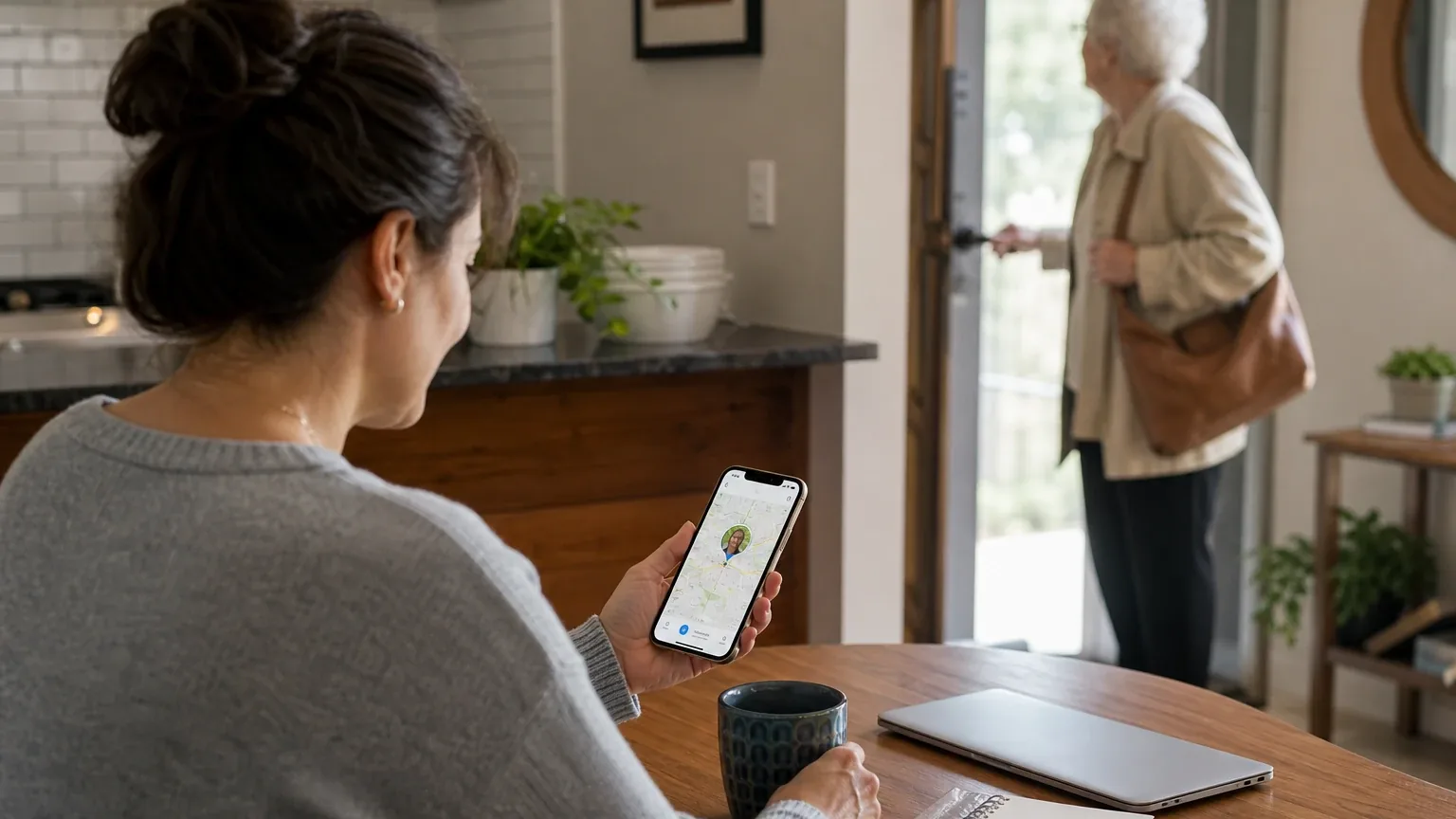
MyGuardian is described as both a web portal and a mobile app, available on iOS and Android, with a desktop alternative [5]. Caregivers can switch between linked member accounts, view device status, battery, alert history, activity, reminders, and last-seen location, and invite or remove portal users [8]. The account owner controls portal membership and call-chain changes [8].
Care Circle is the multi-contact layer. Platform responses describe it as allowing multiple trusted contacts to receive notifications and coordinate, with contacts reachable by phone, email, or SMS [10]. OnGuard Alerts is the documented path to real-time text and email notifications to the buyer and Care Circle during an emergency, listed at $2.99 per month on MGMini support pages [11].
One naming conflict matters for buyers: public pages use MyGuardian, MyMedicalGuardian, Family Guardian, and OnGuard Alerts, and the exact app and add-on combination may vary by device, purchase date, or account migration [8]. Perplexity reported that public sources checked did not clearly confirm whether the MyGuardian app is included with every system or only selected ones [5].
What the AI Platforms Agreed About
Questions This Section Answers
- What do AI platforms agree Medical Guardian does well for family caregivers?
- Does Medical Guardian provide emergency notifications to family members as well as a monitoring center?
Agreement was strong, though not unanimous, on four points: caregiver portal access, multi-contact escalation, monitored emergency response, and the existence of a paid path to real-time family notifications.
On caregiver access, platforms consistently described a portal or app that shows device status, battery, connectivity, alert history, activity, reminders, and location information [13]. Google characterized the app as a centralized dashboard with intuitive navigation (google:cit_safehome, google:cit_seniorlist).
On escalation, platforms agreed that Medical Guardian supports an ordered emergency call chain and lets the account owner configure whether contacts are called before or after emergency dispatch [13]. This is the feature that most directly serves families coordinating several contacts.
On the response model, platforms agreed the relevant systems connect the wearer to 24/7 monitored emergency operators after an SOS activation or supported automatic alert — a monitored medical-alert service rather than a standalone family-alert app [17].
On notifications, platforms agreed that real-time family text/email alerts exist but sit behind an add-on. OnGuard Alerts is documented as sending real-time text and email notifications to the buyer and Care Circle during an emergency [19]. Perplexity separately cited a company FAQ stating that Family Guardian sends emergency notifications to loved ones by email or smartphone when an emergency call reaches the monitoring center [21].
Where the AI Platforms Disagreed or Were Uncertain
Questions This Section Answers
- Where do AI platforms disagree about Medical Guardian's caregiver app features?
- Is Medical Guardian's caregiver app reliable according to independent reviews?
Disagreement clustered around app reliability, location tracking, pricing, and contract terms. These are the areas where a buyer should treat platform summaries as leads to verify, not conclusions.
App reliability. Grok reported mixed evidence: positive tester notes on interface and location features alongside poor App Store and Google Play ratings with complaints about errors and inaccurate data [22]. Anthropic cited app store ratings of roughly 2.3–2.4 stars on Android across 107–111 reviews, with complaints focused on location accuracy and Wi-Fi requirements [23]. Google, by contrast, described the app positively (google:cit_safehome). These are not reconcilable from the supplied evidence.
Location tracking. Anthropic reported that user reviews from February and May 2025 said the app "does NOT work with mobile data" and requires Wi-Fi, with poor accuracy in rural areas [23]. OpenAI reported that standard portal location is described as hourly for mobile devices, with real-time location provided when the SOS button is pressed [24]. Google stated caregivers can view real-time location and tracking history for GPS-enabled mobile devices (google:cit_seniorlist). Perplexity reported that detailed public confirmation of caregiver-facing live location-sharing controls was not clearly verified [25].
Pricing. Google reported high pricing confidence with a full list: MGHome Landline $31.95/month, MGHome Cellular $38.95/month, Guardian Flex $44.95/month, MGMove $42.95–$49.95/month, equipment $149.95–$199.95, OnGuard Alerts $2.99/month, Support Circle/CareCircle $5.00/month, fall detection $10.00/month (google:cit_seniorliving, google:cit_aarp). OpenAI reported Guardian Flex starting at $39.95/month and MGMove as low as $44.95/month [27]. Grok reported monitoring of $27.95–$46.95/month plus equipment of roughly $149.95–$199.95 [28]. Perplexity reported MGMove around $44.95/month on the company page but $39.95–$49.95/month in independent reviews, plus a caregiver add-on around $5/month [25]. Anthropic and deepseek both reported low pricing confidence and could not locate transparent pricing [30].
Contract terms. OpenAI flagged a direct conflict: Medical Guardian markets no long-term contract and no cancellation fee, while current legal terms and support materials state a three-month or 90-day minimum service commitment [32]. Google independently reported the same 3-month minimum alongside "no long-term contracts" (google:cit_seniorliving). Anthropic reported that no contract terms or cancellation policy details were found in its 2025 documentation [30]. Deepseek reported cancellation policy details as not publicly disclosed [31].
Kimi's outlier position. Kimi rated Medical Guardian "uncertain" and reported that its search results returned extensive information about Connected Caregiver (myconnectedcaregiver.com) rather than Medical Guardian, so it could not verify MyGuardian app functionality, Care Circle permissions, or pricing from its sources (kimi:ranking-stage-unverified, kimi:myconnectedcaregiver-app). This is a research-coverage failure, not evidence that the features do not exist, and it should be read as a gap rather than a contradiction.
Use-Case-Specific Features and Capabilities
Questions This Section Answers
- Does Medical Guardian's caregiver app support real-time location sharing and geofencing?
- How many caregivers can Medical Guardian's Care Circle support, and what permissions can they have?
Medical Guardian covers the core caregiver-app requirements unevenly: strong on portal access, escalation, and device-status visibility; weaker and less documented on continuous location, granular permissions, and privacy controls.
Caregiver app usability. MyGuardian is available as a web portal and mobile app on iOS 14.0+ and Android, with a desktop alternative [33]. The dashboard shows device status, battery level, cellular signal, location summary, activity log, and navigation to managed-care features [36]. Caregivers can switch between linked member accounts [37].
Real-time push alerts. OnGuard Alerts sends real-time text and email notifications to the buyer and Care Circle during an emergency [38]. Anthropic reported that non-emergency alerts such as low battery and lost signal are delivered via push notification, but that user reviews indicate the app does not provide real-time location updates during normal monitoring — only historical hourly-pinged data [39]. Deepseek reported that independent testing of alert latency and reliability is not publicly available [41].
Location sharing. OpenAI reported that MyGuardian provides historical or last-seen GPS/Wi-Fi location for mobile devices, with hourly updates described on the MGMove product page, and real-time location during an SOS event [42]. Continuous live location, geofencing, and configurable location-sharing schedules are not clearly documented [42]. Anthropic's user-review evidence points the same direction [40].
Emergency escalation. The portal supports an ordered emergency call chain and lets the account owner configure whether contacts are called before or after emergency dispatch [37]. Contacts receive emergency alerts via phone, email, or SMS [43]. Public documentation does not establish that every portal user can independently edit the chain [37].
Multi-contact permissions. Anthropic reported that MyGuardian supports Account Owner and User roles, with Account Owners holding full access to billing, portal members, and administrative functions, and Users holding limited access to messaging, device info, and care activities [36]. OpenAI reported that the account owner controls portal membership and call-chain changes, and that public materials do not clearly specify granular per-caregiver permissions or caregiver-specific location restrictions [37]. Google reported that members can authorize or revoke caregiver access at any time through the app (google:cit_legal).
Privacy controls. This is the weakest-documented area. Anthropic reported that the app store privacy policy states "data isn't encrypted" with a note that data "can't be deleted," while the scope — in transit, at rest, or both — is unclear [34]. Deepseek reported that Medical Guardian states it protects personal information but that specific privacy controls are not publicly detailed [44]. OpenAI reported that the retention and deletion schedule for location and alert data is not clearly specified [37].
Device suitability. MGMove includes cellular connectivity, SOS calling, portal/app access, location information, and optional family communication features, but requires regular charging. The product page describes up to 24 hours of battery life, while support documentation recommends daily charging and states a full charge takes about four hours [42]. Fall detection is optional and Medical Guardian states that no fall-detection technology works 100% of the time [38].
Pricing, Fees, Contracts, and Ongoing Costs
Questions This Section Answers
- How much does Medical Guardian cost per month for a caregiver app setup, and what add-ons cost extra?
- Does Medical Guardian require a contract or charge a cancellation fee for caregiver alert service?
Public pricing is device- and feature-dependent, and the supplied sources do not agree on a single complete price list. Buyers should treat every figure below as platform-reported and confirm it directly.
| Item | Reported cost | Source |
|---|---|---|
| Guardian Flex monitoring | Starting at $39.95/month | [47] |
| Guardian Flex monitoring | $44.95/month | (google:cit_seniorliving) |
| MGMove monitoring | As low as $44.95/month | [48] |
| MGMove monitoring | $42.95–$49.95/month | (google:cit_seniorliving) |
| MGMove monitoring | $39.95–$49.95/month depending on billing cycle | [49] |
| Monitoring range across devices | $27.95–$46.95/month | [50] |
| MGHome Landline / Cellular | $31.95 / $38.95 per month | (google:cit_seniorliving) |
| OnGuard Alerts | $2.99/month | [51] |
| Care Circle / Support Circle | $5.00/month | (google:cit_aarp) |
| Care/Social Circle | $2.99–$5/month depending on source | [50] |
| Fall detection | $10.00/month | [51] |
| MG Protection Plan | $6.99/month | [51] |
| Equipment (Flex/Home) | $149.95 one-time | (google:cit_seniorliving) |
| Equipment (MGMove) | $199.95 one-time | [50] |
Additional fees. A leased device and accessories not returned within 30 days after cancellation may incur a $350 non-return charge, and a restocking fee of up to $50 may apply to certain prepaid-plan refunds or returns [53]. Deepseek reported activation or setup fees and shipping charges as unclear [54]. Google reported restocking fees for returned leased equipment may apply (google:cit_seniorliving).
Contract and cancellation terms. This is the sharpest documented conflict in the study. Medical Guardian markets no long-term contract and no cancellation fee, but current legal terms and support materials state a three-month or 90-day minimum service commitment [53]. Google independently reported the same 3-month minimum (google:cit_seniorliving). Recurring plans automatically renew monthly, quarterly, or annually until cancelled; cancellation generally requires contacting Medical Guardian, leased equipment must be returned, and billing may continue until the device is received and processed [53]. Unused prepaid service may be refunded on a prorated basis after the minimum commitment, potentially less applicable fees [53].
Pricing confidence. OpenAI rated pricing confidence moderate, google rated it high, and anthropic, deepseek, perplexity, and kimi all rated it low [47]. Pricing for Social Circle Apps, quarterly billing, annual billing, equipment purchase, shipping, taxes, and device-specific plans may vary or require sales confirmation [48].
Best Suited For
Questions This Section Answers
- Who is Medical Guardian best suited for in the caregiver app and family alerts category?
- Is Medical Guardian worth it for families coordinating multiple emergency contacts?
Medical Guardian is best suited to families who want monitored emergency response and caregiver coordination in one subscription, and who are willing to verify feature availability and pricing before committing.
Platforms converged on these buyer profiles:
- Families coordinating several emergency contacts through an ordered call chain [56].
- Caregivers who want portal/app access to location, battery, connection status, alert history, activity, reminders, and messages [56].
- Mobile users who need GPS location information and 24/7 monitored emergency response [59].
- Buyers willing to add OnGuard Alerts for caregiver text/email notifications [61].
- Urban and suburban caregivers with reliable Wi-Fi infrastructure, per anthropic's assessment [57].
- Multi-account caregivers managing more than one care recipient, since the portal supports account switching [56].
Google rated the fit "strong" and emphasized real-time tracking, collaborative tools, and fast response times (google:cit_seniorlist, google:cit_aarp). The other five platforms that reached a rating called it "good."
Probably Not Best Suited For
Questions This Section Answers
- Who should not choose Medical Guardian for caregiver app and family alerts?
- Is Medical Guardian a poor fit for rural caregivers or buyers who need continuous live location?
Medical Guardian is probably not the best choice for buyers whose primary requirement is continuous live location, granular caregiver permissions, or fully transparent all-in pricing.
Platforms identified these exclusion profiles:
- Buyers seeking a dedicated family-monitoring app with extensive geofencing, continuous live location, or detailed caregiver permission controls [63].
- Caregivers in rural areas with sparse Wi-Fi hotspot coverage who need accurate real-time GPS tracking [64].
- Buyers requiring fully transparent checkout pricing for every device, add-on, and billing cycle before contacting sales [66].
- Families unwilling to manage device charging, cellular coverage, or recurring add-on fees [69].
- Buyers who need a free caregiver app with no subscription [71].
- Families requiring open API integrations with third-party platforms [71].
- Buyers who need verifiable independent clinical validation of alert reliability [71].
- Users needing highly rated, bug-free app experiences per independent user reports [72].
- Seniors who want to avoid high up-front equipment costs (google:cit_seniorliving).
- Caregivers wanting a standard 30-day trial without a minimum commitment (google:cit_seniorliving).
When Another Option May Be Better
Questions This Section Answers
- What is a better alternative to Medical Guardian for a caregiver who needs verified real-time family notifications?
- When should a buyer choose a different medical alert system instead of Medical Guardian for family alerts?
Another option may be better when the buyer's priority is verified real-time notification sequences, free unlimited caregiver contacts, or published month-to-month pricing. Kimi specifically named Connected Caregiver as an alternative, reporting Safety+ at $40–$45/month with a free device, fall detection, GPS, geofencing, first-motion detection, and push/text/email/call notifications, plus free unlimited Care Circle invites and month-to-month flexibility (kimi:myconnectedcaregiver-safety, kimi:myconnectedcaregiver-app). That evidence is company-owned and platform-reported, not independently verified.
Platforms also flagged these switch triggers:
- Continuous real-time GPS tracking required in rural areas without Wi-Fi infrastructure [73].
- Caregivers need frequent location push notifications rather than hourly historical updates [73].
- Transparent, published pricing and cancellation terms required before purchase [73].
- Advanced analytics or predictive health alerts beyond activity reminders are needed [73].
- Privacy encryption and data deletion guarantees are mandatory requirements [73].
- Mobile data-only location tracking without Wi-Fi dependency is essential [73].
- A free caregiver app with no subscription is required [75].
- Open API or smart-home integration is required [75].
- Minimizing add-on fees for alerts is critical [76].
- The buyer wants the lowest-cost plan and does not need app-based caregiver coordination [74].
Questions to Verify Before Buying
Questions This Section Answers
- What should a buyer confirm with Medical Guardian before signing up for caregiver alerts?
- Which Medical Guardian plan includes MyGuardian, Care Circle, and OnGuard Alerts?
The supplied platform responses produced a consistent verification list. Buyers should confirm each item directly with Medical Guardian, because public documentation does not resolve them.
Plan and feature mapping. Which exact device and plan include MyGuardian access, Care Circle, messaging, reminders, and OnGuard Alerts [77]? Does the chosen plan include MyGuardian, Care Circle/Social Circle, or Family Guardian alerts by default or as an add-on [78]? Which service tier is required for messaging, calendar reminders, and Care Circle multi-contact features [79]?
Notification behavior. Does OnGuard Alerts notify every Care Circle member by both text and email, and can each recipient opt in or out independently [80]? Are caregiver notifications sent for low battery, loss of cellular connection, device removal, missed check-ins, or only emergency activations [80]? Are app notifications push alerts, text alerts, email alerts, or all three [82]?
Location accuracy. What is the actual update interval for location outside an SOS event, and is continuous live tracking or geofencing available [83]? Does the MyGuardian app support real-time GPS location tracking on mobile data, or is Wi-Fi connectivity required for all location updates [84]? How does the app perform in rural areas with sparse Wi-Fi coverage [84]?
Permissions and control. How many caregivers can be added, and what permissions can be assigned to each [77]? Who can edit the call chain, emergency contacts, dispatch order, and notification settings [77]? Can multiple care recipients be managed under a single family caregiver account [79]?
Total cost. What are the total monthly, quarterly, and annual costs including the device, monitoring, fall detection, OnGuard Alerts, Social Circle Apps, taxes, shipping, and protection coverage [85]? Are there setup fees, device costs, or activation charges in addition to the monthly subscription [86]?
Contract terms. Does the current order require a 90-day minimum commitment despite marketing language stating no long-term contract [87]? If cancellation occurs within the first three months, will any amount be refunded (google:cit_seniorliving)? What is the return policy for leased equipment, and what non-return or restocking fees apply [87]?
Privacy and data. What data is collected, how long location and alert data are retained, who can access it, and how can caregivers or account owners revoke access [77]? Is the MyGuardian app data encrypted in transit and at rest [88]? Does Medical Guardian share any app usage or health data with third parties [88]?
Failure modes. What happens if the device is outside cellular coverage, loses power, or the wearer cannot operate the SOS button [77]? What is the mobile device requirement — iOS/Android version and phone plan necessity — for each feature set [79]?
Final AI Consensus Verdict
Medical Guardian is a good, but not unequivocally strong, fit for Caregiver App & Family Alerts. All seven included platforms named it during ranking, it finished first overall, and five of seven rated the fit "good," with google rating it "strong" and kimi rating it "uncertain."
The case for Medical Guardian rests on a real combination: monitored 24/7 emergency response, a caregiver portal and app with device status, activity, reminders, messaging, and last-seen location, an ordered emergency call chain that supports multi-contact escalation, and a documented paid path to real-time text/email family notifications through OnGuard Alerts [90].
The case against overstates nothing but is substantial. Key caregiver features depend on add-ons. Continuous live location and geofencing are not clearly documented. Granular per-caregiver permissions and privacy controls are underspecified. Public pricing is inconsistent across sources, with confidence ratings ranging from high to low. And there is a material conflict between no-contract marketing and a stated 90-day minimum commitment [93].
Platform agreement here reflects repeated association and shared source material, not verified product quality. Buyers who need continuous live location, transparent all-in pricing, or granular caregiver permissions should verify those specific points before purchase or evaluate alternatives. Buyers who want monitored emergency response plus caregiver coordination in one subscription, and who will confirm the details, have a reasonable fit. For the broader category picture, see the Caregiver App & Family Alerts consensus index, and for the wider market, the medical alert systems category directory.
How This Review Was Produced
This review evaluates Medical Guardian only for the Caregiver App & Family Alerts use case. It is not a broad company review.
Seven AI platforms were queried for this topic: anthropic, deepseek, google, grok, kimi, openai, and perplexity. Each platform produced a fit assessment, use-case findings, pricing and terms, limitations, and a list of questions to verify before buying. Medical Guardian was named by all seven during ranking discovery and qualified for this report under a minimum-mentions threshold of two.
The study research date is 2026-09-27. Platform-reported research dates differ: anthropic reported 2025-05-16 and deepseek reported 2026-06-01, while google, grok, kimi, openai, and perplexity reported 2026-09-27. Platform-reported dates are provenance metadata and do not independently prove freshness.
All included platforms evaluated fit, but the platform-mentions count reflects only platforms that named Medical Guardian during ranking discovery. Citations in this report are platform-reported evidence, not independently verified facts. Company-owned citations materially outnumber independent citations in the supplied catalog, so company claims should not be read as independently verified. The supplied URLs were collected from platform responses and were not independently validated by the writer stage. No personal testing, customer experience, medical benefit, or guaranteed performance is claimed.
Methodology Limitations
Several limitations constrain how far these findings can be pushed.
Source imbalance. The supplied catalog contains 20 company-owned sources and 14 independent sources. Company-owned pages dominate the feature descriptions, so most capability claims trace back to Medical Guardian's own materials.
Date spread. Anthropic's research is dated 2025-05-16, roughly 16 months before the run date, and deepseek's is dated 2026-06-01. Findings from those platforms may not reflect current products, pricing, or terms.
No-search platform. Deepseek reported search_enabled as false, so its findings are model-reported rather than retrieved. Its claims require explicit verification before being treated as current facts.
Naming inconsistency. Public pages use MyGuardian, MyMedicalGuardian, Family Guardian, and OnGuard Alerts, and the exact app and add-on combination may vary by device, purchase date, or account migration [94]. This review does not resolve those names into a single confirmed product map.
Pricing conflict. Sources disagree on monitoring prices, equipment fees, and add-on costs, and several platforms reported low pricing confidence. No single complete price list was available across all relevant devices, caregiver features, billing cycles, and promotions.
Contract conflict. Marketing language stating no long-term contract conflicts with legal terms and support materials stating a 90-day minimum service commitment [96]. This review reports the conflict rather than resolving it.
Missing independent evidence. Independent evidence on caregiver-app usability, notification latency, false-alert rates, and real-world family outcomes was not identified in the reviewed sources [94]. App store ratings cited by anthropic and grok are user-reported and limited in sample size.
Kimi coverage gap. Kimi's search results returned extensive information about Connected Caregiver rather than Medical Guardian, so kimi could not verify MyGuardian functionality, Care Circle permissions, or pricing (kimi:ranking-stage-unverified). This is a coverage gap, not evidence of absence.
Identity normalization. Company-name variants were collapsed onto one canonical brand before the minimum-mentions qualification step, and official-site retrieval failed for one or more mentions. No failed fetch was used as a verified domain key.
No quality inference. Platform agreement indicates repeated association across model outputs. It does not prove product quality, reliability, or suitability for any specific household.
Sources
Company-Owned Sources
- MyMedicalGuardian App - App Store (iOS: https://apps.apple.com/us/app/mymedicalguardian/id1577560184
- Connected Caregiver App - Family Care Management Tools: https://myconnectedcaregiver.com/connected-app/
- Safety+ Medical Alert - Senior Fall Detection & Emergency Alerts: https://myconnectedcaregiver.com/safety/
- MyMedicalGuardian - Apps on Google Play: https://play.google.com/store/apps/details?id=com.medicalguardian.portal.prod&hl=en
- Medical Guardian - Medical Alert Systems: https://www.medicalguardian.com/
- Medical Alerts for AARP Members: https://www.medicalguardian.com/aarp
- Medical Alert System Pricing: https://www.medicalguardian.com/alert-system-pricing
- Using the Freedom Guardian Companion App: https://www.medicalguardian.com/assets/support/files/products/freedom/digital_app_freedom_guardian_manual.pdf
- Using the MyGuardian Customer Care Portal with the Freedom Guardian: https://www.medicalguardian.com/assets/support/files/products/freedom/digital_freedom_guardian_portal_manual.pdf
- Caregivers: https://www.medicalguardian.com/caregivers
- Medical Emergency Response Device FAQs: https://www.medicalguardian.com/faq
- Legal Information About Medical Guardian Services: https://www.medicalguardian.com/legal
- Legal Information About Medical Guardian Services: https://www.medicalguardian.com/legal/terms
- MGMove Medical Alert Smartwatch: https://www.medicalguardian.com/medical-alert-systems/smart-watch-alert-app
- Medical Guardian Pricing: https://www.medicalguardian.com/pricing
- Medical Guardian Privacy Policy: https://www.medicalguardian.com/privacy-policy
- MGMove Support: https://www.medicalguardian.com/support/mg-move/
- MGMini Lite Gen. 2 Support: https://www.medicalguardian.com/support/mgmini-lite-gen2/
- Your Online Portal: https://www.medicalguardian.com/support/your-online-portal/
- Official pricing and terms source: https://www.medicalguardian.com/mobile-terms-and-conditions
Additional AI research evidence96 records
- AI research evidence record openai:c2
- AI research evidence record anthropic:c2
- AI research evidence record perplexity:c3
- AI research evidence record openai:c5
- AI research evidence record perplexity:c1
- AI research evidence record anthropic:c1
- AI research evidence record anthropic:c3
- AI research evidence record openai:c5
- AI research evidence record anthropic:c2
- AI research evidence record anthropic:c7
- AI research evidence record openai:c3
- AI research evidence record perplexity:c3
- AI research evidence record openai:c5
- AI research evidence record anthropic:c2
- AI research evidence record grok:web:0
- AI research evidence record perplexity:c2
- AI research evidence record openai:c0
- AI research evidence record deepseek:c3
- AI research evidence record openai:c3
- AI research evidence record grok:web:1
- AI research evidence record perplexity:c3
- AI research evidence record grok:web:15
- AI research evidence record anthropic:c6
- AI research evidence record openai:c0
- AI research evidence record perplexity:c1
- AI research evidence record perplexity:c6
- AI research evidence record openai:c6
- AI research evidence record grok:web:10
- AI research evidence record perplexity:c5
- AI research evidence record anthropic:c2
- AI research evidence record deepseek:c4
- AI research evidence record openai:c7
- AI research evidence record anthropic:c1
- AI research evidence record anthropic:c3
- AI research evidence record perplexity:c1
- AI research evidence record anthropic:c2
- AI research evidence record openai:c5
- AI research evidence record openai:c3
- AI research evidence record anthropic:c4
- AI research evidence record anthropic:c6
- AI research evidence record deepseek:c1
- AI research evidence record openai:c0
- AI research evidence record anthropic:c7
- AI research evidence record deepseek:c5
- AI research evidence record openai:c1
- AI research evidence record openai:c7
- AI research evidence record openai:c6
- AI research evidence record openai:c0
- AI research evidence record perplexity:c5
- AI research evidence record grok:web:10
- AI research evidence record openai:c3
- AI research evidence record grok:web:1
- AI research evidence record openai:c7
- AI research evidence record deepseek:c4
- AI research evidence record anthropic:c2
- AI research evidence record openai:c5
- AI research evidence record anthropic:c2
- AI research evidence record grok:web:0
- AI research evidence record openai:c0
- AI research evidence record deepseek:c2
- AI research evidence record openai:c3
- AI research evidence record grok:web:1
- AI research evidence record openai:c5
- AI research evidence record anthropic:c2
- AI research evidence record anthropic:c6
- AI research evidence record openai:c6
- AI research evidence record deepseek:c4
- AI research evidence record perplexity:c5
- AI research evidence record openai:c0
- AI research evidence record openai:c1
- AI research evidence record deepseek:c1
- AI research evidence record grok:web:15
- AI research evidence record anthropic:c2
- AI research evidence record perplexity:c5
- AI research evidence record deepseek:c1
- AI research evidence record grok:web:15
- AI research evidence record openai:c5
- AI research evidence record perplexity:c1
- AI research evidence record anthropic:c2
- AI research evidence record openai:c3
- AI research evidence record anthropic:c4
- AI research evidence record perplexity:c3
- AI research evidence record openai:c0
- AI research evidence record anthropic:c6
- AI research evidence record openai:c6
- AI research evidence record deepseek:c4
- AI research evidence record openai:c7
- AI research evidence record anthropic:c3
- AI research evidence record deepseek:c5
- AI research evidence record openai:c5
- AI research evidence record openai:c3
- AI research evidence record anthropic:c2
- AI research evidence record openai:c7
- AI research evidence record openai:c5
- AI research evidence record perplexity:c3
- AI research evidence record openai:c7
Independent Sources
- MEDICAL GUARDIAN MGMove Ultimate Smartwatch with Built-In Life User Guide: https://manuals.plus/medical-guardian/mgmove-utimate-smartwatch-with-built-in-life-manual
- Medical Guardian Cost: $27.95–$46.95/mo, Checked Sept 2026: https://medicalalertreview.com/medical-guardian-cost
- Connected Caregiver - Apps on Google Play: https://play.google.com/store/apps/details?hl=en&id=com.connectedcaregiver.care
- MyMedicalGuardian - Apps on Google Play: https://play.google.com/store/apps/details?id=com.medicalguardian.portal.prod&hl=en_US
- Medical Guardian Medical Alert System Review 2026 | U.S. News: https://realestate.usnews.com/home-services/medical-alert-system/medical-guardian
- Medical Guardian vs. Medical Alert: Who Wins?: https://www.aarp.org/caregiving/home-care/info-2021/medical-guardian-vs-medical-alert.html
- Medical Guardian Review: Tested: https://www.aarp.org/caregiving/home-care/medical-guardian-review/
- Medical Guardian MGMove Review: https://www.medicalalertadvice.com/medical-guardian-mgmove-review/
- Medical Guardian Costs, Pricing, Packages & Monthly Plans: https://www.safehome.org/medical-alert-systems/medical-guardian/cost/
- Medical Guardian Alert System Review for 2026: https://www.seniorliving.org/medical-alert-systems/medical-guardian/reviews/
- Medical Guardian Cost & Pricing: https://www.seniorliving.org/medical-alerts/medical-guardian/cost/
- Medical Guardian Reviews: Our Hands-On Test (2026: https://www.theseniorlist.com/medical-alert-systems/medical-guardian/reviews/
- Medical Guardian Costs: Our Hands-On Analysis: https://www.theseniorlist.com/medical-alerts/medical-guardian/cost/
- Medical Guardian Review 2025: https://www.top10.com/medical-alert-systems/medical-guardian-review
Additional AI research evidence96 records
- AI research evidence record openai:c2
- AI research evidence record anthropic:c2
- AI research evidence record perplexity:c3
- AI research evidence record openai:c5
- AI research evidence record perplexity:c1
- AI research evidence record anthropic:c1
- AI research evidence record anthropic:c3
- AI research evidence record openai:c5
- AI research evidence record anthropic:c2
- AI research evidence record anthropic:c7
- AI research evidence record openai:c3
- AI research evidence record perplexity:c3
- AI research evidence record openai:c5
- AI research evidence record anthropic:c2
- AI research evidence record grok:web:0
- AI research evidence record perplexity:c2
- AI research evidence record openai:c0
- AI research evidence record deepseek:c3
- AI research evidence record openai:c3
- AI research evidence record grok:web:1
- AI research evidence record perplexity:c3
- AI research evidence record grok:web:15
- AI research evidence record anthropic:c6
- AI research evidence record openai:c0
- AI research evidence record perplexity:c1
- AI research evidence record perplexity:c6
- AI research evidence record openai:c6
- AI research evidence record grok:web:10
- AI research evidence record perplexity:c5
- AI research evidence record anthropic:c2
- AI research evidence record deepseek:c4
- AI research evidence record openai:c7
- AI research evidence record anthropic:c1
- AI research evidence record anthropic:c3
- AI research evidence record perplexity:c1
- AI research evidence record anthropic:c2
- AI research evidence record openai:c5
- AI research evidence record openai:c3
- AI research evidence record anthropic:c4
- AI research evidence record anthropic:c6
- AI research evidence record deepseek:c1
- AI research evidence record openai:c0
- AI research evidence record anthropic:c7
- AI research evidence record deepseek:c5
- AI research evidence record openai:c1
- AI research evidence record openai:c7
- AI research evidence record openai:c6
- AI research evidence record openai:c0
- AI research evidence record perplexity:c5
- AI research evidence record grok:web:10
- AI research evidence record openai:c3
- AI research evidence record grok:web:1
- AI research evidence record openai:c7
- AI research evidence record deepseek:c4
- AI research evidence record anthropic:c2
- AI research evidence record openai:c5
- AI research evidence record anthropic:c2
- AI research evidence record grok:web:0
- AI research evidence record openai:c0
- AI research evidence record deepseek:c2
- AI research evidence record openai:c3
- AI research evidence record grok:web:1
- AI research evidence record openai:c5
- AI research evidence record anthropic:c2
- AI research evidence record anthropic:c6
- AI research evidence record openai:c6
- AI research evidence record deepseek:c4
- AI research evidence record perplexity:c5
- AI research evidence record openai:c0
- AI research evidence record openai:c1
- AI research evidence record deepseek:c1
- AI research evidence record grok:web:15
- AI research evidence record anthropic:c2
- AI research evidence record perplexity:c5
- AI research evidence record deepseek:c1
- AI research evidence record grok:web:15
- AI research evidence record openai:c5
- AI research evidence record perplexity:c1
- AI research evidence record anthropic:c2
- AI research evidence record openai:c3
- AI research evidence record anthropic:c4
- AI research evidence record perplexity:c3
- AI research evidence record openai:c0
- AI research evidence record anthropic:c6
- AI research evidence record openai:c6
- AI research evidence record deepseek:c4
- AI research evidence record openai:c7
- AI research evidence record anthropic:c3
- AI research evidence record deepseek:c5
- AI research evidence record openai:c5
- AI research evidence record openai:c3
- AI research evidence record anthropic:c2
- AI research evidence record openai:c7
- AI research evidence record openai:c5
- AI research evidence record perplexity:c3
- AI research evidence record openai:c7
Verify This Research
Review the study details behind this page or download the public machine-readable verification record.
- Study date
- September 27, 2026
- Platforms analyzed
- 7
- Source records
- 34
- Ranking mentions
- 7 of 7
- Platform share
- 100%
- Final consensus rank
- #1
Research trail and source mix
Configured platforms
openai, anthropic, deepseek, grok, perplexity, kimi, google
Source mix
14 independent · 20 company-owned
Evidence support
25 direct · 7 partial
Important limitation
Use the run research_date as the study date. Platform-reported dates are provenance metadata and do not independently prove freshness.
Source snapshot SHA-256 0d4e2d0e8f1a6b99c6c9acddc586655ea42b30d13f8f67b0809b7a6f90de5540
Archived editions
Browse earlier published research snapshots for this article. The latest edition remains at the current URL.