
Answer Capsule
Medical Guardian is a good fit for Cellular Home Monitoring in landline-free apartments, condos, and modern households, provided the buyer verifies cellular coverage at the exact installation address and accepts the current contract terms. Six of seven platforms named Medical Guardian during the ranking stage, and it finished second overall with an average listed rank of 2.33. The strongest reason to consider it is the MGHome Cellular base station: a plug-in 4G LTE unit with an advertised 1,400-foot wearable range, an advertised 32-hour backup battery, and optional fall detection at $10 per month. The main limitation is conflicting public information about pricing, contract terms, and legacy product names, plus unconfirmed carrier details.
Research Snapshot
| Field | Finding |
|---|---|
| Platform mentions in ranking stage | 6 of 7 platforms (anthropic, deepseek, google, grok, kimi, openai) |
| Share of included platform responses | 85.7% |
| Average listed rank | 2.33 |
| Best listed rank | 2 |
| Relevant product/model/plan | MGHome Cellular with optional Fall Detection Pendant; current official page also references Voice Assist |
| Overall use-case fit | Strong (1 platform); Good (4 platforms); Mixed (2 platforms) — 7 platforms analyzed |
| Research date | 2026-09-27 |
What Changed Since August 2026
Medical Guardian remained at No. 2, and platform mentions were unchanged at 6. The September 2026 review keeps Medical Guardian as a good fit for landline-free cellular home monitoring, but reframes the buyer guidance around verifying coverage at the exact installation address and accepting current contract terms. Fall detection is now described as an optional $10 per month add-on, newly reported alongside a $34.95 to $38.95 monthly range. The earlier 24-to-32-hour battery dispute is eased by a consistent 32-hour advertised backup figure, while the previously highlighted 400-foot real-world range is no longer repeated. Setup timing now reflects a test call connecting in about 40 seconds, replacing the earlier under-one-minute monitoring claim. Practical substance is largely unchanged; pricing and range claims remain inconsistent. Differences between the two editions reflect what each article reports; they do not by themselves prove that the product, service, or price changed.
The August 2026 review preserves the earlier article for reference.
Why Medical Guardian Qualified for This Study
Questions This Section Answers
- Is Medical Guardian a good choice for cellular home monitoring in an apartment or condo without a landline?
- How many AI platforms ranked Medical Guardian for cellular medical alert systems without a landline?
Medical Guardian qualified because it is a purpose-built medical alert company with a product line specifically named for cellular home use, and because six of the seven included platforms named it during ranking discovery. It finished second overall with an average listed rank of 2.33 and a best listed rank of 2 (anthropic, deepseek, google, grok, kimi, openai). No platform placed it lower than third.
Platform fit ratings were not unanimous. Grok rated the fit "strong," while anthropic, google, openai, and perplexity rated it "good," and deepseek and kimi rated it "mixed." That spread matters: the mixed ratings came from platforms that could not verify 2026-specific pricing, carrier details, or cancellation terms from the pages they reviewed.
Medical Guardian's own materials state the company has offered emergency monitoring since 2006 and that its monitoring center holds TMA Five Diamond certification (anthropic:source_2). Those are company claims, not independent verification. The company also states its wearable devices are water-resistant and shower-safe while base units must stay dry (official:C1).
The Product, Model, Plan, or Service Most Relevant to Cellular Home Monitoring
Questions This Section Answers
- Which Medical Guardian product should a buyer choose for cellular home monitoring without a landline?
- Is MGHome Cellular different from Classic Guardian, and which one works without a landline?
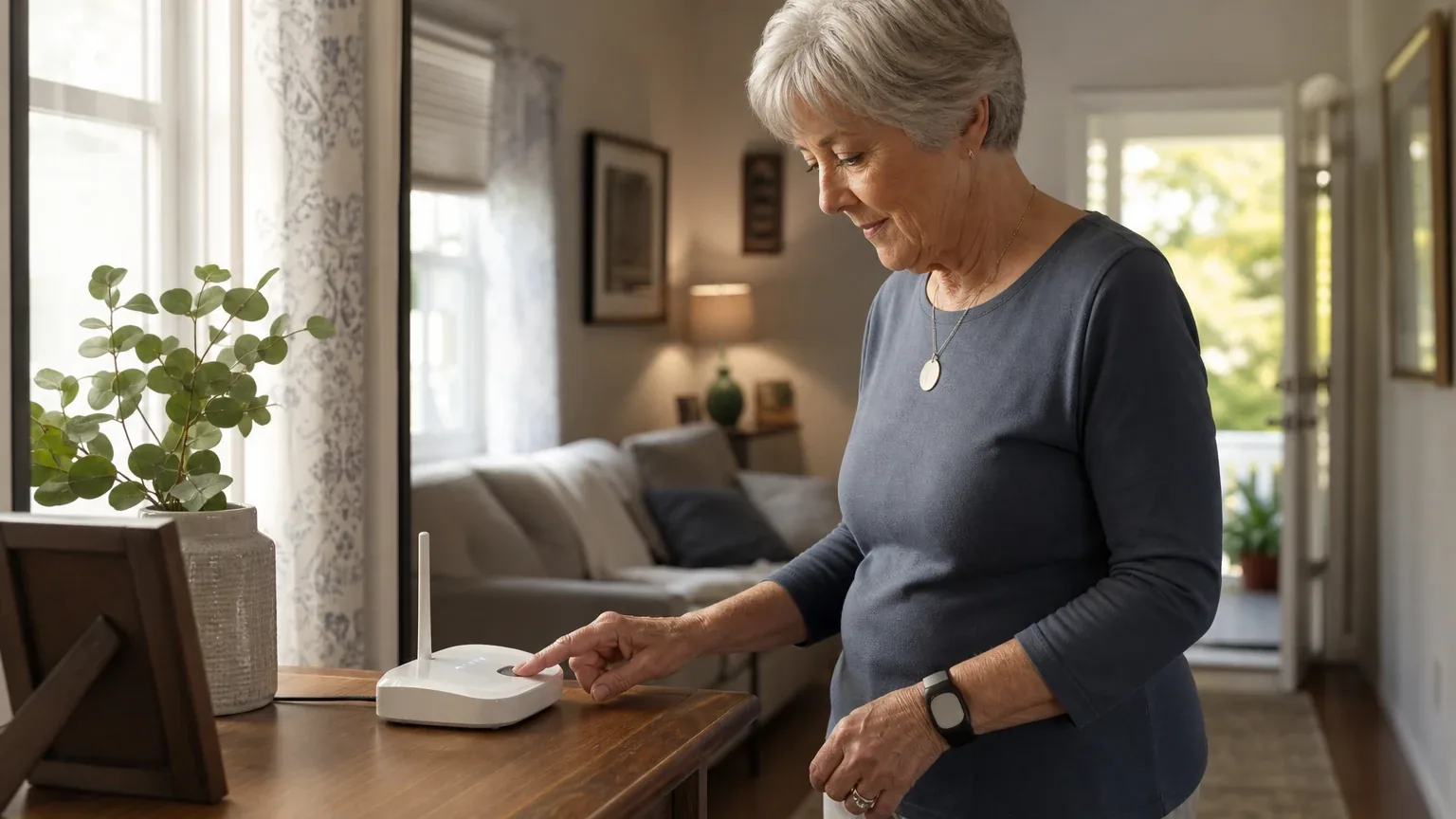
The relevant product is MGHome Cellular, a plug-in cellular base station with a wearable necklace or wristband help button. Medical Guardian's own FAQ states that Classic Guardian requires a landline telephone connection, while its cellular products use a nationwide cellular network [1]. That distinction is the single most important product fact for this use case: buyers replacing a landline need MGHome Cellular, not Classic Guardian.
MGHome Cellular operates on 4G LTE and does not require a landline [2]. The current official product page also references Voice Assist technology, described in platform research as a button that enables self-testing and spoken device status reports (anthropic:source_1). An independent review reports the system uses Verizon and AT&T networks [3], and another independent source describes eSIM technology with multi-carrier support (anthropic:source_5). The current official product page does not identify the carrier, so carrier details remain unconfirmed by the manufacturer.
Product naming is genuinely confusing. Public Medical Guardian materials also contain older Classic Guardian and Home Guardian references with different prices, ranges, and possibly different connectivity [4]. One platform noted that older promotional materials and support forums refer to the cellular home model as "Home 2.0" or "Classic Guardian Cellular," while the standard cellular offering is currently branded MGHome Cellular [6]. Buyers should get written confirmation that the quoted unit is the current MGHome Cellular model.
What the AI Platforms Agreed About
Questions This Section Answers
- What do AI platforms agree on about Medical Guardian's cellular home monitoring features?
- Does MGHome Cellular really have a 32-hour backup battery and 1,400-foot range?
Agreement was strong on core hardware specifications. Multiple platforms independently reported the same advertised figures from Medical Guardian's own product page: 4G LTE operation without a landline, up to 1,400 feet of wearable-to-base range, and a backup battery advertised at up to 32 hours [7]. Independent reviews repeat the 1,400-foot range and 32-hour battery figures [10].
Platforms also agreed on setup. Medical Guardian's instructions require plugging the base station into a direct wall outlet and pressing the rear power button; the device announces "Device ready" once connected [11]. One independent tester found pairing easy but reported a test call taking approximately 40 seconds to connect [13].
There was broad agreement that fall detection is optional rather than standard, priced at an additional $10 per month [14]. Platforms also agreed that Medical Guardian itself discloses fall detection does not detect 100% of falls and should be worn around the neck [17].
Finally, platforms agreed the system is home-based with no GPS tracking, making it unsuitable for protection outside the residence (anthropic, openai).
Where the AI Platforms Disagreed or Were Uncertain
Questions This Section Answers
- Why do AI platforms disagree about Medical Guardian's monthly price and cancellation policy?
- Is Medical Guardian's contract month-to-month or does it require a 90-day minimum?
Pricing is the largest disagreement. Reported monthly figures for MGHome Cellular ranged from $34.95 to $38.95 depending on billing term, with one platform citing a $37.95 starting figure [18]. One independent source reported a broader $27.95–$46.95 range across Medical Guardian plans (grok:13). Equipment fees were reported at $149.95 by several platforms [20], while one platform reported activation fees of $45–$125 (anthropic:source_7) and another reported no activation fee (grok:12). These figures conflict and none should be treated as the final price.
Contract terms conflict even within Medical Guardian's own materials. Current terms dated August 13, 2026 impose a 90-day minimum commitment, automatic renewal, cancellation by phone or written notice, leased-device return requirements, and a possible $350 non-return fee [22]. Older FAQ and policy pages state there is no long-term contract, no cancellation fee, and prorated refunds [24]. One platform reported no long-term contract with prorated refunds after a three-month minimum (grok:12, grok:13), and another reported cancellation at any time by phone with equipment return required [26]. The current dated terms should be treated as controlling unless Medical Guardian confirms otherwise in writing.
Carrier identity is unresolved. Independent sources report Verizon and AT&T [27], AT&T and T-Mobile (deepseek:mg-compare), and AT&T nationwide [25]. The current official product page does not name a carrier.
Battery duration has a minor internal conflict: one manual states 24 hours after a three-hour charge, while marketing materials state 32 hours (anthropic:source_6, anthropic:source_1).
Use-Case-Specific Features and Capabilities
Questions This Section Answers
- Does MGHome Cellular work in a high-rise apartment with concrete walls or a basement?
- Can caregivers monitor a senior using Medical Guardian's app with MGHome Cellular?
Cellular coverage is the decisive variable. Medical Guardian's own support documentation states that metal roofs, concrete buildings, basements, and wooded areas can impact signal strength (anthropic:source_3). No independent data on success rates in dense apartment buildings was found in the supplied research. The company markets the system as its strongest-ever signal and states the device can be moved to another U.S. address, but the new address should be supplied and the device tested there [28].
Range and battery are the standout specifications. The advertised 1,400-foot wearable-to-base range exceeds typical competitor ranges cited in platform research (anthropic:source_2, medgrade.org). The base station's lithium-ion backup battery is advertised at up to 32 hours during a power failure [29]. The base station requires AC power, so the battery is a bridge, not a substitute.
Fall detection is optional and imperfect. The water-resistant pendant uses triaxial accelerometers and must be worn around the neck for optimal detection; Medical Guardian states it does not detect 100% of falls and users should press the button when able [31]. The fall-detection pendant has a separate battery reported at 2–3 years [32].
Caregiver functionality exists but is not fully specified. MGHome Cellular includes access to Medical Guardian's member portal and app, described as supporting caregiver connection [33]. One platform reported an optional Social Circle feature at $5 per month [34]. The extent of real-time alerts included in the base plan versus paid add-ons should be confirmed.
One limitation worth stating plainly: the wearable button communicates through the base station speaker system, so the user cannot speak directly with an operator from the pendant itself (anthropic). The company's user manual also caps liability at $1,000 for system failure or response delay (anthropic:source_9).
Pricing, Fees, Contracts, and Ongoing Costs
Questions This Section Answers
- How much does Medical Guardian's MGHome Cellular cost per month, and what does fall detection add?
- What fees apply if a buyer cancels Medical Guardian and does not return the equipment?
Advertised pricing starts at $34.95 per month for MGHome Cellular, with optional fall detection adding $10 per month, for an advertised starting total of $44.95 per month before taxes, shipping, and add-ons [35]. Independent sources report $38.95 month-to-month, $110.85 quarterly, and $419.40 annually, plus a one-time $149.95 equipment fee [37]. One platform reported $37.95 as a starting figure (anthropic:source_7). These numbers do not reconcile, and the $34.95 figure is explicitly an advertised starting price.
Additional costs reported across platforms include standard shipping of $12.50, expedited shipping at $25.00 for two-day and $35.00 for overnight, and an optional Social Circle feature at $5.00 per month [39]. One platform reported no activation fee (grok:12); another reported activation fees of $45–$125 (anthropic:source_7). Medical Guardian's own pricing page states the company does not charge activation or cancellation fees, while a footnote on the same page states cancellation fees may apply (official:C2). That internal contradiction is unresolved.
Cancellation exposure is the most consequential term. Current terms impose a 90-day minimum commitment, automatic renewal, cancellation by phone or written notice, leased-equipment return at the customer's expense, billing that may continue until equipment is received and processed, up to 30 days of processing time, a possible $350 non-return fee if equipment is not returned within 30 days, and a restocking fee of up to $50 [41]. Older FAQ language promising no cancellation fees and prorated refunds conflicts with these terms [43]. One independent review reports prorated refunds for unused months [44].
Best Suited For
Questions This Section Answers
- Who is Medical Guardian's MGHome Cellular best suited for in a landline-free household?
- Is Medical Guardian worth it for a caregiver who wants app-based oversight and long backup battery life?
Medical Guardian is best suited for seniors and caregivers in apartments, condos, and modern homes without a landline who have adequate cellular coverage at the installation address. The plug-in base station, 1,400-foot advertised range, and 32-hour advertised backup battery align well with that buyer [45].
It also suits households where power outages are a realistic concern, because the backup battery is advertised to last up to 32 hours [46]. It suits caregivers who want portal and app access for care coordination [47]. And it suits buyers who want a dedicated medical alert brand rather than a general home security system adapted for medical use (kimi).
Buyers who can test cellular performance at the exact address before relying on the system are the best-positioned purchasers, because coverage varies by building, floor, and interior location (anthropic:source_3).
Probably Not Best Suited For
Questions This Section Answers
- Who should not choose Medical Guardian for cellular home monitoring?
- Is Medical Guardian a bad choice for a senior who needs protection outside the home?
Buyers who need protection outside the home should not choose this system. MGHome Cellular is home-based with no GPS tracking, so a mobile GPS device is more appropriate for seniors who regularly leave the residence (openai, anthropic).
Buyers unwilling to accept a 90-day minimum commitment or to return leased equipment at their own expense should look elsewhere, given the current terms [48]. Buyers in locations with weak or uncertain cellular coverage who cannot test the system before relying on it should also avoid committing (anthropic:source_3).
Cost-sensitive buyers should note that multiple platforms flagged the equipment fee and monthly rate as higher than some competitors (google, kimi). Buyers who require fully transparent, self-service pricing and cancellation should verify terms directly, because public information conflicts (deepseek, kimi).
When Another Option May Be Better
Questions This Section Answers
- What is a better alternative to Medical Guardian if a buyer needs the lowest monthly cellular monitoring cost?
- When is a mobile GPS system better than Medical Guardian's MGHome Cellular?
A mobile GPS system is better when the senior regularly leaves home and needs protection away from the residence (openai, anthropic). A provider with a documented carrier-selection process or stronger local coverage verification is better when the residence has marginal cellular signal (openai).
A lower-cost cellular monitoring option may be better for budget-focused buyers. Platform research cited competitor cellular monitoring rates starting at $9.99 per month and $14.95–$16.95 per month from non-medical-alert monitoring providers (kimi:tmc-rates, kimi:shc-m2m, kimi:shc-uplink). Those are general alarm monitoring services rather than dedicated medical alert systems, so the comparison is not like-for-like, but the price gap is real.
A provider with month-to-month terms and simpler equipment returns may be better when cancellation flexibility matters more than the 32-hour battery and caregiver-app features (openai). A system with dual-SIM automatic carrier switching may be better where multi-carrier redundancy is needed (kimi:shc-alula-upgrade).
Questions to Verify Before Buying
Questions This Section Answers
- What should a buyer confirm with Medical Guardian before signing a contract for MGHome Cellular?
- Which carrier does MGHome Cellular use at a specific apartment address?
Ask which cellular carrier or carriers the exact MGHome Cellular unit uses at the buyer's address, and whether Medical Guardian can perform or support a coverage test at the exact apartment, condo, or high-rise location before any return period expires (openai). Ask for written confirmation that the quoted unit is MGHome Cellular rather than Classic Guardian, Home Guardian, or another legacy model [50].
Ask for the all-in monthly, quarterly, and annual price including fall detection, shipping, taxes, protection plan, and any equipment charge (openai). Ask whether the 90-day minimum applies to the specific order and promotion, and when exactly billing stops after cancellation: on the call, written confirmation, carrier receipt, or warehouse processing [52].
Ask who pays return shipping and what documentation is required to avoid the $350 non-return charge [52]. Ask what caregiver alerts are included in the base plan versus paid add-ons [54]. Ask what the expected connection time and performance is inside the specific building [55]. Ask what the device replacement, repair, and battery-replacement terms are after the warranty or protection-plan period (openai).
Final AI Consensus Verdict
Medical Guardian is a good fit for cellular home monitoring, with especially strong appeal for landline-free apartments and modern homes that need a long backup battery and optional fall detection. Six of seven platforms named it during ranking, it finished second overall, and no platform rated the fit below mixed.
The consensus is not that the product is proven superior. It is that the product matches the use case on paper, with advertised specifications that multiple platforms independently repeated from company materials. The reservations are consistent across platforms: coverage verification, the 90-day minimum commitment, return-related billing exposure, conflicting pricing, and inconsistent public information about legacy versus current products.
Purchase only after confirming local cellular coverage, the exact current MGHome Cellular model and total price, and the 90-day cancellation and equipment-return obligations in writing.
How This Review Was Produced
This review evaluates Medical Guardian only for the Cellular Home Monitoring use case within the broader Cellular Home Monitoring study. It is not a broad company review. Seven AI platforms were queried for fit research, and six named Medical Guardian during ranking discovery. Platform fit ratings, pricing figures, feature findings, and limitations were compiled from the supplied platform responses and their cited sources.
The study research date is 2026-09-27. Platform-reported research dates differ: anthropic reported 2025-01-20 and deepseek reported 2026-02-14, while google, grok, kimi, openai, and perplexity reported 2026-09-27. Those platform dates are provenance metadata and do not independently prove freshness.
This report sits within a wider directory of medical alert systems research. All factual claims are attributed to the platform that supplied them. Company-owned citations materially outnumber independent citations in the underlying research, so company claims are not described here as independently verified.
Methodology Limitations
Several limitations apply. Company-owned citations materially outnumber independent citations, so most product specifications trace back to Medical Guardian's own materials rather than independent testing. The supplied URLs were collected from platform responses and were not independently validated by the writer stage.
Platform-reported research dates differ from the authoritative run date, and two platforms (anthropic and deepseek) used older research dates. Deepseek reported search disabled, so its claims require explicit verification before being treated as current facts. All included platforms evaluated fit, but platform mentions count only platforms that named the entity during ranking discovery.
Conflicting product names, pricing, and capabilities were not resolved by guessing. Where sources disagreed, the conflict is described and buyers are directed to verify. Missing research was not interpreted as disagreement. No personal testing, customer experience, medical benefit, or guaranteed performance is claimed anywhere in this review.
Sources
Company-Owned Sources
- Cellular Alarm Monitoring Colorado Springs | Never Lose Connection: https://cellularalarmmonitoring.net/
- No Contract M2M Cellular UL Central Station Monitoring From $14.95: https://safehomecentral.com/affordable-no-contract-alarm-monitoring-from-8-95-same-day-switch/m2m-cellular-ul-central-station-monitoring-from-14-95-2/
- Upgrade Your Existing Hardwired Panel To Cellular Using Alula: https://safehomecentral.com/alarm-monitoring/upgrade-your-hardwired-alarm-panel-with-cellular-monitoring-using-alula-and-safehomecentral-com/
- Prima Cellular and WIFI Alarm Monitoring: https://safehomecentral.com/prima-cellular-and-wifi-alarm-monitoring/
- No Contract Uplink Cellular UL Central Station Monitoring from $16.95: https://safehomecentral.com/product/uplink-cellular-alarm-monitoring-monthly/
- Medical Guardian – Medical Alert Systems: https://www.medicalguardian.com/
- In-Home Protection Buyer Guide: https://www.medicalguardian.com/assets/mgbuyersguide.pdf
- The Best Medical Alert Systems: https://www.medicalguardian.com/best-medical-alert-systems
- Medical Guardian – Classic Guardian: https://www.medicalguardian.com/classic-guardian
- Fall Detection | Medical Guardian: https://www.medicalguardian.com/fall-detection
- Medical Guardian FAQ: https://www.medicalguardian.com/faq
- Medical Guardian – How It Works: https://www.medicalguardian.com/how-it-works
- How It Works: Award-Winning Medical Emergency Alert System | Medical Guardian: https://www.medicalguardian.com/how-medical-alert-systems-work
- Legal Information About Medical Guardian Services: https://www.medicalguardian.com/legal/terms
- Medical Guardian – Compare Systems: https://www.medicalguardian.com/medical-alert-systems
- MGHome Cellular - Medical Alert System: https://www.medicalguardian.com/medical-alert-systems/cellular-home-alert
- Medical Guardian Support FAQs: https://www.medicalguardian.com/support/faqs/
- MGClassic Support | Medical Guardian: https://www.medicalguardian.com/support/mgclassic/
- MGHome Cellular Support | Medical Guardian: https://www.medicalguardian.com/support/mghomecellular/
- Alarm Systems Costs | Lowest Rates | The Monitoring Center: https://www.themonitoringcenter.com/products-and-services/alarm-monitoring-services-and-rates/
- MGHome Cellular | Medical Alert System for At-Home Safety with 24/7 Monitoring: https://www.youtube.com/watch?v=gT8B2A-U6vU
- Official pricing and terms source: https://www.medicalguardian.com/alert-system-pricing
- Official pricing and terms source: https://www.medicalguardian.com/mobile-terms-and-conditions
Additional AI research evidence55 records
- AI research evidence record perplexity:c12
- AI research evidence record openai:c1
- AI research evidence record openai:c2
- AI research evidence record openai:c12
- AI research evidence record openai:c13
- AI research evidence record google:1.1.2
- AI research evidence record openai:c1
- AI research evidence record perplexity:c1
- AI research evidence record google:1.2.1
- AI research evidence record google:1.1.8
- AI research evidence record openai:c3
- AI research evidence record google:1.2.9
- AI research evidence record openai:c4
- AI research evidence record openai:c6
- AI research evidence record perplexity:c7
- AI research evidence record google:1.1.3
- AI research evidence record openai:c7
- AI research evidence record openai:c1
- AI research evidence record google:1.2.7
- AI research evidence record perplexity:c3
- AI research evidence record google:1.1.2
- AI research evidence record openai:c9
- AI research evidence record openai:c10
- AI research evidence record openai:c11
- AI research evidence record perplexity:c12
- AI research evidence record perplexity:c6
- AI research evidence record openai:c2
- AI research evidence record openai:c1
- AI research evidence record openai:c5
- AI research evidence record google:1.2.1
- AI research evidence record openai:c7
- AI research evidence record perplexity:c7
- AI research evidence record openai:c8
- AI research evidence record google:1.1.3
- AI research evidence record openai:c1
- AI research evidence record openai:c6
- AI research evidence record google:1.2.7
- AI research evidence record google:1.1.2
- AI research evidence record google:1.1.6
- AI research evidence record google:1.1.3
- AI research evidence record openai:c9
- AI research evidence record openai:c10
- AI research evidence record openai:c11
- AI research evidence record perplexity:c10
- AI research evidence record openai:c1
- AI research evidence record google:1.2.1
- AI research evidence record openai:c8
- AI research evidence record openai:c9
- AI research evidence record openai:c10
- AI research evidence record openai:c12
- AI research evidence record openai:c13
- AI research evidence record openai:c9
- AI research evidence record openai:c10
- AI research evidence record openai:c8
- AI research evidence record openai:c4
Independent Sources
- Medical Guardian MGHome Cellular User Manual: https://manuals.plus/asin/B0BYTGR5V6
- Medical Guardian MGHome Cellular – MedGrade: https://medgrade.org/devices/medical-guardian-mghome-cellular/
- Medical Guardian Cost: $27.95–$46.95/mo, Checked Sept 2026: https://medicalalertreview.com/medical-guardian-cost
- Medical Guardian Review (2026): Tested - AARP: https://www.aarp.org/caregiving/home-care/medical-alert-systems/medical-guardian-review/
- Medical Guardian Alert System Review: Tested: https://www.aarp.org/caregiving/home-care/medical-guardian-review/
- Better Business Bureau – Medical Guardian: https://www.bbb.org/us/pa/philadelphia/profile/medical-alert-systems/medical-guardian-llc-0241-1502503
- Medical Guardian Medical Alert System Review 2026 - Caring.com: https://www.caring.com/best-medical-alert-systems/medical-guardian-reviews/
- Medical Guardian Reviews: https://www.consumeraffairs.com/medical-alert-systems/medical-guardian.html
- Medical Guardian Review – Forbes Health: https://www.forbes.com/health/medical-alert-systems/medical-guardian-active-guardian-review/
- Is Medical Guardian the Right Medical Alert for You? Complete Review: https://www.medicinecontact.com/blog/29664/medical-guardian-20
- Medical Care Alert vs. Medical Guardian Review: https://www.ncoa.org/product-resources/medical-alert-systems/medical-care-alert-vs-medical-guardian-review/
- Medical Guardian Review 2026: https://www.ncoa.org/product-resources/medical-alert-systems/medical-guardian-review/
- Medical Guardian Cost, Pricing, Packages & Monthly Plans - SafeHome.org: https://www.safehome.org/medical-alert-systems/medical-guardian/pricing/
- Medical Guardian Review 2026 | SafeWise: https://www.safewise.com/senior-safety/medical-alerts/medical-guardian/
- Best Cellular Home Security Systems of 2026: https://www.security.org/home-security-systems/best/cellular/
- Medical Guardian Cost & Pricing in 2026: https://www.seniorliving.org/medical-alert-systems/medical-guardian/
- Medical Guardian Alert System Review for 2026: https://www.seniorliving.org/medical-alert-systems/medical-guardian/reviews/
- Medical Guardian Cost & Pricing in 2026 - SeniorLiving.org: https://www.seniorliving.org/medical-alert/medical-guardian/cost/
- TechRadar – Medical Guardian review: https://www.techradar.com/best/best-medical-alert-systems
- Medical Guardian vs. Bay Alarm Medical, Hands-On Comparison: https://www.theseniorlist.com/medical-alert-systems/medical-guardian-vs-bay-alarm-medical/
- Medical Guardian Reviews: Our Hands-On Test (2026: https://www.theseniorlist.com/medical-alert-systems/medical-guardian/reviews/
- Medical Guardian Costs, Our Hands-On Analysis - The Senior List: https://www.theseniorlist.com/medical-alert/medical-guardian/costs/
Additional AI research evidence55 records
- AI research evidence record perplexity:c12
- AI research evidence record openai:c1
- AI research evidence record openai:c2
- AI research evidence record openai:c12
- AI research evidence record openai:c13
- AI research evidence record google:1.1.2
- AI research evidence record openai:c1
- AI research evidence record perplexity:c1
- AI research evidence record google:1.2.1
- AI research evidence record google:1.1.8
- AI research evidence record openai:c3
- AI research evidence record google:1.2.9
- AI research evidence record openai:c4
- AI research evidence record openai:c6
- AI research evidence record perplexity:c7
- AI research evidence record google:1.1.3
- AI research evidence record openai:c7
- AI research evidence record openai:c1
- AI research evidence record google:1.2.7
- AI research evidence record perplexity:c3
- AI research evidence record google:1.1.2
- AI research evidence record openai:c9
- AI research evidence record openai:c10
- AI research evidence record openai:c11
- AI research evidence record perplexity:c12
- AI research evidence record perplexity:c6
- AI research evidence record openai:c2
- AI research evidence record openai:c1
- AI research evidence record openai:c5
- AI research evidence record google:1.2.1
- AI research evidence record openai:c7
- AI research evidence record perplexity:c7
- AI research evidence record openai:c8
- AI research evidence record google:1.1.3
- AI research evidence record openai:c1
- AI research evidence record openai:c6
- AI research evidence record google:1.2.7
- AI research evidence record google:1.1.2
- AI research evidence record google:1.1.6
- AI research evidence record google:1.1.3
- AI research evidence record openai:c9
- AI research evidence record openai:c10
- AI research evidence record openai:c11
- AI research evidence record perplexity:c10
- AI research evidence record openai:c1
- AI research evidence record google:1.2.1
- AI research evidence record openai:c8
- AI research evidence record openai:c9
- AI research evidence record openai:c10
- AI research evidence record openai:c12
- AI research evidence record openai:c13
- AI research evidence record openai:c9
- AI research evidence record openai:c10
- AI research evidence record openai:c8
- AI research evidence record openai:c4
Verify This Research
Review the study details behind this page or download the public machine-readable verification record.
- Study date
- September 27, 2026
- Platforms analyzed
- 7
- Source records
- 47
- Ranking mentions
- 6 of 7
- Platform share
- 86%
- Final consensus rank
- #2
Research trail and source mix
Configured platforms
openai, anthropic, deepseek, grok, perplexity, kimi, google
Source mix
22 independent · 25 company-owned
Evidence support
33 direct · 14 partial
Important limitation
Use the run research_date as the study date. Platform-reported dates are provenance metadata and do not independently prove freshness.
Source snapshot SHA-256 56fa9e16b6fad140e23d8d389448b5fdc4614bdd8b2ec4f2016013d05bf203ed
Archived editions
Browse earlier published research snapshots for this article. The latest edition remains at the current URL.