
Answer Capsule
Medical Alert is a good but not clearly best-in-class fit for older couples who primarily need shared in-home emergency monitoring. Two of seven platforms (Anthropic and Google) named Medical Alert during the ranking stage, giving it a 28.6% platform share with an average listed rank of 6.0 and a best rank of 5. The strongest reason to consider Medical Alert is its affordable Home Cellular System, advertised from $29.95 per month, which supports additional wearable buttons for a second household member on one base station. The main limitation is transparency: no platform could verify the exact second-pendant price, spouse discount, dual-profile monitoring setup, or per-user fall-detection billing from public sources. For couples needing mobile protection, Medical Alert states each user requires a separate mobile system, which weakens package value.
Research Snapshot
| Metric | Value |
|---|---|
| Platform mentions in ranking stage | 2 of 7 (Anthropic, Google) |
| Share of included platform responses | 28.6% |
| Average listed rank | 6.0 |
| Best listed rank | 5 (Google) |
| Relevant product/model/plan | Home Cellular System with Additional Spouse Pendant; Mobile System (dual units) with optional fall detection |
| Overall use-case fit | Good for in-home couples; mixed-to-uncertain for mobile or transparency-focused buyers |
| Research date | 2026-08-06 |
Why Medical Alert Qualified for This Study
Medical Alert qualified for this Shared Household & Two-User Protection review because two of the seven participating AI platforms named it during the ranking discovery stage. Anthropic ranked Medical Alert 7th, and Google ranked it 5th. The other five platforms (OpenAI, DeepSeek, Grok, Perplexity, and Kimi) did not name Medical Alert during ranking but did evaluate its fit when asked directly.
The entity evaluated is Medical Alert (medicalalert.com), a U.S.-based medical alert system provider. The relevant product configuration for couples is the Home Cellular System with an additional spouse pendant or wrist button, plus the Mobile System for users who need protection away from home.
The Product, Model, Plan, or Service Most Relevant to Shared Household & Two-User Protection
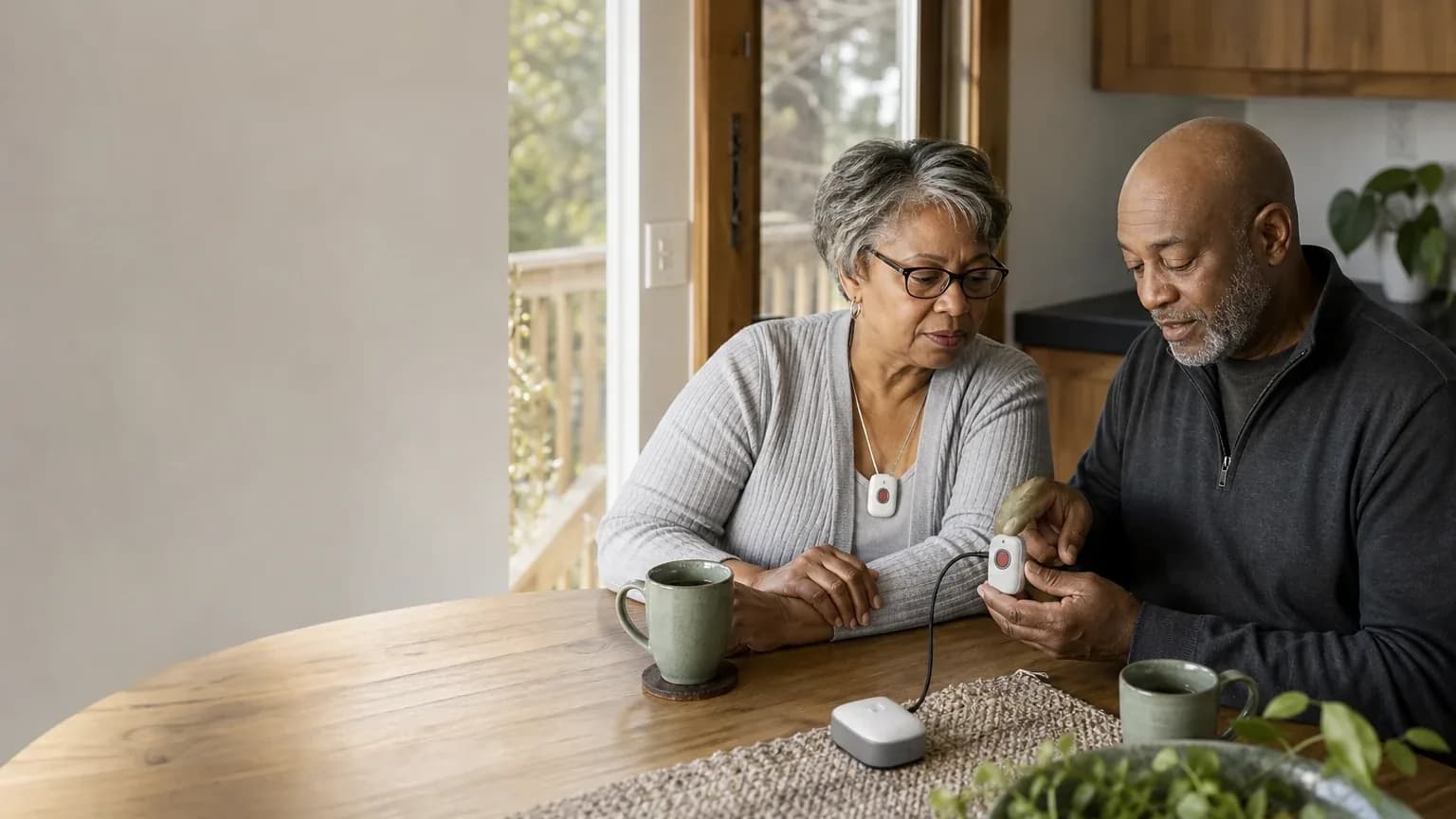
The most relevant Medical Alert configuration for couples is the Home Cellular System with an Additional Spouse Pendant. This setup uses one cellular base station that supports multiple wearable help buttons, allowing two household members to share a single monitoring account. The Home Cellular System is advertised from $29.95 per month with an annual plan [1].
For couples needing mobile protection, Medical Alert offers the Mobile System, but the company states that each mobile user needs their own mobile system [3]. This means two mobile users require two separately purchased units rather than one shared plan. Independent sources list the Mobile Standard at $42.95/month and the Mobile Mini at $47.95/month [5].
Optional automatic fall detection is available as an add-on. Medical Alert's published blog states a $10-per-month add-on price [6], though whether this applies per person or per household is not clearly documented.
What the AI Platforms Agreed About
All seven platforms agreed that Medical Alert's couple-specific pricing and dual-user features are not transparently documented. This was the strongest consensus finding across the entire review.
Strong agreement existed on the following points:
- Additional pendants are available. All platforms that provided substantive findings confirmed Medical Alert allows additional neck or wrist buttons to be linked to a single home base station [7].
- Fall detection is an optional paid add-on. All platforms confirmed fall detection is not included in the base price and requires an additional monthly fee [11].
- The Home Cellular System is competitively priced. Multiple platforms noted the $29.95/month starting price makes it one of the most affordable cellular home options [7].
- Mobile protection requires separate units per user. Medical Alert's official support materials state each mobile user needs their own mobile system, which several platforms flagged as a cost concern for couples [15].
- No long-term contract is advertised. Medical Alert states service can be canceled at any time, though the specific terms vary by source [15].
Moderate agreement existed on these points:
- The advertised home range is up to 800 feet. Three platforms cited this figure from Medical Alert's official product page [7]. However, DeepSeek cited a 600-foot range [8], and independent testing found real-world performance significantly lower.
- Customer service scores are strong. Anthropic cited an NCOA customer service score of 9.7/10 and an easy setup score of 5/5 [20].
Where the AI Platforms Disagreed or Were Uncertain
Fit ratings varied widely across platforms:
| Platform | Fit Rating |
|---|---|
| OpenAI | Good |
| DeepSeek | Good |
| Good | |
| Anthropic | Mixed |
| Grok | Mixed |
| Perplexity | Uncertain |
| Kimi | Uncertain |
Major disagreements and uncertainties included:
-
Second-pendant discounting. DeepSeek claimed Medical Alert offers a discounted spouse pendant, stating the discount is disclosed during sales calls rather than published online [22]. OpenAI and Anthropic could not verify any discount from public sources. Google noted promotional pricing "varies frequently based on seasonal online sales" [23]. This conflict remains unresolved.
-
Base station range. Medical Alert's official page advertises up to 800 feet [24]. DeepSeek cited 600 feet [26]. Independent testing by U.S. News found the Medical Alert Plus system achieved only 100 feet of real-world range despite a 600-foot advertised claim [27]. The actual usable range appears highly dependent on home construction and placement.
-
Contract terms. OpenAI stated Medical Alert allows cancellation at any time with no long-term contract [28]. Anthropic cited the official subscriber terms requiring a three-month minimum with a $35 restocking fee, non-refundable programming fee, and non-refundable shipping for early cancellation [29]. These descriptions conflict and require direct verification.
-
Fall detection pricing. OpenAI cited a published $10/month add-on price [30]. Anthropic stated the cost was not specified in current sources [31]. DeepSeek estimated $5–$10/month per user but labeled this unverified [32].
-
Dual-profile monitoring. No platform could confirm from public sources whether the monitoring center can distinguish which spouse pressed a pendant or maintain separate medical profiles for each user. Google stated multiple pendants can be linked to a single household account [23], but whether this creates distinct user profiles remains unverified.
-
Product lineup currency. Kimi noted the ranking-stage recommendations ("Home Cellular System with Additional Spouse Pendant" and "Mobile System (dual units for couples)") could not be verified against current live offerings on MedicalAlert.com as of August 2026 [33].
Use-Case-Specific Features and Capabilities
Second-Pendant Discounting
Assessment: Unclear. Medical Alert states additional neck or wrist buttons can be purchased for home systems [34]. DeepSeek claims a spouse pendant discount exists but is only disclosed during sales calls [36]. No platform verified the exact discount amount or whether it represents a meaningful saving versus two individual systems.
Dual-Profile Monitoring
Assessment: Unclear. The home system can accept additional buttons, and the mobile app supports managing user accounts [34]. However, public materials do not clearly document whether each spouse receives a distinct monitored profile, separate medical information record, or individualized response protocol. Grok noted public sources "do not clearly confirm dual-profile or fully shared account features" [37].
Base Station Range
Assessment: Mixed. Medical Alert advertises help-button coverage of up to 800 feet for the Home System [34]. Actual coverage depends on home construction, interference, and communicator placement [39]. Independent testing found significantly shorter real-world range—as low as 100 feet in U.S. News testing [40]. This is a critical verification point for couples in larger homes.
Individual Fall-Detection Add-Ons
Assessment: Advantage with cost uncertainty. Fall detection is available as an optional add-on for the Home System [34]. Medical Alert's published blog states a $10-per-month add-on [42]. Independent testing found the feature itself proved reliable when using a separate fall-detection pendant [43]. However, whether two fall-detection pendants receive a household discount or are billed separately is not documented.
Mobile Protection for Two Users
Assessment: Limitation. Medical Alert states each mobile-system user needs their own mobile system [35]. This supports dual protection but generally requires two subscriptions or two separately priced units rather than one shared mobile plan. Anthropic also noted no call-cancellation capability on mobile devices, which creates usability friction when managing false alarms for multiple users [45].
Monitoring and Communication
Assessment: Advantage. The Home System provides 24/7 access to response specialists through a cellular network with two-way voice communication [34]. Cellular availability is required, and performance depends on third-party carrier networks [39].
Contract and Cancellation
Assessment: Conflicting. OpenAI states customers can cancel at any time [35]. Anthropic cites a three-month minimum with non-refundable fees for early cancellation [46]. DeepSeek claims month-to-month plans with no cancellation fees but notes prepaid annual plans may be non-refundable after 30 days [36]. These descriptions cannot all be accurate and require direct verification.
Pricing, Fees, Contracts, and Ongoing Costs
Pricing confidence: Low to moderate. The platforms provided inconsistent pricing information, and no platform could verify the total cost of a two-user configuration.
Known Costs
| Item | Price | Source |
|---|---|---|
| Home Cellular System | From $29.95/month (annual plan) | [47] |
| Mobile System (Standard) | $42.95/month | [49] |
| Mobile System (Mini) | $47.95/month | [49] |
| Fall detection add-on | $10/month (published); unverified per-user billing | [50] |
| Additional spouse pendant | Not publicly disclosed | All platforms |
Additional Fees
- Second pendant price: Not clearly published on reviewed official pages [47].
- Second mobile user: Requires a separate mobile system; total two-user mobile price not clearly published [53].
- Early cancellation fees: Anthropic cites a $35 non-refundable restocking fee, non-refundable programming fee, and non-refundable shipping if canceling within the first three months [54].
- Shipping and activation: May be free or charged depending on promotions [55].
- Equipment return: Required after cancellation; shipping costs are customer responsibility [54].
Contract Terms
- Three-month minimum: Anthropic cites this from the official subscriber terms [54].
- Cancellation at any time: OpenAI cites this from the official support page [53].
- Annual prepayment: May lower the effective monthly rate but should be checked for refund and proration terms [50].
- Equipment return required: Confirmed by both OpenAI and Anthropic [53].
Important disclosure: The pricing conflict between OpenAI's "cancel at any time" and Anthropic's "three-month minimum with non-refundable fees" cannot be resolved from the supplied evidence. Buyers should obtain written cancellation terms before purchasing.
Best Suited For
Based on the platform responses, Medical Alert is best suited for:
- Older couples who spend most of their time at home and want two wearable help buttons connected to one cellular base station (openai; google).
- Budget-conscious households where the $29.95/month starting price is a priority (anthropic).
- Couples who want optional fall detection and do not require both users to have independent mobile units (openai; google).
- Buyers who value month-to-month service and U.S.-based response support (openai).
- Couples in smaller homes where the advertised 800-foot range is likely sufficient (anthropic).
- Households that prioritize simplicity and easy setup over comprehensive caregiver oversight (anthropic).
Probably Not Best Suited For
Medical Alert is probably not the best choice for:
- Couples who both regularly travel outside the home and need mobile protection for each person, since each user requires a separate mobile system (openai; anthropic).
- Buyers seeking a clearly published spouse discount or transparent second-user package price (openai; anthropic; perplexity).
- Households requiring fully documented, separate user profiles with individually itemized fall-detection charges (openai; perplexity).
- Couples needing caregiver remote monitoring via app, which is not available with Medical Alert [57].
- Homes larger than 800 feet or with complex layouts needing longer range coverage (anthropic).
- Buyers who need call-cancellation capability on mobile devices [58].
- Couples seeking maximum-value two-user packages with included fall detection (anthropic).
When Another Option May Be Better
The platforms identified specific competitor alternatives for couples:
- Bay Alarm Medical offers free spouse monitoring with a one-time $40 pendant fee, a 1,000-foot range, and no contract—making it a stronger value for couples who want transparent dual-user pricing [59].
- MobileHelp offers a Duo Bundle with two mobile devices for $49.95/month combined, which is more economical for couples needing mobile protection [60].
- Medical Guardian offers the MGHome Cellular system with a caregiver app for remote monitoring, which Medical Alert lacks [60].
- LifeFone offers lower upfront commitment options [60].
Choose another provider when a clearly published spouse-monitoring price, free or discounted second pendant, or transparent two-user billing is the primary requirement (openai).
Questions to Verify Before Buying
Before purchasing Medical Alert for a two-user household, verify the following with the company directly:
- What is the exact monthly and annual price for a Home Cellular System with a second standard pendant or wrist button?
- Is the second spouse monitored at no extra monthly charge, or is there a recurring fee for the additional button?
- Can each spouse have a separate name, medical history, emergency contacts, and responder instructions?
- When an alert is triggered, can the response center identify which spouse's device sent it?
- Is fall detection charged per person or per household, and is there a discount for adding two fall-detection pendants?
- What is the exact total price for two Mobile LTE systems, including any couple discount, activation, equipment, shipping, and fall-detection charges?
- What are the measured indoor and outdoor ranges in the couple's specific home, and where should the base communicator be placed?
- Which cellular network does the system use locally, and what happens during a cellular outage or power outage?
- Are annual-plan payments refundable on a prorated basis after cancellation?
- What are the return deadline, equipment-return shipping requirements, and any unreturned-equipment charges?
- Does the response center contact both spouses, listed caregivers, and emergency services according to a configurable escalation order?
- Is there a three-month minimum contract, and what are the exact early-cancellation fees?
Final AI Consensus Verdict
Medical Alert is a good fit for older couples who mainly need shared in-home protection, but it is not a clearly best-in-class choice for Shared Household & Two-User Protection. The Home Cellular System's $29.95/month starting price, support for additional wearable buttons, and optional fall detection make it structurally suitable for two people sharing a residence. However, the key couple-buying details—second-pendant pricing, spouse discounts, individualized profiles, and per-person fall-detection billing—are not transparently documented across any of the seven platform responses.
The platform consensus is mixed: three platforms rated Medical Alert "good" (OpenAI, DeepSeek, Google), two rated it "mixed" (Anthropic, Grok), and two rated it "uncertain" (Perplexity, Kimi). No platform rated it as the best option for couples. For couples needing mobile protection, the requirement that each user have a separate mobile system makes the value proposition weaker. For couples who primarily stay home and prioritize affordability, Medical Alert is a reasonable choice—provided they obtain a written two-user quote and confirmation of dual-profile operation before purchasing.
For a broader comparison of couple-focused medical alert options, see the Shared Household & Two-User Protection consensus index. You can also browse all medical alert systems in our category directory.
How This Review Was Produced
This review was produced by aggregating fit-research responses from seven AI platforms: OpenAI, Anthropic, DeepSeek, Grok, Perplexity, Kimi, and Google. Each platform evaluated Medical Alert against five category criteria: second-pendant discounting, dual-profile monitoring, base station range, individual fall-detection add-ons, and overall package value. The research date for this study is 2026-08-06.
The evidence base includes 17 deduplicated citations: 10 from company-owned sources (primarily medicalalert.com) and 7 from independent sources (safehome.org, realestate.usnews.com, ncoa.org, seniorliving.org, safewise.com, theseniorlist.com). Company-owned citations materially outnumber independent citations, so company claims should not be treated as independently verified.
Methodology Limitations
- Platform-reported research dates differ. DeepSeek's response is dated 2026-04-09, while the authoritative run date is 2026-08-06. This discrepancy is disclosed as a methodology limitation.
- Platform mentions count only ranking-stage naming. Two of seven platforms named Medical Alert during ranking discovery. The other five evaluated fit only when asked directly.
- Conflicting product names and pricing were not resolved by guessing. Where platforms disagreed (e.g., 600-foot vs. 800-foot range, cancel-any-time vs. three-month minimum), the conflict is described and buyers are told what to verify.
- Supplied URLs were collected from platform responses and were not independently validated by the writer stage.
- No platform conducted hands-on testing of Medical Alert's two-user configuration. Independent testing cited by Anthropic (U.S. News) tested a different Medical Alert model (Medical Alert Plus) and found real-world range significantly below advertised claims.
- No independent review source from 2025–2026 specifically evaluating Medical Alert for couples was identified in the supplied evidence [61].
- AI-platform agreement does not prove product quality. This review reports what the platforms found; it does not constitute independent verification of Medical Alert's claims.
Sources
- Medical Alert – Home System | Medical Alert (company) – https://www.medicalalert.com/product/home-system-cellular/
- Medical Alert – Support: General Information (company) – https://www.medicalalert.com/support/general/
- Medical Alert – Support: Subscriber Terms and Conditions (company) – https://www.medicalalert.com/support/terms/
- Medical Alert – How Does Fall Detection Work? (company) – https://www.medicalalert.com/blog/fall-detection-technology-then-and-now/
- Medical Alert – Automatic Fall Detection (company) – https://www.medicalalert.com/fall-detection/
- Medical Alert – Home Cellular System (company) – https://www.medicalalert.com/home-cellular-system
- Medical Alert – How Medical Alert Works for Two People (company) – https://www.medicalalert.com/medical-alert-for-two-people
- Medical Alert – Official Website (company) – https://www.medicalalert.com/
- SafeHome.org – Medical Alert Cost, Pricing, Packages and Monthly Plans (independent) – https://www.safehome.org/medical-alert-systems/medical-alert/
- SafeHome.org – Cheapest & Most Affordable Medical Alert Systems of 2026 (independent) – https://www.safehome.org/medical-alert-systems/best/affordable/
- U.S. News – 8 Best Medical Alert Systems 2026: Reviewed (independent) – https://realestate.usnews.com/home-services/medical-alert-system/best-medical-alert-system
- NCOA – The Best Medical Alert Systems in 2026 (independent) – https://www.ncoa.org/product-resources/medical-alert-systems/best-medical-alert-systems/
- SeniorLiving.org – Medical Alert Cost, Pricing, Plans and Packages in 2026 (independent) – https://www.seniorliving.org/medical-alert-systems/medical-alert/
- SafeWise – Medical Alert Systems (independent) – https://www.safewise.com/senior-safety/medical-alerts/
- The Senior List – Best Medical Alert Systems for Couples (independent) – https://www.theseniorlist.com/medical-alert-systems/best/couples/
- Salesforce – What Is Product-Market Fit? (company, partial support) – https://www.salesforce.com/blog/sales/product-market-fit/
Additional AI research evidence61 records
- AI research evidence record openai:c1
- AI research evidence record anthropic:c12
- AI research evidence record openai:c2
- AI research evidence record openai:c5
- AI research evidence record anthropic:c10
- AI research evidence record openai:c4
- AI research evidence record openai:c1
- AI research evidence record deepseek:c1
- AI research evidence record google:c1
- AI research evidence record grok:c1
- AI research evidence record openai:c4
- AI research evidence record anthropic:c7
- AI research evidence record deepseek:c3
- AI research evidence record anthropic:c12
- AI research evidence record openai:c2
- AI research evidence record anthropic:c10
- AI research evidence record deepseek:c2
- AI research evidence record anthropic:c4
- AI research evidence record google:c2
- AI research evidence record anthropic:c14
- AI research evidence record anthropic:c15
- AI research evidence record deepseek:c2
- AI research evidence record google:c1
- AI research evidence record openai:c1
- AI research evidence record google:c2
- AI research evidence record deepseek:c1
- AI research evidence record anthropic:c6
- AI research evidence record openai:c2
- AI research evidence record anthropic:c16
- AI research evidence record openai:c4
- AI research evidence record anthropic:c7
- AI research evidence record deepseek:c3
- AI research evidence record kimi:c1
- AI research evidence record openai:c1
- AI research evidence record openai:c2
- AI research evidence record deepseek:c2
- AI research evidence record grok:c2
- AI research evidence record google:c2
- AI research evidence record openai:c3
- AI research evidence record anthropic:c6
- AI research evidence record anthropic:c7
- AI research evidence record openai:c4
- AI research evidence record anthropic:c8
- AI research evidence record openai:c5
- AI research evidence record anthropic:c11
- AI research evidence record anthropic:c16
- AI research evidence record openai:c1
- AI research evidence record anthropic:c12
- AI research evidence record anthropic:c10
- AI research evidence record openai:c4
- AI research evidence record anthropic:c7
- AI research evidence record anthropic:c2
- AI research evidence record openai:c2
- AI research evidence record anthropic:c16
- AI research evidence record deepseek:c2
- AI research evidence record google:c1
- AI research evidence record anthropic:c9
- AI research evidence record anthropic:c11
- AI research evidence record anthropic:c2
- AI research evidence record anthropic:c3
- AI research evidence record kimi:c1
Verify this research
Review the study details behind this page or download the public machine-readable verification record.
- Study date
- Aug 6, 2026
- Platforms analyzed
- 7
- Source records
- 17
- Ranking mentions
- 2 of 7
- Platform share
- 29%
- Final consensus rank
- #6
Research trail and source mix
Platforms
openai, anthropic, deepseek, grok, perplexity, kimi, google
Source mix
7 independent · 10 company-owned
Evidence support
14 direct · 3 partial
Important limitation
Use the run research_date as the study date. Platform-reported dates are provenance metadata and do not independently prove freshness.
Source snapshot SHA-256 c5cb9d686f348e048041d44a7e8f16043b80457ce0a0eb1a3510800c9b228cd9