
Answer Capsule
Medical Alert Basic Systems is a good fit for older Couples who mainly need shared in-home monitoring: one cellular Home System base unit can support two individually worn help buttons, separate wearer profiles and response plans, and optional per-pendant fall detection [1]. Three of seven platforms named it during the ranking stage — 43% of included platform responses — at an average listed rank of 6.3 and a best rank of 5 (anthropic, kimi, perplexity). The strongest reason to consider it is dual-profile monitoring under one base station without paying for two full subscriptions [2]. The main limitation is that second-button pricing, any couple discount, and the exact per-user fall-detection cost are not clearly published, so a two-user quote must be confirmed before purchase [3].
Research Snapshot
| Field | Finding |
|---|---|
| Platform mentions in ranking stage | 3 of 7 platforms (anthropic, kimi, perplexity) |
| Share of included platform responses | 42.9% |
| Average listed rank | 6.33 |
| Best listed rank | 5 (kimi) |
| Relevant product/model/plan | Cellular Home System with a second help button and optional fall-detection pendant |
| Overall use-case fit | Good for shared in-home monitoring; mixed on pricing transparency |
| Research date | 2026-09-26 |
What Changed Since August 2026
Medical Alert Basic Systems remained at No. 6, and platform mentions increased from 2 to 3. The September 2026 review reframes the offering as Medical Alert Basic Systems, treated as the company's cellular Home System with a second help button, and adds a new explanation of why it qualified for this study. The buyer-facing substance otherwise holds: dual-profile monitoring under one base station remains the core strength, while second-button pricing, any couple discount, and per-user fall-detection totals are still unpublished. Fall detection is now newly reported at an additional $10 per month per wearer, and the $42.95/month mobile figure is no longer repeated. Measured details now include a tested 28-second response time against a competitor's reported 8–12 seconds. Differences between the two editions reflect what each article reports; they do not by themselves prove that the product, service, or price changed.
The August 2026 review preserves the earlier article for reference.
Why Medical Alert Basic Systems Qualified for This Study
Questions This Section Answers
- Is Medical Alert Basic Systems a good choice for Shared Household & Two-User Protection?
- How many AI platforms named Medical Alert Basic Systems for couples in this study?
Medical Alert Basic Systems qualified because three of the seven included platforms named it during ranking discovery for the couples use case, clearing the two-mention threshold (anthropic, kimi, perplexity). Its listed ranks were 8 (anthropic), 5 (kimi), and 6 (perplexity), producing an average of 6.33 and a best rank of 5.
The entity label itself is a documented problem. OpenAI reported that "Medical Alert Basic Systems" is not a clearly distinct product name in the reviewed materials and that the relevant offering appears to be Medical Alert's cellular Home System (openai). Kimi reached a similar conclusion, noting the name may refer to a product tier rather than a company and that whether "Medical Alert" and "Medical Alert Basic Systems" are identical or distinct entities is unclear (kimi). This review therefore treats the entity as the company Medical Alert and its Home System with a second button, which is the configuration every platform mapped to this use case.
Qualification was not unanimous. DeepSeek, Google, and Grok evaluated the entity but did not name it in the ranking stage, so their fit findings appear in this review without a corresponding rank. Platform mentions count only platforms that named the entity during ranking discovery, not every platform that evaluated fit.
The Product, Model, Plan, or Service Most Relevant to Shared Household & Two-User Protection
Questions This Section Answers
- Which Medical Alert Basic Systems plan should a couple choose if they need two users on one base station?
- Does the Medical Alert Home System support two help buttons and separate profiles for a couple?
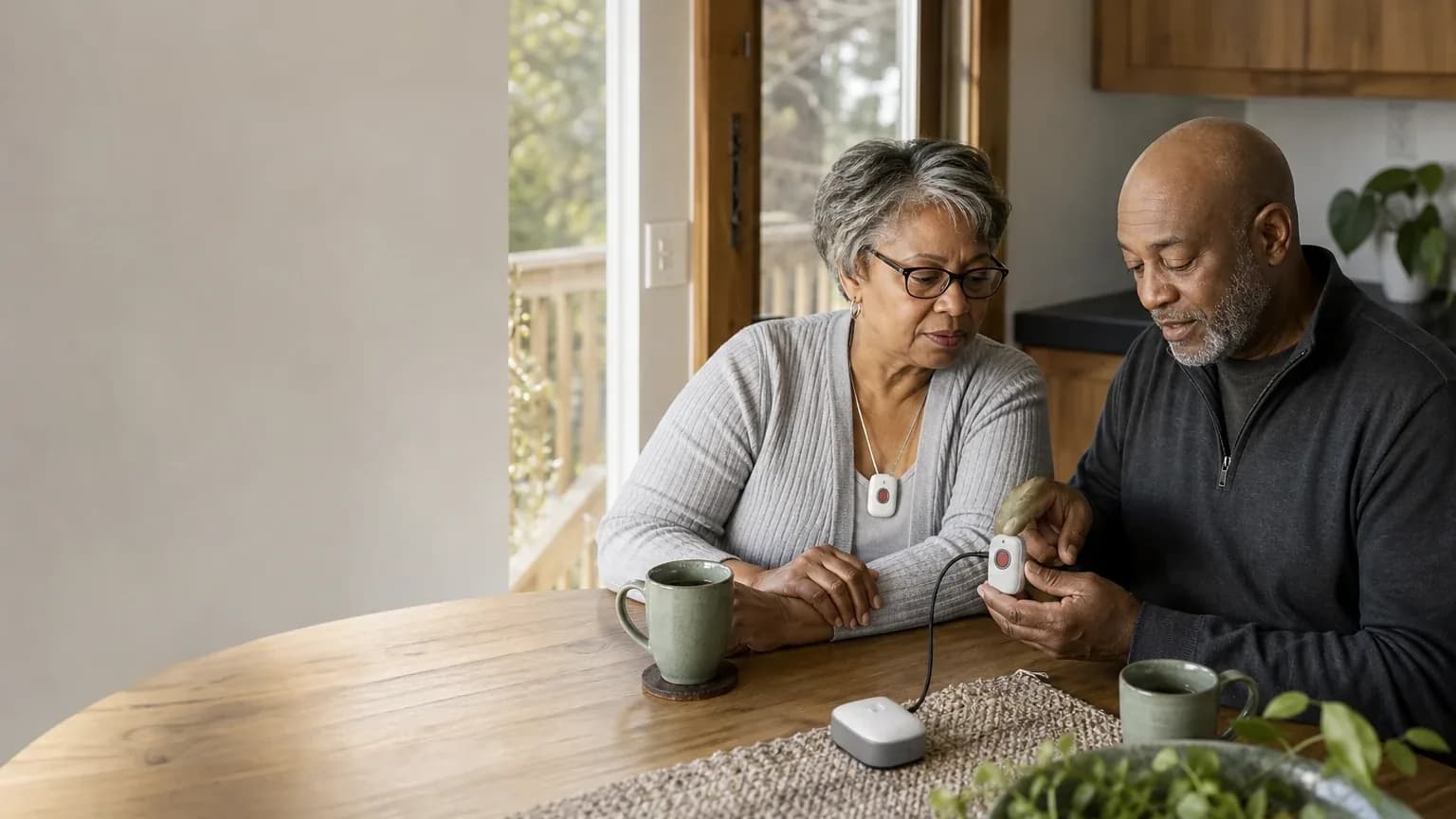
The relevant offering is the Medical Alert Home System — cellular or landline — with a second help button. Medical Alert states that one Home System base unit can serve two people, each with a separate help button, individual profile, response plan, and optional per-person fall detection [5]. A couples guide on the company site repeats that each wearer gets a personal profile with customized medical notes and contact preferences, and that fall detection can be added per pendant [7].
Additional neck or wrist buttons can be purchased for Home Systems, while each mobile-system user needs their own mobile system [8]. The Home System page describes an in-home communicator, a help button, interchangeable pendant and bracelet options, and account management (anthropic:44-8). The Medical Alert Connect app is reported to support multiple user profiles on one account with real-time caregiver notifications (grok:2).
Two naming and scope cautions apply. First, the "Basic Systems" label does not correspond to a clearly documented product tier in the reviewed materials (openai, kimi). Second, a Home System is not equivalent to two mobile systems: independent coverage notes state that a coupled in-home system does not protect users once they leave the base station's signal range [10].
What the AI Platforms Agreed About
Questions This Section Answers
- Do AI platforms agree that Medical Alert Basic Systems supports two users under one account?
- What do reviewers agree the Medical Alert Home System includes for couples?
Platforms broadly agreed on the core dual-user architecture. OpenAI, Grok, Perplexity, and Google all describe one base unit serving two people with separate buttons and separate profiles [11]. This is company-owned evidence repeated across platforms rather than independent verification.
Platforms also agreed on the advertised hardware envelope: up to 800 feet of help-button range from the base unit, cellular operation without a landline, and up to 30 hours of backup battery [14]. Independent testing by SeniorLiving.org confirmed the 800-foot figure and found the help button remained responsive throughout home testing (anthropic:3-4, anthropic:3-5).
On fall detection, platforms agreed it is an optional add-on rather than a standard inclusion, priced at an additional $10 per month, and that the company states it does not detect 100% of falls [16]. Google reported that the $10 monthly charge applies per user if both spouses want fall protection [17].
On contract structure, platforms agreed the company advertises monthly and annual plans with no long-term contract [14]. Independent reviews add that semiannual and annual plans carry discounts and that a 30-day return window exists [19].
Where the AI Platforms Disagreed or Were Uncertain
Questions This Section Answers
- Why can't buyers find a published price for a second Medical Alert help button?
- Do AI platforms disagree about Medical Alert Basic Systems pricing for two users?
The largest unresolved issue is second-button pricing. OpenAI reported that the company separately states added buttons can be purchased and that couples can use individual profiles, but does not clearly publish the current price or discount for the second button [20]. Perplexity found no clearly published second-pendant discount or spouse-monitoring price break [21]. Grok stated the exact cost and terms for a second button are unclear without direct inquiry (grok). Google reported that the website does not disclose the current standalone cost, one-time or monthly, for the extra button (google). DeepSeek rated pricing confidence low and said a direct quote is required for a reliable two-user total (deepseek). Kimi could not confirm any second-pendant or spousal pricing at all (kimi).
Pricing figures conflict across independent sources. Google noted third-party reviews cite starting prices ranging from $19.95 to $29.95 per month depending on promotional periods and billing cycles (google). Perplexity reported that public sources disagree on some Medical Alert pricing figures and package names, so third-party pricing should be treated as approximate [23]. Anthropic listed a $99.95 one-time setup fee and $24.95 shipping per order, waived with semiannual or annual plans (anthropic). Grok also referenced a possible $99.95 one-time equipment or shipping charge in some reviews (grok). These figures are platform-reported and were not confirmed on the company's own pages.
Cancellation terms are also contested. Perplexity reported that the subscriber terms describe month-to-month renewal unless canceled in writing, and that early cancellation within the initial three-month period can trigger a non-refundable three-month minimum plus a $35.00 restocking fee, a programming fee, and shipping and handling charges [26]. Google and Anthropic instead describe a straightforward 30-day risk-free evaluation with refund [27]. Buyers should treat the early-cancellation fee structure as unresolved.
Range is a third conflict. The company advertises up to 800 feet while also stating that actual coverage depends on device location, environment, equipment, and facility conditions [28]. Independent testing in a 1,700-square-foot house found coverage in nearly every room but a faltering connection in the yard and driveway (anthropic:3-6, anthropic:3-7). DeepSeek reported that the reviewed official page did not publish range in specific units at all (deepseek).
Response time is a fourth. Anthropic cited independent testing showing a 28-second average response for the Medical Alert Home System, described as within industry standards but slower than Bay Alarm Medical's reported 8–12 seconds (anthropic:3-2, anthropic:3-3, anthropic:7-13). No other platform in this study reported a measured response time for this entity.
Finally, no independent source identified in the reviewed search verifies the company's dual-user monitoring, range, response-time, or fall-detection claims (openai). Kimi's search retrieved unrelated results and produced no direct sources for couple-specific pricing or features (kimi).
Use-Case-Specific Features and Capabilities
Questions This Section Answers
- Does the Medical Alert Home System give each spouse a separate medical profile and contact list?
- Can fall detection be added to only one spouse's pendant on Medical Alert Basic Systems?
Dual-profile monitoring is the strongest use-case feature. When either spouse presses their specific button, the monitoring specialist accesses that individual's profile, including medications, medical conditions, and personalized emergency contact preferences [29]. The Medical Alert Connect app is reported to support multiple user profiles on one account with real-time caregiver notifications (grok:2).
Second-pendant availability is confirmed but not priced. Additional neck or wrist buttons can be purchased for Home Systems [31]. No platform found a published second-button price or a couple-specific discount.
Base-station range is advertised at up to 800 feet from the in-home communicator [33]. Independent testing confirmed the figure and found the connection faltered in the yard and driveway of a 1,700-square-foot home (anthropic:3-5, anthropic:3-6, anthropic:3-7). Competitor range comparisons cited by Anthropic put MobileHelp at 1,400 feet and Medical Guardian at 1,300–1,400 feet (anthropic:3-5).
Individual fall detection is an optional add-on priced at an additional $10 per month, added per pendant so either or both wearers can have it [34]. The company states fall detection does not detect 100% of falls and that users should always push their button when they need help [34]. Google reported the $10 charge applies per user if both spouses add it [36]. One platform noted that fall-detection pendants from a different company using a similar name carry a reduced 400-foot range versus 1,000 feet for standard buttons, but Medical Alert does not publish equivalent specifications for its own fall-detection pendant (anthropic:26-2, anthropic:26-13).
Shared monitoring and communication run through the base communicator with two-way voice and 24/7/365 access to response specialists; the company states help may be sent even if the user cannot speak [33]. Google reported that the pendants themselves do not have speakers, so both users must be close enough to the base station to speak with an operator, and that simultaneous alerts from both spouses share a single conversation through the base speaker (google). No other platform confirmed or contradicted that limitation.
Coverage during outages and water exposure are advertised advantages: up to 30 hours of backup battery, and help buttons advertised as waterproof for shower or bath use, with a company disclaimer specifying up to one meter of water for 30 minutes [33].
Mobility outside the home is the clearest capability gap. Medical Alert states that each user of a mobile system needs their own mobile system, so a shared Home System does not by itself provide equivalent off-site coverage for both partners [31]. Independent coverage notes agree that coupled in-home systems stop protecting users once they leave the base station's signal range [37].
Pricing, Fees, Contracts, and Ongoing Costs
Questions This Section Answers
- How much does Medical Alert Basic Systems cost per month for two users, and are there setup or cancellation fees?
- Is there a couple discount or free spouse monitoring with Medical Alert Basic Systems?
The advertised entry price is $29.95 per month for the cellular Home System, with prices varying by system, rate plan, and add-ons [38]. Independent reviews describe that price as among the most affordable in-home cellular options on the market (anthropic:10-11). Fall detection is listed at an additional $10 per month [40].
What is not published matters more for couples. The current price for a second help button, any couple-specific discount, and the total cost for two fall-detection pendants are not clearly published in the reviewed public materials [42]. Perplexity rated pricing confidence low and stated the exact two-user total is not clearly published (perplexity). DeepSeek also rated confidence low and said a direct quote is required (deepseek). Kimi could not verify couple-oriented pricing at all (kimi).
Additional fees are platform-reported and inconsistent. Anthropic listed a $99.95 one-time setup fee and $24.95 shipping per order, waived with semiannual or annual plans (anthropic). Grok referenced a possible $99.95 one-time equipment or shipping charge in some reviews and an optional protection plan at about $5 per month (grok). Google listed a $12.50 shipping fee, waived with semiannual or annual billing, and an optional protection plan that prevents out-of-pocket costs up to $350 for lost or damaged devices (google). Perplexity reported a possible one-time programming fee, a $35.00 restocking fee if canceling within the initial three-month period after activation, non-refundable shipping and handling in that scenario, and applicable sales tax [44]. These figures conflict and none was confirmed on the company's own pricing pages.
Contract terms are more consistent. The company states monthly and annual rate plans are available with no long-term contract [38]. Annual plans include free ground shipping and a free lockbox according to the company [38]. Independent reviews add that semiannual and annual plans carry discounts and that a 30-day return window allows a full refund minus shipping costs [46]. Cancellation requires contacting Medical Alert by email or telephone, and equipment must be returned after cancellation according to the support page [42].
Protection plans cover specified lost or damaged equipment. The Basic plan lists one main-system replacement and replacement of up to two help buttons during a 12-month period; the Premium plan lists unlimited replacements [47]. Plan pricing was not identified on the reviewed public pages [47]. Perplexity reported that protection plans offer 25% off accessories and can be canceled at any time, but it is not clear this applies to dual-user setup costs [48].
Best Suited For
Questions This Section Answers
- Who is Medical Alert Basic Systems best for among older couples living together?
- Is Medical Alert Basic Systems worth it for couples who mostly stay home?
Medical Alert Basic Systems is best suited for couples living in one home who want one shared base station and response connection (openai, anthropic). It fits households needing up to 800 feet of advertised base-station coverage and cellular operation without a landline [49]. It also fits couples where fall detection is needed for one or both partners and can be added per pendant [50].
Budget-conscious couples in smaller homes are the strongest match. Independent reviews describe the $29.95 monthly entry price as among the most affordable in-home cellular options (anthropic:10-11), and Google characterized the model as a cost-effective one-monitoring-fee structure for in-home couples (google). Couples who value contract flexibility also fit: no long-term contract is stated, monthly and annual plans are available, and a 30-day return window is described [49].
Couples who want separate medical profiles and contact lists under one account are a documented fit, since each wearer gets a personal profile with customized medical notes and contact preferences [52]. Couples willing to confirm the two-user quote by phone before ordering are better positioned than those who need fully transparent online checkout, because the second-button price is not published [54].
Probably Not Best Suited For
Questions This Section Answers
- Who should not choose Medical Alert Basic Systems for Shared Household & Two-User Protection?
- Is Medical Alert Basic Systems a poor fit for couples who need protection away from home?
Couples who require transparent, published second-user pricing before ordering are not well served, because the second-button price and any couple discount are not clearly published [56]. Couples needing reliable protection for both users away from home are also a poor fit without buying separate mobile systems, since each mobile-system user needs their own mobile system [56].
Buyers seeking independently verified performance, response-time, or clinical-outcome evidence should look elsewhere: no independent source identified in the reviewed search verifies the company's dual-user monitoring, range, response-time, or fall-detection claims (openai). Couples in large homes, acreage, or multi-story properties requiring range beyond 800 feet are a documented mismatch, given independent testing that found the connection faltered in the yard and driveway of a 1,700-square-foot home (anthropic:3-6, anthropic:3-7).
Households prioritizing automatic fall detection as a baseline feature rather than a paid add-on are also a weaker fit, since fall detection is optional at an additional $10 per month and applies per user if both spouses add it [59]. Couples who need direct two-way talk through the wearable itself may be disappointed: Google reported the pendants do not have speakers, so users must be near the base station to speak with an operator (google).
When Another Option May Be Better
Questions This Section Answers
- What is a better alternative to Medical Alert Basic Systems for a couple who needs free spouse monitoring?
- When should a couple choose a competitor over Medical Alert Basic Systems for wider range or faster response?
Another option may be better when published second-button pricing is a primary requirement. Anthropic reported that Medical Guardian offers extra pendants at $2.99 per month with no additional equipment fees, and that Bay Alarm Medical provides complimentary spousal coverage with a $40 one-time fee for the additional pendant (anthropic:11-6, anthropic:11-7, anthropic:38-3, anthropic:38-4). ADT was reported to include free spousal monitoring with a $14.99 one-time button purchase (anthropic:40-2). These are platform-reported competitor figures from independent review sites.
Wider range is another trigger. Anthropic reported that MobileHelp reaches 1,400 feet and Medical Guardian reaches 1,300–1,400 feet, versus Medical Alert's 800 feet (anthropic:3-5). Couples in large homes or properties with outdoor exposure should weigh that difference.
Faster response time is a third. Anthropic cited independent testing showing a 28-second average for the Medical Alert Home System versus a reported 8–12 seconds for Bay Alarm Medical (anthropic:3-2, anthropic:3-3, anthropic:7-13). Couples who prioritize measured response speed may prefer a provider with published testing.
Mobile coverage for both partners is a fourth. Couples who need GPS or mobile on-the-go alert buttons for both users should consider providers offering paired home-and-mobile plans, since a shared Home System does not cover users outside its range [61]. Google specifically noted that MobileHelp Duo plans pair an in-home system with a mobile GPS unit under one account (google).
Questions to Verify Before Buying
Questions This Section Answers
-
What should a couple confirm with Medical Alert Basic Systems before signing up for two users?
-
Which Medical Alert Basic Systems costs are not published and must be quoted by phone?
-
What is the exact monthly and annual price for a Home System with two help buttons? (openai)
-
Is the second pendant or wrist button discounted, and is the discount recurring or one-time? [62]
-
Will each partner have a separate profile, medical-information record, contact list, and response plan under one account? [63]
-
Can fall detection be added to one pendant only, and what is the total monthly price if added to both? [65]
-
Does the base station support simultaneous or clearly distinguishable alerts from both users? (openai, google)
-
What cellular network is used at the couple's address, and how is coverage tested before or after installation? (openai)
-
What are the current prices and cancellation terms for the Basic and Premium Protection Plans? [67]
-
What equipment-return, shipping, or prorated-refund rules apply when cancelling an annual plan? [69]
-
What happens when one partner leaves the home, and can a Home System and a separate mobile system be combined under one account? [69]
-
What are the measured response times, false-alarm rates, and limitations for the specific fall-detection pendant offered? [65]
Final AI Consensus Verdict
Medical Alert Basic Systems is a good fit for couples who mainly need shared in-home monitoring with two personal buttons and separate response profiles, and a mixed fit on value transparency. Three of seven platforms named it during ranking, and four platforms — OpenAI, Grok, Perplexity, and Google — rated the fit good, while Anthropic and DeepSeek rated it mixed and Kimi rated it uncertain.
The consensus strengths are dual-profile monitoring under one base station, an advertised 800-foot range with cellular operation and 30-hour backup battery, optional per-pendant fall detection at $10 per month, and no long-term contract. The consensus limitations are unpublished second-button pricing, no confirmed couple discount, optional rather than included fall detection, an 800-foot range that independent testing found insufficient for yard and driveway coverage in a 1,700-square-foot home, and a 28-second tested response time that is slower than at least one competitor's reported figure.
This review cannot confirm that AI-platform agreement reflects product quality. Most supporting evidence is company-owned, and no independent source identified in the reviewed search verifies the dual-user monitoring, range, response-time, or fall-detection claims. Verify the two-user quote, profile configuration, and per-user fall-detection cost before purchase. For the broader category comparison, see the Shared Household & Two-User Protection consensus index, and browse the full medical alert systems directory for other providers evaluated under the same criteria.
How This Review Was Produced
This review was produced from a structured multi-platform research run dated 2026-09-26. Seven platforms evaluated Medical Alert Basic Systems for the Shared Household & Two-User Protection use case: OpenAI (gpt-5.6-luna), Anthropic (claude-haiku-4-5-20251001), Google (gemini-3.5-flash), Grok (x-ai/grok-4.3), Perplexity (perplexity/sonar), DeepSeek (deepseek-v4-flash), and Kimi (moonshotai/kimi-k2.6). Six of the seven ran with search enabled; DeepSeek ran without search.
Platforms were asked to assess fit against five category criteria: second-pendant discounting, dual-profile monitoring, base station range, individual fall-detection add-ons, and overall package value. Ranking-stage mentions were counted separately from fit evaluation, so a platform could evaluate the entity without naming it in the ranking stage. Fit ratings were recorded as good, mixed, or uncertain based on each platform's own assessment.
All factual claims in this review are attributed to the platform that supplied them using parenthetical citation IDs. Company-owned sources are distinguished from independent sources in the Sources section. No personal testing, customer experience, or independent verification was performed for this review.
Methodology Limitations
Several limitations apply. Platform-reported research dates differ from the authoritative run date: DeepSeek reported 2026-05-13, while the other six platforms reported 2026-09-27. These are provenance metadata and do not independently prove freshness.
Platform mentions count only platforms that named the entity during ranking discovery, not every platform that evaluated fit. DeepSeek, Google, and Grok evaluated the entity but did not name it in the ranking stage, so their findings appear without a corresponding rank.
Conflicting product names, pricing, and capabilities were not resolved by guessing. The entity label "Medical Alert Basic Systems" is not a clearly distinct product name in the reviewed materials, and the relevant offering appears to be the cellular Home System (openai, kimi). Second-button pricing, couple discounts, per-user fall-detection totals, setup fees, shipping fees, and early-cancellation penalties conflict across sources or are unpublished.
The supplied URLs were collected from platform responses and were not independently validated by the writer stage. Citations are platform-reported evidence, not independently verified facts. DeepSeek ran without search enabled, so its claims require explicit verification before being described as current facts. Kimi's search retrieved unrelated results and produced no direct sources for couple-specific pricing or features, which is why its fit rating is uncertain rather than negative.
No independent source identified in the reviewed search verifies the company's dual-user monitoring, range, response-time, or fall-detection claims. AI-platform agreement on a claim does not establish that the claim is accurate or that the product performs as described.
Sources
Company-Owned Sources
- Award-Winning Medical Alert for In-Home Use: https://www.bayalarmmedical.com/medical-alert-system/in-home/
- Medical Alert Systems | Medical Alert: https://www.medicalalert.com/
- Can Two People Use One Medical Alert System?: https://www.medicalalert.com/blog/can-two-people-use-one-medical-alert-system/
- Medical Alert vs Medical ID Bracelet Differences: https://www.medicalalert.com/blog/medical-alert-bracelet-vs-medical-id-bracelet/
- Medical Alert Systems for Couples Guide: https://www.medicalalert.com/blog/medical-alert-systems-for-couples/
- Automatic Fall Detection: https://www.medicalalert.com/fall-detection/
- Medical Alert Connect Mobile App: https://www.medicalalert.com/mobile-app/
- Medical Alert Home System: https://www.medicalalert.com/product/home-system-cellular/
- Home System Product Page: https://www.medicalalert.com/products/home-system/
- General Information and Support: https://www.medicalalert.com/support/general/
- Mytrex Landline Setup Guide: https://www.medicalalert.com/support/mytrex-landline/
- Protection Plans: https://www.medicalalert.com/support/protection/
- Subscriber Terms and Conditions: https://www.medicalalert.com/support/terms/
- Fall Detection | FAQ | Medical Alert Systems: https://www.medicalcarealert.com/faq-fall-detection-medical-alert-systems/
- Official pricing and terms source: https://www.medicalalert.com/terms-and-conditions/
Additional AI research evidence71 records
- AI research evidence record openai:c1
- AI research evidence record google:1.2.1
- AI research evidence record openai:c2
- AI research evidence record perplexity:c9
- AI research evidence record openai:c1
- AI research evidence record perplexity:c1
- AI research evidence record google:1.2.1
- AI research evidence record openai:c2
- AI research evidence record perplexity:c9
- AI research evidence record google:1.2.4
- AI research evidence record openai:c1
- AI research evidence record perplexity:c1
- AI research evidence record google:1.2.1
- AI research evidence record openai:c3
- AI research evidence record google:1.1.1
- AI research evidence record openai:c4
- AI research evidence record google:3.1.1
- AI research evidence record perplexity:c8
- AI research evidence record google:2.1.2
- AI research evidence record openai:c2
- AI research evidence record perplexity:c1
- AI research evidence record perplexity:c9
- AI research evidence record perplexity:c10
- AI research evidence record perplexity:c12
- AI research evidence record perplexity:c14
- AI research evidence record perplexity:c3
- AI research evidence record google:2.1.2
- AI research evidence record openai:c3
- AI research evidence record google:1.2.1
- AI research evidence record openai:c1
- AI research evidence record openai:c2
- AI research evidence record perplexity:c9
- AI research evidence record openai:c3
- AI research evidence record openai:c4
- AI research evidence record perplexity:c1
- AI research evidence record google:3.1.1
- AI research evidence record google:1.2.4
- AI research evidence record openai:c3
- AI research evidence record perplexity:c5
- AI research evidence record openai:c4
- AI research evidence record google:3.1.1
- AI research evidence record openai:c2
- AI research evidence record perplexity:c9
- AI research evidence record perplexity:c3
- AI research evidence record perplexity:c8
- AI research evidence record google:2.1.2
- AI research evidence record openai:c5
- AI research evidence record perplexity:c6
- AI research evidence record openai:c3
- AI research evidence record openai:c4
- AI research evidence record perplexity:c1
- AI research evidence record google:1.2.1
- AI research evidence record openai:c1
- AI research evidence record openai:c2
- AI research evidence record perplexity:c9
- AI research evidence record openai:c2
- AI research evidence record perplexity:c9
- AI research evidence record google:1.2.4
- AI research evidence record openai:c4
- AI research evidence record google:3.1.1
- AI research evidence record google:1.2.4
- AI research evidence record perplexity:c9
- AI research evidence record openai:c1
- AI research evidence record google:1.2.1
- AI research evidence record openai:c4
- AI research evidence record google:3.1.1
- AI research evidence record openai:c5
- AI research evidence record perplexity:c6
- AI research evidence record openai:c2
- AI research evidence record perplexity:c3
- AI research evidence record google:1.2.4
Independent Sources
- Medical Alert Systems Reviews and Pricing: https://www.consumeraffairs.com/health/medical-alert-systems.html
- Medical Alert Review & Pricing Plans: https://www.everydayhealth.com/senior-health/medical-alert-systems/
- Best Medical Alert Systems With Fall Detection (2026: https://www.lifestation.com/best-medical-alert-systems-with-fall-detection/
- MedicalAlert.com System Review: https://www.medicalalertbuyersguide.org/reviews/medicalalert-com/
- 8 Best Medical Alert Systems 2026: https://www.medicaldaily.com/8-best-medical-alert-systems-2026-475121
- Medical Alert System Features: Which Do You Need?: https://www.ncoa.org/article/medical-alert-features/
- Medical Alert Review in 2026: https://www.ncoa.org/product-resources/medical-alert-systems/medical-alert-review/
- ADT Medical Alert Cost, Packages, Pricing & Monthly Plan: https://www.safehome.org/medical-alert-systems/adt/
- Cheapest & Most Affordable Medical Alert Systems of 2026: https://www.safehome.org/medical-alert-systems/best/affordable/
- Medical Alert Cost, Pricing, Packages and Monthly Plans: https://www.safehome.org/medical-alert-systems/medical-alert/
- ADT Medical Alert System Review - SafeWise: https://www.safewise.com/senior-safety/medical-alerts/adt/
- Best Medical Alert Systems of 2026: Tested and Ranked: https://www.seniorliving.org/medical-alert-systems/best/
- Medical Alert Cost, Pricing, Plans and Packages in 2026: https://www.seniorliving.org/medical-alert-systems/medical-alert/
- At-Home vs Mobile Medical Alert Comparison: https://www.seniorsentry.ca/compare-medical-alert-systems/
- The Best Couples for Medical Alert Systems: https://www.theseniorlist.com/medical-alert-systems/best/couples/
- Medical Alert Systems for Couples and Two People: https://www.topmedicalalertsystems.com/guides/two-person-plans/
Additional AI research evidence71 records
- AI research evidence record openai:c1
- AI research evidence record google:1.2.1
- AI research evidence record openai:c2
- AI research evidence record perplexity:c9
- AI research evidence record openai:c1
- AI research evidence record perplexity:c1
- AI research evidence record google:1.2.1
- AI research evidence record openai:c2
- AI research evidence record perplexity:c9
- AI research evidence record google:1.2.4
- AI research evidence record openai:c1
- AI research evidence record perplexity:c1
- AI research evidence record google:1.2.1
- AI research evidence record openai:c3
- AI research evidence record google:1.1.1
- AI research evidence record openai:c4
- AI research evidence record google:3.1.1
- AI research evidence record perplexity:c8
- AI research evidence record google:2.1.2
- AI research evidence record openai:c2
- AI research evidence record perplexity:c1
- AI research evidence record perplexity:c9
- AI research evidence record perplexity:c10
- AI research evidence record perplexity:c12
- AI research evidence record perplexity:c14
- AI research evidence record perplexity:c3
- AI research evidence record google:2.1.2
- AI research evidence record openai:c3
- AI research evidence record google:1.2.1
- AI research evidence record openai:c1
- AI research evidence record openai:c2
- AI research evidence record perplexity:c9
- AI research evidence record openai:c3
- AI research evidence record openai:c4
- AI research evidence record perplexity:c1
- AI research evidence record google:3.1.1
- AI research evidence record google:1.2.4
- AI research evidence record openai:c3
- AI research evidence record perplexity:c5
- AI research evidence record openai:c4
- AI research evidence record google:3.1.1
- AI research evidence record openai:c2
- AI research evidence record perplexity:c9
- AI research evidence record perplexity:c3
- AI research evidence record perplexity:c8
- AI research evidence record google:2.1.2
- AI research evidence record openai:c5
- AI research evidence record perplexity:c6
- AI research evidence record openai:c3
- AI research evidence record openai:c4
- AI research evidence record perplexity:c1
- AI research evidence record google:1.2.1
- AI research evidence record openai:c1
- AI research evidence record openai:c2
- AI research evidence record perplexity:c9
- AI research evidence record openai:c2
- AI research evidence record perplexity:c9
- AI research evidence record google:1.2.4
- AI research evidence record openai:c4
- AI research evidence record google:3.1.1
- AI research evidence record google:1.2.4
- AI research evidence record perplexity:c9
- AI research evidence record openai:c1
- AI research evidence record google:1.2.1
- AI research evidence record openai:c4
- AI research evidence record google:3.1.1
- AI research evidence record openai:c5
- AI research evidence record perplexity:c6
- AI research evidence record openai:c2
- AI research evidence record perplexity:c3
- AI research evidence record google:1.2.4
Verify This Research
Review the study details behind this page or download the public machine-readable verification record.
- Study date
- September 26, 2026
- Platforms analyzed
- 7
- Source records
- 31
- Ranking mentions
- 3 of 7
- Platform share
- 43%
- Final consensus rank
- #6
Research trail and source mix
Configured platforms
openai, anthropic, deepseek, grok, perplexity, kimi, google
Source mix
16 independent · 15 company-owned
Evidence support
26 direct · 4 partial
Important limitation
Use the run research_date as the study date. Platform-reported dates are provenance metadata and do not independently prove freshness.
Source snapshot SHA-256 c15435f580bb4ecf3195de9c5717a2cb344c3da591cf7d4bdb3f8aa6957a4bf1