
Answer Capsule
ClearCaptions Blue Phone is a good fit for U.S. seniors with mild-to-severe hearing loss who need real-time call captions plus amplified audio, and who have home internet. Three of seven platforms named it during the ranking stage (43% of included platform responses), at an average listed rank of 5.3 and a best rank of 3. Its strongest advantage is a federally funded IP Captioned Telephone Service that combines near-real-time captions, adjustable amplification, visual call alerts, and hearing-aid compatibility at no direct cost to eligible users. The main limitation is verification: no maximum dB amplification figure or numeric HAC M/T rating was published in the reviewed sources, and the Blue model name may not match currently issued hardware.
Research Snapshot
| Field | Finding |
|---|---|
| Platform mentions in ranking stage | 3 of 7 platforms (anthropic, google, kimi) |
| Share of included platform responses | 43% |
| Average listed rank | 5.3 |
| Best listed rank | 3 (google) |
| Relevant product/model/plan | ClearCaptions Home Phone and federally funded IP Captioned Telephone Service using the ClearCaptions Blue phone |
| Overall use-case fit | Good — captioning-first accessibility phone with amplification controls |
| Research date | 2026-09-26 |
What Changed Since August 2026
ClearCaptions Blue Phone remained at No. 7, and platform mentions increased from 2 to 3. The September 2026 review keeps the same core buyer picture: ClearCaptions Blue Phone is still presented as a captioning-first home phone for U.S. seniors with hearing loss who have home internet, with amplification, visual alerts, and hearing-aid compatibility noted but no published maximum amplification figure or numeric HAC rating. The description and supporting evidence were rewritten across most sections, including a new explanation of why the phone qualified, but that is an article-level refresh, not evidence the product changed. No pricing changes were reported, and the recommended configuration is unchanged. Differences between the two editions reflect what each article reports; they do not by themselves prove that the product, service, or price changed.
The August 2026 review preserves the earlier article for reference.
Why ClearCaptions Blue Phone Qualified for This Study
Questions This Section Answers
- Is ClearCaptions Blue Phone a good choice for amplified and hearing-accessible phones for a senior with hearing loss?
- How many AI platforms named ClearCaptions Blue Phone in the amplified and hearing-accessible phone rankings?
ClearCaptions Blue Phone qualified because it was named by three of the seven platforms whose responses were included in this study, clearing the two-mention minimum for finalist consideration. Anthropic listed it at rank 4, google at rank 3, and kimi at rank 9, producing an average listed rank of 5.3 and a best listed rank of 3 [1].
Qualification was based on the category criteria for this use case: decibel amplification level, Hearing Aid Compatibility rating, real-time captioning support, visual ringer alerts, and audio clarity enhancement. The entity addresses captioning, amplification controls, and visual alerting directly, but the reviewed sources did not establish a published dB figure or a numeric HAC M/T rating [2].
Platforms that evaluated fit without naming the entity during ranking discovery are not counted in the mention total. This distinction matters: the mention count measures ranking-stage discovery, not whether a platform considered the product suitable.
The Product, Model, Plan, or Service Most Relevant to Amplified & Hearing-Accessible Phones
Questions This Section Answers
- Which ClearCaptions product or plan should a buyer choose if they need amplified call audio plus real-time captions at home?
- Is the ClearCaptions Blue Phone still the model being supplied, or has it been replaced by a newer ClearCaptions phone?
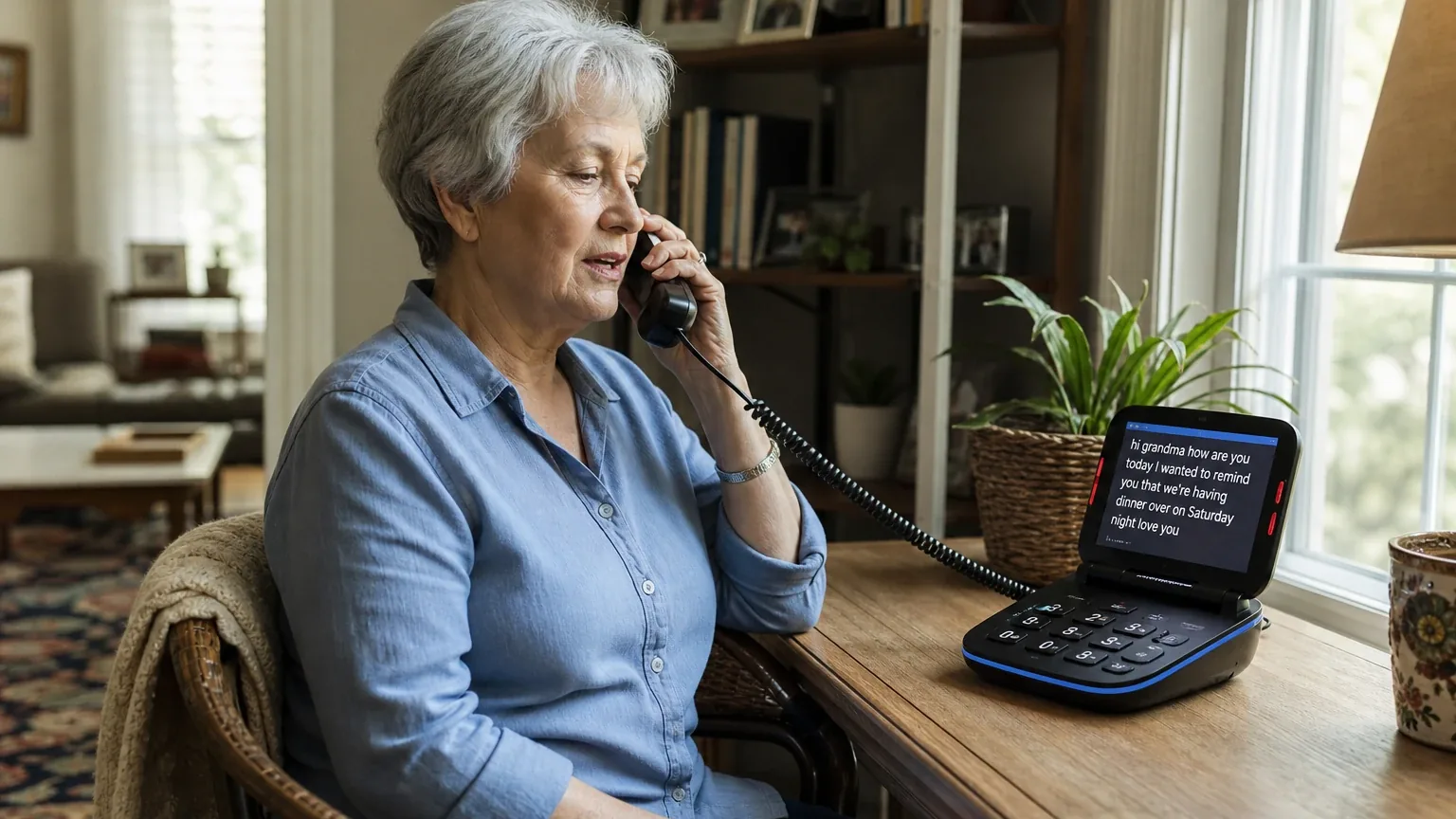
The relevant offering is the ClearCaptions home phone paired with Internet Protocol Captioned Telephone Service (IP CTS), funded through the federal Telecommunications Relay Service program [4]. The hardware referenced across platform responses is the ClearCaptions Blue phone, a caption phone with a color touchscreen, a physical keypad, amplified handset and speakerphone audio, and a flashing light bar [5].
Naming is a genuine open question. ClearCaptions terms define "ClearCaptions Phone" as a ClearCaptions-branded telephone "including a mobile telephone," and state that the term refers to either "Blue" or "Ensemble" (official:C2). The current official home-phone page generally describes the product as the "ClearCaptions Phone" rather than the Blue [6]. Buyers should confirm which model is being shipped before ordering.
The service, not the handset, is the core of the offer. IP CTS delivers near-real-time captions of the other party's speech to the phone screen, generated by automated speech recognition, live communications assistants, or both [6]. The FCC certified ClearCaptions to provide IP CTS, with compensation authorization running through April 3, 2028 [8].
What the AI Platforms Agreed About
Questions This Section Answers
- What do AI platforms agree ClearCaptions Blue Phone does well for seniors who cannot understand speech on the phone?
- Is ClearCaptions Blue Phone free for qualified U.S. residents with hearing loss?
Agreement was strongest on captioning, cost structure, and eligibility gating. All seven platform responses described real-time or near-real-time captioning as the product's central function [9].
Platforms also agreed, with near-uniform support, that the phone and captioning service are provided at no direct cost to eligible U.S. residents under Title IV of the Americans with Disabilities Act, funded through the federally administered TRS Fund [13]. ClearCaptions' own terms confirm the no-cost framing while reserving exceptions for certain taxes, government-mandated and elective fees, charges for a ClearCaptions Phone, and surcharges [17].
A third area of agreement was eligibility restriction. Federal law limits captioned use to registered users with hearing loss that necessitates IP CTS, and users must register and self-certify [18]. Platforms consistently treated this as a gate rather than a drawback.
Agreement among AI platforms reflects overlapping source material, not independent proof of product quality. Several platforms drew on the same company pages and the same third-party review.
Where the AI Platforms Disagreed or Were Uncertain
Questions This Section Answers
- What is the maximum dB amplification of the ClearCaptions Blue Phone, and does it have a published HAC M/T rating?
- Does ClearCaptions Blue Phone support Spanish captions or only English?
The largest unresolved question is amplification specification. No platform located a published maximum dB figure for the Blue handset or speakerphone [20]. One independent source notes a competing Clarity Ensemble model amplifies up to 50 dB while Blue's output is undisclosed (anthropic:cc-9). Kimi went further and characterized the Blue as a caption phone rather than an amplified phone, arguing it is not marketed as an amplification-first device (kimi:deafvibes_amplified_vs_caption). That is a platform interpretation, not a verified specification.
HAC documentation was similarly split. The Blue user guide states the equipment is hearing-aid compatible under FCC 47 CFR Section 68.316 [22]. One platform cited TIA-1083 certification for modern caption phones including similar models [23], while others reported no verified M or T rating [21]. The FCC requires wireline and wireless handsets to be rated and labeled with M and T ratings, so the absence of a published rating is a documentation gap buyers should close directly (deepseek:fcc-hac).
Language support conflicted. One independent review states the captioning service supports English only (anthropic:cc-12), while ClearCaptions' sign-up page describes near-real-time captions for English and bilingual English/Spanish individuals [24]. Whether bilingual support applies to the Blue phone specifically was not established.
Visual ringer support was confirmed by some platforms [20] and reported as unverified by others [21]. Audio clarity beyond volume adjustment — noise reduction, frequency shaping, or speech enhancement — was not documented in any reviewed source [25].
Use-Case-Specific Features and Capabilities
Questions This Section Answers
- Does ClearCaptions Blue Phone have a visual ringer alert and Bluetooth hearing aid streaming for a senior with hearing loss?
- How does the ClearCaptions Blue Phone handle 911 calls and emergency alerts?
Captioning is the primary accommodation. The phone displays near-real-time text of the other caller's speech on a full-color touchscreen, with adjustable caption size, speed, and color, including inverted color settings [26]. Captioning may involve a live communications assistant listening to the incoming audio, and ClearCaptions states that incoming audio and transcription are not retained except for voicemail stored on its servers [27].
Amplification is adjustable rather than specified. The Blue installation checklist documents handset and speakerphone volume controls, an Amplify mode that boosts volume further, and an Amplify Reset function [28]. ClearCaptions setup guidance describes the same Amplify mode and automatic volume reset [29]. The FCC granted ClearCaptions a waiver related to volume control reset on Blue telephones [30]. No maximum dB level was published.
Hearing-aid compatibility is documented at the regulatory level but not numerically. The Blue user guide cites FCC 47 CFR Section 68.316 compatibility [31], and a 2019 company announcement claims Bluetooth connectivity for hearing aids [32]. An independent review states the phone streams the caller's voice directly into Bluetooth-enabled hearing aids or cochlear implant processors (anthropic:cc-5). Buyers should confirm compatibility with their specific hearing aid or processor model.
Visual alerting is present. The Blue phone has a built-in flashing light bar that signals incoming calls, new messages, and missed calls [28].
Emergency communications carry explicit limits. The current product page lists an Emergency Alert System integrated with FEMA [26], but ClearCaptions terms state that 911 calling over the service differs from traditional wireline or TTY service, may fail during broadband or power outages, may not reach the geographically appropriate response center, and may not transmit location data (official:C2). The terms also disclaim liability for emergency-alert transmission failures. This should not be treated as a safety guarantee.
Pricing, Fees, Contracts, and Ongoing Costs
Questions This Section Answers
- How much does ClearCaptions Blue Phone cost per month, and are there setup or cancellation fees for qualified users?
- What costs does a ClearCaptions Blue Phone buyer still pay if they do not qualify for the federal IP CTS program?
For qualified U.S. residents, ClearCaptions states that the phone hardware and IP CTS captioning service are provided at no direct cost through the federally administered TRS Fund [33]. Multiple platforms reported zero cost for hardware, in-home setup, training, and ongoing support [35]. This is a regulated accessibility program, not a normal retail purchase.
Exceptions exist and are stated in the company's own terms. ClearCaptions reserves the right to recover certain taxes, government-mandated and elective fees, charges for a ClearCaptions Phone, and surcharges, with prior notice before billing [37]. The current amount and the circumstances that trigger these charges were not identified in the reviewed sources.
Cancellation and return terms are partially documented. ClearCaptions terms state that users can cancel service at any time with no charge, and describe a 60-day refund window for amounts actually paid for a ClearCaptions Phone, requiring return of the undamaged device before a refund is issued (official:C2). A one-year replacement window applies to product defects, with ClearCaptions determining whether to repair or replace (official:C2). One platform reported no contracts and no cancellation fees [36]; another noted that equipment may need to be returned if service ends (deepseek:cc-home). Whether every legacy Blue unit remains supported under current warranty terms was not established.
Buyers still pay for their own internet service. Captioning requires a working home internet connection, and any separate internet or telephone bill is the buyer's responsibility [38]. The amount is not specified by ClearCaptions in the sources reviewed.
Best Suited For
Questions This Section Answers
- Who is ClearCaptions Blue Phone best suited for among seniors with mild-to-severe hearing loss?
- Is ClearCaptions Blue Phone worth it for a senior who wants captions on every landline-style call?
ClearCaptions Blue Phone is best suited to U.S. seniors with mild-to-severe hearing impairment who benefit from reading captions while listening, and who have reliable home internet [40]. The combination of captions plus amplified audio serves buyers whose comprehension problem persists even when volume is raised.
It also fits users who want a large touchscreen with adjustable caption display alongside a familiar physical keypad, and who value supported in-home setup and ongoing technical support [41]. Eligible U.S. residents who want captioning hardware and service at no direct cost are the core audience [42].
Buyers who use Bluetooth-enabled hearing aids or cochlear implant processors and want call audio streamed directly to them are a reasonable fit, subject to confirming compatibility with their specific device [44].
Probably Not Best Suited For
Questions This Section Answers
- Who should not choose ClearCaptions Blue Phone for amplified and hearing-accessible phones?
- Is ClearCaptions Blue Phone a poor fit for a senior without home internet or who needs a published dB rating?
Buyers whose primary need is a documented high-decibel amplified handset with a published HAC rating should look elsewhere or verify specifications first, because neither figure was located in the reviewed sources [45]. One platform argued the Blue is not designed or marketed as an amplified phone at all (kimi:deafvibes_amplified_vs_caption).
Users without reliable home internet are a poor fit, since captioning depends on broadband and degrades or fails without it [46]. Buyers who want a fully cordless or mobile-first captioning solution should consider a different product category (deepseek:cc-home, kimi:deafvibes_amplified_vs_caption).
Non-English speakers face a documented barrier. One independent review states the captioning service supports English only (anthropic:cc-12), and the current product page describes English-language eligibility [47]. Buyers with significant visual impairment who cannot read touchscreen text may also struggle with the caption-first interface (anthropic:cc-10).
Ineligible applicants are excluded by federal rule. IP CTS is limited to individuals with medically recognized hearing loss that necessitates captions, and captions must be turned off when non-registered household members use the phone [48].
When Another Option May Be Better
Questions This Section Answers
- What is a better alternative to ClearCaptions Blue Phone for a buyer who needs 50 dB amplification without captions?
- What is a better alternative to ClearCaptions Blue Phone for a senior with no home internet connection?
Choose a conventional amplified phone from a specialist manufacturer when the buyer does not need captions and wants a clearly published maximum dB rating and HAC specification [49]. One independent comparison lists Clarity amplified phones reaching up to 53 dB on the AltoPlus model, with HAC labels and corded or cordless options (kimi:telecom-store_clarity). A separate source notes the Clarity Ensemble amplifies up to 50 dB while Blue's output is undisclosed (anthropic:cc-9).
Choose a telecoil-capable amplified phone when the buyer needs a built-in amplified magnetic loop transmitter; one source describes the CHAAMP offering 30 dB amplification, a high-pass filter, and T-coil compatibility (kimi:audex_chaamp).
Choose a mobile captioning solution when the buyer primarily needs captions away from home. ClearCaptions' mobile app is available for iPhone and iPad only, with no Android support reported (anthropic:cc-17). Buyers who need Android captioning should evaluate other providers.
Choose a non-internet captioning option when broadband is unavailable. One source notes that IP CTS phones require an internet connection and points to alternatives for households without home internet [50]. Buyers who want no service dependency at all should consider a stand-alone amplified phone (kimi:deafvibes_amplified_vs_caption).
Choose an audiologist-recommended hearing-aid or assistive-listening setup when the main problem is individualized sound quality rather than telephone text captions [49].
Questions to Verify Before Buying
Questions This Section Answers
- What should a buyer confirm with ClearCaptions before accepting a Blue Phone and IP CTS service?
- What internet speed and connection type does ClearCaptions Blue Phone require for reliable captioning?
Confirm the exact model being supplied. Ask whether the unit is specifically the ClearCaptions Blue or a newer ClearCaptions phone, since the current product page uses the generic name and the terms define "ClearCaptions Phone" as either Blue or Ensemble [51].
Confirm the amplification and compatibility specifications. Ask for the maximum handset and speakerphone amplification in dB, the standard used to measure it, and the exact HAC M and T ratings for the unit, plus whether it supports the buyer's specific hearing aid, telecoil, Bluetooth profile, or cochlear implant processor [52].
Confirm connectivity. Ask what internet speed and connection type are required, whether the buyer's router and Wi-Fi arrangement work with the phone, and what happens during an outage or power loss (deepseek:cc-faq, anthropic:cc-14, official:C2).
Confirm language support. Ask whether English is required for captioning and whether any other languages are supported for this specific model [54].
Confirm the cost boundary. Ask whether any taxes, surcharges, equipment charges, shipping fees, or return obligations apply to this applicant, and what happens if eligibility requirements are not met [55].
Confirm privacy and retention. Ask how captions are processed, whether a live assistant may hear the call, and how long captions or call logs remain on the device or elsewhere [56].
Confirm emergency behavior. Ask how the phone handles 911 calls and emergency alerts and what limitations or disclaimers apply [51].
Confirm support terms. Ask whether free in-home setup, lifetime warranty, replacement, shipping, and repair support apply to the specific unit offered [51].
Final AI Consensus Verdict
ClearCaptions Blue Phone earns a good fit rating for amplified and hearing-accessible phones for U.S. seniors with mild-to-severe hearing loss. Three of seven platforms named it during ranking discovery, and every platform that evaluated it rated the fit as good or strong (anthropic, deepseek, google, grok, kimi, openai, perplexity).
The strongest reason to consider it is the combination of near-real-time captions, adjustable amplified audio, visual call alerts, and hearing-aid compatibility, delivered at no direct cost to eligible users under a federally funded program certified through April 3, 2028 [58].
The main limitation is verification, not capability. No maximum dB amplification figure and no numeric HAC M/T rating were published in the reviewed sources, the Blue model name may not match currently issued hardware, and bilingual captioning support is disputed between sources [60]. Buyers whose priority is measured amplification or a documented HAC rating should treat this as a captioning-first option and confirm specifications directly before ordering.
How This Review Was Produced
This review was generated from platform fit-research responses collected for the "Best Phones for Seniors With Hearing Loss" topic, use case "Amplified & Hearing-Accessible Phones," with a research date of 2026-09-26. Seven platforms supplied fit-research responses: openai, anthropic, deepseek, grok, kimi, perplexity, and google. Three of those platforms named ClearCaptions Blue Phone during ranking discovery, which is the basis for the mention count and share reported above.
Each platform response included a fit rating, use-case findings, limitations, pricing and terms, and questions to verify before buying. Those inputs were consolidated into the sections above. Where platforms disagreed, the disagreement is reported rather than resolved. Company-owned sources are distinguished from independent and government sources throughout, and the Sources section groups them accordingly.
The consensus index for this category is available at Amplified & Hearing-Accessible Phones, which lists the other finalists evaluated under the same criteria. Broader coverage of this product category is organized in the senior technology directory.
Methodology Limitations
Platform-reported research dates differ from the authoritative run date. DeepSeek's response carries a research date of 2026-01-29, while the remaining platforms and the run itself are dated 2026-09-26. Platform-reported dates are provenance metadata and do not independently prove freshness.
All included platforms evaluated fit, but the platform mention count reflects only platforms that named the entity during ranking discovery. Platforms that assessed the product without naming it in ranking are excluded from that count.
The supplied URLs were collected from platform responses and were not independently validated at the writing stage. Citations are platform-reported evidence, not independently verified facts. Claims without retrieved citations are labeled platform-reported or unverified rather than presented as established.
Official-site retrieval failed for at least one platform during the ranking stage, and one platform ran without search enabled. No failed fetch was treated as a verified domain key, and no-search model claims require explicit verification before being described as current facts.
Conflicting product names, pricing, and capabilities were not resolved by guessing. The Blue-versus-current-model naming question, the missing dB and HAC figures, and the English-versus-bilingual captioning conflict are all reported as open items for buyers to verify.
No personal testing, customer experience, medical benefit, or guaranteed performance is claimed in this review. Agreement among AI platforms reflects overlapping source material and does not prove product quality.
Sources
Company-Owned Sources
- The CHAAMP Cell Phone for the Hearing Impaired, By Audex: http://audex.com/chaamp.html
- Call - Captions: https://captions.com/call/
- ClearCaptions | Caption Phones for Hearing Loss at No-Cost: https://clearcaptions.com/
- About ClearCaptions | FCC-Certified Caption Phones: https://clearcaptions.com/about-us/
- Contact ClearCaptions | Phone, Email & Support Hours: https://clearcaptions.com/about-us/contact-us/
- Voicemail, Contacts and More - Your Guide to Using a Caption Phone: https://clearcaptions.com/blog/hearing-technology/guide-using-caption-phone/
- How to Set Up Your ClearCaptions Phone: https://clearcaptions.com/blog/hearing-technology/setting-up-your-clearcaptions-phone/
- Understanding ClearCaptions Phone Security: https://clearcaptions.com/blog/hearing-technology/understanding-clearcaptions-phone-security/
- Caption Phones & Hearing Aids: Why They Work Better Together: https://clearcaptions.com/captioned-phone-hearing-aids/
- ClearCaptions FAQ: https://clearcaptions.com/faq/
- How ClearCaptions Works: https://clearcaptions.com/how-it-works/
- Captioned Telephones | Captioning Phone for Your Home: https://clearcaptions.com/how-it-works/home-phone/
- How do We Provide a Caption Phone Service at No Cost: https://clearcaptions.com/how-it-works/why-its-free/
- ClearCaptions Privacy Policy: https://clearcaptions.com/privacy-policy/
- Sign Up for a Free Caption Phone: https://clearcaptions.com/sign-me-up/
- How ClearCaptions Works | Caption Phone FAQ: https://clearcaptions.com/support/faq/how-clearcaptions-works/
- Getting Started with Your Caption Phone: https://clearcaptions.com/support/getting-started/
- ClearCaptions Terms and Self-Certification Information: https://clearcaptions.com/tv-interest/
- ClearCaptions® Unveils Blue, New Innovative Caption Phone: https://clearcaptions.com/wp-content/uploads/2019/05/J2222-Press-Release-PSTN-Blue-Release_FINAL.pdf
- Blue Install Checklist: https://clearcaptions.com/wp-content/uploads/2020/10/Blue-Installation-Checklist_100220.pdf
- Official pricing and terms source: https://clearcaptions.com/terms/
Additional AI research evidence62 records
- AI research evidence record google:1.1.1
- AI research evidence record openai:c2
- AI research evidence record openai:c4
- AI research evidence record perplexity:c11
- AI research evidence record openai:c2
- AI research evidence record openai:c1
- AI research evidence record perplexity:c15
- AI research evidence record openai:c8
- AI research evidence record openai:c1
- AI research evidence record grok:web:1
- AI research evidence record perplexity:c4
- AI research evidence record google:1.1.3
- AI research evidence record openai:c6
- AI research evidence record grok:web:0
- AI research evidence record perplexity:c5
- AI research evidence record google:1.2.1
- AI research evidence record perplexity:c3
- AI research evidence record openai:c7
- AI research evidence record google:1.4.1
- AI research evidence record openai:c2
- AI research evidence record perplexity:c1
- AI research evidence record openai:c4
- AI research evidence record grok:web:2
- AI research evidence record perplexity:c6
- AI research evidence record openai:c3
- AI research evidence record openai:c1
- AI research evidence record openai:c9
- AI research evidence record openai:c2
- AI research evidence record openai:c3
- AI research evidence record grok:web:12
- AI research evidence record openai:c4
- AI research evidence record openai:c5
- AI research evidence record openai:c6
- AI research evidence record perplexity:c4
- AI research evidence record grok:web:0
- AI research evidence record google:1.2.2
- AI research evidence record perplexity:c3
- AI research evidence record openai:c1
- AI research evidence record google:1.2.3
- AI research evidence record openai:c1
- AI research evidence record google:1.2.2
- AI research evidence record openai:c6
- AI research evidence record perplexity:c7
- AI research evidence record openai:c5
- AI research evidence record openai:c2
- AI research evidence record google:1.4.8
- AI research evidence record openai:c1
- AI research evidence record openai:c7
- AI research evidence record openai:c1
- AI research evidence record google:1.4.8
- AI research evidence record openai:c1
- AI research evidence record openai:c2
- AI research evidence record openai:c4
- AI research evidence record perplexity:c6
- AI research evidence record perplexity:c3
- AI research evidence record openai:c9
- AI research evidence record google:1.2.2
- AI research evidence record openai:c8
- AI research evidence record perplexity:c11
- AI research evidence record openai:c2
- AI research evidence record openai:c4
- AI research evidence record perplexity:c6
Independent Sources
- Amplified Phones vs Caption Phones: Which One You Really Need - Deaf Vibes: https://deafvibes.com/living-with-hearing-loss/amplified-phone-vs-caption-phone/
- 5 Best Hearing Aid Compatible Cell Phones for Clear Communication - Deaf Vibes: https://deafvibes.com/vetted/best-hearing-aid-compatible-cell-phones/
- ClearCaptions Internet-Based TRS Certification, DA 23-291: https://docs.fcc.gov/public/attachments/DA-23-291A1.pdf
- Best Amplified Phones for Seniors & Hearing Loss: https://hearfitworld.com/the-complete-guide-to-amplified-phones-for-seniors-and-people-with-hearing-loss/
- Closed Caption Phone | Captioned Telephone Without Internet: https://sorenson.com/
- Clarity Amplified Phones for Seniors, Hearing Loss, and Offices | Buyer Tips & Comparison: https://telecom-store.com/amplified-telephones/clarity-amplified-phones/
- What are ClearCaptions' Products and Services?: https://www.audiologyonline.com/
- The Best Caption Phones for Seniors - Caring.com: https://www.caring.com/
- ClearCaptions Certified to Provide IP CTS Using Automatic Speech Recognition: https://www.fcc.gov/clearcaptions-certified-provide-ip-cts-using-automatic-speech-recognition-0
- Hearing Aid Compatibility for Wireline and Wireless Telephones: https://www.fcc.gov/consumers/guides/hearing-aid-compatibility-wireline-telephone-service
- Telecommunications Relay Service: https://www.fcc.gov/consumers/guides/telecommunications-relay-service-trs
- ClearCaptions Certified for Fully Automatic IP Captioned Phone Service: https://www.fcc.gov/document/clearcaptions-certified-fully-automatic-ip-captioned-phone-service
- FCC Certifies ClearCaptions to Provide Internet Protocol Captioned Telephone Service: https://www.fcc.gov/fcc-certifies-clearcaptions-provide-internet-protocol-captioned-telephone-service
- ClearCaptions Unveils Blue, New Innovative Caption Phone: https://www.globenewswire.com/news-release/2019/05/14/1823834/0/en/ClearCaptions-Unveils-Blue-New-Innovative-Caption-Phone-Blending-Modern-Tech-and-Accessibility.html
- The Clear Caption Phone: A Comprehensive Review of ClearCaptions: https://www.hearingtracker.com/
- Captioned Telephones: The Definitive Guide to IP CTS (2026: https://www.hearingtracker.com/captioned-telephones
- The Clear Caption Phone: A Comprehensive Review of ClearCaptions: https://www.hearingtracker.com/captioned-telephones/clearcaptions-review
- ClearCaptions improves service to hard of hearing by adding VoIP connectivity to home phone: https://www.prnewswire.com/
- Clarity Ensemble Amplified Captioned Phone with ClearCaptions: https://www.prohearingcare.com/shop/uncategorized/clarity-ensemble-amplified-captioned-phone-with-clearcaptions/
- How to Set Up Your Internet-Enabled ClearCaptions Phone: https://www.youtube.com/
Additional AI research evidence62 records
- AI research evidence record google:1.1.1
- AI research evidence record openai:c2
- AI research evidence record openai:c4
- AI research evidence record perplexity:c11
- AI research evidence record openai:c2
- AI research evidence record openai:c1
- AI research evidence record perplexity:c15
- AI research evidence record openai:c8
- AI research evidence record openai:c1
- AI research evidence record grok:web:1
- AI research evidence record perplexity:c4
- AI research evidence record google:1.1.3
- AI research evidence record openai:c6
- AI research evidence record grok:web:0
- AI research evidence record perplexity:c5
- AI research evidence record google:1.2.1
- AI research evidence record perplexity:c3
- AI research evidence record openai:c7
- AI research evidence record google:1.4.1
- AI research evidence record openai:c2
- AI research evidence record perplexity:c1
- AI research evidence record openai:c4
- AI research evidence record grok:web:2
- AI research evidence record perplexity:c6
- AI research evidence record openai:c3
- AI research evidence record openai:c1
- AI research evidence record openai:c9
- AI research evidence record openai:c2
- AI research evidence record openai:c3
- AI research evidence record grok:web:12
- AI research evidence record openai:c4
- AI research evidence record openai:c5
- AI research evidence record openai:c6
- AI research evidence record perplexity:c4
- AI research evidence record grok:web:0
- AI research evidence record google:1.2.2
- AI research evidence record perplexity:c3
- AI research evidence record openai:c1
- AI research evidence record google:1.2.3
- AI research evidence record openai:c1
- AI research evidence record google:1.2.2
- AI research evidence record openai:c6
- AI research evidence record perplexity:c7
- AI research evidence record openai:c5
- AI research evidence record openai:c2
- AI research evidence record google:1.4.8
- AI research evidence record openai:c1
- AI research evidence record openai:c7
- AI research evidence record openai:c1
- AI research evidence record google:1.4.8
- AI research evidence record openai:c1
- AI research evidence record openai:c2
- AI research evidence record openai:c4
- AI research evidence record perplexity:c6
- AI research evidence record perplexity:c3
- AI research evidence record openai:c9
- AI research evidence record google:1.2.2
- AI research evidence record openai:c8
- AI research evidence record perplexity:c11
- AI research evidence record openai:c2
- AI research evidence record openai:c4
- AI research evidence record perplexity:c6
Other Sources
- FCC Order granting waiver to ClearCaptions: https://docs.fcc.gov/public/attachments/DA-25-814A1_Rcd.pdf
- ClearCaptionsblue Calling Phone User Guide: https://manuals.plus/clearcaptions/clearcaptionsblue-calling-phone-manual.pdf
- FCC Certifies ClearCaptions to Provide Internet Protocol Captioned Telephone Service: https://www.fcc.gov/
Additional AI research evidence62 records
- AI research evidence record google:1.1.1
- AI research evidence record openai:c2
- AI research evidence record openai:c4
- AI research evidence record perplexity:c11
- AI research evidence record openai:c2
- AI research evidence record openai:c1
- AI research evidence record perplexity:c15
- AI research evidence record openai:c8
- AI research evidence record openai:c1
- AI research evidence record grok:web:1
- AI research evidence record perplexity:c4
- AI research evidence record google:1.1.3
- AI research evidence record openai:c6
- AI research evidence record grok:web:0
- AI research evidence record perplexity:c5
- AI research evidence record google:1.2.1
- AI research evidence record perplexity:c3
- AI research evidence record openai:c7
- AI research evidence record google:1.4.1
- AI research evidence record openai:c2
- AI research evidence record perplexity:c1
- AI research evidence record openai:c4
- AI research evidence record grok:web:2
- AI research evidence record perplexity:c6
- AI research evidence record openai:c3
- AI research evidence record openai:c1
- AI research evidence record openai:c9
- AI research evidence record openai:c2
- AI research evidence record openai:c3
- AI research evidence record grok:web:12
- AI research evidence record openai:c4
- AI research evidence record openai:c5
- AI research evidence record openai:c6
- AI research evidence record perplexity:c4
- AI research evidence record grok:web:0
- AI research evidence record google:1.2.2
- AI research evidence record perplexity:c3
- AI research evidence record openai:c1
- AI research evidence record google:1.2.3
- AI research evidence record openai:c1
- AI research evidence record google:1.2.2
- AI research evidence record openai:c6
- AI research evidence record perplexity:c7
- AI research evidence record openai:c5
- AI research evidence record openai:c2
- AI research evidence record google:1.4.8
- AI research evidence record openai:c1
- AI research evidence record openai:c7
- AI research evidence record openai:c1
- AI research evidence record google:1.4.8
- AI research evidence record openai:c1
- AI research evidence record openai:c2
- AI research evidence record openai:c4
- AI research evidence record perplexity:c6
- AI research evidence record perplexity:c3
- AI research evidence record openai:c9
- AI research evidence record google:1.2.2
- AI research evidence record openai:c8
- AI research evidence record perplexity:c11
- AI research evidence record openai:c2
- AI research evidence record openai:c4
- AI research evidence record perplexity:c6
Verify This Research
Review the study details behind this page or download the public machine-readable verification record.
- Study date
- September 26, 2026
- Platforms analyzed
- 7
- Source records
- 44
- Ranking mentions
- 3 of 7
- Platform share
- 43%
- Final consensus rank
- #8
Research trail and source mix
Configured platforms
openai, anthropic, deepseek, grok, perplexity, kimi, google
Source mix
20 independent · 21 company-owned · 3 unclear
Evidence support
35 direct · 9 partial
Important limitation
Use the run research_date as the study date. Platform-reported dates are provenance metadata and do not independently prove freshness.
Source snapshot SHA-256 fa83b1f831295d487bfcf647f71b41ddffa4d7efaf8ce6b1833e1714aa0ef5b8