
Answer Capsule
MedMinder is a strong fit for Automated Medication Management when the buyer's priority is preventing missed doses and accidental double-dosing through locked dose compartments, escalating reminders, and caregiver connectivity. All seven included platforms named MedMinder during the ranking stage — a 100% share of included platform responses — with an average listed rank of 3.14 and a best listed rank of 2. The strongest reason to consider it is the Jon model's hard-locked individual compartments combined with built-in cellular connectivity and multi-channel caregiver alerts. The main limitation is pricing and contract opacity: published figures conflict, and current consumer pricing for the exact connected Jon or Maya configuration is not transparently displayed.
Research Snapshot
| Field | Detail |
|---|---|
| Platform mentions in ranking stage | 7 of 7 included platforms |
| Share of included platform responses | 100% |
| Average listed rank | 3.14 |
| Best listed rank | 2 |
| Relevant product/model/plan | MedMinder connected dispenser service using a locking Jon or Maya device with cellular connectivity, caregiver alerts, and optional pharmacy-filled trays |
| Overall use-case fit | Strong (four platforms rated strong, one good, one mixed, one uncertain) |
| Research date | 2026-09-26 |
What Changed Since August 2026
MedMinder moved up from No. 3 to No. 2, and platform mentions increased from 5 to 7. The September 2026 review keeps the same buyer-facing case for MedMinder: locking Jon compartments, built-in cellular connectivity, and escalating caregiver alerts. Description and supporting evidence were refreshed, but the recommended configuration did not change, and fit guidance for the same buyer remains intact. Pricing evidence shifted rather than settled: $75/month and $50/month are newly reported, while $49.95/month is no longer repeated. Battery backup is now described as roughly 6–12 hours, with older figures not carried forward. Buyers should still confirm the exact model, total monthly cost, contract terms, and battery runtime before ordering. Differences between the two editions reflect what each article reports; they do not by themselves prove that the product, service, or price changed.
The August 2026 review preserves the earlier article for reference.
Why MedMinder Qualified for This Study
Questions This Section Answers
- Why did MedMinder qualify for a 2026 Automated Medication Management fit review?
- How many AI platforms named MedMinder during the ranking stage for senior medication reminders?
MedMinder qualified because every included platform named it during the ranking stage for Best Medication Reminders for Seniors, and each one evaluated it against the Automated Medication Management use case. The platform set was anthropic, deepseek, google, grok, kimi, openai, and perplexity — seven platforms, seven mentions, a 100% share of included platform responses [1].
The entity cleared the study's minimum-mention threshold of two with substantial margin. Its average listed rank was 3.14, its best listed rank was 2, and its final rank was 2. Ranks by platform were: google 2, grok 2, anthropic 3, kimi 3, openai 3, perplexity 4, and deepseek 5.
MedMinder also matched the configured category criteria directly. Platforms described scheduled multi-dose dispensing, locking compartments, visual and audible alerts, caregiver notifications, and battery backup — the five factors the study used to screen candidates [2].
The Product, Model, Plan, or Service Most Relevant to Automated Medication Management
Questions This Section Answers
- Which MedMinder model — Jon or Maya — is the right choice for a senior who may take the wrong dose?
- Does MedMinder Jon include cellular connectivity and caregiver alerts without home Wi-Fi?
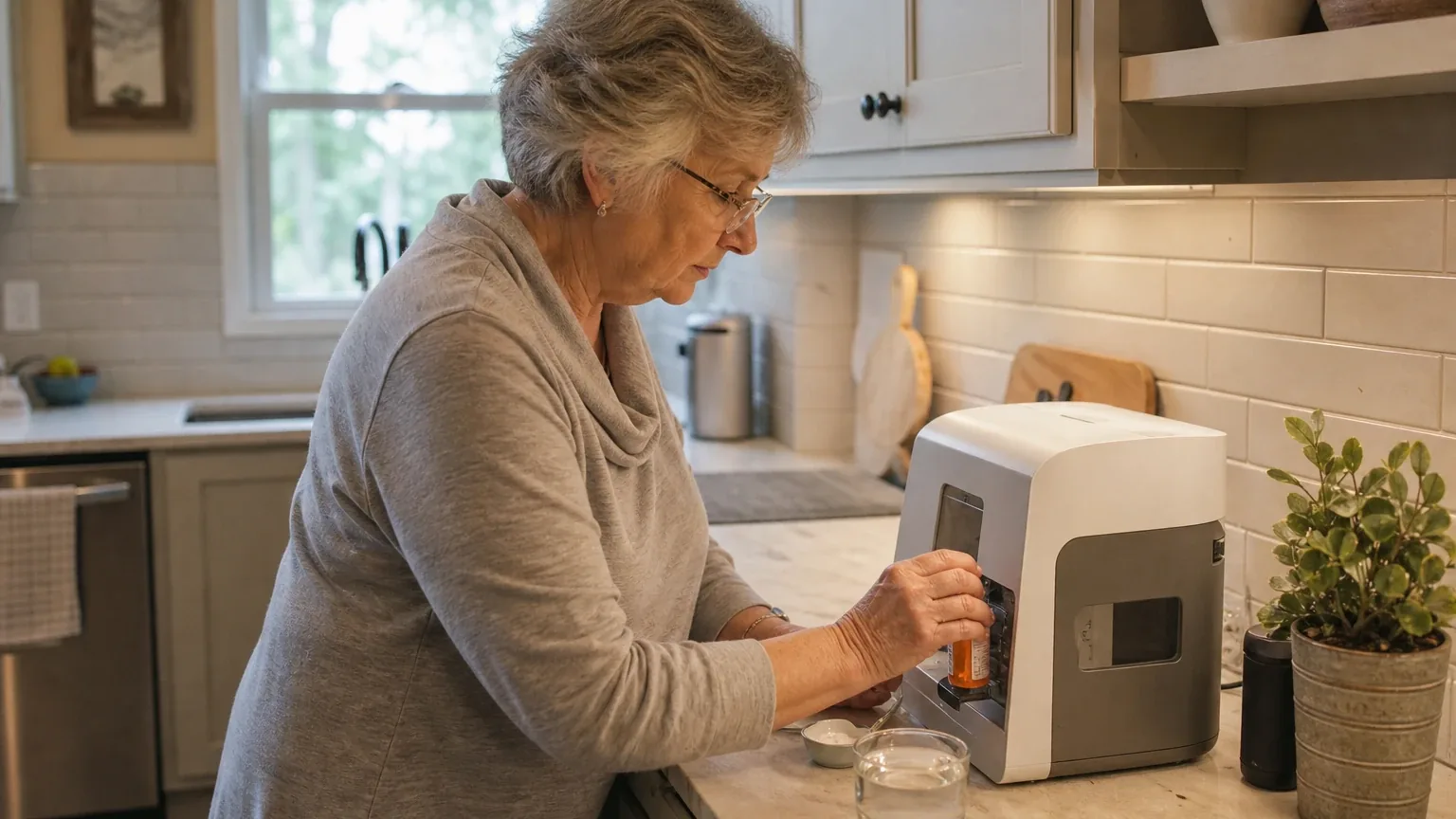
The relevant offering is the MedMinder connected dispenser service, delivered as either the Jon locking model or the Maya model, with cellular connectivity, caregiver alerts, and optional pharmacy-filled trays [6].
The distinction between the two models matters more than any other product detail in this review. Independent reviews describe Jon as a dispenser that looks like a standard pillbox but locks individual compartments, unlocking only the scheduled compartment at the appropriate time (anthropic:1-14, anthropic:1-15, anthropic:37-4). Maya is described as the standard model whose compartments open freely when a dose is due (anthropic:4-12). A scoping review indexed by one platform states that Maya does not possess locking features, whereas models like Jon come with locking mechanisms [8].
For a buyer whose concern is accidental double-dosing, that difference is decisive. One independent review states that Jon prevents a senior with cognitive decline from accessing pills from the wrong time slot even if they try multiple times (anthropic:4-13), and another calls MedMinder the category leader for preventing unauthorized medication access rather than just sending reminders (anthropic:4-4).
Platforms did not agree on a single canonical plan name. Recommended configurations across the seven responses included "MedMinder Jon," "MedMinder Jon locking model with cellular," "MedMinder Jon with Cellular Monitoring," "MedMinder Maya automatic pill dispenser with cellular caregiver alerts and locking," and a combined "Maya/Jon connected medication dispenser service." Buyers should treat the exact model name as something to confirm in writing rather than assume.
What the AI Platforms Agreed About
Questions This Section Answers
- What do AI platforms agree MedMinder does well for preventing missed doses and double-dosing?
- Is MedMinder's cellular connectivity a genuine advantage over Wi-Fi-dependent dispensers?
Agreement was strongest on locking, connectivity, and alert escalation — the three capabilities that map most directly to the stated buyer problem.
On locking, platforms converged. The Jon model locks compartments and unlocks only at scheduled times [9]. One independent review states that no other automatic dispenser provides genuine hard-locked compartments at a comparable price point (anthropic:27-14). Another describes MedMinder as the category leader for preventing unauthorized medication access versus just sending reminders (anthropic:4-4).
On connectivity, agreement was unanimous in substance. MedMinder does not require Wi-Fi because the device includes its own cellular connection, which removes a common point of failure for seniors in homes with unreliable internet and simplifies setup (anthropic:4-14, anthropic:4-15). One review notes that Hero, Pria, and basic LiveFine all require home Wi-Fi, making MedMinder the choice when a parent has no Wi-Fi (anthropic:1-9, anthropic:1-10). Company materials state that no wireless connection or phone line is needed (anthropic:11-3).
On alert escalation, platforms described the same sequence: a flashing light reminder, then an auditory reminder, then a phone call if medications are not taken in a timely fashion (anthropic:11-10, anthropic:14-2, anthropic:14-3, anthropic:14-4). One independent review rated MedMinder strongest in the phone-call alert escalation category (anthropic:1-8).
On capacity, multiple sources describe 28 compartments holding up to roughly 12 pills each (anthropic:2-18, anthropic:5-5). Company FAQ material states each cup can hold up to approximately 11–12 regular M&M-sized pieces and that capacity depends on pill size [10].
On pharmacy support, platforms agreed that MedMinder can pre-sort medications into a tray that loads directly into the device, removing the manual filling step (anthropic:2-21, anthropic:4-16, anthropic:29-3).
Where the AI Platforms Disagreed or Were Uncertain
Questions This Section Answers
- Why do AI platforms disagree about MedMinder's monthly price and contract terms?
- Is MedMinder's battery backup duration confirmed, or do sources conflict?
Pricing is the largest and most consequential conflict. Reported monthly figures span a wide range and do not reconcile cleanly.
| Reported figure | Source type | Citation |
|---|---|---|
| $125/month | Company shop page | [11] |
| $49.95/month plus ~$175 device | Independent review | [12] |
| $75/month with 3-year commitment | Independent journalism | [13] |
| ~$50/month | Competitor page | (kimi:hero-competitor-mention) |
| Up to $125/month | Independent review | [14] |
One platform explicitly flagged that public sources conflict on monthly price, with figures reported around $45, $75, and $125 depending on source and plan [15]. Another noted that MedMinder's official store and website focus heavily on direct pharmacy enrollments, making standalone consumer device pricing less transparent without contacting sales [13]. A third stated that pricing was not verifiable from the checked MedMinder page at all [16].
Battery backup is the second unresolved item. Several sources state a 48-hour backup [17]. Company FAQ material instead describes a rechargeable battery lasting approximately 6–12 hours during a power outage, with duration depending on conditions [19]. One platform reported that battery backup is not clearly documented in the accessible public sources it reviewed [20]. These figures are not reconcilable from the supplied evidence, and the discrepancy should be treated as unresolved.
Daily dosing frequency is a third conflict. One caregiver report states that Jon handles only 4× daily and that the user did not want a second device for a six-times-daily regimen (anthropic:25-10, anthropic:25-11). Other sources describe a 28-compartment tray as supporting a 7-day supply at four doses daily [22]. Official product specifications confirming a hard daily-dose ceiling were not located in the reviewed materials.
Contract terms are a fourth gap. One secondary source reports a 3-year commitment [15], while another describes contract-free plans with a 30-day money-back guarantee depending on insurance or clinical partners [13]. Independent reviews state hardware must be returned if the subscription is cancelled (anthropic:40-3). No early-termination fee structure was published in the reviewed sources.
Finally, one platform could not retrieve MedMinder's own website in its search results and relied entirely on indirect and competitor-sourced claims, rating its fit as uncertain as a result (kimi:hero-competitor-mention).
Use-Case-Specific Features and Capabilities
Questions This Section Answers
- How many compartments and pills per cup does MedMinder hold for a multi-prescription regimen?
- What happens when a MedMinder dose is missed, and who gets notified?
Dose compartment capacity. Sources describe 28 compartments holding up to 12 pills each (anthropic:2-18, anthropic:5-5). Company FAQ material states each cup holds up to approximately 11–12 regular M&M-sized pieces and that actual capacity depends on pill size [24]. One platform noted that the exact number of compartments or pill capacity per model is not specified on the page it checked [25]. Buyers should confirm capacity against their specific prescription mix.
Alert intensity. MedMinder provides visual and auditory alerts: beeps that can be easily heard and lights that flash on and off (anthropic:14-2, anthropic:14-3). The system then provides automatic phone calls as reminders if lights and beeps do not prompt medication (anthropic:14-4). One platform reported that exact decibel levels, light intensity, and configurability are not published on the page it checked [25].
Automatic locking. The Jon model locks compartments and unlocks only at scheduled times (anthropic:37-4). Company brochure material describes locked compartments and Jon unlocking and relocking schedules [26]. One platform noted that trays are not child-safe as shipped and that the locked configuration is optional, so buyers should confirm the ordered model and tray configuration actually include locking [24].
Caregiver notification. Caregivers can receive instant notifications if a dose is missed, allowing prompt intervention (anthropic:13-1, anthropic:13-4). The MMConnect portal provides a full history of doses taken, missed, and taken late with timestamps, and caregivers can review weekly and monthly adherence patterns (anthropic:27-5, anthropic:27-6). Company mobile application documentation describes caregiver notification settings [27]. No source established a guaranteed notification delivery time [24].
Battery backup. Reported as 48 hours by several sources [28] and as approximately 6–12 hours by company FAQ material [24]. This conflict is unresolved.
Connectivity resilience. Wi-Fi is not required because the device includes cellular connectivity. If wireless coverage is unavailable, local lights, beeps, and locking can continue while powered; remote calls, email, and texts require wireless or Wi-Fi connectivity [24].
Pharmacy support. MedMinder pharmacy enrollment can provide setup, medication synchronization, adherence packaging, delivery, medication reviews, and reporting [30]. One source states the pharmacy service does not increase costs beyond normal medication copays and that MedMinder coordinates with insurance (anthropic:7-9). Pharmacy availability and restrictions may vary by state [24].
Clinical evidence. A company publication cites a study in JMIR Formative Research showing improved adherence and reduced caregiver burden over six months (anthropic:22-1). A registered clinical trial describes an Enhanced Medication Management Program aimed at increasing frail elders' ability to adhere to complex regimens (anthropic:24-1). MedMinder also publicly reports a 92% average adherence rate, but this is a company claim without sufficient independent methodology in the cited material [31].
Pricing, Fees, Contracts, and Ongoing Costs
Questions This Section Answers
- How much does MedMinder cost per month, and are there setup or cancellation fees?
- Is there a minimum MedMinder contract term or hardware return requirement?
Pricing confidence across platforms was low to moderate, and no platform established current consumer pricing for the exact connected Jon or Maya configuration with confidence.
Known and reported costs include a $125.00 monthly subscription shown on the MedMinder shop page [32], a reported $49.95/month Jon subscription plus approximately $175 upfront device cost [33], a reported $75/month figure with a 3-year commitment [34], and a competitor-cited ~$50/month figure that is unverified by MedMinder directly (kimi:hero-competitor-mention).
Additional fees reported across sources include a setup or initiation fee of approximately $100 that is often waived at signup [33], prescription copays and medication costs when using pharmacy services [33], and possible shipping, installation, or return-related charges depending on plan [35]. Potential charges for replacement trays, shipping, optional medical-alert services, or device replacement were described as unclear [36].
Contract and cancellation terms are not transparently published. Independent reviews state hardware must be returned if the subscription is cancelled (anthropic:40-3). One secondary source reports a 3-year commitment [37], while another describes contract-free plans with a 30-day money-back guarantee depending on insurance or clinical partners [34]. The reviewed patient terms permit termination for nonpayment or nonperformance, but the current customer-facing cancellation procedure, minimum term, notice period, return obligations, and early-termination fees were not clearly established [36].
One platform calculated that over five years MedMinder costs $7,500 at $125/month, versus $2,996 at $49.95/month plus a $175 one-time device cost — a spread wide enough to materially change budget planning (anthropic:7-1, anthropic:4-2).
Best Suited For
Questions This Section Answers
- Who gets the most value from MedMinder for Automated Medication Management?
- Is MedMinder a good choice for a caregiver managing a parent with dementia remotely?
MedMinder is best suited to buyers whose primary concern is physical access control combined with remote caregiver visibility.
Platforms most consistently named these buyer profiles: seniors with cognitive decline or dementia who may attempt to access medications outside scheduled doses [38]; caregivers who need remote missed-dose alerts and adherence visibility (anthropic:13-1, anthropic:27-5); households without reliable Wi-Fi that need built-in cellular connectivity (anthropic:1-9, anthropic:4-14); and families wanting optional pharmacy synchronization, adherence packaging, and home delivery [39].
One platform also noted that for seniors whose doctors want to monitor compliance, MedMinder's clinical connectivity is distinctive (anthropic:27-3). Another described it as suited to users who want a clinically oriented service with pharmacy coordination (kimi:hero-competitor-mention).
Probably Not Best Suited For
Questions This Section Answers
- Who should not choose MedMinder for Automated Medication Management?
- Is MedMinder worth it for a senior taking only one or two medications daily?
MedMinder is probably not the right purchase for several buyer profiles that platforms identified consistently.
Buyers seeking a simple, inexpensive weekly pill organizer should look elsewhere [40]. Seniors taking only one or two medications daily who need basic reminder functionality may find lower-cost options sufficient (anthropic:1-1). Budget-conscious buyers prioritizing lowest total cost of ownership over five or more years should weigh single-purchase alternatives (anthropic:7-1, kimi:livipod-no-subscription).
Buyers unwilling to accept an ongoing connected-device or pharmacy-service relationship are a poor fit [40]. So are situations requiring a person to administer medication, assess symptoms, or verify ingestion — the device does not establish that medication was actually swallowed [40].
Users needing support for liquids, soft gels, or oversized supplements should not assume compatibility [42]. Buyers who need a clearly documented no-commitment, low-cost option, or who require fully transparent fixed public pricing before sales contact, should treat MedMinder cautiously [43].
When Another Option May Be Better
Questions This Section Answers
- What is a better alternative to MedMinder for a buyer who wants no monthly subscription fee?
- Which MedMinder alternative fits a senior who needs more than four doses per day?
Several specific alternatives were named by platforms for specific buyer situations.
When no monthly fee is acceptable, a basic pill organizer or phone alarm may be better [44]. For buyers who want a one-time hardware purchase with zero ongoing subscription fees, LiviPod is described as a no-subscription dispenser with a free app and a purchase price model (kimi:livipod-no-subscription), and MedaCube is listed at $2,299 with a $0 monthly fee for software updates and support (kimi:medacube-purchase).
When budget is the primary constraint, Medikyu is described as offering smart pill dispensers starting at $19.99/month on a Gold plan and $29.99/month on a Platinum plan (kimi:medikyu-pricing). Hero is cited at $29.99/month prepaid (kimi:hero-competitor-mention).
When a senior requires more than four doses per day and cannot use multiple devices, rotating cartridge dispensers such as MedReady were suggested as handling higher frequencies (anthropic:1-1). One caregiver report described exactly this problem: a mother taking pills six times daily, where Jon would only handle 4× daily and the family did not want a second device (anthropic:25-10, anthropic:25-11).
When complex or frequently changing regimens are involved, a pharmacist-led blister pack or medication synchronization service may fit better [44]. When the senior is fully cognitively intact and only needs a simple, inexpensive alarm-based weekly tray, a basic option is sufficient [45].
For buyers comparing across the full field, the Automated Medication Management consensus index aggregates the platform rankings behind this review.
Questions to Verify Before Buying
Questions This Section Answers
- What should a buyer confirm with MedMinder before signing a contract?
- Which exact MedMinder model will be delivered, and does it include locking and cellular?
The verification list below consolidates the open items platforms flagged. Each one reflects a documented gap rather than a hypothetical concern.
Confirm the exact ordered device — Jon or Maya — and whether it includes locking, cellular connectivity, caregiver alerts, and the stated battery backup [46]. Confirm how many compartments and doses per day the specific device supports and whether each medication will fit safely in the cups [46]. Confirm what happens when a dose is missed: which alerts are sent, to whom, after what delay, and through which channels [46]. Confirm whether caregiver alerts are sent through the cellular network without Wi-Fi and what happens during carrier outages [46].
Confirm the current device fee, monthly service fee, pharmacy fee, shipping fee, replacement-tray fee, and any medical-alert fee [46]. Confirm whether there is a minimum contract term, equipment-return requirement, cancellation notice period, or early-termination fee [46]. Confirm who fills the trays, how medication changes are handled mid-cycle, and the turnaround for urgent prescription changes [46]. Confirm whether all prescribed medications, PRN medications, controlled substances, refrigerated drugs, or split tablets are compatible [46]. Confirm the warranty and replacement process for dispenser, tray, battery, cellular, or connectivity failures [46]. Confirm whether the caregiver can audit dose events and configure multiple caregivers, and what privacy permissions are required [46].
Final AI Consensus Verdict
MedMinder earned a strong overall fit rating for Automated Medication Management, with four of seven platforms rating it strong, one good, one mixed, and one uncertain. All seven named it during ranking, at an average listed rank of 3.14 and a best listed rank of 2.
The consensus case rests on three capabilities that platforms described consistently: hard-locked individual compartments on the Jon model that prevent access to the wrong time slot (anthropic:4-13, anthropic:27-14, anthropic:37-4), built-in cellular connectivity that removes Wi-Fi as a point of failure (anthropic:4-14, anthropic:1-9), and escalating multi-channel alerts ending in an automated phone call (anthropic:11-10, anthropic:1-8). Optional pharmacy pre-fill reduces caregiver workload [51].
The consensus case against unqualified purchase rests on unresolved facts. Monthly pricing is reported between roughly $50 and $125 depending on source and plan [52]. Battery backup is reported as both 48 hours and 6–12 hours [54]. Contract length is reported as both a 3-year commitment and contract-free [55]. Daily dose ceiling on Jon is reported as four (anthropic:25-10). No source established a guaranteed caregiver-notification delivery time [54].
Platform agreement here reflects convergence in retrieved sources, not proof of product quality. Buyers should obtain a written quote and exact Jon or Maya feature confirmation before ordering.
How This Review Was Produced
This fit review evaluates MedMinder only for the Automated Medication Management use case, not as a broad company assessment. Seven AI platforms — anthropic, deepseek, google, grok, kimi, openai, and perplexity — were queried for Best Medication Reminders for Seniors and evaluated MedMinder against five configured criteria: dose compartment capacity, alert intensity, automatic locking mechanisms, caregiver notification speed, and battery backup system.
All seven platforms named MedMinder during the ranking stage, clearing the two-mention inclusion threshold. Fit ratings were strong for anthropic, google, grok, and openai; good for perplexity; mixed for deepseek; and uncertain for kimi. The study research date is 2026-09-26.
Methodology Limitations
Platform-reported research dates differ from the authoritative run date. Six platforms reported 2026-09-26; deepseek reported 2026-05-07. Platform-reported dates are provenance metadata and do not independently prove freshness.
Deepseek ran with search disabled, so its findings are model-reported rather than retrieved. Kimi reported that MedMinder's own website was not retrieved in its search results, meaning all of its pricing and feature claims are indirect or competitor-sourced. One platform's cited sources were not independently validated by the writer stage.
Citations in this review are platform-reported evidence, not independently verified facts. Company-owned sources are labeled as such in the Sources section and should be read as vendor claims. The 92% adherence figure is a company-reported claim with unclear independent validation [56]. The JMIR study reference appears in company-published material (anthropic:22-1).
Several buyer-critical facts could not be established from any supplied source: current consumer pricing for the exact connected Jon or Maya configuration, a guaranteed caregiver-notification delivery time, a confirmed battery runtime, a confirmed maximum daily dose count for Jon, and current contract, cancellation, and return terms. Where sources conflicted, this review describes the conflict rather than resolving it.
MedMinder's customer intake page states that it currently services people in the United States, matching the stated geography [57]. Pharmacy service availability and restrictions may vary by state [58].
For broader context on how this category is evaluated, see the senior technology directory.
Sources
Company-Owned Sources
- Hero Smart Dispenser and App for stress free Pill Management: https://herohealth.com/smart-pill-dispenser/
- LiviPod Smart Automatic Pill Dispenser | No Subscription Required: https://livipods.com/
- Medikyu | Smart Pill Dispensers | Medikyu Single and Medikyu Multi: https://medikyu.com/
- MedMinder | Automatic Pill Dispenser and Medication Reminder: https://medminder.com/
- Customer Intake Form - MedMinder: https://medminder.com/customer-intake-form/
- FAQ - MedMinder: https://medminder.com/Faq/
- Caregiving Made Easier: Tips for Picking the Right Smart Medication Dispenser: https://medminder.com/from-pillbox-to-platform-medminder-makes-medication-management-effortless/
- New technology provides an opportunity to address the complex factors that contribute to medication non-adherence: https://medminder.com/new-technology-provides-an-opportunity-to-addressthe-complex-factors-that-contribute-to-medicationnon-adherence/
- MedMinder Device Instructions For Use: https://medminder.com/wp-content/uploads/2024/05/MedMinder-Device-Instructions-For-Use.pdf
- MedMinder Mobile Application User Guide: https://medminder.com/wp-content/uploads/2024/05/MedMinder-Mobile-Application-User-Guide.pdf
- Get to know MedMinder: https://pdf.medicalexpo.com/pdf/medminder/get-to-know-medminder/84219-160657.html
- MedMinder Advanced Pharmacy Services: https://shop.medminder.com/medminder-advanced-pharmacy-services/
- Monthly Subscription - MedMinder Shop: https://shop.medminder.com/product/monthly-subscription/
- MedMinder Shop: https://shop.medminder.com/shop/
- Features - MedMinder: https://test.medminder.com/features/
- MedMinder Product Brochure: https://test.medminder.com/wp-content/uploads/Medminder-brochure.pdf
- MedaCube Automatic Pill Dispenser - Holds Up to 16 Medications: https://www.medacube.com/products/medacube-2-0-automatic-pill-dispenser-usat
Additional AI research evidence58 records
- AI research evidence record openai:c1
- AI research evidence record deepseek:c1
- AI research evidence record grok:web:1
- AI research evidence record google:1.2.3
- AI research evidence record perplexity:c2
- AI research evidence record openai:c1
- AI research evidence record perplexity:c3
- AI research evidence record google:1.2.6
- AI research evidence record grok:web:1
- AI research evidence record openai:c1
- AI research evidence record perplexity:c2
- AI research evidence record grok:web:1
- AI research evidence record google:2.1.4
- AI research evidence record google:2.1.6
- AI research evidence record perplexity:c5
- AI research evidence record deepseek:c1
- AI research evidence record google:1.3.1
- AI research evidence record grok:web:15
- AI research evidence record openai:c1
- AI research evidence record perplexity:c1
- AI research evidence record perplexity:c3
- AI research evidence record google:1.2.3
- AI research evidence record google:1.2.4
- AI research evidence record openai:c1
- AI research evidence record deepseek:c1
- AI research evidence record openai:c3
- AI research evidence record openai:c4
- AI research evidence record google:1.3.1
- AI research evidence record grok:web:15
- AI research evidence record openai:c5
- AI research evidence record openai:c7
- AI research evidence record perplexity:c2
- AI research evidence record grok:web:1
- AI research evidence record google:2.1.4
- AI research evidence record perplexity:c1
- AI research evidence record openai:c1
- AI research evidence record perplexity:c5
- AI research evidence record google:1.2.3
- AI research evidence record openai:c5
- AI research evidence record openai:c1
- AI research evidence record deepseek:c1
- AI research evidence record grok:web:1
- AI research evidence record perplexity:c1
- AI research evidence record deepseek:c1
- AI research evidence record google:1.2.3
- AI research evidence record openai:c1
- AI research evidence record deepseek:c1
- AI research evidence record perplexity:c1
- AI research evidence record perplexity:c5
- AI research evidence record grok:web:1
- AI research evidence record openai:c5
- AI research evidence record perplexity:c2
- AI research evidence record google:2.1.4
- AI research evidence record openai:c1
- AI research evidence record perplexity:c5
- AI research evidence record openai:c7
- AI research evidence record openai:c6
- AI research evidence record openai:c1
Independent Sources
- 9 Best Automatic Pill Dispensers of 2026: Caregiver-Reviewed: https://caringvillage.com/product-reviews/automatic-pill-dispensers/
- An Enhanced Medication Monitoring Program: https://clinicaltrials.gov/study/NCT01105104
- MedMinder Medication Dispenser Review: Honest Pros, Cons & Verdict 2026: https://elderlivinghub.com/reviews/medminder-medication-dispenser-review/
- 5 Best Automatic Pill Dispensers (2026): Locked & Alarmed: https://elderlydaily.com/reviews/best-automatic-pill-dispensers
- MedMinder: Pricing, Reviews & Features 2026 | Healthcare Tools: https://healthcare.toolsinfo.com/tool/medminder
- Pill box wireless / digital Maya™ MedMinder: https://healthmanagement.org/products/view/pill-box-wireless-digital-maya-medminder
- Get to know MedMinder - MedMinder - PDF Catalogs: https://pdf.medicalexpo.com/pdf/medminder/get-to-know-medminder/84219-98027.html
- 9 Easy-to-Use Automatic Pill Dispensers for Elderly Parents: https://seniorsite.org/resource/9-easy-to-use-automatic-pill-dispensers-for-elderly-parents
- MedMinder Review 2026: Pricing, Features & Alternatives | Carezano: https://vertexaisearch.cloud.google.com/grounding-api-redirect/AUZIYQEc5or-rBma3D8obqoWX26-nu9RyS1MC0pwc3ei9NhToRiqM3xT6Q9mJtJitj4SNhFlFnVxC7KS_z4oKkRoarfCN6fvv26-kuWWp-VeGR423_wdC5IE3jCvxK0ipg==
- MedMinder Medication Dispenser Review: Honest Pros, Cons & Verdict 2026 - ElderLivingHub: https://vertexaisearch.cloud.google.com/grounding-api-redirect/AUZIYQGk8rHryaehUmL8O0TjnzCGMt1TKBoMtsDmxlAj_OGerdUWmj1vSQ_mzqyW7nmFDl9fcOKPnSlmO0tamJr2yKxL4S6c-aqu8UtD77MCAGV4gwyduIchJ5TlRQF6k7mTcC08eSOG08yXpeaH-vXFA24EclTLPaXGpVgrHXNDIb8=
- A review of features and characteristics of smart medication adherence products - PMC: https://vertexaisearch.cloud.google.com/grounding-api-redirect/AUZIYQH4QjRVYBKp2jzOjf6cPhUpKklK9ZeQZ2dAGzrdpZOYmC87DaSzzIjxGk2b0Z23Teh-VYxnTbWxPFxBO51enCt6BV3OkFJnlg_4gRIFcP24ggB7Mlw6MWLOBm9PpHHqq4BZQZ0QJ6k=
- Hero Smart Medication Dispenser Review: Senior Guide & Comparison: https://vertexaisearch.cloud.google.com/grounding-api-redirect/AUZIYQHjr9_94JcIymipx8KwpfggnOV4fm4-ntw_fAdRL2dKTtE81WR6NOPCpsBnxFyTYbQx_K6piVAngELzcQwk4COJnJsK_2oUK-U-0XWARFRuB6GhRb8QISz7pFXuG3QlYUQMcy0e2kP62MESSAAPPTPbdu5AXYNE
- Comparison: Automated Medication Dispensers - The Senior List: https://vertexaisearch.cloud.google.com/grounding-api-redirect/AUZIYQHXmLGWztEFKFGQnKfDW9NUQcPusbrYB1kVfNDcBDWxn9jFMgQgC2Eef8f8pEUxC8mLJa8TeiPDcer4eQpuP6Eepvfr4AnYX0SNDg2b7CYnLdjzjZY7RacC-DzH0FOOLBGcoEyPjVQCJ8Q=
- Key Features of Smart Medication Adherence Products: Updated Scoping Review - PMC: https://vertexaisearch.cloud.google.com/grounding-api-redirect/AUZIYQHyCrGzKxyvf7_QtZ0YSLwcNJfKwt_2ybKYTffVRtW-35PUXLKoRl_VdWOtsGES-SO_D6TK3Zh2M3WQ8TRqky6uYTRiaremP6EdgVyWu_o817zGOy06Zoj-4JNZquMn_V-6YTUqsJdl
- 6 of the Best Medication Reminders - Healthline: https://www.healthline.com/health/best-medication-reminders
- MedMinder Reviews: https://www.reviews.io/company-reviews/store/medminder
- Comparison: Automated Medication Dispensers: https://www.theseniorlist.com/medication/dispensers/
Additional AI research evidence58 records
- AI research evidence record openai:c1
- AI research evidence record deepseek:c1
- AI research evidence record grok:web:1
- AI research evidence record google:1.2.3
- AI research evidence record perplexity:c2
- AI research evidence record openai:c1
- AI research evidence record perplexity:c3
- AI research evidence record google:1.2.6
- AI research evidence record grok:web:1
- AI research evidence record openai:c1
- AI research evidence record perplexity:c2
- AI research evidence record grok:web:1
- AI research evidence record google:2.1.4
- AI research evidence record google:2.1.6
- AI research evidence record perplexity:c5
- AI research evidence record deepseek:c1
- AI research evidence record google:1.3.1
- AI research evidence record grok:web:15
- AI research evidence record openai:c1
- AI research evidence record perplexity:c1
- AI research evidence record perplexity:c3
- AI research evidence record google:1.2.3
- AI research evidence record google:1.2.4
- AI research evidence record openai:c1
- AI research evidence record deepseek:c1
- AI research evidence record openai:c3
- AI research evidence record openai:c4
- AI research evidence record google:1.3.1
- AI research evidence record grok:web:15
- AI research evidence record openai:c5
- AI research evidence record openai:c7
- AI research evidence record perplexity:c2
- AI research evidence record grok:web:1
- AI research evidence record google:2.1.4
- AI research evidence record perplexity:c1
- AI research evidence record openai:c1
- AI research evidence record perplexity:c5
- AI research evidence record google:1.2.3
- AI research evidence record openai:c5
- AI research evidence record openai:c1
- AI research evidence record deepseek:c1
- AI research evidence record grok:web:1
- AI research evidence record perplexity:c1
- AI research evidence record deepseek:c1
- AI research evidence record google:1.2.3
- AI research evidence record openai:c1
- AI research evidence record deepseek:c1
- AI research evidence record perplexity:c1
- AI research evidence record perplexity:c5
- AI research evidence record grok:web:1
- AI research evidence record openai:c5
- AI research evidence record perplexity:c2
- AI research evidence record google:2.1.4
- AI research evidence record openai:c1
- AI research evidence record perplexity:c5
- AI research evidence record openai:c7
- AI research evidence record openai:c6
- AI research evidence record openai:c1
Other Sources
- 10 Memory Care Technology Devices for Safer Care - Guardian: https://vertexaisearch.cloud.google.com/grounding-api-redirect/AUZIYQGdl-j2ynlMRlYN7Rtz1qstwylu-0AABVj-Fh438PeyBjHqeBhjVuGrGugA07w3uyJnrpc4XPAJlX_txG4-dDOUYIoO_G_wzUqBoKT-hytNDjkSBtP5WjvOEvDGrq0H1iQbSnXJO0fg8VH1-3zz
Additional AI research evidence58 records
- AI research evidence record openai:c1
- AI research evidence record deepseek:c1
- AI research evidence record grok:web:1
- AI research evidence record google:1.2.3
- AI research evidence record perplexity:c2
- AI research evidence record openai:c1
- AI research evidence record perplexity:c3
- AI research evidence record google:1.2.6
- AI research evidence record grok:web:1
- AI research evidence record openai:c1
- AI research evidence record perplexity:c2
- AI research evidence record grok:web:1
- AI research evidence record google:2.1.4
- AI research evidence record google:2.1.6
- AI research evidence record perplexity:c5
- AI research evidence record deepseek:c1
- AI research evidence record google:1.3.1
- AI research evidence record grok:web:15
- AI research evidence record openai:c1
- AI research evidence record perplexity:c1
- AI research evidence record perplexity:c3
- AI research evidence record google:1.2.3
- AI research evidence record google:1.2.4
- AI research evidence record openai:c1
- AI research evidence record deepseek:c1
- AI research evidence record openai:c3
- AI research evidence record openai:c4
- AI research evidence record google:1.3.1
- AI research evidence record grok:web:15
- AI research evidence record openai:c5
- AI research evidence record openai:c7
- AI research evidence record perplexity:c2
- AI research evidence record grok:web:1
- AI research evidence record google:2.1.4
- AI research evidence record perplexity:c1
- AI research evidence record openai:c1
- AI research evidence record perplexity:c5
- AI research evidence record google:1.2.3
- AI research evidence record openai:c5
- AI research evidence record openai:c1
- AI research evidence record deepseek:c1
- AI research evidence record grok:web:1
- AI research evidence record perplexity:c1
- AI research evidence record deepseek:c1
- AI research evidence record google:1.2.3
- AI research evidence record openai:c1
- AI research evidence record deepseek:c1
- AI research evidence record perplexity:c1
- AI research evidence record perplexity:c5
- AI research evidence record grok:web:1
- AI research evidence record openai:c5
- AI research evidence record perplexity:c2
- AI research evidence record google:2.1.4
- AI research evidence record openai:c1
- AI research evidence record perplexity:c5
- AI research evidence record openai:c7
- AI research evidence record openai:c6
- AI research evidence record openai:c1
Verify This Research
Review the study details behind this page or download the public machine-readable verification record.
- Study date
- September 26, 2026
- Platforms analyzed
- 7
- Source records
- 38
- Ranking mentions
- 7 of 7
- Platform share
- 100%
- Final consensus rank
- #2
Research trail and source mix
Configured platforms
openai, anthropic, deepseek, grok, perplexity, kimi, google
Source mix
19 independent · 17 company-owned · 2 unclear
Evidence support
23 direct · 5 partial
Important limitation
Use the run research_date as the study date. Platform-reported dates are provenance metadata and do not independently prove freshness.
Source snapshot SHA-256 dd64eb5533ce00a9e70e025db52a980c385b5a2b0c5745d1057dee7fad81e7e7
Archived editions
Browse earlier published research snapshots for this article. The latest edition remains at the current URL.