
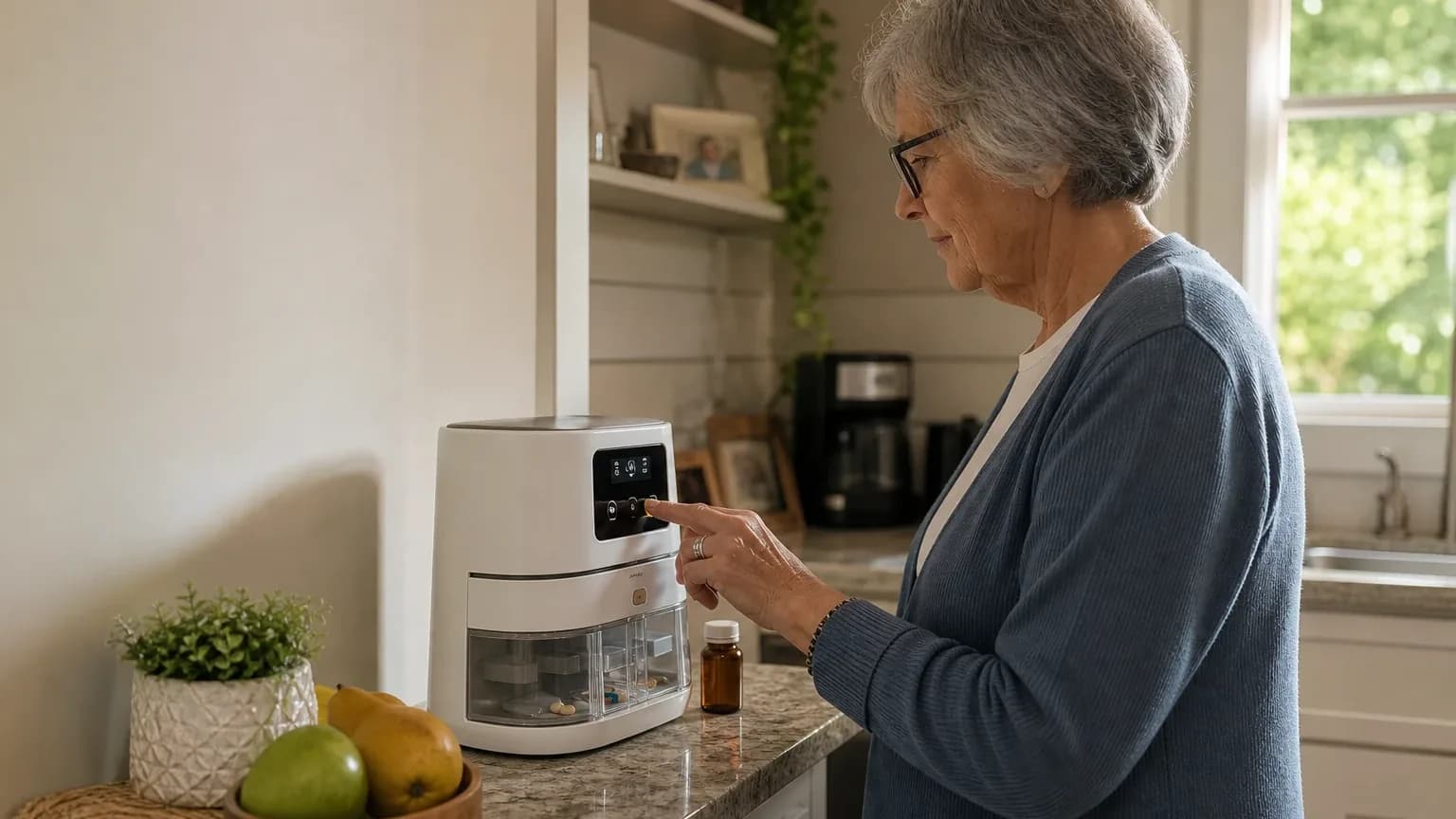
Answer Capsule
MedReady is a good fit for Automated Medication Management when a senior can respond to a timed alarm and open a locked dispenser, and a caregiver wants remote missed-dose alerts. Four of the seven platforms in this study named MedReady during the ranking stage (57.1% of included platform responses), with an average listed rank of 5.0 and a best rank of 3. The strongest reason to consider it is the MR-357FL's combination of key-locked single-dose access, audible plus flashing alerts, and cellular caregiver notifications that do not depend on the senior's phone or home internet [13]. The main limitation is that MedReady does not administer medication or confirm ingestion, and independent evidence on notification latency, cellular coverage, and clinical outcomes is thin [15].
Research Snapshot
| Field | Detail |
|---|---|
| Platform mentions in ranking stage | 4 of 7 platforms (google, kimi, openai, perplexity) |
| Share of included platform responses | 57.1% |
| Average listed rank | 5.0 |
| Best listed rank | 3 (openai) |
| Relevant product/model/plan | MedReady MR-357FL Cellular Monitored Dispenser with cellular monitoring plan |
| Overall use-case fit | Good (five platforms rated "good," two rated "strong") |
| Research date | 2026-11-10 |
What Changed Since September 2026
MedReady moved down from No. 5 to No. 6, and platform mentions were unchanged at 4. The November 2026 review describes MedReady in largely familiar terms: a locked dispenser with cellular caregiver alerts, suited to a senior who can respond to an alarm and open the door, with a caregiver filling the tray. Buyer fit, the recommended configuration, and the core strengths and limitations carry over. The pricing evidence shifts: $15.95 to $16.00 in monthly monitoring fees is newly reported, while $159 is no longer repeated. Capacity is now framed as 28 doses across one to four daily events rather than fixed day counts, and prepaid monitoring terms of six and 12 months are newly reported. Differences between the two editions reflect what each article reports; they do not by themselves prove that the product, service, or price changed.
The September 2026 review preserves the earlier article for reference.
Why MedReady Qualified for This Study
Questions This Section Answers
- Why did MedReady qualify for this Automated Medication Management ranking when only four of seven platforms named it?
- Does MedReady's long manufacturing history make it a safer buy for senior medication management than newer dispenser brands?
MedReady qualified because four of the seven platforms in this study named it during ranking discovery, giving it a 57.1% share of included platform responses and an average listed rank of 5.0 [13]. It cleared the study's two-mention minimum with room to spare, and every platform that evaluated it rated the fit "good" or "strong" for Automated Medication Management.
The company describes itself as established in 1999 in Torrance, California, with more than 100,000 devices in service [6]. That longevity is company-reported, not independently audited, but it is the kind of operating history that keeps a subscription-dependent device serviceable over time.
MedReady also qualified on product substance rather than brand recognition. The MR-357FL is a locking carousel dispenser with a 28-compartment tray, audible and visual alerts, cellular caregiver notifications, and battery backup — a feature set that maps directly onto the five criteria this study scores [13]. This review sits inside the broader Automated Medication Management comparison, and MedReady is one of the dispenser-and-service models evaluated there.
The Product, Model, Plan, or Service Most Relevant to Automated Medication Management
Questions This Section Answers
- Is the MedReady MR-357FL with cellular monitoring the right MedReady model for a caregiver who lives far from the senior?
- What is the difference between the MedReady 1700 and the MR-357FL for remote caregiver alerts?
The MedReady MR-357FL with the cellular monitoring plan is the model that matters for this use case. The non-monitored MedReady 1700 is a different product with a different job.
MedReady's own materials direct caregivers who want remote monitoring to the monitored models, and describe the 1700 as non-monitored [14]. The MR-357FL adds an internal cellular connection that reports compliance events to MedReady servers and triggers caregiver notifications by text message, email, and automated phone call [13]. The senior does not need a cell phone, landline, or home internet for the dispenser to report [8].
The 1700 and 1700FL keep the locking tray and the audible and flashing alerts but drop the remote notification layer [10]. For a caregiver in the same home, that can be enough. For a caregiver at a distance, it removes the single most valuable feature in this category.
One naming caution: platforms used several labels for the same family, including "MedReady 1700 with cellular monitoring service," "MedReady 357 Series MR-357FL," and "MedReady MR-357FL Cellular Monitored Dispenser" [13]. DeepSeek explicitly flagged that model naming was unclear in its research [6]. Buyers should confirm the exact model number and whether monitoring is included before ordering.
What the AI Platforms Agreed About
Questions This Section Answers
- Do AI platforms agree that MedReady prevents double-dosing for seniors taking multiple daily prescriptions?
- Is MedReady's cellular monitoring genuinely independent of the senior's phone and internet across platform assessments?
Agreement was strong, though not unanimous, on four points: locking access control, dual alerts, cellular independence, and the manual tray-filling burden.
On locking and double-dose prevention, platforms converged. The dispenser uses a key-locked lid, exposes only the current scheduled dose, and locks a missed dose while advancing the tray to the next one [13]. Google described this as effectively eliminating double-dosing risk [33]. MedReady's own Australian site is more careful, stating the device is not a medication safe or vault and is not 100% tamperproof [4].
On alerts, platforms agreed the MR-357FL pairs a low-frequency buzzer with a red flashing light, and that opening the door silences the alarm [8]. The low-frequency choice is aimed at Seniors with hearing loss [10].
On connectivity, platforms agreed the cellular model needs no landline or internet at the dispenser and no smartphone for the patient [8].
On the refill burden, platforms agreed a caregiver must manually load the 28-compartment tray, and the device records door access rather than confirmed ingestion [1]. No platform claimed the device verifies swallowing.
Where the AI Platforms Disagreed or Were Uncertain
Questions This Section Answers
- How long does the MedReady MR-357FL battery backup actually last during a power outage?
- How fast does MedReady notify a caregiver after a missed dose, and is that delay documented anywhere independent?
The sharpest conflicts concern battery runtime, notification speed, alert loudness, and price.
Battery backup. Most sources, including MedReady's brochure, state up to 48 hours [27]. One Amazon listing and a secondary source cited up to 72 hours, which Anthropic flagged as unverified [19]. Treat 48 hours as the manufacturer figure and 72 hours as unsupported.
Notification speed. MedReady describes notifications as real-time [13]. Kimi reported a default 30-minute delay after the initial alert before a caregiver notification sends, configurable but not immediate [12]. No platform located an independent measurement of end-to-end latency, and no service-level guarantee was published [13]. This is a genuine conflict buyers should resolve with the vendor.
Alert loudness. Grok reported an 85 dB alarm with adjustable duration up to 30+ minutes [1]. OpenAI stated the exact decibel level was not clearly published on the current product page [8]. Anthropic noted 85 dB is documented for the basic 1700 but not confirmed for the MR-357FL [26].
Price. The official product page lists $307 for the MR-357FL and $16 per month for monitoring [13]. Anthropic found retailer variation from $307 to $359 depending on vendor and flashing-light configuration, and cited a $297 listing on one MedReady page [1]. Google reported monitoring fees of $15.95 to $16.00 across distributors [21].
Capacity verification. Perplexity and DeepSeek could not confirm the exact compartment count from the pages they checked [13]. OpenAI, Google, Kimi, and Anthropic all reported 28 compartments holding up to nine M&M-sized pills each [13].
Certification. MedReady's blog claims PTCRB/CTIA approval for the MR-357FL on AT&T and Verizon 4G networks, but this appeared only on company-owned material and was not independently corroborated [9].
Use-Case-Specific Features and Capabilities
Questions This Section Answers
- How many days of medication can the MedReady MR-357FL hold at four doses per day?
- Does the MedReady MR-357FL work for a senior who takes liquid medication or large supplements?
Capacity is the first constraint to check. The 28-compartment tray supports one to four dispensing events per day, which yields 28 days at one dose daily but only seven days at four doses daily [13]. Each compartment holds roughly nine M&M-sized pills, so large supplements or multi-pill doses may not fit [25].
Medication form is the second constraint. The device handles dry pills and capsules only; liquids, powders, inhalers, injectables, and refrigerated medicines are out of scope [23].
| Study criterion | MedReady MR-357FL finding | Assessment |
|---|---|---|
| Dose compartment capacity | 28 compartments, up to 9 M&M-sized pills each; 1–4 doses daily [13] | Advantage, with refill-frequency caveat |
| Alert intensity (visual/audible) | Low-frequency buzzer plus red flashing light; alarm stops when door opens [8] | Advantage; decibel level disputed |
| Automatic locking mechanisms | Key-locked lid; only current dose accessible; missed dose locks and tray advances [13] | Advantage; not tamperproof |
| Caregiver notification speed | Cellular events to MedReady servers; SMS, email, automated call [29] | Advantage; latency undocumented |
| Battery backup system | Rechargeable NiMH, up to 48 hours per manufacturer [27] | Advantage; runtime unverified |
Remote management adds practical value. The caregiver web portal supports alarm-time changes, early-dose triggering, vacation mode, and compliance-log access without visiting the senior [13].
Usability is the weakest documented area. An independent prospective study reported substantially lower usability scores and higher workload for the MedReady 1700 than for several compared products among older adults, caregivers, and health care providers [15]. That study evaluated the 1700, not the MR-357FL, so its applicability to the cellular model is partial.
Pricing, Fees, Contracts, and Ongoing Costs
Questions This Section Answers
- What does the MedReady MR-357FL with cellular monitoring cost upfront and per month in 2026?
- Can a buyer cancel MedReady cellular monitoring after the two-month minimum, and are prepaid months refundable?
Published pricing is $307 for the MR-357FL device, $16 per month for cellular monitoring, $96 for six months prepaid, and $192 for 12 months prepaid, with free U.S. shipping stated on the product page [13]. Retailer pricing runs higher in some channels, up to roughly $359 [1].
| Cost item | Amount | Source confidence |
|---|---|---|
| MR-357FL device | $307 official; $307–$359 at retailers | Moderate [13] |
| Cellular monitoring, monthly | $16/month, two-month minimum | Moderate [13] |
| Monitoring, 6 months prepaid | $96 | Moderate [13] |
| Monitoring, 12 months prepaid | $192 | Moderate [13] |
| Non-monitored 1700 / 1700FL | $149–$179 | Moderate [21] |
| Replacement parts | Battery, trays, keys, adapters priced separately | Low; exact prices not consolidated [13] |
Contract terms are only partly published. The product page states a two-month minimum for month-to-month monitoring [13]. A complete cancellation, refund, suspension, and service-termination policy was not clearly located by any platform [13]. Google reported month-to-month plans cancelable at any time with no long-term contract, which conflicts with the two-month minimum and should be verified [21].
Warranty coverage is one year, limited, with exclusions and return-shipping obligations [30]. Taxes and activation fees were not specified in the reviewed materials [13].
Best Suited For
Questions This Section Answers
- Is MedReady a good choice for a caregiver managing a parent's pills from another city?
- Is the MedReady MR-357FL worth it for a senior with hearing loss who lives alone?
MedReady fits best when the senior can respond to an alarm and open a locked door, and the caregiver needs to know about missed doses without being in the house.
The strongest match is a senior on a stable, scheduled regimen of one to four doses daily who benefits from locked access to future doses and a loud, visible reminder [13]. The second strong match is a distant caregiver who wants text, email, and automated phone-call alerts without relying on the senior's phone or Wi-Fi [8]. Households without reliable landline or internet at the dispensing location are a third fit [8].
Seniors with mild-to-moderate hearing impairment are a fourth, given the low-frequency buzzer plus flashing light [10]. Budget-conscious buyers who want locked dispensing without a high monthly subscription also fit, particularly with prepaid monitoring [12].
Probably Not Best Suited For
Questions This Section Answers
- Is MedReady safe for a senior with severe dementia who may try to break into the dispenser?
- Can MedReady dispense liquid medication or inhalers for a senior with a complex regimen?
MedReady is not the right device when the senior cannot safely operate the lock and door, or when the regimen falls outside dry, scheduled pills.
MedReady's own Australian site warns the device is not a medication safe or vault, is not 100% tamperproof, and should not be used if there is any doubt the patient will have an uncontrollable urge to access more medicine [4]. Severe cognitive impairment with override risk calls for professional administration, not a reminder dispenser [4].
Liquids, powders, inhalers, injectables, and refrigerated medicines are excluded [32]. Complex as-needed regimens with variable timing do not fit a fixed carousel schedule [1]. Buyers who need pharmacy-filled cartridges, app-centric control, or a touchscreen interface should look elsewhere [13]. And a caregiver who needs a guaranteed human response to a missed dose, rather than an automated notification, is asking for a service MedReady does not describe [13].
When Another Option May Be Better
Questions This Section Answers
- When is a non-monitored MedReady 1700 a better buy than the MR-357FL with monitoring?
- Which alternative to MedReady fits a senior who needs more than 28 doses per refill cycle?
A non-monitored MedReady 1700 is the better buy when remote caregiver notification is unnecessary and lower upfront cost matters more; it runs roughly $149–$179 versus $307 for the monitored model [21].
A pharmacy-packed or professionally administered service is better when loading accuracy, frequent medication changes, or complex regimens exceed what a caregiver can safely manage [13]. A different dispenser is better when the buyer prioritizes a modern mobile app, larger or interchangeable cartridges, pharmacy integration, or independently documented usability [13]. Kimi specifically pointed to higher-capacity options for regimens exceeding 28 doses per cycle and to subscription-heavy competitors with touchscreen interfaces [2]. Hands-on home care or clinical medication management is better when the senior cannot reliably respond to alerts [13].
Buyers comparing across the wider market can browse the senior technology category directory for adjacent device types.
Questions to Verify Before Buying
Questions This Section Answers
- What should a caregiver confirm with MedReady about cellular coverage and notification delay before paying for monitoring?
- What should a buyer confirm about MedReady's cancellation and refund terms before starting the $16 monthly plan?
Confirm coverage first. Ask whether the buyer's exact address is supported, which carrier and network the MR-357FL uses, and whether the PTCRB/AT&T/Verizon claim applies to the unit being shipped [13].
Confirm notification behavior second. Ask for typical and worst-case delay between a missed dose and caregiver notification, how many recipients can be configured, whether alerts escalate if the first recipient does not respond, and what counts as a missed, late, early, or jammed dose [13].
Confirm outage behavior third. Ask whether the device keeps dispensing and logging during power or cellular loss, the expected battery life and replacement interval, and the current replacement-battery price [27].
Confirm medication fit fourth. Ask whether split tablets, capsules, powders, liquids, refrigerated items, or controlled substances are excluded, and whether the buyer's pill sizes fit nine M&M-sized pills per compartment [13].
Confirm commercial terms last. Ask whether monitoring can be paused or canceled, whether unused prepaid months are refundable, what the warranty excludes, and what the return window and support hours are [30].
Final AI Consensus Verdict
MedReady is a good fit for Automated Medication Management, not a universal one. Five platforms rated it "good" and two rated it "strong," with no platform rating it poor [13]. The consensus case rests on locked single-dose access, dual audible and visual alerts, cellular caregiver notifications independent of the senior's phone or internet, and a 48-hour battery backup [13].
The consensus caveats are equally consistent. The device does not administer medication or confirm ingestion, a caregiver must load the tray, capacity tops out at 28 doses, and independent evidence covers usability rather than missed-dose or hospitalization outcomes [1]. Notification latency, cellular coverage, cancellation terms, and the 48-hour battery figure remain unverified [13].
Buy the MR-357FL with monitoring when a cognitively intact senior on a stable dry-pill schedule needs locked access and a distant caregiver needs alerts. Buy the 1700 when no remote alerts are needed. Look elsewhere when the senior cannot safely operate the device or the regimen falls outside scheduled pills.
How This Review Was Produced
This review used the supplied platform fit-research responses from seven AI platforms — OpenAI, Anthropic, Google, Kimi, Perplexity, Grok, and DeepSeek — each asked to assess MedReady for Automated Medication Management. Four of the seven named MedReady during ranking discovery; all seven produced a fit assessment. Platform ratings, feature findings, pricing, and conflicts were synthesized without resolving disagreements by guesswork. Company-owned sources were separated from independent sources, and no personal testing, customer experience, or clinical verification was performed. The research date is 2026-11-10.
Methodology Limitations
Platform-reported research dates differ from the authoritative run date: DeepSeek reported 2026-06-15 while the other six reported 2026-11-10, so DeepSeek's findings may be older [6]. DeepSeek also ran without search enabled, so its claims are platform-reported rather than retrieved [6].
Platform mentions count only platforms that named MedReady during ranking discovery, not every platform that evaluated fit. The supplied URLs were collected from platform responses and were not independently validated at the writing stage. Citations are platform-reported evidence, not independently verified facts.
The available source evidence flagged that one or more fetched domains were not corroborated by brand-name or site-identity metadata and were not used as official identity signals; the official homepage retrieval returned only a cart fragment, so official-page excerpts were not verified [6]. AI-platform agreement does not prove product quality, and no platform supplied independent measurement of notification latency, battery runtime, or clinical outcomes.
Sources
Company-Owned Sources
- Automatic Pill Dispenser - How the Hero Dispenser Works!: https://herohealth.com/our-product/
- MedReady MR-357FL Pill Dispenser - MedReady Australia: https://medready.com.au/products/medready-mr-357fl-medication-dispenser-cellular-monitored-mr-357fl
- MedReady, Inc - Official Website: https://medreadyinc.net/
- About MedReady: https://medreadyinc.net/about-medready/
- About MedReady: https://medreadyinc.net/about/
- Blog - New - MedReady: https://medreadyinc.net/blog/
- Medready 1700FL Medication Dispenser with Flashing Lights: https://medreadyinc.net/product/medready-1700fl-medication-dispenser-with-flashing-lights/
- MedReady 1750 Landline Monitored Medication Dispenser: https://medreadyinc.net/products/medication-dispensers/monitored-medication-dispensers/medready-1750/
- MedReady MR-357 Medication Dispenser - MedReady Official: https://medreadyinc.net/products/medication-dispensers/monitored-medication-dispensers/medready-mr-357/
- MedReady MR-357FL Automated Medication Dispenser with Flashing Lights: https://medreadyinc.net/products/medication-dispensers/monitored-medication-dispensers/medready-mr-357fl/
- Medready 1700 Medication Dispenser | Free Shipping: https://medreadyinc.net/products/medication-dispensers/non-monitored-medication-dispensers/medready-1700/
- MedReady Automated Medication Dispenser Brochure: https://www.medreadyinc.net/assets/pdf/MedReadyBrochure_lr.pdf
- MedReady 1700, MR-357, 1750 Instructions: https://www.medreadyinc.net/assets/pdf/mr-357_1700_1750_inst.pdf
- MedReady Cellular MR-357 Monitoring Instructions: https://www.medreadyinc.net/assets/pdf/mr-357_1750_inst.pdf
- MedReady Limited Warranty: https://www.medreadyinc.net/assets/pdf/mr_warranty.pdf
Independent Sources
- MedReady Review for Senior Medication Management: https://aginginplaceindex.com/senior-technology/automated-medication-management/medready
- 9 Best Automatic Pill Dispensers of 2026: Caregiver-Reviewed: https://caringvillage.com/product-reviews/automatic-pill-dispensers/
- MedReady MR-357FL Pill Dispenser w SMS/Email Alerts & Light: https://medready.com.au/products/medready-mr-357fl-pill-dispenser-w-sms-email-alerts-light
- A Prospective Study of Usability and Workload of Electronic Medication Adherence Products by Older Adults, Caregivers, and Health Care Providers: https://pubmed.ncbi.nlm.nih.gov/32348292/
- MedReady MR-357FL - Veterans Network of Care: https://veterans.networkofcare.org/Caroline-md/AssistiveDevices/ProductDetail?productId=123588
- MedReady Automatic Pill Dispenser - Amazon: https://www.amazon.com/MedReady-1700-Medication-Dispenser-Basic/dp/B001D8TJ6Y
- MedReady Automatic Pill Dispenser - Amazon: https://www.amazon.com/MedReady-Medication-Dispenser-Flashing-1700FL/dp/B00FK9A6PA
- MedReady MR-357 Cellular Monitored Pill Dispenser - Amazon: https://www.amazon.com/MedReady-MR-357-Medication-Dispenser-Modem/dp/B00FK9A9G6
- MedReady Medication Management - Assisted Living Technologies: https://www.assistedlivingtechnologies.com/products/medready-1700fl
- MedReady 357FL Cellular Monitored Medication Dispenser: https://www.assistedlivingtechnologies.com/products/medready-357fl-cellular-monitored-medication-dispenser
- MedReady MR-357FL Flashing Cellular Monitored Medication Dispenser: https://www.hearmore.com/product/medready-mr-357fl-flashing-cellular-monitored-medication-dispenser
- MedReady Brochure - HomeControls PDF: https://www.homecontrols.com/homecontrols/products/pdfs/MR-MedReady/MedReady_Brochure.pdf
- Automatic Medication Dispenser | MedReady® | Lifeline Canada: https://www.lifeline.ca/en/products/medready-medication-dispenser/
- MedReady MR-357FL Flashing Cellular Monitored Medication Dispenser - Maxi Aids: https://www.maxiaids.com/medready-mr-357fl-flashing-cellular-monitored-medication-dispenser
- MedReady 1700 Medication Pill Dispenser: https://www.maxiaids.com/product/medready-1700-medication-pill-dispenser
- Summary | YOURmeds for medication support in long-term conditions | Advice | NICE: https://www.nice.org.uk/advice/mib289/chapter/Summary
- MedReady Medication Dispenser : Review - Tech-enhanced Life: https://www.techenhancedlife.com/reviews/medready-medication-dispenser
- How the MedReady Pill Dispenser Works: https://www.youtube.com/watch?v=aqsE3he0Av0
Verify This Research
Review the study details behind this page or download the public machine-readable verification record.
- Study date
- November 10, 2026
- Platforms analyzed
- 7
- Source records
- 33
- Ranking mentions
- 4 of 7
- Platform share
- 57%
- Final consensus rank
- #6
Research trail and source mix
Configured platforms
openai, anthropic, deepseek, grok, perplexity, kimi, google
Source mix
18 independent · 15 company-owned
Evidence support
16 direct · 4 partial
Important limitation
Use the run research_date as the study date. Platform-reported dates are provenance metadata and do not independently prove freshness.
Source snapshot SHA-256 102277fc2e6a7c2e3fc2a13d1493604094afdecc67aa1854a4391be57048034a
Archived editions
Browse earlier published research snapshots for this article. The latest edition remains at the current URL.