
Answer Capsule
envoyatHome is a good fit for long-distance caregivers who want camera-free, passive monitoring of daily routines, with the strongest case made by five of seven platforms that named it during ranking. It was named by 5 of 7 platforms in the ranking stage (71.4% share), with an average listed rank of 1.6 and a best rank of 1. Its strongest advantage is zero required action from the senior: motion, door, and cabinet sensors feed behavioral alerts and Insight reports without cameras, wearables, or button presses (openai:envoy_faq, anthropic:4-8). The main limitation is unverified detection performance: no platform found published accuracy, false-alarm, or validation data, and monitoring stops during internet or power outages (openai:envoy_faq, anthropic:3-28).
Research Snapshot
| Metric | Value |
|---|---|
| Platform mentions in ranking stage | 5 of 7 platforms (google, grok, kimi, openai, perplexity) |
| Share of included platform responses | 71.4% |
| Average listed rank | 1.6 |
| Best listed rank | 1 |
| Relevant product/model/plan | envoyatHome passive remote monitoring subscription with standard 8-sensor equipment package, internet hub, caregiver app, real-time notifications, and Insight reports |
| Overall use-case fit | Good (platform ratings: strong for anthropic, google, grok; good for openai, perplexity; uncertain for deepseek, kimi) |
| Research date | 2026-09-27 |
What Changed Since August 2026
envoyatHome moved up from No. 4 to No. 1, and platform mentions increased from 2 to 5. The September 2026 review gives buyers more pricing detail than the August 2026 comparison: $99 per month is newly reported, while a different $99/month figure is no longer repeated. The description of the recommended offering also now centers on a standard eight-sensor package with an internet hub and unlimited caregiver app access. Measured details are newly reported for bed-exit prediction timing and installation time, replacing earlier reported day-based figures. Buyer fit, recommended configuration, core strengths, and limitations remain substantively unchanged, including the absence of verified detection accuracy and the dependence on home internet. Differences between the two editions reflect what each article reports; they do not by themselves prove that the product, service, or price changed.
The August 2026 review preserves the earlier article for reference.
Why envoyatHome Qualified for This Study
Questions This Section Answers
- Why did multiple AI platforms rank envoyatHome for non-intrusive ambient safety monitoring?
- Is envoyatHome a top-ranked option for camera-free senior monitoring in 2026?
envoyatHome qualified because it was named by 5 of the 7 platforms in the ranking stage, clearing the two-mention minimum with the highest average rank in the set (1.6) and a best rank of 1 (grok, kimi, openai). The platforms that named it were google, grok, kimi, openai, and perplexity; anthropic and deepseek evaluated fit without naming it in ranking discovery.
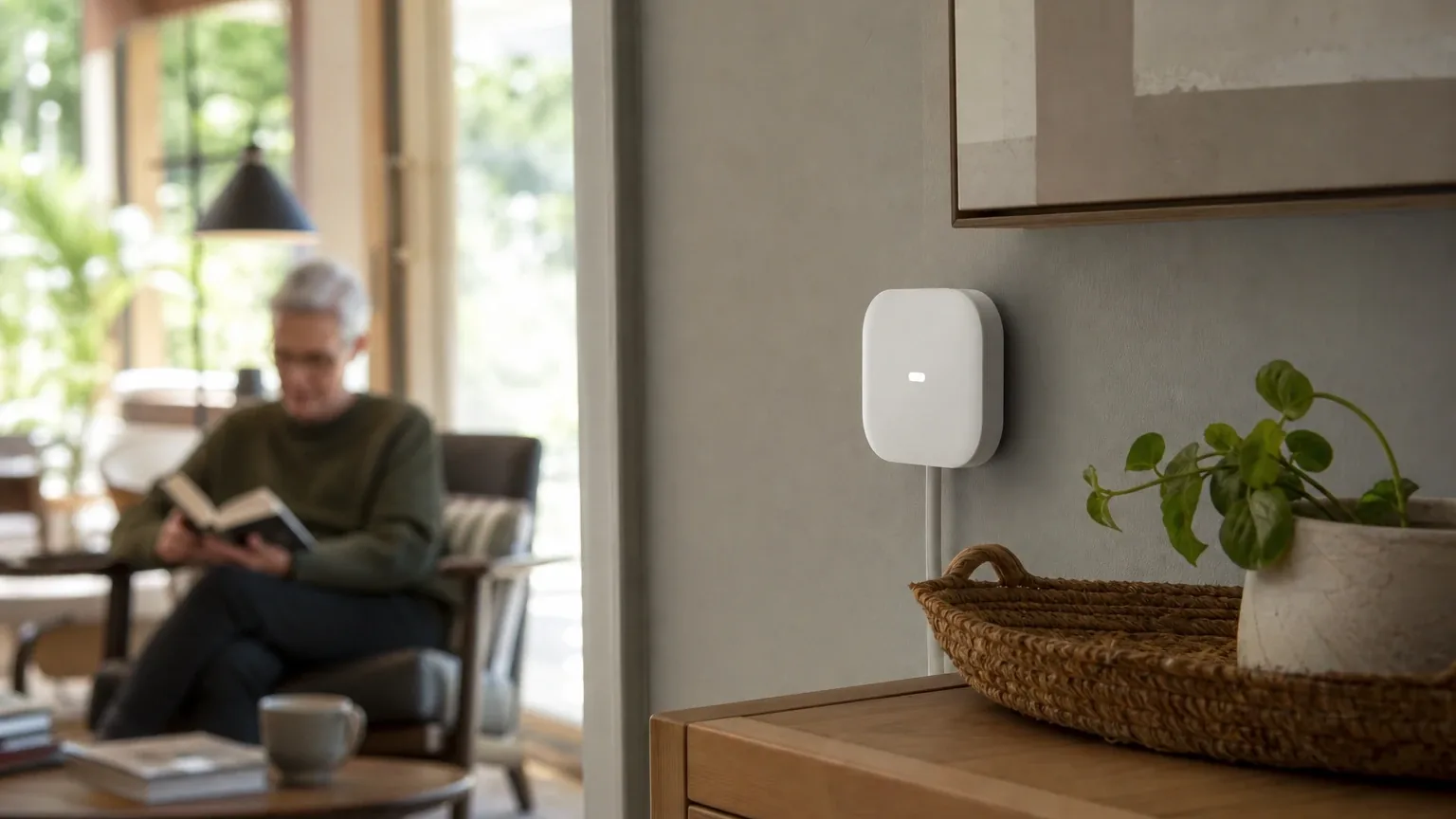
The qualification rests on structural alignment with the use case rather than verified performance. Every platform that evaluated it described the same core design: battery-operated passive motion, door, and cabinet sensors connected to an internet hub, with no cameras, microphones, wearables, or required senior interaction [1]. That design maps directly to the target buyer — a long-distance caregiver who wants to verify well-being without intruding on a parent who resists cameras or forgets wearables (anthropic:21-11).
Qualification does not equal verified quality. Company-owned citations materially outnumber independent citations in this evidence set, and no platform located independent accuracy testing, clinical validation, or security audits. The ranking reflects how often platforms surfaced the brand for this use case, not proven detection performance.
The Product, Model, Plan, or Service Most Relevant to Non-Intrusive Ambient Safety Monitoring
Questions This Section Answers
- Which envoyatHome plan should a buyer choose for camera-free motion and routine monitoring?
- What equipment is included in the envoyatHome standard 8-sensor package for ambient safety monitoring?
The relevant offer is the envoyatHome passive remote monitoring subscription built around the standard equipment package: eight sensors and one internet hub, sold with a $99 monthly subscription and a one-time $399 equipment fee [2]. The company describes the package as supporting most care plans and notes that larger or unusual homes may need additional sensors or an internet range extender (openai:envoy_faq, anthropic:13-1).
The sensor mix is motion, door, and cabinet contacts. Sensors are battery powered, require no wiring, and are installed with double-sided tape (openai:envoy_faq, anthropic:4-7). No bed-presence sensor is confirmed in the standard package; platforms that looked for one either did not find it or flagged it as unverified [4]. Bed-related insights such as being still in bed later than expected appear to be inferred from motion and contact patterns rather than a dedicated bed sensor (openai:envoy_faq).
The subscription includes real-time mobile alerts, daily and weekly Insight reports, virtual installation assistance, phone and email support, and app access for an unlimited number of family caregivers at no extra cost [5]. The company states the system is not a medical device and does not diagnose any condition (anthropic:3-28, anthropic:2-6).
What the AI Platforms Agreed About
Questions This Section Answers
- What do AI platforms agree on about envoyatHome for non-intrusive ambient safety monitoring?
- Does envoyatHome require the senior to wear or press anything for monitoring to work?
Agreement was strong on design and pricing, and limited on performance. Five platforms — google, grok, openai, perplexity, and anthropic — independently described the same camera-free, passive sensor architecture, and four of them (openai, anthropic, grok, perplexity) reported the same $99 monthly subscription and $399 one-time equipment fee [7].
The shared findings:
- No senior action required. The system uses no cameras, microphones, listening devices, GPS, or wearables, and the senior does not need to wear, charge, or press anything (openai:envoy_faq, anthropic:4-8, anthropic:18-8).
- Behavioral monitoring scope. The company claims monitoring of more than 35 behaviors, including falls, immobility, night wandering, unexpected departures, and missed routines, delivered as real-time alerts plus Insight reports that surface changes over time [9].
- Caregiver sharing. Unlimited family caregivers can access the app at no additional cost, and Insight reports can be shared with a physician [11].
- Contract terms. The company states there are no contracts and that families may cancel at any time without cancellation fees or penalties (anthropic:4-14, anthropic:4-15, openai:envoy_faq).
- Not a medical device. The company states envoyatHome does not diagnose conditions and should not substitute for emergency response or clinical assessment (anthropic:3-28, anthropic:2-6).
Agreement among platforms reflects shared reliance on the same company-owned pages, not independent verification. No platform located third-party accuracy testing, false-alarm data, or security certifications.
Where the AI Platforms Disagreed or Were Uncertain
Questions This Section Answers
- How certain are AI platforms about envoyatHome's AI anomaly detection accuracy and false-alarm rates?
- Does envoyatHome work during an internet or power outage?
Fit ratings diverged sharply. Anthropic, google, and grok rated envoyatHome a strong fit; openai and perplexity rated it good; deepseek and kimi rated it uncertain (anthropic, google, grok, openai, perplexity, deepseek, kimi). The split tracks how much each platform could verify rather than any disagreement about the product's design.
The unresolved points:
- AI detection claims. The company describes proprietary software that converts sensor data into behavioral insights, but public materials do not disclose the model, training data, detection thresholds, accuracy metrics, or false-alarm rates (openai:envoy_faq, anthropic:3-26). Kimi found no confirmation that the behavioral reports use AI rather than rule-based thresholds (kimi:envoyatHome_unclear_1).
- Outage behavior. OpenAI and google report that monitoring stops during power or internet outages, with an outage notification sent and automatic resumption afterward [12]. Anthropic found no documentation of outage behavior at all (anthropic). Deepseek and kimi also could not confirm continuity options (deepseek:envoy-home, kimi:envoyatHome_unclear_1).
- Pricing verification. Deepseek and kimi could not confirm the $99 monthly figure against the official site during their checks and treated it as unverified (deepseek:envoy-home, kimi:envoyatHome_unclear_1). Perplexity found additional 6-month ($534.60) and 12-month ($950.40) subscription offers on a shop page whose relationship to the standard monthly plan is not fully explained [13].
- Pet and multi-occupant handling. Anthropic found that the FAQ raises pets and multi-occupant homes but does not publish the answers, and noted general motion-sensor difficulty distinguishing pets from people (anthropic:39-1, anthropic:3-21).
- Emergency response. No platform found evidence that alerts are monitored by staff or escalated automatically to emergency services (openai, kimi). Kimi noted the company name suggests possible live agent monitoring but could not confirm it (kimi:envoyatHome_unclear_1).
- Identity corroboration. Deepseek's source evaluation flagged that one or more fetched domains were not corroborated by brand or site-identity metadata, and recommended re-verifying identity details before purchase (deepseek:envoy-home).
Use-Case-Specific Features and Capabilities
Questions This Section Answers
- Does envoyatHome detect falls and immobility without a wearable pendant?
- How does envoyatHome's caregiver app deliver alerts and Insight reports for long-distance monitoring?
Fall and immobility detection is pattern-based, not impact-based. The company says it detects immobility after hard or soft falls using multiple sensor-data layers rather than a wearable or impact-only detector, and google's review describes analysis of immobility following falls plus behaviors like night wandering, pacing, day-night reversal, and fridge or cabinet access patterns [14]. No platform found independent sensitivity, specificity, latency, or comparative performance data for these claims.
The caregiver app delivers real-time notifications and Insight reports to an unlimited number of family members at no extra cost, and reports can be exported for physician conversations [15]. Public materials do not document the app's accessibility features, notification controls, response workflows, or integration with third-party care platforms (openai:envoy_faq). No platform located app store ratings or independent usability evaluations (deepseek:envoy-home, kimi:envoyatHome_unclear_1).
Privacy protection is architectural rather than certified. The system avoids cameras, microphones, and wearables entirely, and the company claims multilevel encryption, two-factor authorization, unique user credentials, and no personally identifiable information stored or transmitted by in-home equipment (openai:envoy_faq, anthropic:18-8). No platform found a security certification, independent audit, retention schedule, or breach-notification policy (openai, anthropic:3-6, kimi:envoyatHome_unclear_1).
Installation is assisted virtually by a human guide, and sensors are battery powered with batteries the company says should be replaced roughly yearly at the user's expense [16]. The system requires dependable home internet; no platform found a cellular-backup option [17].
Pricing, Fees, Contracts, and Ongoing Costs
Questions This Section Answers
- How much does envoyatHome cost per month, and what is the one-time equipment fee?
- Are there cancellation fees or a contract with the envoyatHome subscription?
Published pricing is $99 per month plus a one-time $399 equipment fee for the standard eight-sensor package and one hub, with taxes and shipping excluded [18]. The company frames this as about 14 cents per hour and offers a HERO discount for retired military or first-responder care recipients, limited to one discount per subscription (official:C1, anthropic:4-12).
Contract terms are stated clearly by the company: no contract, no long-term commitment, cancel any time without cancellation fees or penalties, with cancellation handled by phone or email (anthropic:4-14, anthropic:4-15, openai:envoy_faq). Perplexity notes that cancellation and refund specifics were not clearly published and that the relationship between monthly, 6-month, and 12-month offers is not fully explained [20].
Known and potential additional costs:
- Extra motion sensors and garage door sensors are listed separately at $49 each [21].
- Additional sensors or an internet range extender may be needed for larger or unusual homes, with prices not publicly specified (openai:envoy_faq, anthropic:13-1).
- Sensor batteries are replaced roughly yearly at the user's expense [22].
- Taxes and shipping are excluded from published prices (anthropic:5-2, official:C1).
- Grok notes long-term care insurance reimbursement is possible but not guaranteed and should be verified with the provider [23].
Deepseek and kimi could not verify the $99 monthly figure against the official site and rated pricing confidence low; openai, anthropic, grok, google, and perplexity rated it high [23].
Best Suited For
Questions This Section Answers
- Who is envoyatHome best suited for in non-intrusive ambient safety monitoring?
- Is envoyatHome a good choice for caregivers of seniors with dementia who refuse cameras or wearables?
envoyatHome is best suited to long-distance family caregivers monitoring a senior who lives independently and resists cameras or wearables. The platforms converge on this profile: caregivers of Seniors with cognitive decline or dementia who reject or forget wearables, households where the senior has privacy concerns about camera surveillance, and multi-caregiver families who need shared app access without per-user fees (anthropic, google, grok, openai).
Specific fits named across platforms:
- Seniors living alone or in independent-living settings who may not reliably wear, charge, or activate a device (openai, anthropic:21-11).
- Caregivers who want routine-change and behavioral notifications rather than continuous live viewing (deepseek:envoy-home).
- Families who want exportable behavioral reports to share with a physician [24].
- Households where the standard eight-sensor package is likely sufficient [25].
Probably Not Best Suited For
Questions This Section Answers
- Who should not choose envoyatHome for non-intrusive ambient safety monitoring?
- Is envoyatHome suitable for assisted living facilities or homes with multiple occupants?
Buyers who need emergency dispatch, video verification, or independently validated detection should look elsewhere. No platform found evidence that envoyatHome provides professionally staffed monitoring, 911 dispatch, two-way voice, GPS, or a wearable panic button [26].
Platforms flagged these exclusions:
- Buyers needing emergency-response dispatch rather than caregiver notification [26].
- Buyers requiring independently validated fall-detection performance or regulated medical-device evidence (openai, kimi).
- Homes without dependable internet or needing cellular backup (openai:envoy_faq, anthropic).
- Assisted living or care-facility settings, which anthropic describes as explicitly out of scope (anthropic).
- Homes with multiple permanent occupants other than the monitored senior, which anthropic says the system is not designed for (anthropic:3-21).
- Budget-constrained buyers, since kimi notes the $99 monthly figure, if accurate, is among the highest in the category (kimi:envoyatHome_unclear_1).
- Buyers who need bed-presence or vital-sign sensing beyond motion, door, and cabinet contacts [27].
When Another Option May Be Better
Questions This Section Answers
- What is a better alternative to envoyatHome for a buyer who needs verified fall-detection accuracy?
- Which alternative suits a buyer who needs lower upfront cost than envoyatHome's $399 equipment fee?
Alternatives become preferable when the buyer's priority shifts from privacy-first ambient sensing to verified performance, lower cost, or emergency response. Kimi named several competitors with published specifications: Alerta Home at a $189 kit with the first month included and no contracts, VirtuSense VSTAlert with LiDAR-based ambient sensors and a claimed 31–65 second bed-exit prediction at 98% accuracy, Butlr Care with thermal sensing described as 100% anonymous, Arqaios with mmWave radar and on-device processing, and nami aiCare with 10–15 minute installation and API integration (kimi:alertahome_1, kimi:virtusense_1, kimi:butlr_1, kimi:arqaios_1, kimi:nami_1, kimi:nami_2).
Those competitor figures are company-reported and were not independently verified in this evidence set. The comparison is useful mainly as a prompt: buyers who need published accuracy metrics, bed-exit prediction, or HIPAA-related claims should evaluate vendors that disclose them, and buyers who need emergency dispatch should consider professional medical alert services with emergency call centers (anthropic, openai).
Questions to Verify Before Buying
Questions This Section Answers
- What should a buyer confirm with envoyatHome before signing up for the $99 monthly plan?
- How should a buyer verify envoyatHome's alert escalation and outage procedures before purchase?
Platforms converged on a verification checklist that should be resolved directly with the company before purchase:
- Exact sensor mix in the $399 package, whether placement is buyer-selected, and whether a dedicated bed-presence sensor exists [28].
- Measured false-positive and false-negative rates for falls, immobility, wandering, and missed routines (openai, anthropic).
- Alert latency and what happens if the caregiver does not acknowledge an alert (openai, anthropic).
- Whether any human monitoring, 911 dispatch, or escalation exists beyond caregiver notifications (openai, kimi).
- Behavior during internet or power outages, and whether cellular or battery backup is available (anthropic, openai:envoy_faq).
- Pet handling, multi-occupant constraints, multi-story coverage, and sensitivity configuration (anthropic:39-1, anthropic:3-21).
- Data collection, storage location, retention period, access controls, deletion after cancellation, and any security audit or breach-notification policy (openai, anthropic:3-7).
- Prices for extra sensors, range extenders, replacement equipment, batteries, taxes, shipping, and returned equipment [29].
- Whether the 6-month and 12-month subscription offers change total cost or commitment terms [31].
- Insurance or managed-care reimbursement eligibility for the specific buyer and plan [32].
Final AI Consensus Verdict
envoyatHome is a good fit for non-intrusive ambient safety monitoring when privacy, passive operation, and routine monitoring matter more than independently validated detection performance or professional emergency response. Five of seven platforms named it in ranking, with an average rank of 1.6 and a best rank of 1, and fit ratings ranged from strong (anthropic, google, grok) to good (openai, perplexity) to uncertain (deepseek, kimi).
The consensus case is architectural: camera-free, wearable-free sensing of motion, doors, and cabinets, feeding behavioral alerts and Insight reports to unlimited caregivers, at $99 per month plus a $399 equipment fee with no contract (openai:envoy_home, anthropic:4-13, anthropic:4-14). The consensus caution is evidentiary: no platform found published accuracy, false-alarm, or validation data; outage behavior is either a documented limitation or undocumented depending on the platform; and company-owned sources dominate the evidence base.
Purchase should be contingent on verifying alert accuracy, escalation procedures, outage resilience, data handling, and total costs for the specific home. For buyers who need those answers documented before purchase, this review's evidence does not supply them.
How This Review Was Produced
This review evaluates envoyatHome only for Non-Intrusive Ambient Safety Monitoring, using platform fit-research responses collected for the 2026 study dated 2026-09-27. Seven platforms evaluated fit: anthropic, deepseek, google, grok, kimi, openai, and perplexity. Five of those platforms — google, grok, kimi, openai, and perplexity — named envoyatHome during ranking discovery, which is the basis for the 71.4% mention share and the 1.6 average rank.
Platform fit ratings were: strong for anthropic, google, and grok; good for openai and perplexity; uncertain for deepseek and kimi. All platform outputs are labeled platform-reported and were not independently verified. Company-owned citations materially outnumber independent citations in this evidence set, and company claims are described as company claims throughout.
Methodology Limitations
- Platform-reported research dates differ from the authoritative run date of 2026-09-27; deepseek's responses carry a 2026-06-01 date, and platform dates are provenance metadata that do not independently prove freshness.
- All included platforms evaluated fit, but the platform-mention count includes only platforms that named the entity during ranking discovery.
- Conflicting product names, pricing, and capabilities were not resolved by guessing; conflicts are described and buyers are directed to verify.
- Supplied URLs were collected from platform responses and were not independently validated by the writer stage.
- Company-owned citations materially outnumber independent citations; company claims are not described as independently verified.
- The available source evidence flagged that one or more fetched domains were not corroborated by brand or site-identity metadata, and company-name variants were collapsed onto one canonical brand before qualification.
- Citations are platform-reported evidence, not independently verified facts. Deepseek's responses were produced without search enabled, so its claims require explicit verification before being treated as current facts.
- No platform reported personal testing, customer experience, medical benefit, or guaranteed performance, and none is claimed here.
Explore more senior technology guidance in the category directory.
Sources
Company-Owned Sources
- Fall Detection for Senior Living Without Cameras: https://arqaios.com/solutions/fall-detection
- Independent Living Awareness | nami: https://nami.ai/independent-living-awareness/
- Wellness and Awareness Systems | nami: https://nami.ai/wellness-awareness-systems/
- Alerta Home | Continuous Caregiving Awareness: https://www.alertahome.com/
- Best Passive Remote Monitoring System for Seniors: https://www.envoyathome.com/
- Monitoring System for the Elderly is 2024's Best Product to Help Long Distance Caregivers - envoyatHome: https://www.envoyathome.com/2024s-best-product-to-help-long-distance-caregiver-stress-factors/
- What If Mom Falls and Can't Press the Button? Rethinking: https://www.envoyathome.com/fall-detection-elderly-parents-living-alone/
- Frequently Asked Questions | Monitor Seniors | envoyatHome: https://www.envoyathome.com/faqs/
- Monitor Elderly Parents Remotely: The Complete 2026 Guide for Family Caregivers - envoyatHome: https://www.envoyathome.com/monitor-elderly-parents-remotely-guide-2026/
- Remote Night Monitor for Elderly | envoyatHome: https://www.envoyathome.com/overnight/
- Monitor Elderly Parents Remotely: https://www.envoyathome.com/pricing/
- A Passive Remote Monitor of Elderly Parents That Works Better Than Any Camera: https://www.envoyathome.com/remote-monitor-of-elderly-parents-better-than-camera/
- Shattered Assumptions: What Caregivers Discover Using an Elderly Monitoring System - envoyatHome: https://www.envoyathome.com/shattered-assumptions-what-caregivers-discover-using-an-elderly-monitoring-system/
- Shop envoyatHome: https://www.envoyathome.com/shop-envoyathome/
- Products: https://www.envoyathome.com/shop/
- Motion Sensor - envoyatHome: https://www.envoyathome.com/shop/motion-sensor/
- VSTAlert by VirtuSense | Ambient Vision AI Fall Prevention: https://www.virtusense.ai/products/vstalert
Additional AI research evidence32 records
- AI research evidence record grok:web:0
- AI research evidence record perplexity:c1
- AI research evidence record google:1.1.1
- AI research evidence record perplexity:c3
- AI research evidence record perplexity:c2
- AI research evidence record google:1.1.3
- AI research evidence record grok:web:0
- AI research evidence record perplexity:c1
- AI research evidence record perplexity:c4
- AI research evidence record google:1.2.3
- AI research evidence record google:1.1.3
- AI research evidence record google:1.2.1
- AI research evidence record perplexity:c5
- AI research evidence record google:1.2.3
- AI research evidence record google:1.1.3
- AI research evidence record google:1.1.2
- AI research evidence record google:1.2.1
- AI research evidence record perplexity:c1
- AI research evidence record google:1.1.1
- AI research evidence record perplexity:c5
- AI research evidence record perplexity:c6
- AI research evidence record google:1.1.2
- AI research evidence record grok:web:11
- AI research evidence record google:1.1.3
- AI research evidence record perplexity:c3
- AI research evidence record google:1.2.1
- AI research evidence record perplexity:c3
- AI research evidence record perplexity:c3
- AI research evidence record perplexity:c6
- AI research evidence record google:1.1.2
- AI research evidence record perplexity:c5
- AI research evidence record grok:web:11
Independent Sources
- Best Monitoring Systems For Elderly In The Home - AgingInPlace.org: https://aginginplace.org/medical-alert-systems/monitoring-system-for-elderly-in-the-home/
- Infrared intrusion detector and method: https://image-ppubs.uspto.gov/dirsearch-public/print/downloadPdf/6642846
- envoyatHome Review 2026: Cost, How It Works & Who It’s For: https://renalcareplanner.com/envoyathome-review-cost-how-it-works/
- 9 Senior Remote Monitoring Systems Compared - Guardian: https://www.guardianhome.eu/blog/senior-remote-monitoring/
Additional AI research evidence32 records
- AI research evidence record grok:web:0
- AI research evidence record perplexity:c1
- AI research evidence record google:1.1.1
- AI research evidence record perplexity:c3
- AI research evidence record perplexity:c2
- AI research evidence record google:1.1.3
- AI research evidence record grok:web:0
- AI research evidence record perplexity:c1
- AI research evidence record perplexity:c4
- AI research evidence record google:1.2.3
- AI research evidence record google:1.1.3
- AI research evidence record google:1.2.1
- AI research evidence record perplexity:c5
- AI research evidence record google:1.2.3
- AI research evidence record google:1.1.3
- AI research evidence record google:1.1.2
- AI research evidence record google:1.2.1
- AI research evidence record perplexity:c1
- AI research evidence record google:1.1.1
- AI research evidence record perplexity:c5
- AI research evidence record perplexity:c6
- AI research evidence record google:1.1.2
- AI research evidence record grok:web:11
- AI research evidence record google:1.1.3
- AI research evidence record perplexity:c3
- AI research evidence record google:1.2.1
- AI research evidence record perplexity:c3
- AI research evidence record perplexity:c3
- AI research evidence record perplexity:c6
- AI research evidence record google:1.1.2
- AI research evidence record perplexity:c5
- AI research evidence record grok:web:11
Verify This Research
Review the study details behind this page or download the public machine-readable verification record.
- Study date
- September 27, 2026
- Platforms analyzed
- 7
- Source records
- 28
- Ranking mentions
- 5 of 7
- Platform share
- 71%
- Final consensus rank
- #1
Research trail and source mix
Configured platforms
openai, anthropic, deepseek, grok, perplexity, kimi, google
Source mix
6 independent · 22 company-owned
Evidence support
26 direct · 2 partial
Important limitation
Use the run research_date as the study date. Platform-reported dates are provenance metadata and do not independently prove freshness.
Source snapshot SHA-256 3f769329341162944623a046b5340dcc5f787bfaf8f5219764562ad5d83362c5
Archived editions
Browse earlier published research snapshots for this article. The latest edition remains at the current URL.