
Answer Capsule
Bay Alarm Medical is a mixed fit for rural and low-signal reliability. All seven platforms that reached the ranking stage named it, and it finished first overall, but the platforms split on fit: four rated it good and three rated it mixed. The strongest reason to consider it is its landline In-Home Classic option, which Bay Alarm Medical itself recommends for weak-cellular locations, plus AT&T-or-Verizon carrier selection on cellular models. The main limitation is that cellular models still depend on local AT&T or Verizon coverage, no satellite fallback exists, and independent testing has produced conflicting connection-reliability results, including a prior report of failed monitoring-center connections.
Research Snapshot
| Field | Finding |
|---|---|
| Platform mentions in ranking stage | 7 of 7 included platforms |
| Share of included platform responses | 100% (7 of 7) |
| Average listed rank | 3.29 |
| Best listed rank | 1 (deepseek, openai, perplexity) |
| Relevant product/model/plan | In-Home Classic (landline) or SOS Home landline for weak-cellular homes; SOS Home cellular or SOS All-In-One 2 mobile GPS where AT&T or Verizon coverage is verified |
| Overall use-case fit | Mixed — four platforms rated good, three rated mixed |
| Research date | 2026-09-27 |
What Changed Since August 2026
Bay Alarm Medical remained at No. 1, and platform mentions increased from 6 to 7. The September 2026 review reshapes Bay Alarm Medical's rural fit story around refresh, not redesign. It retains the mixed rural verdict but swaps the previous good-but-location-dependent framing for a clearer split: four platforms good, three mixed. Landline In-Home Classic remains the strongest rural case, while cellular dependence, no satellite fallback, and conflicting connection-reliability testing remain the main limits. Pricing evidence shifted: $27.95 per month is newly reported for an in-home system, and $24.95–$27.95/month is no longer repeated. Newly reported details include roughly 800 to 1,000 feet of in-home wearable range and a 32-hour base-station backup battery. Differences between the two editions reflect what each article reports; they do not by themselves prove that the product, service, or price changed.
The August 2026 review preserves the earlier article for reference.
Why Bay Alarm Medical Qualified for This Study
Questions This Section Answers
- Is Bay Alarm Medical a good choice for rural seniors who need low-signal reliability?
- How many AI platforms named Bay Alarm Medical for rural and low-signal medical alert use?
Bay Alarm Medical qualified because every platform that reached the ranking stage named it, and it finished first in the final ranking. All seven included platforms — anthropic, deepseek, google, grok, kimi, openai, and perplexity — listed Bay Alarm Medical during ranking discovery, giving it a 100% mention share and an average listed rank of 3.29. Three platforms placed it first: deepseek, openai, and perplexity. Its weakest placement was eighth, from kimi.
Qualification does not equal endorsement. The platforms agreed Bay Alarm Medical belongs in the rural conversation largely because of two structural features: a landline in-home option and a choice between AT&T and Verizon cellular hardware. They disagreed on whether those features are enough in genuinely low-signal conditions.
The fit ratings split four to three. Anthropic, google, grok, and perplexity rated Bay Alarm Medical a good fit for this use case. Deepseek, kimi, and openai rated it mixed. That split is the central finding of this review, and it is reflected throughout the sections below.
The Product, Model, Plan, or Service Most Relevant to Rural & Low-Signal Reliability
Questions This Section Answers
- Which Bay Alarm Medical system should a rural buyer choose if cellular coverage at the house is weak?
- Does Bay Alarm Medical's landline In-Home Classic work without cellular signal?
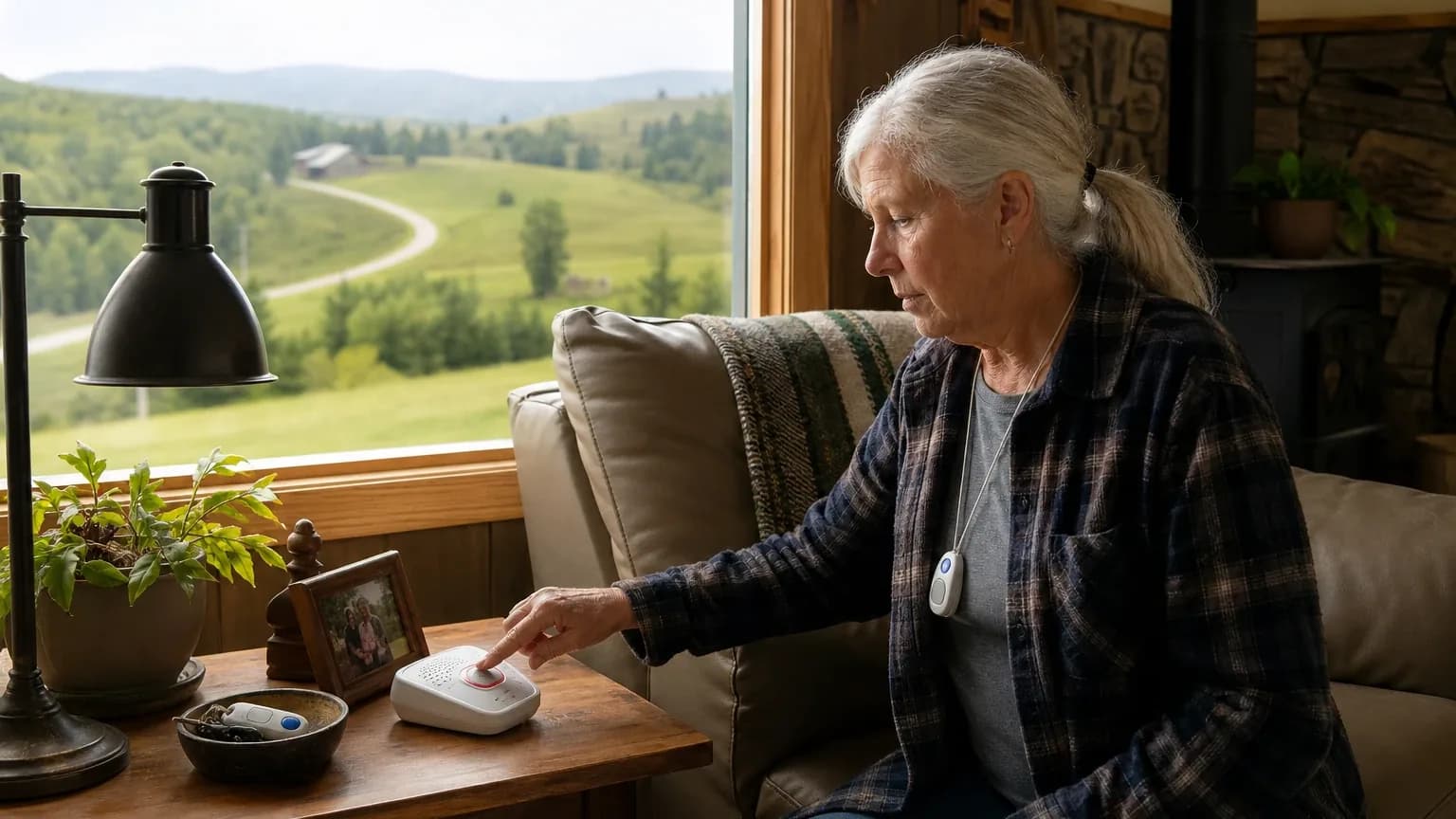
The most relevant option is the landline in-home system — referred to across sources as In-Home Classic, SOS Home landline, or the landline version of SOS Home. Bay Alarm Medical states that if you live in an area with a weak cellular signal, it suggests using the landline version of the SOS Home system rather than the cellular-connection version [1]. The In-Home Classic base unit uses a traditional landline as its connection path [3].
For households with verified carrier coverage, the relevant cellular options are the SOS Home cellular version and the SOS All-In-One 2 mobile GPS unit, offered in AT&T and Verizon 4G LTE versions [4]. Bay Alarm Medical says its cellular systems run on AT&T or Verizon network towers with no cell phone required [6], and that SOS Mobile ships with the SIM that best matches coverage in the area [7].
Product naming is inconsistent across sources. The recommended-product lists include In-Home Classic, Home 2.0, SOS Home, SOS Mobile, and SOS All-In-One 2, and several platforms flagged that legacy and current names may refer to the same or different hardware. Buyers should confirm the exact retail name and hardware before ordering.
What the AI Platforms Agreed About
Questions This Section Answers
- What do AI platforms agree Bay Alarm Medical does well for rural low-signal reliability?
- Is Bay Alarm Medical's landline fallback considered a real advantage for weak-signal homes?
The clearest agreement is that the landline option is a genuine rural advantage. Every platform that discussed connectivity treated the landline in-home system as the appropriate choice for weak-cellular homes, and Bay Alarm Medical's own guidance recommends it [8]. Grok described the landline SOS Home as providing a reliable connection independent of cellular signals [11].
The platforms also agreed on carrier choice. Bay Alarm Medical offers AT&T and Verizon 4G LTE versions, letting buyers match the stronger carrier at their address [12]. Google framed this as a dual-carrier advantage for areas where one carrier is strong and the other weak.
A third area of agreement is in-home range. Bay Alarm Medical reports approximately 800 to 1,000 feet of range from the base station to the wearable button [10]. Google and grok both cited the 1,000-foot figure as useful for farmsteads and large yards.
The platforms also agreed on contract structure. Bay Alarm Medical states its plans are month-to-month with no long-term contract or cancellation fee, and that unused months may be refunded after return of the working device, less shipping [10].
Where the AI Platforms Disagreed or Were Uncertain
Questions This Section Answers
- How reliable is Bay Alarm Medical's monitoring-center connection in rural areas, based on independent testing?
- Does Bay Alarm Medical publish backup battery life and speaker volume specs for its rural-relevant models?
Connection reliability is the sharpest disagreement. SafeHome reported a 16-second connection to Bay Alarm Medical's monitoring center [19]. AARP reported frequent responses under 30 seconds and clear, strong two-way speakers across tested devices [20]. Bay Alarm Medical states operators typically answer in under 45 seconds [21]. Independent testing cited by anthropic recorded a 48-second average response time [22]. TechRadar reported fast response in one test but connection and speaker-quality problems in earlier testing, including two failed connections [23]. These results do not reconcile into a single reliability figure.
Battery specifications conflict. Official materials cite mobile battery life ranging from 1 to 6 days, while the SOS Micro listing states up to 36 hours [21]. Anthropic's sources cite up to 6 days for SOS Mobile, with independent testing showing 2.5 to 3 days typical usage [24]. Google's sources cite 72 hours rated with roughly 60 hours in hands-on testing [26]. These likely reflect different models, but the platforms did not resolve which figure applies to which device.
Several specifications are simply missing. Deepseek reported that Bay Alarm Medical does not publicly disclose speaker volume, backup battery life for the in-home base, or independent dispatch response-time metrics for rural areas [28]. Perplexity reached the same conclusion, stating that public sources reviewed do not clearly verify backup battery duration, speaker volume, or rural dispatch performance [29]. Kimi found no independent rural audio testing and no published rural-specific response-time data (kimi:bam-reviews-2).
No reviewed source provides a guaranteed GPS accuracy specification for rural or wooded locations, and no reviewed source independently verifies emergency-dispatch reliability specifically across low-signal rural counties. That absence is not evidence of failure; it is missing evidence.
Use-Case-Specific Features and Capabilities
Questions This Section Answers
- How much in-home range does Bay Alarm Medical offer for a large rural property?
- Does Bay Alarm Medical offer any satellite or non-cellular fallback for zero-coverage rural areas?
Landline fallback is the headline capability. The In-Home Classic base unit connects through a standard phone jack and is compatible with traditional phone lines, cable VOIP, and AT&T or Verizon VOIP [32]. Bay Alarm Medical acknowledges the tradeoff: if the phone line is down, the alert system cannot connect to the monitoring center, and if a power outage cancels connectivity, the system cannot send an alarm [34].
Range is reported at approximately 800 to 1,000 feet from the in-home base station to the wearable button [35]. The SOS All-In-One 2 is cited at up to 600 feet from its base, which is less than the SOS Home system [37]. Kimi noted that walls and terrain reduce range, with no published rural-structure performance data (kimi:bam-reviews-2).
GPS and location assistance are available on mobile systems. The SOS All-In-One 2 and other mobile devices provide GPS-based location assistance, caregiver tracking, and two-way communication [39]. Independent testing cited by anthropic confirmed accurate GPS location tracking across more than 10 locations with location updates delivered within 20 seconds [41]. GPS precision at a specific rural driveway, wooded area, or building is not independently guaranteed in the reviewed sources.
Backup battery is reported at up to 32 hours for the base station during a power outage [35]. Wearable in-home buttons are reported to last approximately 2 to 5 years, while mobile devices generally last 1 to 6 days depending on model and use [35]. The advertised 32-hour base-station backup does not eliminate all risks from prolonged power outages.
Dispatch protocol: operators attempt two-way communication and can contact 911 or listed emergency contacts according to account preferences. If the user cannot speak, Bay Alarm Medical says operators follow the preset emergency protocol [35]. Local emergency-service fees, if imposed, are not covered by Bay Alarm Medical [35].
No satellite fallback exists. Kimi stated plainly that the SOS All-In-One 2 and SOS Mobile require cellular signal for emergency communication outside the home, with no satellite backup for zero-coverage areas (kimi:bam-reviews-1). Deepseek noted the company offers no signal booster or external antenna accessory [38].
Pricing, Fees, Contracts, and Ongoing Costs
Questions This Section Answers
- How much does Bay Alarm Medical cost per month for a rural landline or cellular plan?
- Are there setup, equipment, or cancellation fees with Bay Alarm Medical?
Advertised pricing starts at $27.95 per month for an in-home system [44]. Bundle packages start at $59.95 per month, and automatic fall detection starts at $10 per month [44]. The company's homepage lists SOS All-In-One 2 at $34.95 per month, SOS Micro at $34.95 per month, and SOS Smartwatch at $39.95 per month (official:C1).
Platform-reported pricing varies by source. Anthropic reported In-Home Classic landline at $27.95 per month, SOS Home cellular at $34.95 per month, SOS All-In-One 2 at $34.95 per month, and SOS Smartwatch at $39.95 per month, with device purchases of $99 to $199 and a 20% discount available on some devices [45]. Anthropic also reported SOS Mobile at $34.95 per month without fall detection and $44.95 with it, plus a device cost of roughly $69 to $99 [46]. Google reported the SOS All-In-One 2 equipment fee at $149, sometimes discounted to $89.40 [47]. Kimi cited In-Home Classic at roughly $24.95 per month and SOS Mobile or All-In-One 2 at roughly $39.95 to $49.95 per month (kimi:bam-reviews-1). Grok cited landline SOS Home at roughly $24.95 to $27.95 per month [49]. Deepseek reported low pricing confidence, citing In-Home Classic at roughly $20 to $25 per month and SOS All-In-One 2 at roughly $30 to $35 per month [50].
One source cited SOS Mobile sold exclusively on Amazon at $74.95 per month, which conflicts with direct pricing of $34.95 to $44.95 per month; it is unclear whether this is a different product or a distribution-channel difference [51].
Contract terms are consistent across sources. Bay Alarm Medical states plans are month-to-month with no long-term contract or cancellation fee, and unused months may be refunded after return of the working device, less shipping [52]. The company's cancellation page says refunds may be based on the postmark date of the returned device [53]. Quarterly and annual pre-pay options offer free shipping and, for annual, a free month, with prorated refunds minus shipping and promotional credits on early cancellation [46].
Additional fees to verify: shipping may be deducted from refunds [52]; some devices carry one-time equipment fees [54]; and local emergency-service or false-alarm fees may be imposed by local authorities, though these are not Bay Alarm Medical charges [52]. Deepseek reported that activation fees, shipping charges, and cancellation penalties are not clearly disclosed on all pages [50].
Best Suited For
Questions This Section Answers
- Who gets the most value from Bay Alarm Medical for rural low-signal reliability?
- Is Bay Alarm Medical worth it for a rural senior with a working landline?
Bay Alarm Medical is best suited to rural homes with a functioning compatible landline and a need for roughly 800 to 1,000 feet of wearable-button range [55]. It also suits rural users whose residence and regular travel areas have verified AT&T or Verizon 4G LTE coverage [57].
It fits buyers who prioritize U.S.-based 24/7 monitoring, two-way voice, GPS on mobile devices, and no long-term contract [55]. Anthropic identified dual-connectivity setups — landline in-home plus mobile cellular backup — as the configuration that best matches the company's own design principles for redundancy [60].
It also suits buyers who want carrier choice. Because devices ship with either an AT&T or Verizon SIM based on local coverage, buyers in areas where one carrier is strong and the other weak can be matched to the stronger network [61].
Probably Not Best Suited For
Questions This Section Answers
- Who should not choose Bay Alarm Medical for a rural low-signal home?
- Is Bay Alarm Medical a poor fit if the home has neither landline nor AT&T or Verizon coverage?
Bay Alarm Medical is probably not the best fit for homes with no usable landline, unreliable power, and inadequate AT&T or Verizon coverage [63]. Multiple platforms identified this combination as the disqualifying scenario [64].
It is also a weak fit for users requiring satellite, Wi-Fi, or other non-cellular fallback connectivity, because no such fallback is documented [63]. Buyers who need a cellular-signal booster or external antenna option will not find one [65].
Buyers unwilling to perform location-specific signal testing before purchase should look elsewhere, because the company places coverage verification responsibility on the buyer [64]. Deepseek noted the company does not publish coverage maps or guarantee signal strength at a specific rural address [66].
Users who need published speaker-volume decibel ratings or guaranteed backup battery runtimes for the exact device will also be underserved, because those specifications are not publicly disclosed [65].
When Another Option May Be Better
Questions This Section Answers
- What is a better alternative to Bay Alarm Medical for a rural senior in a complete cellular dead zone?
- When should a rural buyer choose a satellite-based alert system instead of Bay Alarm Medical?
Another option may be better when the property has neither reliable landline service nor adequate AT&T or Verizon coverage. Multiple platforms recommended satellite-based or hybrid alternatives in that scenario, including satellite communicators such as SPOT or Garmin InReach [68].
A different provider may be better when the buyer needs multi-carrier or roaming capability. Kimi noted it is unclear whether Bay Alarm Medical devices support carrier roaming versus single-carrier locking, and suggested comparing providers with multi-carrier roaming or satellite options (kimi:bam-reviews-1). Anthropic noted buyers in areas where T-Mobile or a regional carrier has strong signal but AT&T and Verizon do not may find competitors with multi-carrier devices more suitable [68].
A different provider may also be better when the buyer needs independently documented battery-life, speaker, or response-time benchmarks before purchase [71]. Buyers who want fall detection included at no additional cost rather than a $10-per-month add-on should compare with competitors that bundle it [68].
For very large properties beyond 1,000 feet where the senior frequently works outdoors without carrying a mobile device, a mobile GPS system — from Bay Alarm Medical or another provider — is more appropriate than an in-home-only or landline system [68].
Questions to Verify Before Buying
Questions This Section Answers
- What should a rural buyer confirm with Bay Alarm Medical before signing up?
- Which exact Bay Alarm Medical device and carrier will be shipped to a rural address?
Confirm the exact device and plan that will ship: current SOS Home, In-Home Classic, Home 2.0, SOS All-In-One 2, or another model [72]. Ask which carrier, AT&T or Verizon, will be assigned, and whether Bay Alarm Medical can test signal strength at the exact residence and common outdoor locations [73].
If both cellular carriers are weak, ask whether a landline model is available and whether your copper, cable, or VoIP service is compatible [75]. Ask what happens when the device loses cellular service during an alert, and whether any Wi-Fi, landline, or other fallback exists [72].
Request the exact battery capacity and expected runtime for the quoted mobile device, including GPS and talk-time use [72]. Ask for the exact in-home range on your property, including through walls, detached buildings, basements, and outdoor areas (kimi:bam-reviews-2).
Ask whether you can perform a monitored test from the home, driveway, yard, and regular travel routes during the return period [72]. Ask what GPS location information is transmitted to operators and local responders when the wearer is inside a building or under tree cover [72].
Ask about the current response-center certification, redundancy arrangement, and procedure if one center or a carrier connection fails [72]. Request all equipment, activation, shipping, tax, fall-detection, replacement, and return charges for the quoted configuration [79]. Ask whether your county imposes local emergency-service fees for false alarms or dispatched responders [72]. Finally, ask what exact dispatch order will be used if the senior cannot speak, and how medical records and rural directions are conveyed to responders [72].
Final AI Consensus Verdict
Bay Alarm Medical is a mixed fit for rural and low-signal reliability, and the platform split reflects that. Four platforms rated it good; three rated it mixed. All seven named it during ranking, and it finished first overall, but ranking position and fit rating measure different things.
The strongest case for Bay Alarm Medical in this use case is the landline in-home option. It is the one feature every platform treated as a genuine rural advantage, and the company itself recommends it for weak-cellular locations. Carrier selection between AT&T and Verizon adds a second layer of adaptability for households with verified coverage.
The strongest case against treating it as a default is that cellular models remain dependent on local coverage, no satellite fallback exists, and independent evidence on connection reliability is inconsistent — ranging from a 16-second connection to reported failed connections in earlier testing. Several specifications relevant to rural buyers, including speaker volume and exact backup battery runtime, are not publicly disclosed.
The practical conclusion supported by the evidence: Bay Alarm Medical is a reasonable choice when the rural home has a dependable compatible landline or verified AT&T or Verizon coverage, and when the buyer is willing to test the system at the exact address during the return period. It is not a reliable default for genuinely low-signal properties where neither connectivity path is dependable.
How This Review Was Produced
This review was produced from platform-reported research collected on 2026-09-27. Seven platforms — anthropic, deepseek, google, grok, kimi, openai, and perplexity — evaluated Bay Alarm Medical for the Rural & Low-Signal Reliability use case. Each platform supplied fit assessments, use-case findings, pricing and terms, limitations, and questions to verify before buying.
Ranking statistics were calculated from the platforms that named Bay Alarm Medical during ranking discovery. Fit ratings were taken as reported by each platform and are not independently verified. Citations in this article map to the supplied source catalog and reflect platform-reported evidence, not independently verified facts.
The consensus index for this use case is available at Rural & Low-Signal Reliability. Broader coverage of the category is available in the medical alert systems directory.
Methodology Limitations
Platform-reported research dates differ from the authoritative run date. Anthropic reported a research date of 2026-01-15, while the other six platforms reported 2026-09-27. Platform-reported dates are provenance metadata and do not independently prove freshness.
All included platforms evaluated fit, but the platform-mention count reflects only platforms that named Bay Alarm Medical during ranking discovery. The supplied URLs were collected from platform responses and were not independently validated by the writer stage.
Citations are platform-reported evidence, not independently verified facts. Claims without retrieved citations are labeled platform-reported or unverified rather than presented as established. Missing research is not treated as disagreement; where sources were silent, this review says so.
Product naming, pricing, and capability conflicts were not resolved by guessing. Where sources disagreed — including legacy product names, battery-life figures, response times, and pricing — this review describes the conflict and identifies what buyers should verify. One official-site retrieval failed during the audit, and no failed fetch was used as a verified domain key.
See the broader Rural Seniors consensus index for comparisons across qualified options.
Sources
Company-Owned Sources
- #1 Rated Medical Alert Systems: Life-Saving Alert Buttons From $27.95/mo: https://www.bayalarmmedical.com/
- Cancellations: https://www.bayalarmmedical.com/cancellations/
- Bay Alarm Medical FAQ: https://www.bayalarmmedical.com/faq/
- How do Medical Alert Systems Work? FAQs: https://www.bayalarmmedical.com/frequently-asked-questions/
- Cellular or Landline: Which In-Home Medical Alert System is Best for You?: https://www.bayalarmmedical.com/medical-alert-blog/cellular-or-landline-which-in-home-medical-alert-system-is-best-for-you/
- How to Choose a Medical Alert System: 6 Key Topics to Research: https://www.bayalarmmedical.com/medical-alert-blog/how-to-choose-a-medical-alert-system/
- How Far Outside My Home Will My Medical Alert System Work?: https://www.bayalarmmedical.com/medical-alert-blog/medical-alert-system-range/
- Mobile Medical Alert Systems Support Active Lifestyles - Bay Alarm Medical: https://www.bayalarmmedical.com/medical-alert-blog/mobile-medical-alert-systems/
- Cost vs Logicmark Medical Alert Who Has Better Service ESP - Bay Alarm Medical: https://www.bayalarmmedical.com/medical-alert-system-comparison/logicmark-medical-alert/
- Award-Winning Medical Alert Systems for Seniors: https://www.bayalarmmedical.com/medical-alert-system/
- SOS Mobile: GPS Mobile Medical Alert System: https://www.bayalarmmedical.com/medical-alert-system/sos-mobile/
- Bay Alarm Medical In-Home Classic Landline: https://www.bayalarmmedical.com/medical-alert-systems/in-home-classic/
- Bay Alarm Medical SOS Mobile Help Button: https://www.bayalarmmedical.com/medical-alert-systems/sos-mobile-help-button/
- Medical Alert Costs | Compare Us to Life Alert® and Other: https://www.bayalarmmedical.com/pricing/
Additional AI research evidence80 records
- AI research evidence record anthropic:c4
- AI research evidence record grok:web:0
- AI research evidence record deepseek:c2
- AI research evidence record deepseek:c1
- AI research evidence record google:1.1.3
- AI research evidence record google:1.1.4
- AI research evidence record perplexity:c4
- AI research evidence record anthropic:c4
- AI research evidence record grok:web:0
- AI research evidence record openai:c1
- AI research evidence record grok:web:1
- AI research evidence record deepseek:c1
- AI research evidence record google:1.1.3
- AI research evidence record perplexity:c4
- AI research evidence record google:1.2.3
- AI research evidence record anthropic:c1
- AI research evidence record anthropic:c7
- AI research evidence record perplexity:c1
- AI research evidence record openai:c6
- AI research evidence record openai:c4
- AI research evidence record openai:c1
- AI research evidence record anthropic:c3
- AI research evidence record openai:c5
- AI research evidence record anthropic:c1
- AI research evidence record anthropic:c6
- AI research evidence record google:2.1.7
- AI research evidence record google:2.2.4
- AI research evidence record deepseek:c3
- AI research evidence record perplexity:c2
- AI research evidence record perplexity:c3
- AI research evidence record perplexity:c10
- AI research evidence record anthropic:c8
- AI research evidence record deepseek:c2
- AI research evidence record anthropic:c5
- AI research evidence record openai:c1
- AI research evidence record google:1.2.3
- AI research evidence record anthropic:c1
- AI research evidence record deepseek:c3
- AI research evidence record openai:c3
- AI research evidence record openai:c4
- AI research evidence record anthropic:c3
- AI research evidence record google:1.4.9
- AI research evidence record google:2.1.5
- AI research evidence record openai:c3
- AI research evidence record anthropic:c8
- AI research evidence record anthropic:c7
- AI research evidence record google:2.2.4
- AI research evidence record google:2.2.6
- AI research evidence record grok:web:10
- AI research evidence record deepseek:c3
- AI research evidence record anthropic:c1
- AI research evidence record openai:c1
- AI research evidence record perplexity:c1
- AI research evidence record perplexity:c5
- AI research evidence record openai:c1
- AI research evidence record google:1.2.3
- AI research evidence record anthropic:c1
- AI research evidence record deepseek:c1
- AI research evidence record anthropic:c2
- AI research evidence record anthropic:c5
- AI research evidence record perplexity:c4
- AI research evidence record google:1.1.3
- AI research evidence record openai:c1
- AI research evidence record anthropic:c1
- AI research evidence record deepseek:c3
- AI research evidence record deepseek:c1
- AI research evidence record perplexity:c2
- AI research evidence record anthropic:c1
- AI research evidence record deepseek:c3
- AI research evidence record google:1.1.3
- AI research evidence record perplexity:c2
- AI research evidence record openai:c1
- AI research evidence record anthropic:c1
- AI research evidence record deepseek:c1
- AI research evidence record anthropic:c8
- AI research evidence record deepseek:c2
- AI research evidence record anthropic:c6
- AI research evidence record anthropic:c2
- AI research evidence record deepseek:c3
- AI research evidence record perplexity:c5
Independent Sources
- Bay Alarm Medical SOS Home (Landline) Review: https://medgrade.org/reviews/bay-alarm-medical-sos-home-landline-review/
- Bay Alarm Medical Review 2026: Cost, Plans & Verdict: https://medicalalertreview.com/bay-alarm-medical-review
- Bay Alarm Medical GPS Mobile Alert System Review: https://medicalalertsystemshq.com/reviews/bay-alarm-medical-gps-mobile-alert-system-review.html
- Verizon Home Internet Rural Review 2026 — Is It Worth It?: https://ruralinternetguide.com/verizon-home-internet-rural-review-2026/
- Bay Alarm Medical Review (2026): Tested & Approved: https://www.aarp.org/caregiving/home-care/bay-alarm-medical-review/
- Bay Alarm Medical Alert Systems Review: https://www.forbes.com/health/medical-alert-systems/bay-alarm-medical-review/
- Bay Alarm Medical: In-Depth Review and Testing Results: https://www.medicalalertbuyersguide.org/bay-alarm-medical/review
- Bay Alarm Medical SOS Mobile Medical Alert System Review: https://www.medicalalertbuyersguide.org/mobile-medical-alert-system/bay-alarm-medical-sos-mobile-medical-alert-system-review/
- Bay Alarm Medical Review in 2026 - The National Council on Aging (NCOA: https://www.ncoa.org/adviser/medical-alert-systems/bay-alarm-medical-review/
- Bay Alarm Medical SOS Home Review - PCMag: https://www.pcmag.com/reviews/bay-alarm-medical-sos-home
- Bay Alarm Medical Review 2026: Plans, Pricing, and Features: https://www.retirementliving.com/medical-alert-systems/bay-alarm-medical-review
- Bay Alarm Medical Review 2026: https://www.safehome.org/medical-alert-systems/bay-alarm-medical/reviews/
- Bay Alarm Medical Alert System Review 2026 - SeniorLiving.org: https://www.seniorliving.org/medical-alerts/bay-alarm-medical/
- Bay Alarm Medical Cost and Monthly Pricing in 2026 - SeniorLiving.org: https://www.seniorliving.org/medical-alerts/bay-alarm-medical/costs/
- Bay Alarm Medical review: https://www.techradar.com/reviews/bay-alarm-medical-review
- Bay Alarm Medical Costs, Our In-Depth Analysis 2026 - The Senior List: https://www.theseniorlist.com/medical-alert-systems/bay-alarm-medical/costs/
- Bay Alarm SOS All-In-One 2 Review, Hands-On Test - The Senior List: https://www.theseniorlist.com/medical-alert-systems/bay-alarm-medical/sos-all-in-one/
Additional AI research evidence80 records
- AI research evidence record anthropic:c4
- AI research evidence record grok:web:0
- AI research evidence record deepseek:c2
- AI research evidence record deepseek:c1
- AI research evidence record google:1.1.3
- AI research evidence record google:1.1.4
- AI research evidence record perplexity:c4
- AI research evidence record anthropic:c4
- AI research evidence record grok:web:0
- AI research evidence record openai:c1
- AI research evidence record grok:web:1
- AI research evidence record deepseek:c1
- AI research evidence record google:1.1.3
- AI research evidence record perplexity:c4
- AI research evidence record google:1.2.3
- AI research evidence record anthropic:c1
- AI research evidence record anthropic:c7
- AI research evidence record perplexity:c1
- AI research evidence record openai:c6
- AI research evidence record openai:c4
- AI research evidence record openai:c1
- AI research evidence record anthropic:c3
- AI research evidence record openai:c5
- AI research evidence record anthropic:c1
- AI research evidence record anthropic:c6
- AI research evidence record google:2.1.7
- AI research evidence record google:2.2.4
- AI research evidence record deepseek:c3
- AI research evidence record perplexity:c2
- AI research evidence record perplexity:c3
- AI research evidence record perplexity:c10
- AI research evidence record anthropic:c8
- AI research evidence record deepseek:c2
- AI research evidence record anthropic:c5
- AI research evidence record openai:c1
- AI research evidence record google:1.2.3
- AI research evidence record anthropic:c1
- AI research evidence record deepseek:c3
- AI research evidence record openai:c3
- AI research evidence record openai:c4
- AI research evidence record anthropic:c3
- AI research evidence record google:1.4.9
- AI research evidence record google:2.1.5
- AI research evidence record openai:c3
- AI research evidence record anthropic:c8
- AI research evidence record anthropic:c7
- AI research evidence record google:2.2.4
- AI research evidence record google:2.2.6
- AI research evidence record grok:web:10
- AI research evidence record deepseek:c3
- AI research evidence record anthropic:c1
- AI research evidence record openai:c1
- AI research evidence record perplexity:c1
- AI research evidence record perplexity:c5
- AI research evidence record openai:c1
- AI research evidence record google:1.2.3
- AI research evidence record anthropic:c1
- AI research evidence record deepseek:c1
- AI research evidence record anthropic:c2
- AI research evidence record anthropic:c5
- AI research evidence record perplexity:c4
- AI research evidence record google:1.1.3
- AI research evidence record openai:c1
- AI research evidence record anthropic:c1
- AI research evidence record deepseek:c3
- AI research evidence record deepseek:c1
- AI research evidence record perplexity:c2
- AI research evidence record anthropic:c1
- AI research evidence record deepseek:c3
- AI research evidence record google:1.1.3
- AI research evidence record perplexity:c2
- AI research evidence record openai:c1
- AI research evidence record anthropic:c1
- AI research evidence record deepseek:c1
- AI research evidence record anthropic:c8
- AI research evidence record deepseek:c2
- AI research evidence record anthropic:c6
- AI research evidence record anthropic:c2
- AI research evidence record deepseek:c3
- AI research evidence record perplexity:c5
Other Sources
- Bay Alarm Medical Alert Review: Features, Pricing, and Plans: https://insurancenewsnet.com/oarticle/bay-alarm-medical-alert-review-features-pricing-and-plans-lexington-herald-leader
- How Bay Alarm Medical Works: https://www.consumeraffairs.com/age/bay-alarm-medical.html
- Review of Bay Alarm Medical Alert Systems: https://www.healthline.com/health/bay-alarm-medical-reviews
Additional AI research evidence80 records
- AI research evidence record anthropic:c4
- AI research evidence record grok:web:0
- AI research evidence record deepseek:c2
- AI research evidence record deepseek:c1
- AI research evidence record google:1.1.3
- AI research evidence record google:1.1.4
- AI research evidence record perplexity:c4
- AI research evidence record anthropic:c4
- AI research evidence record grok:web:0
- AI research evidence record openai:c1
- AI research evidence record grok:web:1
- AI research evidence record deepseek:c1
- AI research evidence record google:1.1.3
- AI research evidence record perplexity:c4
- AI research evidence record google:1.2.3
- AI research evidence record anthropic:c1
- AI research evidence record anthropic:c7
- AI research evidence record perplexity:c1
- AI research evidence record openai:c6
- AI research evidence record openai:c4
- AI research evidence record openai:c1
- AI research evidence record anthropic:c3
- AI research evidence record openai:c5
- AI research evidence record anthropic:c1
- AI research evidence record anthropic:c6
- AI research evidence record google:2.1.7
- AI research evidence record google:2.2.4
- AI research evidence record deepseek:c3
- AI research evidence record perplexity:c2
- AI research evidence record perplexity:c3
- AI research evidence record perplexity:c10
- AI research evidence record anthropic:c8
- AI research evidence record deepseek:c2
- AI research evidence record anthropic:c5
- AI research evidence record openai:c1
- AI research evidence record google:1.2.3
- AI research evidence record anthropic:c1
- AI research evidence record deepseek:c3
- AI research evidence record openai:c3
- AI research evidence record openai:c4
- AI research evidence record anthropic:c3
- AI research evidence record google:1.4.9
- AI research evidence record google:2.1.5
- AI research evidence record openai:c3
- AI research evidence record anthropic:c8
- AI research evidence record anthropic:c7
- AI research evidence record google:2.2.4
- AI research evidence record google:2.2.6
- AI research evidence record grok:web:10
- AI research evidence record deepseek:c3
- AI research evidence record anthropic:c1
- AI research evidence record openai:c1
- AI research evidence record perplexity:c1
- AI research evidence record perplexity:c5
- AI research evidence record openai:c1
- AI research evidence record google:1.2.3
- AI research evidence record anthropic:c1
- AI research evidence record deepseek:c1
- AI research evidence record anthropic:c2
- AI research evidence record anthropic:c5
- AI research evidence record perplexity:c4
- AI research evidence record google:1.1.3
- AI research evidence record openai:c1
- AI research evidence record anthropic:c1
- AI research evidence record deepseek:c3
- AI research evidence record deepseek:c1
- AI research evidence record perplexity:c2
- AI research evidence record anthropic:c1
- AI research evidence record deepseek:c3
- AI research evidence record google:1.1.3
- AI research evidence record perplexity:c2
- AI research evidence record openai:c1
- AI research evidence record anthropic:c1
- AI research evidence record deepseek:c1
- AI research evidence record anthropic:c8
- AI research evidence record deepseek:c2
- AI research evidence record anthropic:c6
- AI research evidence record anthropic:c2
- AI research evidence record deepseek:c3
- AI research evidence record perplexity:c5
Verify This Research
Review the study details behind this page or download the public machine-readable verification record.
- Study date
- September 27, 2026
- Platforms analyzed
- 7
- Source records
- 34
- Ranking mentions
- 7 of 7
- Platform share
- 100%
- Final consensus rank
- #1
Research trail and source mix
Configured platforms
openai, anthropic, deepseek, grok, perplexity, kimi, google
Source mix
17 independent · 14 company-owned · 3 unclear
Evidence support
26 direct · 7 partial
Important limitation
Use the run research_date as the study date. Platform-reported dates are provenance metadata and do not independently prove freshness.
Source snapshot SHA-256 a33c6f3d9278fe2997d2c2a9280cfb2ed6238093be455ae5f5daf6e41227cc66
Archived editions
Browse earlier published research snapshots for this article. The latest edition remains at the current URL.