
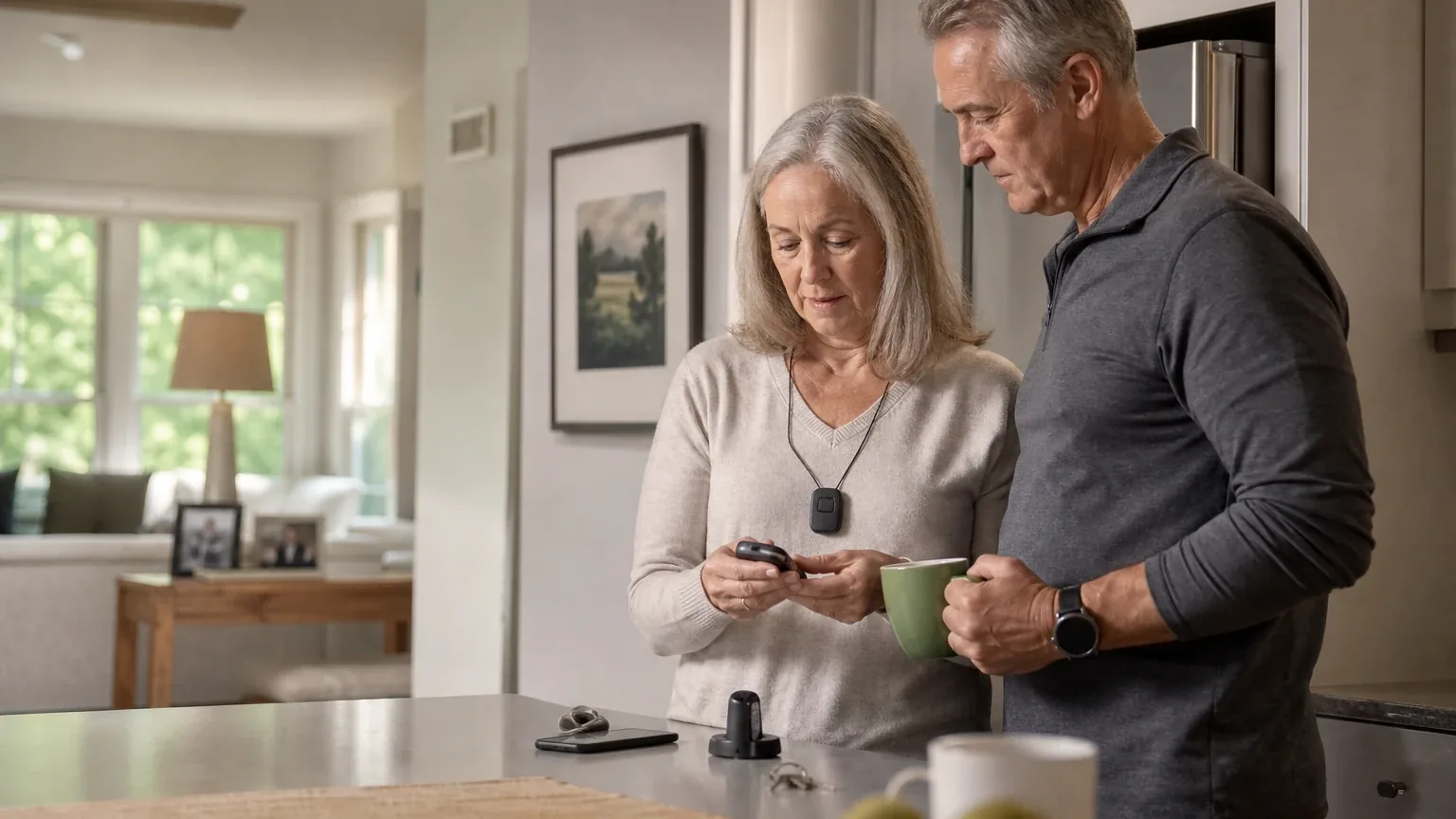
Answer Capsule
GetSafe is a mixed fit for couples seeking shared household and two-user protection. Of the 7 AI platforms that evaluated GetSafe for this use case, only 2 (deepseek and perplexity) named it during the ranking stage, giving it a 28.6% platform share with an average listed rank of 7.0. The strongest reason to consider GetSafe is its whole-home, voice-activated wall button system that lets either partner call for help without wearing a pendant, paired with a flat monthly monitoring fee. The main limitation is the absence of verified dual-profile monitoring, second-pendant discounts, or transparent per-user pricing—critical gaps for couples who need individually managed emergency records and fall detection for two people.
Research Snapshot
| Metric | Value |
|---|---|
| Platform mentions in ranking stage | 2 of 7 (deepseek, perplexity) |
| Share of included platform responses | 28.6% |
| Average listed rank | 7.0 |
| Best listed rank | 7 |
| Fit ratings across platforms | 1 good, 3 mixed, 1 weak, 2 uncertain |
| Relevant product/plan | GetSafe in-home medical alert plan (Standard or Select package) |
| Overall use-case fit | Mixed |
| Research date | 2026-08-06 |
Why GetSafe Qualified for This Study
GetSafe entered this evaluation because it markets an in-home medical alert system with multiple wall buttons, wearable pendants, and optional fall detection—features that could theoretically serve two adults sharing one residence. The platform responses evaluated GetSafe specifically against five criteria: second-pendant discounting, dual-profile monitoring, base station range, individual fall-detection add-ons, and overall package value.
Seven AI platforms (openai, anthropic, deepseek, grok, perplexity, kimi, google) provided fit assessments. Their ratings ranged from "good" to "weak" and "uncertain," reflecting the difficulty of verifying GetSafe's couple-specific capabilities from public materials.
The Product, Model, Plan, or Service Most Relevant to Shared Household & Two-User Protection
The most relevant GetSafe offering is the in-home medical alert plan, specifically the Standard or Select package with additional wearable buttons and optional fall-detection pendants. Six of seven platforms referenced this configuration, though they described it slightly differently:
- openai: "GetSafe in-home medical alert plan, most likely the Standard or Select package with additional wearable buttons and optional fall-detection pendants"
- anthropic: "GetSafe in-home medical alert system (Standard or Select package with dual wearable pendants for fall detection)"
- google: "GetSafe In-Home Medical Alert System (Standard/Select Packages with Wall/Pendant Add-ons)"
- deepseek: "In-home medical alert plan with two wearable pros (SmartWatch + basic pendant) under one account"
- grok: "GetSafe in-home medical alert plan with bundled protection features; Two wearable pros (SmartWatch + basic pendant) under one plan"
- perplexity: "GetSafe in-home medical alert plan with bundled protection features; two wearable devices under one shared plan"
Important conflict: The "SmartWatch + basic pendant" configuration cited by deepseek and grok could not be verified as a standard GetSafe bundle. openai explicitly noted: "The requested SmartWatch-plus-basic-pendant recommendation could not be verified as a standard GetSafe in-home bundle." anthropic added that GetSafe does not offer a smartwatch at all—its sister company Bay Alarm Medical does, but as a separate product line [10].
What the AI Platforms Agreed About
Strong agreement: GetSafe excels at whole-home, hands-free coverage
Five of seven platforms (openai, anthropic, google, grok, deepseek) independently identified GetSafe's core strength: a single cellular base console supporting multiple wall-mounted and wearable alert devices throughout a shared residence. Key supporting facts:
- Voice-activated wall buttons allow users to say "Call 9-1-1" twice to trigger emergency response without touching a device [1].
- Wall buttons can be placed near stairs, bathrooms, kitchens, and hallways—high-risk fall areas for both partners [1].
- The flat monthly monitoring fee does not increase with additional static wall buttons [16].
- SafeWise explicitly states GetSafe is "better for couples and large homes" compared to alternatives like Bay Alarm Medical [7].
Strong agreement: No documented second-pendant discount
Six of seven platforms (openai, anthropic, grok, deepseek, google, kimi) found no evidence of a couple-specific or second-user discount. The pricing structure is per-device:
- Additional personal help button (wearable): $25 one-time [9]
- Additional standard wall button: $30 one-time [11]
- Fall detection add-on: $10/month per pendant plus $30 one-time device fee [7]
anthropic summarized: "No documented pricing advantage for purchasing multiple devices as a couple" [3].
Strong agreement: Dual-profile monitoring is unverified
Six of seven platforms (openai, anthropic, grok, perplexity, kimi, google) stated that public materials do not confirm whether GetSafe can register two residents under one account with separate emergency contacts, medical information, and response instructions. anthropic noted: "No independent sources or company documentation reviewed indicate dedicated dual-profile support or separate monitoring profiles for two users sharing one base station" [10]. google added: "The system operates under a single household account and base station rather than tracking individual user profiles separately in a dispatch database" [11].
Majority agreement: Base station range is adequate for most homes
Four platforms (openai, anthropic, google, grok) reported a wearable-to-base range of approximately 800 to 1,000 feet [6]. deepseek was the outlier, citing a 600-foot range from GetSafe's website [4]. Actual coverage depends on home layout, walls, interference, and device placement.
Where the AI Platforms Disagreed or Were Uncertain
Fit rating disagreement
| Platform | Fit Rating | Key Rationale |
|---|---|---|
| anthropic | Good | Explicit reviewer endorsement for couples; strong hands-free design |
| openai | Mixed | Good shared-home coverage; unverified dual-user features |
| deepseek | Mixed | Shared account with two wearables; unclear pricing and shorter range |
| Mixed | Whole-home layout strong; lacks dedicated dual-user profiles | |
| grok | Weak | No dual-user features found; competitors better for couples |
| kimi | Uncertain | Medical alert appears secondary to smart home security focus |
| perplexity | Uncertain | Evidence insufficient to verify couple-specific claims |
Pricing conflicts
- Monthly monitoring fee: Most sources cite $29.95/month [3], but google also reported $24.95–$29.95 range, and kimi cited $24.95/month for basic security [4]. anthropic flagged: "No current pricing published on GetSafe website" as of its review.
- Equipment costs: openai cited Starter at $79, Standard at $193, Select at $307 [3]. anthropic cited Standard at $229 and Select at $307–$359 [11]. Medical Alert Advice cited base unit at $99 [9]. These discrepancies were not resolved.
- Fall detection device fee: SafeWise and NCOA cite $30 one-time [7]; other sources show variable pricing.
Fall detection reliability conflict
anthropic reported that Forbes Health testing "found GetSafe Starter failed to detect simulated falls, hard sits, or slides from chairs during independent review" [5]. This directly contradicts GetSafe's marketing claims about fall detection availability. No other platform cited this testing failure, and it is unclear whether this reflects a device limitation or testing error.
SmartWatch availability conflict
deepseek and grok referenced a "SmartWatch + basic pendant" configuration under one plan. anthropic explicitly stated GetSafe does not offer a smartwatch [10]. openai noted the configuration could not be verified. This is a material conflict that buyers must resolve directly with GetSafe.
Use-Case-Specific Features and Capabilities
Second-pendant discounting
Assessment: Unclear to limitation. No platform found evidence of a couple-specific discount. Additional wearables cost $25–$30 one-time each, with fall detection at $10/month per pendant. grok called this a "flat $30 one-time fee" with no bundle pricing [7].
Dual-profile monitoring
Assessment: Limitation. The system operates under a single household account. No platform found evidence that the monitoring center can identify which resident activated a device or maintain separate emergency protocols per person. deepseek was the only platform suggesting the monitoring service "can identify which wearable was activated based on the device's signal" [4], but this claim was not independently verified.
Base station range
Assessment: Advantage (with conflict). Most sources report 800–1,000 feet [6]. deepseek cited 600 feet from GetSafe's website [4]. google noted this range "accommodates large shared residences or yards" [17].
Individual fall-detection add-ons
Assessment: Unclear. Fall detection is available at $10/month per pendant plus a $30 one-time device fee [7]. Public materials do not clarify whether two fall-detection pendants can be active simultaneously under one account at two separate charges, or whether any multi-user discount applies [5].
Overall package value
Assessment: Neutral to limitation. The Standard and Select packages provide multiple in-home wall buttons for one monthly fee, which benefits couples sharing a home. However, adding a second wearable, fall detection, or other accessories increases total cost, and equipment charges are paid upfront [1].
Pricing, Fees, Contracts, and Ongoing Costs
Known costs (platform-reported)
| Item | Cost | Source |
|---|---|---|
| Monthly monitoring | $29.95/month (some sources cite $24.95–$29.95) | [3] |
| Starter equipment | $79 regular; $39.50 promotional | [3] |
| Standard equipment | $193 regular; $96.50 promotional (anthropic cites $229) | [3] |
| Select equipment | $307 regular; $153.50 promotional (anthropic cites $307–$359) | [3] |
| Additional wearable button | $25–$30 one-time | [9] |
| Fall detection add-on | $10/month per pendant + $30 one-time device fee | [7] |
| Extended warranty | ~$5/month optional | [5] |
| Caregiver app access | $5/month optional | [9] |
| Mobile GPS unit | $30 one-time + $20/month add-on | [9] |
| Lock box | $30 optional | [9] |
Contract and cancellation terms
- Month-to-month service with no long-term contract [9]
- 30-day risk-free trial [3]
- Main base console must be returned upon cancellation [3]
- No activation fees documented [9]
- No documented early termination penalties [9]
Pricing confidence
Moderate to low. openai rated pricing confidence "moderate"; deepseek and perplexity rated it "low"; anthropic and google rated it "high" but with conflicting figures. The exact cost for two users with fall detection is not published and requires a quote [4].
Best Suited For
Based on platform consensus, GetSafe is best suited for:
- Couples who primarily need room-to-room emergency access inside one home (openai, anthropic, google)
- Households where either partner may not consistently wear a pendant—voice-activated wall buttons reduce wearable dependence (openai, anthropic)
- Couples living in 2–5 bedroom homes requiring whole-home coverage (anthropic)
- Buyers who value a flat monthly monitoring fee regardless of how many static wall units are deployed (google)
- Couples who can place the base station centrally to mitigate range limitations (deepseek)
Probably Not Best Suited For
- Couples requiring clearly separated user profiles, individualized responder instructions, or per-person monitoring records (openai, anthropic, grok, google)
- Buyers specifically seeking two smartwatches or two fully independent wearable systems under one account (openai, anthropic)
- Couples needing strong out-of-home or mobile GPS protection for both partners (openai, anthropic, google)
- Buyers expecting significant second-user cost savings or documented couple's bundles (anthropic, grok, deepseek)
- Those requiring automatic fall detection without a separate wearable purchase (anthropic)
- Couples with large homes where wide range is critical (deepseek)
When Another Option May Be Better
Platforms identified specific alternatives for specific needs:
- MobileHelp Duo for a true "two-for-one" bundled mobile system with dual cellular pendants (google)
- Bay Alarm Medical for a simpler system with lower monthly fee ($27.95 vs. $29.95) and lower equipment costs, plus smartwatch options (anthropic)
- LifeStation, Medical Guardian, or Bay Alarm Medical for explicit couples plans with transparent second-user pricing (kimi)
- Aloe Care Health for advanced caregiver features including activity monitoring and temperature sensors (anthropic)
- Medical Alert for a longer 1,300-foot base station range (deepseek)
- Life Alert and other mobile-enabled systems for outdoor/mobile protection (anthropic)
Questions to Verify Before Buying
Based on the unresolved conflicts across platforms, buyers should verify the following directly with GetSafe:
- Can GetSafe formally register two residents under one account, with each person's name, medical information, emergency contacts, and response instructions separately recorded? (openai, anthropic)
- Can the monitoring center identify which person activated each pendant or wall device? (openai, google)
- Is there a discount for a second standard pendant or second fall-detection pendant? (openai, anthropic, grok)
- Can two fall-detection pendants be active simultaneously, and is the charge $10 per month for each one? (openai)
- Is the proposed SmartWatch compatible with GetSafe monitoring, and is it sold directly by GetSafe or through a separate service? (openai, anthropic)
- What is the exact monthly cost for two wearables on a shared plan? (deepseek)
- What is the actual base station range in real-world conditions—600 feet or 800–1,000 feet? (deepseek vs. openai/anthropic/google)
- Why did Forbes Health testing show fall detection failing to activate during simulated falls? (anthropic)
- What is the return deadline and refund policy during the 30-day trial? (openai)
- Does the mobile/GPS option provide separate location and caregiver access for both partners? (openai)
Final AI Consensus Verdict
GetSafe is a mixed fit for Shared Household & Two-User Protection. The platform consensus is clear on what GetSafe does well: it provides excellent whole-home, hands-free emergency access through voice-activated wall buttons and multiple alert points under a single flat monthly fee—genuinely useful for couples sharing a residence. Independent reviewers explicitly endorse it for couples and large homes [7].
However, the consensus is equally clear on what GetSafe does not verifiably provide: dual-profile monitoring with separate records, second-pendant discounts, transparent per-user pricing, or confirmed support for two individually managed fall-detection devices. The SmartWatch-plus-pendant configuration referenced by some platforms could not be verified, and one independent test found fall detection failed to activate during simulated falls [5].
For couples who primarily need in-home, room-to-room protection and are comfortable with a shared account structure, GetSafe can work—but only after direct verification of the multi-user account architecture, device assignment, fall-detection pricing, and wearable compatibility. For couples requiring independent mobile tracking, per-person monitoring records, or documented two-user cost savings, other providers with explicit couples plans are better choices.
How This Review Was Produced
This review was produced on 2026-08-06 by aggregating fit assessments from 7 AI platforms (openai, anthropic, deepseek, grok, perplexity, kimi, google). Each platform evaluated GetSafe against five criteria: second-pendant discounting, dual-profile monitoring, base station range, individual fall-detection add-ons, and overall package value. The analysis draws on 19 deduplicated citations: 14 from independent sources (Forbes Health, SafeWise, U.S. News, Caring.com, Consumer Affairs, Healthline, Medical Alert Advice, Reviews.org, ElderLife Financial) and 5 from GetSafe-owned sources (getsafe.com).
Platform fit ratings were: anthropic (good), openai (mixed), deepseek (mixed), google (mixed), grok (weak), kimi (uncertain), perplexity (uncertain).
For the full comparison of all providers evaluated for this use case, see the Shared Household & Two-User Protection consensus index.
For all medical alert system reviews, see the medical alert systems category directory.
Methodology Limitations
-
Platform-reported research dates differ: deepseek reported a research date of 2026-04-09, while all other platforms and the authoritative run date are 2026-08-06. This discrepancy is disclosed as provenance metadata and does not independently prove freshness.
-
Platform mentions vs. evaluations: All 7 platforms evaluated GetSafe's fit, but only 2 (deepseek, perplexity) named GetSafe during the ranking discovery stage. The ranking statistics (average rank 7.0, best rank 7) reflect only those 2 platforms.
-
Unverified URLs: The supplied URLs were collected from platform responses and were not independently validated during the writing stage.
-
Conflicting product claims: The "SmartWatch + basic pendant" configuration cited by deepseek and grok could not be verified as a standard GetSafe bundle. anthropic explicitly states GetSafe does not offer a smartwatch. These conflicts are described but not resolved.
-
Pricing conflicts: Sources disagree on equipment costs (Starter $79 vs. $99; Standard $193 vs. $229), monthly monitoring ($24.95 vs. $29.95), and fall-detection device fees. No attempt was made to guess the correct figures.
-
No independent verification: AI-platform agreement does not prove product quality. No platform conducted hands-on testing for this review; the Forbes Health fall-detection failure was cited by only one platform (anthropic).
-
Limited couple-specific evidence: No platform found official GetSafe documentation describing dual-profile monitoring, second-user discounts, or couple-specific contract terms. The absence of evidence is a finding, not a confirmation that these features do not exist.
Sources
- GetSafe Medical Alert System Review: Is It the Right Choice for Your Loved Ones: https://helplocal.in/blog/getsafe-medical-alert-system-review/
- GetSafe – Medical Alert System Product Overview (company, getsafe.com) — openai:C1, anthropic:C10, anthropic:C11
- GetSafe – Customer Support (company, getsafe.com) — openai:C3
- GetSafe – Life Saving Medical Alert Costs (company, getsafe.com) — openai:C5, anthropic:C16
- GetSafe – Official Website (company, getsafe.com) — deepseek:C1, grok:C2, kimi:C1
- Forbes Health – GetSafe Medical Alert Starter Review (independent, forbes.com) — openai:C2, anthropic:C4, anthropic:C6, anthropic:C14, google:1.2.3
- Healthline – GetSafe Medical Alert System: A Review (independent, healthline.com) — openai:C4
- SafeWise – GetSafe Medical Alert Review (independent, safewise.com) — anthropic:C1, anthropic:C7, anthropic:C8, anthropic:C12, grok:C1
- SafeWise Blog – GetSafe Medical Alert Review (independent, safewise.com) — anthropic:C2
- Medical Alert Advice – GetSafe Reviews (independent, medicalalertadvice.com) — anthropic:C3, anthropic:C17
- U.S. News – GetSafe Medical Alert System Review 2026 (independent, usnews.com) — anthropic:C5, anthropic:C9, anthropic:C13
- Caring.com – GetSafe Medical Alert System Review 2026 (independent, caring.com) — anthropic:C15, google:1.1.1
- Reviews.org – Best Medical Alert Systems for 2025 (independent, reviews.org) — deepseek:C2
- ElderLife Financial – Best Medical Alert Systems of 2026 (independent, elderlifefinancial.com) — grok:C3
- Salesforce – What Is Product-Market Fit? (company, salesforce.com) — perplexity:C1
- SafeHome.org – Best Identity Theft Protection for Couples (independent, safehome.org) — kimi:C2
- Consumer Affairs – GetSafe Medical Alert (independent, consumeraffairs.com) — google:1.1.3
- HelpLocal – GetSafe Medical Alert System Review (independent, helplocal.in) — google:1.2.1
Verify this research
Review the study details behind this page or download the public machine-readable verification record.
- Study date
- Aug 6, 2026
- Platforms analyzed
- 7
- Source records
- 19
- Ranking mentions
- 2 of 7
- Platform share
- 29%
- Final consensus rank
- #9
Research trail and source mix
Platforms
openai, anthropic, deepseek, grok, perplexity, kimi, google
Source mix
14 independent · 5 company-owned
Evidence support
14 direct · 3 partial
Important limitation
Use the run research_date as the study date. Platform-reported dates are provenance metadata and do not independently prove freshness.
Source snapshot SHA-256 fa87382186d7865fe7fc99ae8032b7c7afda2c411bd5ad6c0b61b6845b6bfb6d