
Answer Capsule
StackCare is a good-to-strong fit for long-distance caregivers seeking camera-free, wearable-free monitoring of a senior's daily routines. Of the 7 AI platforms that evaluated StackCare for this use case, 2 named it during the ranking stage (Google ranked it #2, OpenAI ranked it #4), giving it an average listed rank of 3.0. The strongest reason to consider StackCare is its privacy-first design: no cameras, microphones, or wearables, combined with AI-driven routine anomaly detection that alerts caregivers to changes in sleep, bathroom visits, and activity patterns. The main limitation is that StackCare is not an emergency-response system—it does not dispatch authorities, and its fall detection works through behavioral inference rather than impact detection. Pricing transparency is also a concern, with conflicting published figures ranging from roughly $30–$35/month direct to $75/month through partners.
Research Snapshot
| Metric | Value |
|---|---|
| Platform mentions in ranking stage | 2 of 7 (Google, OpenAI) |
| Share of included platform responses | 28.6% (2 of 7 platforms) |
| Average listed rank | 3.0 |
| Best listed rank | 2 (Google) |
| Relevant product/model/plan | StackCare @home monitoring platform with sensor package; StackCare @Home Smart Monitoring System |
| Overall use-case fit | Good to strong (4 platforms: good; 3 platforms: strong; 1 platform: uncertain) |
| Research date | 2026-08-12 |
Why StackCare Qualified for This Study
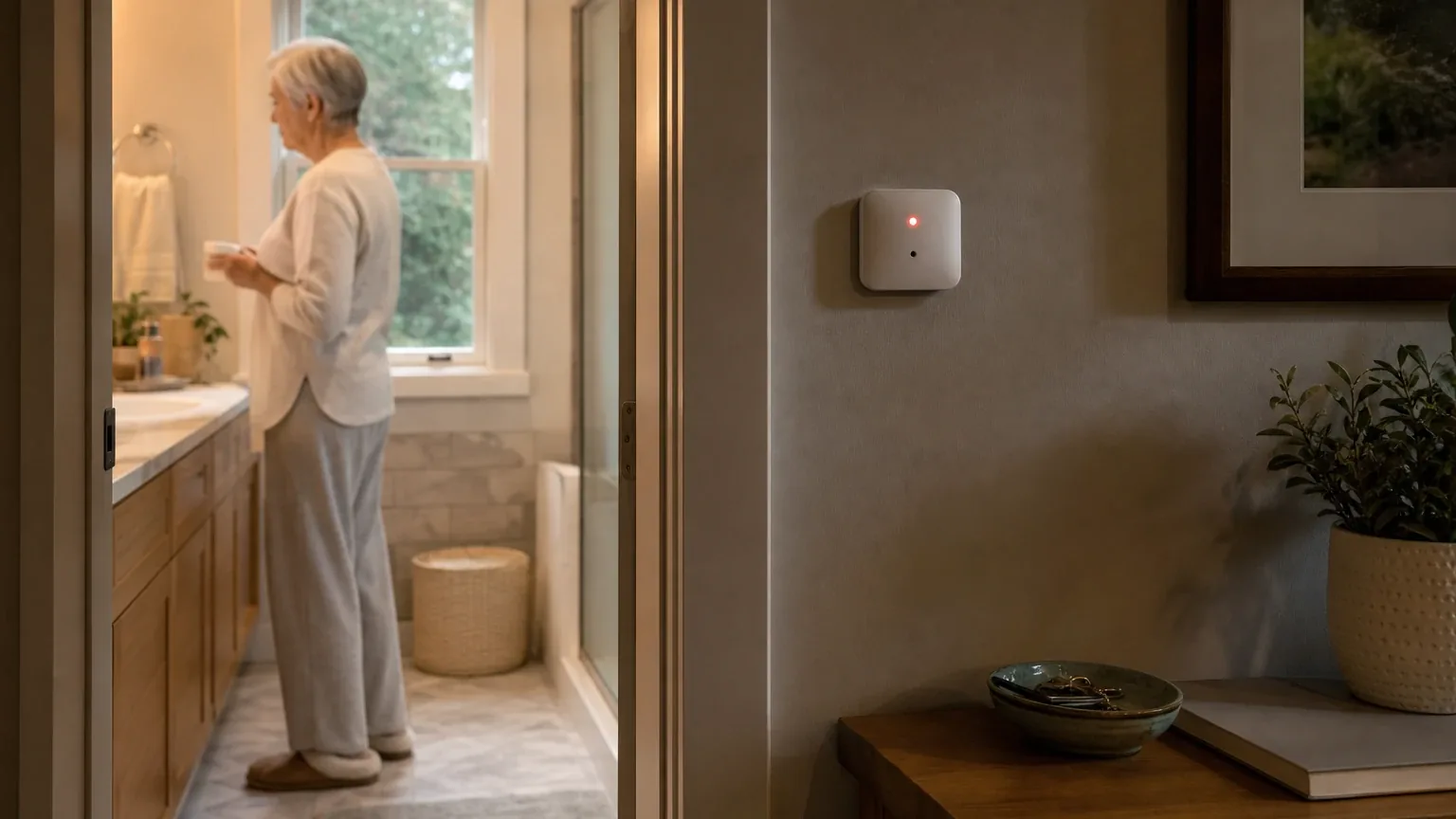
StackCare qualified for evaluation because it directly targets the Non-Intrusive Ambient Safety Monitoring category. The system uses discreet motion sensors placed around the home to track activity patterns without cameras, microphones, or wearables [1]. This aligns with the core buyer criteria: sensor variety, AI routine anomaly detection, caregiver app design, privacy protection, and monthly subscription pricing.
Seven AI platforms evaluated StackCare's fit for this use case. Fit ratings were: Google (strong), Grok (strong), Kimi (strong), OpenAI (good), Anthropic (good), DeepSeek (good), and Perplexity (uncertain) (fit_ratings_by_platform). Only Google and OpenAI named StackCare during the ranking discovery stage, which is why the platform mention count is 2 despite 7 platforms evaluating fit.
The Product, Model, Plan, or Service Most Relevant to Non-Intrusive Ambient Safety Monitoring
The relevant product is the StackCare @home Smart Monitoring System (also referred to as the StackCare Passive Monitoring System). This is a subscription-based, in-home passive monitoring platform consisting of:
- Motion sensors (typically 4 in the standard kit) that detect movement and measure room temperature [3]
- Door/contact sensors (typically 2 in the standard kit) [5]
- A gateway hub that connects to home Wi-Fi or an optional LTE cellular gateway [7]
- A caregiver smartphone app for iOS and Android with alerts, daily summaries, and historical data [9]
The system is designed for a senior living alone. It monitors household-level activity rather than tracking individuals, meaning it cannot differentiate between multiple residents or visitors [11].
What the AI Platforms Agreed About
Strong Agreement: Privacy-First, Camera-Free Design
All 7 platforms that evaluated StackCare agreed that its privacy positioning is a core strength. The system uses no cameras, microphones, or wearables, relying entirely on passive motion and temperature sensors [12]. This was described as a "dignity-preserving" design that helps with senior acceptance [16]. One platform noted that "camera-free does not mean data-free," since the privacy policy confirms collection of account, device, log, product, and operational data [18].
Strong Agreement: AI Routine Anomaly Detection Is a Core Feature
All platforms confirmed that StackCare uses machine learning to learn an individual's baseline routines and detect deviations. Publicly described alerts include [19]:
- Changes in morning activity
- No detected activity when expected
- Unusual nighttime activity
- Extended bathroom stays or increased bathroom-visit frequency
- Failure to return to bed
- Irregular sleep cycles
Google's analysis noted that increased bathroom trips can point to UTIs, and atypical inactivity can indicate a fall or emergency [17].
Strong Agreement: Not an Emergency-Response System
Every platform that addressed this point agreed that StackCare is not a substitute for a medical alert system. The terms of service expressly state that the service is not suitable for emergency response, does not dispatch emergency authorities, and should not be relied upon for life-safety or critical uses [21]. Alerts go to caregivers only, who must respond manually [22]. There is no 24/7 monitoring center or operator dispatch [22].
Majority Agreement: Installation Is Simple and Non-Invasive
Five platforms described installation as taking under 15–20 minutes with no tools required [23]. Sensors are battery-powered with a stated life of 1–2 years and low-battery notifications [26]. The system uses Command Strips for mounting, requiring no drilling [25].
Majority Agreement: Caregiver App Is Designed for Remote Monitoring
The app provides daily summaries, real-time push notifications, historical activity views, and customizable alert settings [19]. It supports iPhone and Android, and notifications can be sent to a smartwatch [27]. Color-coded charts are reported for easy interpretation [27]. Multiple caregivers can share access [25].
Where the AI Platforms Disagreed or Were Uncertain
Pricing Conflict: Direct vs. Partner Pricing
There is a significant discrepancy in published pricing. Google reported that direct StackCare subscriptions average "a little over $1 a day" (approximately $30–$35/month) with hardware provided free [30]. However, partner retail through Connected Caregiver charges $75/month with a $150 sign-up fee [31]. Anthropic found the same $75/month figure on Amazon but noted a $40/month bundled price on the Connected Caregiver website [32]. Grok reported $75/month with a $75 sign-up fee [34]. Kimi noted a historical sign-up fee of $150 versus a current promotional $75 [35]. DeepSeek reported that no pricing is listed on the official website and customers must contact sales [36].
Bottom line: Pricing confidence is low to moderate. The buyer should verify the exact current US price, whether hardware is included, and whether the sign-up fee applies.
Sensor Variety: What's Actually Included?
Platforms disagreed on whether dedicated door and bed sensors are included. DeepSeek stated that StackCare provides motion, door, and bed sensors [37]. Kimi reported the standard kit includes 4 motion sensors and 2 door/contact sensors, with no dedicated bed or chair presence sensors—bed activity is inferred from motion detection algorithms [38]. OpenAI noted that dedicated door, bed-occupancy, temperature, or water sensors are not clearly documented as part of the @home package [39]. Anthropic stated the system uses motion and door contact sensors, with temperature monitoring built into the motion sensors [40].
Bottom line: The buyer should confirm exactly which sensors are included before purchase.
Fall Detection: Behavioral Inference vs. Impact Detection
Platforms disagreed on how to characterize StackCare's fall detection. Anthropic noted that the CareIntel+ AI engine uses room-level movement patterns to recognize sudden inactivity or abnormal behavior that may indicate a fall [42]. However, this is behavioral analysis, not impact-based detection. Google stated the system "only infers a fall via prolonged inactivity" and cannot detect the instant a physical impact occurs [30]. Kimi noted there is "no explicit fall detection capability (indirect inference only)" [38]. No platform found published sensitivity or specificity metrics for fall detection.
Bottom line: StackCare may alert to prolonged inactivity that could indicate a fall, but it is not a verified fall-detection system.
Multi-Resident and Pet Limitations
Google flagged that StackCare monitors at the household level and cannot differentiate between multiple residents [30]. It also noted that pets over 50 lbs may skew motion and activity data [30]. Anthropic noted that motion sensors may generate false alerts in homes with pets [42]. This is a meaningful limitation for households where the senior lives with a spouse, roommate, or large pet.
Use-Case-Specific Features and Capabilities
Sensor Variety
The standard StackCare kit includes 4 motion sensors, 2 door/contact sensors, and 1 gateway hub [43]. Motion sensors also measure room temperature, alerting caregivers to unsafe heat or cold [44]. Sensors are manufactured by NYCE Sensors Inc. in Canada [43]. The system is designed for key rooms: bedroom, bathroom, living room, and kitchen [43]. Extra sensors can be purchased for larger homes [46].
AI Routine Anomaly Detection
StackCare's AI learns individual baselines for sleep, movement, bathroom visits, and mealtimes over the initial days of use, then detects deviations [43]. The company describes this as machine-learning algorithms that identify atypical activity [47]. Specific algorithm details, accuracy rates, and clinical validation are not disclosed [43].
Caregiver App Design
The app provides [48]:
- Daily wellbeing summaries (a "Daily Update" notification confirms the senior's status)
- Real-time push notifications for anomalies
- Historical activity reports (sleep, bathroom trips, movement)
- Customizable alert types and urgency levels
- Multi-caregiver sharing and a built-in chat function
- Smartwatch notification support
Privacy Protection
The system is camera-free, microphone-free, and wearable-free [47]. Sensors register motion rather than personal visual or audio characteristics [53]. The system reports information by household, not individual tracking [54]. However, the privacy policy confirms collection of account, device, log, product, and operational data [55].
Installation and Maintenance
Self-installation takes under 15–20 minutes with no tools [56]. Sensor batteries last 1–2 years with low-battery notifications [53]. The system requires Wi-Fi and a compatible smartphone [53]. An LTE cellular gateway is available at a higher cost for homes without stable internet [58].
Pricing, Fees, Contracts, and Ongoing Costs
| Cost Item | Published Figure | Confidence |
|---|---|---|
| Monthly subscription (direct) | "A little over $1/day" (~$30–$35/month) | Low |
| Monthly subscription (partner) | $75/month | Moderate |
| Sign-up fee | $75–$150 (varies by source and promotion) | Low |
| Annual subscription | Discounted, exact price not specified | Low |
| Hardware | Described as free with subscription on one official page | Low |
| LTE cellular gateway | Higher subscription rate, exact premium not specified | Low |
| Extra sensors | £49.95 (~$62) in UK; US pricing not confirmed | Low |
| Installation fee | None (self-install) | Moderate |
Contract terms: Month-to-month billing is implied with no long-term commitment stated [60]. Official support states cancellation is allowed after the initial 90 days, and annual subscription refunds are prorated [62]. The publicly visible terms page was last updated February 15, 2022, so current terms should be verified [62].
Best Suited For
StackCare is best suited for [63]:
- Long-distance caregivers monitoring a senior living alone who want camera-free oversight
- Seniors who refuse wearables (panic pendants, watch-style trackers) or cameras
- Families seeking daily routine anomaly detection for sleep, bathroom, and activity patterns
- Privacy-conscious households that prioritize non-intrusive monitoring
- Post-hospital recovery monitoring without emergency-response button dependency
- Dementia or cognitive decline monitoring through activity pattern changes (disorientation, sleep disturbances, bathroom frequency changes) [67]
- Environmental safety monitoring through room temperature alerts [68]
Probably Not Best Suited For
StackCare is probably not the best choice for [69]:
- Emergency response requiring automatic dispatch or two-way voice communication
- Confirmed fall detection in every room or outdoor areas
- Homes with multiple residents or pets over 50 lbs, which can skew activity data
- Seniors at immediate high fall risk requiring impact-based fall detection
- Renters or temporary housing where sensor installation is restricted
- Buyers requiring transparent, itemized online pricing before contacting the vendor
- Homes with unreliable Wi-Fi where the LTE premium option is not in budget
- Buyers needing comprehensive vital signs monitoring (blood pressure, pulse, oxygen)
- Medication adherence monitoring as the primary concern
When Another Option May Be Better
Consider alternatives when [73]:
- Bed/chair occupancy sensing is critical: Zemplee Sense offers dedicated presence sensors [75]
- Fall detection with real-time response is the primary concern: KuboCare offers explicit fall alerts [77]
- Lowest hardware cost with more sensors is preferred: FutureCare HomeKit at $515 one-time plus monthly fee may offer more sensors initially [74]
- Explicit HIPAA compliance documentation is required: FutureCare advertises built-in HIPAA compliance [74]
- Professional emergency dispatch is preferred: A monitored medical-alert service with a 24/7 call center is more appropriate [78]
- The senior lives with a spouse, roommate, or active pet over 50 lbs: Household-level monitoring cannot isolate individual changes [76]
Questions to Verify Before Buying
Before purchasing StackCare, verify the following with the vendor [79]:
- What is the exact current US monthly and annual price, including taxes and shipping? (Published figures range from ~$30 to $75/month)
- What sensors are included in the @home package? Are dedicated door, bed, temperature, water, or fall sensors available?
- How many sensors can be connected to one gateway, and what is the price of additional or replacement sensors?
- Does the gateway require continuous Wi-Fi, and is there cellular or battery backup during outages?
- What are the documented false-alert and missed-alert rates for the specific @home system?
- How are alerts delivered, escalated, acknowledged, and shared among multiple caregivers?
- What happens if the senior leaves the sensor-covered area or stops moving in an uncovered room?
- Who owns the hardware during and after subscription cancellation?
- What data is retained, where is it stored, how long is it retained, and can customers permanently delete it?
- Does the 90-day minimum apply to every subscription, and what are the exact annual cancellation and refund rules?
- Is the service intended only for wellness awareness, or are any features marketed or validated as fall detection?
- How does the system perform with pets or other sources of movement in the home?
- Is the system available in your area, or is it accessed only through home care agencies?
Final AI Consensus Verdict
StackCare is a good-to-strong fit for non-intrusive ambient safety monitoring, particularly for long-distance caregivers who want AI-generated summaries and alerts without cameras or wearables. The system directly addresses the core evaluation criteria: camera-free motion and temperature sensing, AI-driven routine anomaly detection, a caregiver-focused app, and strong privacy positioning.
However, StackCare should not be treated as a standalone safety or emergency-response solution. It does not dispatch authorities, its fall detection is behavioral inference rather than impact detection, and it monitors at the household level rather than tracking individuals. Pricing transparency is a genuine concern, with conflicting published figures that the buyer must resolve before purchase.
The buyer should obtain written confirmation of the current US price, included sensor types, hardware terms, connectivity requirements, and performance limitations before purchasing [83]. For a senior living alone with reliable Wi-Fi who accepts passive monitoring, StackCare is a solid, privacy-respecting choice. For higher-risk seniors needing immediate emergency response, a monitored medical-alert system should be added or substituted.
How This Review Was Produced
This review was produced by aggregating fit-research responses from 7 AI platforms (Google, OpenAI, Anthropic, DeepSeek, Grok, Kimi, and Perplexity) that evaluated StackCare specifically for the Non-Intrusive Ambient Safety Monitoring use case. Each platform assessed StackCare against five criteria: sensor variety, AI routine anomaly detection, caregiver app design, privacy protection, and monthly subscription pricing. The research date for this study is 2026-08-12. Platform responses were compiled, deduplicated, and synthesized into this report. The consensus index for Non-Intrusive Ambient Safety Monitoring provides the full category comparison.
Methodology Limitations
- Platform mention count: Only 2 of 7 platforms (Google, OpenAI) named StackCare during the ranking discovery stage. The other 5 platforms evaluated fit but did not rank StackCare among their top finalists. This means StackCare's competitive standing is based on limited ranking-stage visibility.
- Company-owned evidence dominance: Company-owned citations (16) materially outnumber independent citations (9). Much of the product capability evidence comes from StackCare's own website and marketing materials, which were not independently verified.
- Platform-reported date discrepancy: DeepSeek reported a research date of 2026-04-16, while all other platforms reported 2026-08-12. The authoritative run date is 2026-08-12.
- No independent testing: No platform conducted hands-on testing of StackCare. The Age Tech Now review (October 2025) was the only recent third-party assessment found, and it was described as testing "a variety of motion sensors" with limited StackCare-specific evaluation [84].
- No clinical validation: No peer-reviewed clinical studies specific to StackCare's efficacy were found. One academic study on ambient sensor systems generally was cited, but it does not validate StackCare specifically [85].
- Pricing conflicts unresolved: The $30–$35/month direct price versus $75/month partner price discrepancy was not resolved. Buyers must verify current pricing directly.
- URLs not independently validated: The supplied URLs were collected from platform responses and were not independently validated by the writer stage.
Explore more senior technology guidance in the category directory.
Sources
Company-Owned Sources
- StackCare App - App Store: https://apps.apple.com/ca/app/stackcare/id1471170266
- FutureCare HomeKit: https://futurecare.ai/product/futurecare-homekit/
- My Connected Caregiver | Remote Health Monitoring tool: https://myconnectedcaregiver.com/
- In-Home Passive Monitoring: https://myconnectedcaregiver.com/passive-monitoring/
- StackCare In-Home Passive Monitoring System: https://myconnectedcaregiver.com/product/stackcare/
- StackCare: https://stack.care/
- Inside The App — StackCare: https://stack.care/inside-the-app
- Installation 1, 2, 3... — StackCare: https://stack.care/installation-1-2-3
- StackCare - Contact Page: https://stack.care/pages/contact-us
- Privacy Policy — StackCare: https://stack.care/privacy-policy
- Senior Care Professionals — StackCare: https://stack.care/senior-care
- Support — StackCare: https://stack.care/support
- Terms - StackCare: https://stack.care/terms
- Terms — StackCare: https://stack.care/terms-of-service
- Spotlight on STACKCARE Innovative smart monitoring technology: https://www.youtube.com/watch?v=A2g_bW-79g4
- Zemplee Sense: https://zemplee.com/products/sense
Additional AI research evidence85 records
- AI research evidence record openai:c2
- AI research evidence record anthropic:c1
- AI research evidence record google:c1
- AI research evidence record google:c2
- AI research evidence record kimi:c1
- AI research evidence record anthropic:c1
- AI research evidence record google:c5
- AI research evidence record anthropic:c16
- AI research evidence record anthropic:c9
- AI research evidence record openai:c4
- AI research evidence record google:c4
- AI research evidence record openai:c2
- AI research evidence record anthropic:c8
- AI research evidence record deepseek:c1
- AI research evidence record grok:c1
- AI research evidence record kimi:c2
- AI research evidence record google:c1
- AI research evidence record openai:c6
- AI research evidence record openai:c4
- AI research evidence record anthropic:c6
- AI research evidence record openai:c7
- AI research evidence record anthropic:c19
- AI research evidence record openai:c3
- AI research evidence record anthropic:c12
- AI research evidence record kimi:c1
- AI research evidence record openai:c1
- AI research evidence record anthropic:c9
- AI research evidence record anthropic:c10
- AI research evidence record anthropic:c11
- AI research evidence record google:c4
- AI research evidence record google:c3
- AI research evidence record anthropic:c13
- AI research evidence record anthropic:c14
- AI research evidence record grok:c3
- AI research evidence record kimi:c3
- AI research evidence record deepseek:c2
- AI research evidence record deepseek:c1
- AI research evidence record kimi:c1
- AI research evidence record openai:c1
- AI research evidence record anthropic:c1
- AI research evidence record anthropic:c3
- AI research evidence record anthropic:c4
- AI research evidence record kimi:c1
- AI research evidence record anthropic:c23
- AI research evidence record google:c2
- AI research evidence record google:c4
- AI research evidence record openai:c2
- AI research evidence record openai:c4
- AI research evidence record anthropic:c9
- AI research evidence record anthropic:c10
- AI research evidence record anthropic:c11
- AI research evidence record anthropic:c8
- AI research evidence record openai:c1
- AI research evidence record anthropic:c7
- AI research evidence record openai:c6
- AI research evidence record openai:c3
- AI research evidence record anthropic:c12
- AI research evidence record anthropic:c16
- AI research evidence record google:c5
- AI research evidence record kimi:c1
- AI research evidence record google:c4
- AI research evidence record openai:c1
- AI research evidence record openai:c1
- AI research evidence record anthropic:c1
- AI research evidence record google:c1
- AI research evidence record kimi:c1
- AI research evidence record anthropic:c22
- AI research evidence record anthropic:c23
- AI research evidence record openai:c1
- AI research evidence record anthropic:c1
- AI research evidence record google:c1
- AI research evidence record kimi:c1
- AI research evidence record anthropic:c1
- AI research evidence record kimi:c4
- AI research evidence record kimi:c5
- AI research evidence record google:c4
- AI research evidence record kimi:c1
- AI research evidence record anthropic:c19
- AI research evidence record openai:c1
- AI research evidence record anthropic:c1
- AI research evidence record kimi:c1
- AI research evidence record google:c4
- AI research evidence record openai:c1
- AI research evidence record anthropic:c20
- AI research evidence record anthropic:c21
Independent Sources
- Senior Tech Solutions: How StackCare Supports Aging in Place: https://olderadultcare.com/stackcare/
- StackCare – Smart home monitoring at an affordable price: https://www.agespace.org/products/stack-care
- StackCare | Affordable Home Monitoring for the Elderly - Age Space: https://www.agespace.org/tech/stackcare-review
- StackCare — Age Tech Now: https://www.agetechnow.com/resources/stackcare
- Amazon: StackCare by Connected Caregiver Medical Alert System: https://www.amazon.com/StackCare-Connected-Caregiver-Detection-Monitoring/dp/B0G4M4NK4M
- StackCare Passive Monitoring System - Connected Caregiver: https://www.connectedcaregiver.com/product/stackcare-passive-monitoring-system
- Potential of Ambient Sensor Systems for Early Detection of Health Problems in Older Adults: https://www.ncbi.nlm.nih.gov/pmc/articles/PMC7373719/
- 24/7 Remote Care Monitoring | StackCare in Palo Alto, CA: https://www.seniorhelpers.com/ca/palo-alto/services/remote-care-monitoring/
- 24/7 Remote Care Monitoring | StackCare in Pleasanton CA: https://www.seniorhelpers.com/ca/pleasanton/services/remote-care-monitoring/
Additional AI research evidence85 records
- AI research evidence record openai:c2
- AI research evidence record anthropic:c1
- AI research evidence record google:c1
- AI research evidence record google:c2
- AI research evidence record kimi:c1
- AI research evidence record anthropic:c1
- AI research evidence record google:c5
- AI research evidence record anthropic:c16
- AI research evidence record anthropic:c9
- AI research evidence record openai:c4
- AI research evidence record google:c4
- AI research evidence record openai:c2
- AI research evidence record anthropic:c8
- AI research evidence record deepseek:c1
- AI research evidence record grok:c1
- AI research evidence record kimi:c2
- AI research evidence record google:c1
- AI research evidence record openai:c6
- AI research evidence record openai:c4
- AI research evidence record anthropic:c6
- AI research evidence record openai:c7
- AI research evidence record anthropic:c19
- AI research evidence record openai:c3
- AI research evidence record anthropic:c12
- AI research evidence record kimi:c1
- AI research evidence record openai:c1
- AI research evidence record anthropic:c9
- AI research evidence record anthropic:c10
- AI research evidence record anthropic:c11
- AI research evidence record google:c4
- AI research evidence record google:c3
- AI research evidence record anthropic:c13
- AI research evidence record anthropic:c14
- AI research evidence record grok:c3
- AI research evidence record kimi:c3
- AI research evidence record deepseek:c2
- AI research evidence record deepseek:c1
- AI research evidence record kimi:c1
- AI research evidence record openai:c1
- AI research evidence record anthropic:c1
- AI research evidence record anthropic:c3
- AI research evidence record anthropic:c4
- AI research evidence record kimi:c1
- AI research evidence record anthropic:c23
- AI research evidence record google:c2
- AI research evidence record google:c4
- AI research evidence record openai:c2
- AI research evidence record openai:c4
- AI research evidence record anthropic:c9
- AI research evidence record anthropic:c10
- AI research evidence record anthropic:c11
- AI research evidence record anthropic:c8
- AI research evidence record openai:c1
- AI research evidence record anthropic:c7
- AI research evidence record openai:c6
- AI research evidence record openai:c3
- AI research evidence record anthropic:c12
- AI research evidence record anthropic:c16
- AI research evidence record google:c5
- AI research evidence record kimi:c1
- AI research evidence record google:c4
- AI research evidence record openai:c1
- AI research evidence record openai:c1
- AI research evidence record anthropic:c1
- AI research evidence record google:c1
- AI research evidence record kimi:c1
- AI research evidence record anthropic:c22
- AI research evidence record anthropic:c23
- AI research evidence record openai:c1
- AI research evidence record anthropic:c1
- AI research evidence record google:c1
- AI research evidence record kimi:c1
- AI research evidence record anthropic:c1
- AI research evidence record kimi:c4
- AI research evidence record kimi:c5
- AI research evidence record google:c4
- AI research evidence record kimi:c1
- AI research evidence record anthropic:c19
- AI research evidence record openai:c1
- AI research evidence record anthropic:c1
- AI research evidence record kimi:c1
- AI research evidence record google:c4
- AI research evidence record openai:c1
- AI research evidence record anthropic:c20
- AI research evidence record anthropic:c21
Verify this research
Review the study details behind this page or download the public machine-readable verification record.
- Study date
- Aug 12, 2026
- Platforms analyzed
- 7
- Source records
- 25
- Ranking mentions
- 2 of 7
- Platform share
- 29%
- Final consensus rank
- #5
Research trail and source mix
Platforms
openai, anthropic, deepseek, grok, perplexity, kimi, google
Source mix
9 independent · 16 company-owned
Evidence support
20 direct · 2 partial
Important limitation
Use the run research_date as the study date. Platform-reported dates are provenance metadata and do not independently prove freshness.
Source snapshot SHA-256 4d70c8b871a709608998ed4564d1de5272e20d38d55b1fcc608f13951a06a14d